
Réponse rapide
Un pompe à boue de sable anti-abrasive est une pompe centrifuge spécialement conçue avec des matériaux résistants à l'usure et des conceptions hydrauliques renforcées pour traiter les boues contenant du sable, du gravier et des particules abrasives dures. Les facteurs de sélection clés — par ordre de priorité technique — incluent :
- (1) Sélection des matériaux — la durée de vie de la pompe est déterminée principalement par le matériau de ses composants en contact avec le fluide. L'alliage à haute teneur en chrome (BTMCr27, BTMCr33), le caoutchouc naturel, le polyuréthane et l'UHMW-PE servent chacun des fenêtres opérationnelles distinctes définies par la taille des particules, la dureté, la vitesse et la chimie de la boue. Choisir le matériau correct est la décision de spécification la plus impactante.
- (2) Conception d'usure sacrificielle — les pompes à boue anti-abrasives sont conçues avec des composants d'usure épaissis et remplaçables (roue, revêtements, plaques d'usure) qui sont destinés à être consommés au fil du temps et remplacés à intervalles prévisibles. Cette approche de maintenance planifiée élimine les temps d'arrêt non planifiés causés par une défaillance soudaine des pompes non résistantes à l'usure.
- (3) Caractéristiques des particules — les solides grossiers, tranchants et secs nécessitent du métal dur (alliage à haute teneur en chrome) ; les particules fines et arrondies dans un écoulement à haute vitesse favorisent les revêtements en caoutchouc ou en polymère qui absorbent l'énergie d'impact.
- (4) Vitesse de fonctionnement — le taux d'usure augmente avec la vitesse de la pompe élevée à une puissance d'environ 2,5 à 3 dans les modèles d'usure abrasive. Une pompe fonctionnant à 800 tr/min peut atteindre 3 à 5 fois la durée de vie de la même pompe à 1 800 tr/min.
- (5) Coût total de possession — une pompe à boue anti-abrasive avec la spécification de matériau correcte peut coûter plus cher initialement, mais récupère généralement la prime en quelques mois grâce à une réduction des temps d'arrêt et à moins de pièces de rechange.
Pomper une boue chargée de sable est l'une des tâches les plus exigeantes dans la manutention industrielle de fluides. Une pompe centrifuge standard avec des composants en contact avec le fluide en fonte peut perdre sa roue à cause de l'usure abrasive en seulement trois semaines lorsqu'elle traite du sable de silice tranchant à des concentrations supérieures à 20 % en poids. Chaque remplacement non planifié signifie des heures d'arrêt, une perte de production et des coûts de maintenance cumulés qui peuvent dépasser plusieurs fois le prix d'achat de la pompe en une seule année.
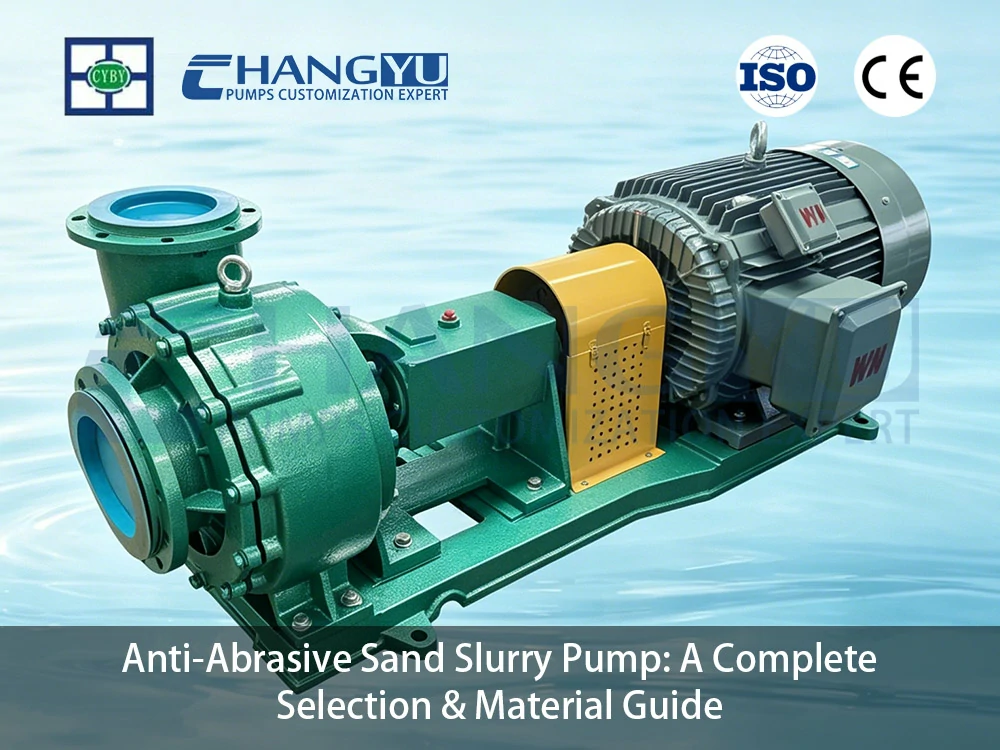
Avec plus de 20 ans dans la fabrication de pompes à boue abrasives, Changyu Pump a conçu des solutions pour les applications minières, de dragage, de traitement du sable et de production d'énergie où la durée de vie de la pompe est le principal déterminant de la rentabilité opérationnelle. Ce guide vous donne le cadre de sélection complet — de la compréhension du matériau d'usure qui correspond aux caractéristiques de vos particules de sable, à la sélection du modèle de pompe correct, en passant par la réalisation d'une analyse du coût total de possession sur 5 ans. À la fin, vous saurez exactement comment spécifier une pompe à boue de sable anti-abrasive qui offre une durée de vie maximale dans vos conditions de fonctionnement spécifiques.
Qu'est-ce qu'une Pompe à Boue de Sable Anti-Abrasive ?
Une pompe à boue de sable anti-abrasive est une pompe centrifuge spécialement conçue pour résister aux forces érosives et abrasives générées lors du pompage de mélanges de liquide et de particules solides dures. Contrairement aux pompes centrifuges standard conçues pour l'eau propre ou les produits chimiques légers, ces pompes intègrent trois caractéristiques de conception clés qui combattent directement l'usure abrasive.
Caractéristiques de Conception de Base
- Composants en contact avec le fluide épaissis : La roue, le corps de volute et les plaques d'usure sont coulés avec des sections substantiellement plus épaisses que les pompes standard — généralement 30 à 50 % plus épaisses — pour fournir une marge d'usure sacrificielle avant qu'un remplacement ne soit nécessaire.
- Matériaux résistants à l'usure spécialisés : Les composants en contact avec le fluide sont fabriqués à partir de matériaux sélectionnés spécifiquement pour la résistance à l'abrasion plutôt que de la fonte à usage général. Les quatre catégories de matériaux principales sont les alliages de fonte blanche à haute teneur en chrome, le caoutchouc naturel, le polyuréthane et le polyéthylène à ultra haute masse moléculaire (UHMW-PE).
- Revêtements d'usure remplaçables : Le corps de pompe est conçu avec des plaques d'usure et des revêtements boulonnés ou serrés qui peuvent être remplacés sans remplacer l'ensemble du corps, réduisant ainsi le coût de maintenance et les temps d'arrêt.
Pompe à Boue Anti-Abrasive vs Pompe Centrifuge Standard
Tableau : Pompe à Boue Anti-Abrasive vs Pompe Centrifuge Standard — Comparaison de Conception
| Fonctionnalité | Pompe centrifuge standard | Pompe à Boue Anti-Abrasive |
|---|---|---|
| Matériau du corps | Fonte, paroi mince | Alliage à haute teneur en chrome, revêtu de caoutchouc ou revêtu de polymère avec sections épaissies |
| Matériau de la roue | Fonte ou bronze | Alliage à haute teneur en chrome (BTMCr27/BTMCr33), caoutchouc ou UHMW-PE |
| Marge d'usure | Minimale — conçue pour les fluides propres | Généreuse — sections 30 à 50 % plus épaisses pour l'usure sacrificielle |
| Conception du corps | Corps simple, surfaces d'usure non remplaçables | Corps double avec revêtements d'usure remplaçables ou corps simple revêtu |
| Dispositif d'étanchéité | Garniture mécanique standard ou presse-étoupe | Étanchéité par expulseur avec presse-étoupe, ou garniture mécanique rincée pour empêcher l'entrée de sable |
| Ensemble arbre et roulement | Usage standard | Usage intensif avec diamètre d'arbre et entraxe de roulement augmentés pour gérer une densité de boue plus élevée |
| Durée de vie typique dans la boue de sable | 3 à 12 semaines | 12 à 24+ mois dans des conditions de fonctionnement typiques avec une sélection de matériau correcte |
Comment l'Usure Abrasive se Produit dans une Pompe à Boue
L'usure abrasive dans une pompe à boue centrifuge est causée par des particules solides en suspension dans le fluide pompé qui frappent et glissent contre les surfaces internes du corps et de la roue. Le taux d'usure dépend de la dureté des particules par rapport au matériau de la pompe, de la forme des particules (tranchantes vs arrondies), de la vitesse des particules (proportionnelle à la vitesse de la pompe) et de la concentration de solides dans la boue. L'usure est la plus élevée aux extrémités des aubes de la roue et au bec de séparation — la région où le flux sort de la roue et entre dans la volute. C'est pourquoi les pompes anti-abrasives concentrent leurs sections résistantes à l'usure les plus épaisses à ces endroits critiques.
Comment Sélectionner le Bon Matériau Anti-Abrasive pour les Pompes à Boue de Sable ?
Le matériau des composants en contact avec le fluide est la décision de spécification la plus importante pour une pompe à boue de sable anti-abrasive. Aucun matériau unique n'est le meilleur pour toutes les boues de sable. Le choix correct dépend de quatre variables interdépendantes : la taille des particules, la dureté des particules, la vitesse de la boue et la composition chimique, y compris le pH.
Matrice de sélection des matériaux à quatre dimensions
Tableau : Matrice de sélection des matériaux anti-abrasifs pour pompes à boue de sable
| Matériau | Meilleur pour | Limite de taille des particules | Gamme de pH | Température maximale | Durée de vie relative à l'usure | Norme clé |
|---|---|---|---|---|---|---|
| Alliage à haute teneur en chrome (BTMCr27/BTMCr33) | Solides grossiers, anguleux et secs ; applications à fort impact | > 50 mm | 5–12 (légèrement acide à alcalin) | 80°C | Référence pour le métal dur | ASTM A532 |
| Caoutchouc naturel | Particules fines et arrondies ; écoulement à grande vitesse ; boue humide ; solutions alcalines | < 10 mm (pas d'arêtes vives) | 5–12 (bonne résistance aux alcalis ; éviter les acides oxydants forts et les solvants) | 70°C | 3–5× par rapport au chrome élevé dans des conditions idéales | ASTM D1418 |
| Polyuréthane | Particules fines (< 5 mm) ; impact modéré ; boues huileuses ou neutres chargées de produits chimiques | < 5 mm | 4–8,5 (ne convient pas aux alcalis forts — risque d'hydrolyse) | 150°C+ | 2–4× par rapport au chrome élevé | ASTM D2000 |
| UHMW-PE | Particules ultra-fines ; boue hautement corrosive (acide/alcaline) ; faible impact | < 3 mm | 2–12 (large résistance chimique) | 80°C | 5–10× par rapport au chrome élevé dans un service à particules fines | ASTM D4020 |
Normes industrielles clés pour les matériaux des pompes à boue abrasive
Les normes suivantes fournissent le cadre pour la spécification des matériaux, les tests et la vérification de la qualité. Lors de l'évaluation des revendications matérielles du fabricant, référez-vous à ces normes comme base d'acceptation.
Tableau : Normes industrielles pour les matériaux d'usure des pompes à boue abrasive
| Standard | Matériau couvert | Pertinence pour la spécification de la pompe à boue |
|---|---|---|
| ASTM A532 | Fonte blanche à haute teneur en chrome | Spécification standard pour les fontes résistantes à l'abrasion utilisées dans les roues et les corps de pompes à boue. Définit les nuances, y compris la classe II (BTMCr15) et la classe III (BTMCr27/BTMCr33). |
| ASTM D1418 | Caoutchouc et latex de caoutchouc | Pratique standard pour la nomenclature du caoutchouc. Fournit le système de classification pour les revêtements en caoutchouc naturel et en élastomère synthétique utilisés dans les corps de pompes à boue. |
| ASTM D2000 | Produits en caoutchouc dans les applications automobiles | Système de classification standard pour les produits en caoutchouc. Appliqué aux composants de pompe en polyuréthane et autres élastomères pour la dureté, la résistance à la traction et la résistance chimique. |
| ASTM D4020 | Polyéthylène de masse molaire très élevée | Spécification standard pour les matériaux de moulage et d'extrusion d'UHMW-PE. Définit la masse moléculaire et les exigences de propriétés mécaniques pour les revêtements et les roues de pompe. |
Chemin de décision pour la sélection des matériaux
Les ingénieurs de Changyu Pump, forts de 20 ans d'expérience sur le terrain avec les boues abrasives dans les applications minières et de dragage, recommandent la logique de sélection suivante :
Étape 1 : Évaluer la taille et la forme des particules.
- Particules de plus de 10 mm avec des bords tranchants et anguleux → Un alliage à haute teneur en chrome est requis. Les revêtements en caoutchouc et en polymère seront coupés ou déchirés par de grandes particules tranchantes impactant à grande vitesse.
- Particules de moins de 5 mm, arrondies ou semi-arrondies → Le caoutchouc naturel ou l'UHMW-PE sont préférés. La surface élastique absorbe l'énergie d'impact et résiste à l'usure par coupe des particules fines et arrondies.
- Particules de moins de 3 mm avec une chimie acide ou alcaline → L'UHMW-PE est le choix optimal. Sa résistance chimique exceptionnelle combinée à des propriétés de surface à faible friction offre la durée de vie la plus longue dans les boues corrosives à particules fines.
Étape 2 : Évaluer la chimie de la boue.
- pH entre 5 et 10 sans solvants organiques → Le caoutchouc naturel ou l'alliage à haute teneur en chrome sont acceptables. Le caoutchouc naturel offre une bonne résistance à de nombreux alcalis dans cette plage.
- pH inférieur à 5 (acide) → L'UHMW-PE est requis. L'alliage à haute teneur en chrome se corrode dans des conditions acides ; le caoutchouc naturel se dégrade dans les acides oxydants forts.
- pH supérieur à 10 (fortement alcalin) → L'UHMW-PE est requis. Le polyuréthane ne convient pas aux alcalis forts en raison du risque d'hydrolyse à pH élevé, en particulier au-dessus de 8,5. L'alliage à haute teneur en chrome est acceptable pour un service alcalin si les conditions des particules justifient également un métal dur.
- Présence d'huiles, de solvants ou de produits chimiques de flottation → Le polyuréthane ou l'UHMW-PE sont requis. Le caoutchouc naturel gonfle en présence d'hydrocarbures.
Étape 3 : Considérer la vitesse de fonctionnement.
- Vitesses de pompe supérieures à 1 200 tr/min avec des particules fines (< 3 mm) → Favoriser les revêtements en caoutchouc ou en polymère. La surface élastique absorbe l'énergie cinétique plus élevée des particules à des vitesses élevées, réduisant le taux d'usure par rapport au métal dur.
- Vitesses de pompe supérieures à 1 200 tr/min avec des particules grossières et tranchantes (> 10 mm) → Un alliage à haute teneur en chrome est requis quelle que soit la vitesse. Le caoutchouc et les polymères seront coupés par l'impact à grande vitesse de grandes particules tranchantes.
- Vitesses de pompe inférieures à 800 tr/min → L'alliage à haute teneur en chrome fonctionne bien. À des vitesses d'impact plus faibles, le métal dur résiste efficacement à l'abrasion par glissement sur une plus large gamme de tailles de particules.
Erreurs courantes de sélection des matériaux
La sélection d'un alliage à haute teneur en chrome pour une boue acide à particules fines — parce que “ le métal est toujours plus résistant ” — conduit à une corrosion-érosion rapide. L'acide attaque la matrice métallique entre les carbures durs, sapant la structure résistante à l'usure. Le choix correct pour cette condition est l'UHMW-PE, qui résiste à la fois à l'attaque chimique et à l'abrasion par particules fines.
La sélection du caoutchouc naturel pour une boue contenant des particules de sable sec et tranchantes de plus de 10 mm entraîne la coupe et la déchirure du revêtement en caoutchouc en quelques jours. Les particules tranchantes tranchent la surface élastique plutôt que d'être absorbées par celle-ci. Le choix correct est l'alliage à haute teneur en chrome.
La sélection du polyuréthane pour une boue alcaline forte à pH supérieur à 10 conduit à une hydrolyse rapide — les chaînes polymères se décomposent chimiquement, provoquant un ramollissement, un gonflement et une défaillance mécanique. Le choix correct pour les alcalis forts est l'UHMW-PE ou l'alliage à haute teneur en chrome, selon les caractéristiques des particules.
Comment sélectionner le bon modèle de pompe à boue de sable ?
Une fois le matériau déterminé, le modèle de pompe doit être sélectionné en fonction des exigences hydrauliques de l'application : débit, hauteur de refoulement et effets rhéologiques de la boue sur les performances de la pompe.
Paramètres de sélection clés
- Débit (m³/h) : Le volume de boue à pomper par heure. Les pompes à boue anti-abrasives sont disponibles dans une large gamme — des petites unités traitant 16 m³/h aux grandes pompes minières dépassant 1 000 m³/h.
- Hauteur de refoulement (m) : La hauteur dynamique totale que la pompe doit surmonter, incluant la hauteur d'aspiration statique, les pertes par frottement dans la canalisation et toute exigence de pression de refoulement. Les pertes par frottement des boues sont plus élevées que celles de l'eau propre en raison de l'augmentation de la densité et de la viscosité — calculez toujours la perte de charge en utilisant la densité réelle des boues.
- Concentration en solides (% en poids) : Une charge en solides plus élevée augmente la densité et la viscosité effectives des boues. La consommation électrique de la pompe augmente proportionnellement à la densité des boues. Un moteur de pompe dimensionné pour l'eau sera surchargé si la densité des boues est significativement plus élevée.
- Taille maximale des particules (mm) : Les passages d'écoulement de la roue et du corps de la pompe doivent être suffisamment grands pour laisser passer la plus grande particule attendue sans colmatage. Les pompes à boues anti-abrasives sont conçues avec des passages de roue plus larges que les pompes centrifuges standard spécifiquement à cet effet.
Déclassement pour le service des boues
Lorsqu'une pompe centrifuge traite des boues au lieu de l'eau, la hauteur et le rendement sont tous deux réduits — un effet connu sous le nom de déclassement. Le facteur de déclassement dépend de la concentration en solides, de la taille des particules et de la densité des boues. En règle générale pour les pompes à boues anti-abrasives :
Tableau : Facteurs de déclassement des performances des pompes à boues
| Concentration en solides (% en poids) | Déclassement approximatif de la hauteur | Déclassement approximatif du rendement |
|---|---|---|
| < 15% | 2–5% | 3–5% |
| 15–30% | 5–10% | 5–10% |
| 30–50% | 10–20% | 10–15% |
| > 50% | 20%+ | 15%+ |
Appliquez toujours les facteurs de déclassement du fabricant pour les caractéristiques spécifiques de vos boues lors du dimensionnement de la pompe et du moteur.
Référence rapide pour la sélection du modèle
| Application | Série de pompe Changyu recommandée | Matériau clé |
|---|---|---|
| Boues minières grossières, impact élevé | Série PHH | Alliage à haute teneur en chrome BTMCr27/BTMCr33 |
| Boues chimiques corrosives avec solides | Série CYB-ZKJ | Revêtement FEP/PTFE |
| Boues à particules fines, hautement abrasives | Série UHB | Doublure en UHMW-PE |
Comment estimer et prolonger la durée de vie d'une pompe à boues ?
La durée de vie d'une pompe à boues de sable anti-abrasive est déterminée par l'interaction entre le matériau de la pompe, les caractéristiques des particules et les conditions de fonctionnement. Bien que la durée de vie précise ne puisse être déterminée que par l'expérience sur le terrain ou des tests en laboratoire, les effets relatifs des variables clés peuvent être estimés pour guider la sélection et le fonctionnement.
Trois variables qui contrôlent le taux d'usure
Vitesse de la pompe (tr/min) — la variable dominante.
Dans les modèles d'usure abrasive, le taux d'usure est généralement proportionnel à la vitesse d'impact des particules élevée à une puissance d'environ 2,5 à 3. Étant donné que la vitesse d'impact évolue avec la vitesse de la pompe, une petite réduction de la vitesse de la pompe produit une augmentation disproportionnée de la durée de vie.
- Une pompe fonctionnant à 800 tr/min subit environ 1/8 du taux d'usure de la même pompe à 1 600 tr/min au même débit.
- Directive pratique : Chaque réduction de 10% de la vitesse prolonge la durée de vie de la roue et du revêtement d'environ 25–35%.
Les ingénieurs de Changyu Pump recommandent de faire fonctionner les pompes à boues anti-abrasives à la vitesse la plus basse qui satisfait aux exigences de débit et de hauteur. Lors de la sélection d'un modèle de pompe, choisissez une pompe plus grande fonctionnant à une vitesse plus basse plutôt qu'une pompe plus petite fonctionnant à une vitesse plus élevée — le coût initial plus élevé de la pompe plus grande est généralement récupéré au cours de la première année grâce à une durée de vie prolongée des composants d'usure.
Taille et forme des particules.
- Les particules tranchantes et angulaires (sable concassé, minerai broyé) provoquent une usure par coupe à un taux environ 2 à 3 fois supérieur à celui des particules arrondies (sable de rivière, sable de plage) de même taille.
- Les particules de plus de 5 mm provoquent une usure par impact — le matériau est enlevé par transfert d'énergie cinétique plutôt que par abrasion par glissement. L'alliage à haute teneur en chrome résiste à l'usure par impact ; le caoutchouc l'absorbe.
- Les particules de moins de 1 mm provoquent une abrasion par glissement — le matériau est enlevé par l'action de lessivage des particules se déplaçant sur la surface. Le PE-UHMW et le caoutchouc surpassent le métal dur dans ce régime en raison de leurs surfaces élastiques à faible frottement.
Concentration en solides.
Le taux d'usure augmente approximativement linéairement avec la concentration en solides jusqu'à environ 30% en poids. Au-dessus de 30%, l'augmentation devient non linéaire car les interactions particule-particule dans les boues modifient le mécanisme d'usure. À des concentrations très élevées (au-dessus de 50%), les boues peuvent devenir un lit dense qui amortit en fait l'impact — mais la consommation électrique de la pompe et les pertes par frottement dans la canalisation augmentent considérablement.
Tableau des multiplicateurs de durée de vie
Le tableau ci-dessous fournit des multiplicateurs de durée de vie estimés par rapport à une configuration de référence. Utilisez-le pour comparer l'impact relatif de différentes combinaisons de matériaux et de vitesses.
Tableau : Multiplicateur relatif de durée de vie pour les configurations de pompes à boues de sable
| Configuration | Vitesse (r/min) | Multiplicateur relatif de durée de vie |
|---|---|---|
| Roue en fonte, 1 800 tr/min | 1,800 | 1,0 (référence — durée de vie la plus courte) |
| Roue en fonte, 1 200 tr/min | 1,200 | 2,5–3,5× |
| Alliage à haute teneur en chrome, 1 200 tr/min | 1,200 | 5–8× |
| Alliage à haute teneur en chrome, 800 tr/min | 800 | 12–20× |
| Caoutchouc naturel, 1 200 tr/min | 1,200 | 6–10× (particules fines et arrondies uniquement ; pH neutre) |
| Caoutchouc naturel, 800 tr/min | 800 | 15–25× (particules fines et arrondies uniquement ; pH neutre) |
| PE-UHMW, 1 200 tr/min | 1,200 | 10–18× (particules fines < 3 mm ; large gamme chimique) |
| PE-UHMW, 800 tr/min | 800 | 25–50× (particules fines < 3 mm ; large gamme chimique) |
*Remarque : Les multiplicateurs sont approximatifs et basés sur une boue de sable de silice typique à 25% de solides en poids avec une taille de particules inférieure à 5 mm. Les valeurs réelles dépendent des conditions spécifiques au site. Le PE-UHMW atteint généralement l'extrémité supérieure de sa plage dans un service chimiquement agressif ou à très fines particules.*
Stratégies de prolongation de la durée de vie
- Sélectionnez une pompe plus lente et plus grande. L'action unique la plus efficace pour prolonger la durée de vie.
- Adaptez le matériau au type de particules. Une sélection correcte du matériau peut prolonger la durée de vie de 3 à 10 fois par rapport à un matériau inadapté.
- Maintenez une vitesse de pompe constante. Les démarrages, arrêts et changements de vitesse fréquents accélèrent l'usure en raison des conditions d'écoulement transitoires.
- Surveillez l'usure via les tendances de pression et de débit. Une baisse progressive de la pression de refoulement à vitesse constante indique une usure de la roue ; une baisse du débit à vitesse constante indique une usure du corps ou du revêtement. Suivez ces données pour planifier les remplacements avant la défaillance.
Combien coûte une pompe à boues de sable anti-abrasive ?
Le prix d'achat d'une pompe à boue de sable anti-abrasive n'est que le début de l'histoire des coûts. Dans un service de boue abrasive, les pièces de maintenance, les temps d'arrêt et la consommation d'énergie dominent collectivement le coût total de possession. Cette section fournit une comparaison quantifiée du TCO pour une application typique d'extraction de sable.
Comparaison du TCO sur 5 ans : Pompe à boue anti-abrasive vs Pompe centrifuge standard
Hypothèses : Débit de 200 m³/h à une hauteur de 40 m, boue de sable siliceux à 25 % de solides en poids, taille de particules 2–15 mm (mélange arrondi et angulaire), 6 000 heures de fonctionnement par an, électricité à 0,10 $/kWh. La pompe standard est une pompe centrifuge à usage général sans caractéristiques anti-abrasion spécifiques, représentant l'option au coût initial le plus bas qui pourrait être incorrectement sélectionnée pour un service de boue de sable.
Tableau : Coût total de possession sur 5 ans — Pompe à boue anti-abrasive vs Pompe standard
| Élément de coût | Pompe standard en fonte (sans protection contre l'abrasion) | Pompe à boue anti-abrasive (BTMCr27) | Notes |
|---|---|---|---|
| Premier achat | 5 000 $–8 000 $ | 12 000 $–20 000 $ | La pompe anti-abrasive a un coût initial plus élevé |
| Remplacements de la roue (5 ans) | 15 000 $–30 000 $ (6–10 remplacements) | 3 000 $–6 000 $ (1 remplacement) | La roue standard dure 6–12 mois ; la haute teneur en chrome dure 3–5 ans à la vitesse recommandée |
| Remplacements du corps/revêtement (5 ans) | 10 000 $–20 000 $ (1–2 remplacements complets du corps) | 4 000 $–8 000 $ (1 remplacement du revêtement) | Le corps standard s'use ; l'anti-abrasif a des revêtements remplaçables |
| Temps d'arrêt non planifié (5 ans) | 25 000 $–50 000 $ (estimé à 2–4 événements par an) | 5 000 $–10 000 $ (1 événement tous les 2–3 ans) | Le coût des temps d'arrêt est le facteur caché qui multiplie le coût total de possession |
| Coût énergétique annuel | 18 000 $–20 000 $ | 17 000 $–19 000 $ | La pompe anti-abrasive maintient le profil hydraulique plus longtemps |
| Coût total de possession estimé sur 5 ans | 73 000 $–128 000 $ | 41 000 $–63 000 $ | La pompe anti-abrasive économise 32 000 $–65 000 $ sur 5 ans |
Le calcul du retour sur investissement
La prime du prix d'achat de la pompe à boue anti-abrasive d'environ 7 000 $–12 000 $ est récupérée grâce aux seuls remplacements de roue dans les 12 à 18 premiers mois de fonctionnement. Lorsque les coûts des temps d'arrêt sont inclus — ce qui doit être le cas pour toute pompe critique pour la production — la période de retour sur investissement est généralement inférieure à 6 mois.
L'aperçu clé du TCO : dans un service de boue de sable abrasive, la pompe standard n'est pas l'option la moins chère. C'est l'option la plus chère déguisée en option la moins chère. Chaque remplacement de roue, chaque défaillance du corps, chaque heure de temps d'arrêt non planifié ajoute des coûts que la pompe anti-abrasive a été conçue pour éviter.
Quelles sont les applications typiques des pompes à boue de sable anti-abrasives ?
Les pompes à boue de sable anti-abrasives fonctionnent à l'interface entre le liquide et le solide — là où la pompe est chargée de déplacer non seulement du fluide, mais un fluide transportant des milliers de tonnes de particules abrasives chaque année. Les industries suivantes dépendent de ces pompes pour des processus critiques de production.
Exploitation minière et traitement des minerais
- Décharge du broyeur et alimentation du cyclone : Particules de minerai grossières et tranchantes à des concentrations élevées. Les pompes en alliage à haute teneur en chrome dominent cette application.
- Transport des résidus : Boue de résidus fine et abrasive pompée vers des installations de stockage. Le pipeline longue distance nécessite des pompes qui maintiennent l'efficacité sur une durée de vie prolongée.
- Manutention du concentré : Concentrés minéraux denses et abrasifs. Les pompes en alliage à haute teneur en chrome et à revêtement en caoutchouc sont utilisées en fonction des caractéristiques des particules.
Traitement du sable et du gravier
- Lavage et classification du sable : Boue de sable fin avec une concentration modérée de solides. Les pompes en UHMW-PE ou à revêtement en caoutchouc offrent une durée de vie prolongée dans cette application.
- Extraction de sable par dragage et marin : Sable grossier et gravier entraînés dans de grands volumes d'eau. Les pompes en alliage à haute teneur en chrome avec de larges passages de roue traitent les plus grosses particules.
Production d'électricité
- Manutention des cendres : Boues de cendres volantes et de cendres de fond fines et abrasives. Les pompes à revêtement en UHMW-PE sont préférées pour leur résistance combinée à l'abrasion et à la corrosion dans l'environnement souvent acide des boues de cendres.
- Désulfuration des gaz de combustion (DGC) : Boue de calcaire avec une abrasivité modérée et une chimie contrôlée. Les pompes à revêtement en caoutchouc sont couramment spécifiées.
Construction et tunnelier
- Bentonite et boue de forage : Particules fines d'argile et de sable dans le fluide de forage. Les pompes en polyuréthane ou en UHMW-PE résistent à la fois à l'abrasion et aux additifs chimiques dans les boues de forage.
- Boue de tunnelier : Des conditions de sol mixtes produisent des tailles de particules variables. Les pompes en alliage à haute teneur en chrome offrent la robustesse nécessaire pour les solides imprévisibles.
Quelles sont les solutions de pompes à boue de sable anti-abrasives de Changyu Pump ?
Changyu Pump fabrique trois séries distinctes de pompes à boue anti-abrasives, chacune optimisée pour une fenêtre de fonctionnement spécifique dans le spectre de la manutention du sable et des boues. Les séries diffèrent par leur technologie de matériau d'usure, permettant un appariement précis de la pompe aux caractéristiques abrasives et chimiques de la boue.
Série PHH — Pompe à boue en alliage à haute teneur en chrome pour l'exploitation minière et les boues lourdes
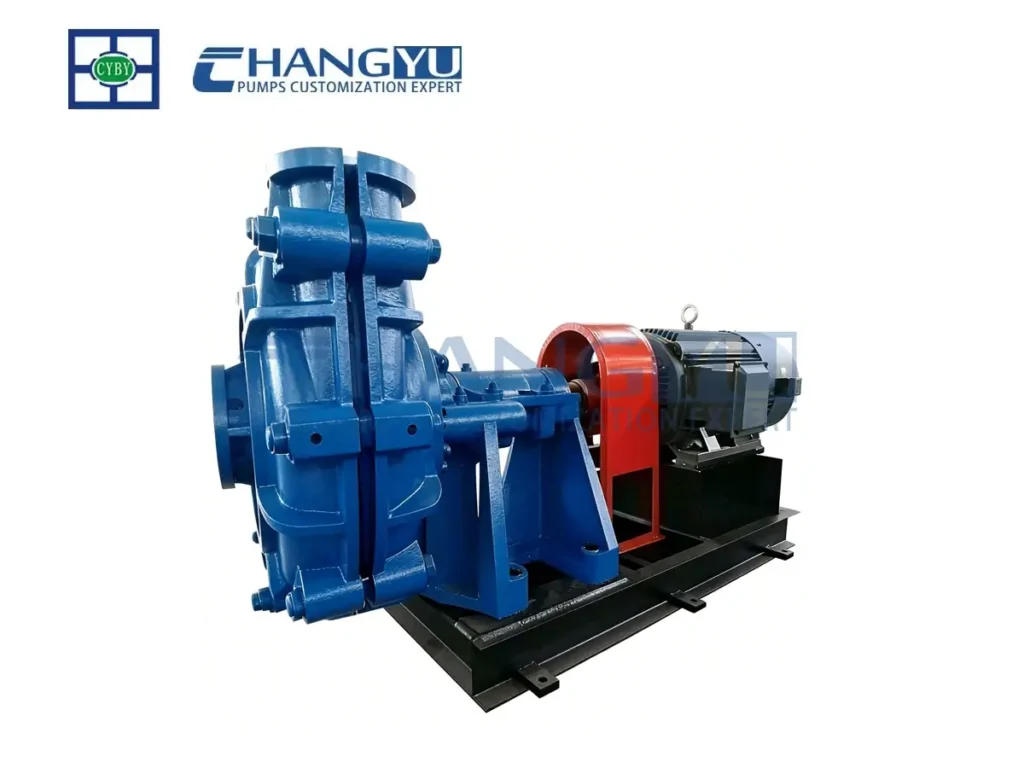
La série PHH est une pompe à boue centrifuge horizontale conçue pour le transport longue distance de boues denses et abrasives dans les applications minières, de production d'énergie et de dragage. Sa structure à double corps avec des pièces d'usure en alliage à haute teneur en chrome offre une durée de vie prolongée dans les applications les plus exigeantes de particules grossières.
Tableau : Spécifications de la série PHH
| Paramètres | Spécifications |
|---|---|
| Plage de débit | 16,2–1 008 m³/h |
| Gamme de têtes | 20–97 m |
| Puissance du moteur | 30–560 kW |
| Plage de vitesse | 500–2 200 tr/min |
| Température moyenne | -20°C à 80°C |
| Matériaux d'usure | BTMCr27, alliage à haute teneur en chrome BTMCr33, caoutchouc naturel, polyuréthane |
Voir la pompe à boue centrifuge série PHH →
Meilleur pour : Boues grossières, tranchantes et à fort impact dans les mines, la décharge du broyeur et le dragage où la taille des particules dépasse 10 mm et où l'usure par impact est le mécanisme de défaillance dominant.
Série CYB-ZKJ — Pompe à boue résistante à la corrosion pour boues chimiques et acides
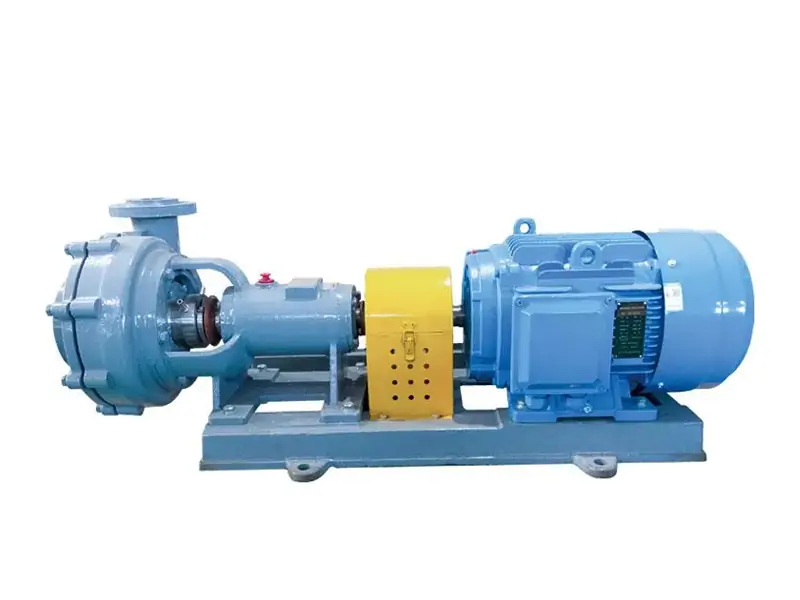
La série CYB-ZKJ est une pompe à boue horizontale résistante à l'usure et à la corrosion utilisant un matériau FEP/PTFE importé pour le corps de pompe et les composants de passage. Elle est conçue pour transporter des liquides clairs acides ou alcalins, des boues, des pulpes minérales corrosives et des fluides chimiquement agressifs similaires.
Tableau : Spécifications de la série CYB-ZKJ
| Paramètres | Spécifications |
|---|---|
| Plage de débit | 3-2 600 m³/h |
| Gamme de têtes | 5-100 m |
| Puissance du moteur | 0,75-300 kW |
| Plage de vitesse | 968-3 450 r/min |
| Température moyenne | De -80°C à 120°C |
| Matériau d'usure | FEP (éthylène propylène fluoré) |
Voir la pompe à boue horizontale résistante à la corrosion série CYB-ZKJ →
Meilleur pour : Boues corrosives où l'attaque chimique se combine à l'usure abrasive — drainage minier acide, effluents d'usines chimiques, boues de cendres acides, et toute application où le pH est en dehors de la plage 5–10 adaptée aux matériaux standard.
Série UHB — Pompe à boues à revêtement UHMW-PE pour boues abrasives à particules fines
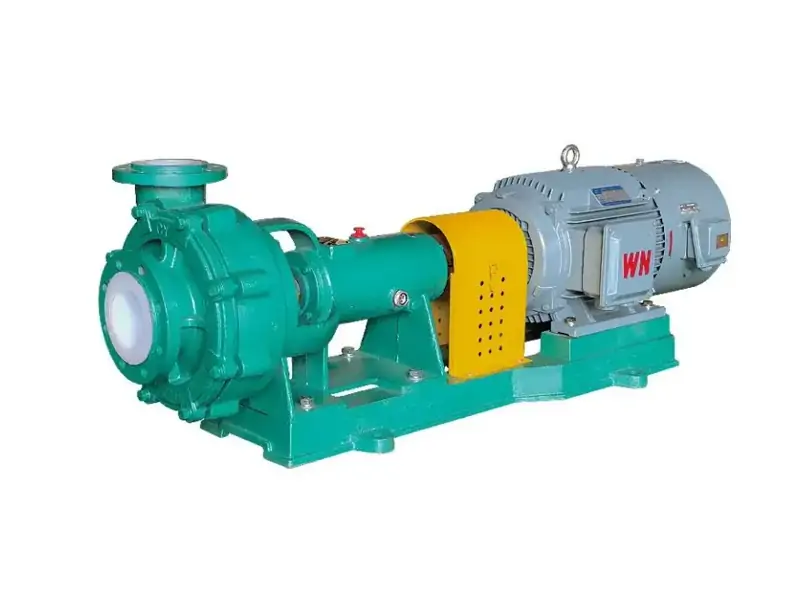
La série UHB est une pompe centrifuge cantilever, monocellulaire, à simple aspiration, dotée d'une construction avancée “ acier revêtu de plastique ”. Le corps de pompe est revêtu de polyéthylène à ultra-haut poids moléculaire (UHMW-PE), qui offre une durée de vie bien supérieure à celle des pompes métalliques traditionnelles lors du traitement de boues hautement abrasives contenant des particules fines.
Tableau : Spécifications de la série UHB
| Paramètres | Spécifications |
|---|---|
| Plage de débit | 3-2 600 m³/h |
| Gamme de têtes | 5-100 m |
| Puissance du moteur | 0,75-300 kW |
| Plage de vitesse | 750-2 900 r/min |
| Température moyenne | De -20°C à 90°C |
| Matériau d'usure | UHMW-PE (polyéthylène à ultra-haut poids moléculaire) |
Voir la pompe à boues abrasives série UHB →
Meilleur pour : Boues hautement abrasives à particules fines de moins de 3 mm — lavage de sable, transport de résidus, manutention de cendres volantes, et toute application où la combinaison d'abrasifs fins et d'une chimie modérée exige la résistance exceptionnelle à l'usure du UHMW-PE.
Référence rapide pour la sélection de produits
Tableau : Guide de sélection des pompes à boues anti-abrasives Changyu
| Caractéristique de la boue | Série recommandée | Matériau principal | Avantage typique en durée de vie |
|---|---|---|---|
| Particules grossières et anguleuses (> 10 mm) ; impact élevé ; exploitation minière et dragage | Série PHH | BTMCr27/BTMCr33 | 5–8× par rapport à la fonte |
| Boue corrosive, acide ou fortement alcaline avec solides | Série CYB-ZKJ | FEP | 3–5× par rapport à l'acier inoxydable en corrosion-abrasion combinée |
| Particules fines hautement abrasives (< 3 mm) ; chimie modérée ou alcalis forts | Série UHB | UHMW-PE | 8–15× par rapport à la fonte en service de particules fines |
Étude de cas de pompe à boues de sable anti-abrasive : Résolution de l'abrasion sévère du sable dans le dragage
Le cas suivant documente une application réelle de pompe à boues anti-abrasive. Le scénario illustre les conséquences de l'utilisation d'une pompe standard dans un service de sable abrasif et les avantages quantifiés de la mise à niveau vers une pompe anti-abrasive correctement spécifiée.
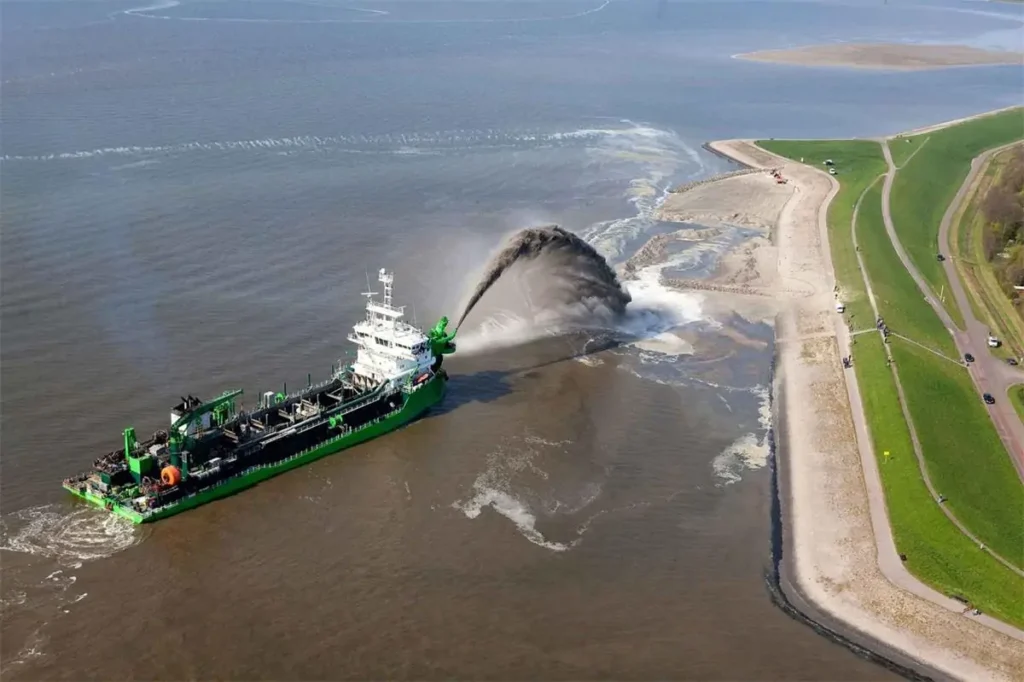
Cas : Opération de dragage de sable — Défaillance de la roue toutes les 3 à 4 semaines
Utilisation : Une entreprise de dragage de sable en Asie du Sud-Est exploitait une drague suceuse à élinde rotative extrayant du sable de rivière pour les granulats de construction. La boue de sable contenait environ 20–25 % de solides en poids, avec des tailles de particules allant du limon fin au sable grossier jusqu'à 20 mm, y compris des particules de quartz anguleuses et tranchantes. La pompe de drague fonctionnait environ 5 000 heures par an.
Configuration de la pompe d'origine :
- Pompe : Pompe de drague centrifuge standard, corps et roue en fonte
- Débit : 400 m³/h à 35 m de hauteur
- Vitesse de fonctionnement : 1 200 tr/min
- Schéma de défaillance : La roue s'est usée au point de réduire inacceptablement le débit après 3 à 4 semaines de fonctionnement ; la languette du corps s'est usée après environ 12 semaines
- Conséquence : Temps d'arrêt non planifié de 8 à 12 heures par remplacement de roue, se produisant environ 12 fois par an ; remplacement du corps requis une fois par trimestre ; coût annuel de maintenance pour les pièces d'usure seul dépassant 40 000 $ ; perte de production totale estimée entre 80 000 $ et 120 000 $ par an en raison des temps d'arrêt
Analyse des causes profondes réalisée par les ingénieurs de Changyu Pump :
La pompe en fonte était fondamentalement inadaptée aux conditions d'usure abrasive. La fonte a une dureté Brinell d'environ 200 HB, tandis que les particules de sable de quartz ont une dureté d'environ 1 000 HV (Vickers) — environ 5× plus dures que le matériau de la pompe. Dans l'usure abrasive, lorsque la dureté des particules dépasse la dureté du matériau d'un facteur de 1,3 ou plus, le taux d'usure augmente de manière exponentielle. Les particules de quartz enlevaient de la fonte des surfaces de la roue et du corps à chaque passage dans la pompe.
De plus, la vitesse de la pompe de 1 200 tr/min générait des vitesses d'impact élevées des particules à l'intérieur du corps. À cette vitesse, les particules de sable frappaient les extrémités des aubes de la roue à des vitesses dépassant 25 m/s, provoquant une érosion rapide.
Solution de pompage Changyu :
- Remplacement de la pompe de drague standard par une pompe à boues anti-abrasive Changyu série PHH
- Matériau de la roue et du corps : Fonte blanche à haute teneur en chrome BTMCr27 (dureté 650–700 HB dans la matrice, avec des carbures durs M7C3 offrant une résistance supplémentaire à l'usure)
- Réduction de la vitesse de fonctionnement à 800 tr/min en spécifiant un modèle de pompe plus grand avec un moteur à vitesse réduite — cela a maintenu le débit requis de 400 m³/h tout en réduisant la vitesse d'impact des particules d'environ 33 %
- Installation de revêtements d'usure remplaçables dans le corps pour permettre un renouvellement rapide de la surface d'usure sans remplacement du corps
- Mise en œuvre d'une surveillance hebdomadaire de l'usure via la tendance de la pression de refoulement
Résultats après l'installation :
- Durée de vie de la roue prolongée de 3–4 semaines à plus de 16 mois — une augmentation d'environ 16×
- Intervalle de remplacement du revêtement d'usure du corps : 10–12 mois (contre 12 semaines pour le corps en fonte d'origine)
- Coût annuel des pièces d'usure réduit de plus de 40 000 $ à environ 8 000 $
- Temps d'arrêt non planifié réduit de 12 événements par an à zéro — tous les remplacements de composants d'usure ont été programmés pendant les fenêtres de maintenance planifiée
- L'entreprise a ajouté trois pompes supplémentaires Changyu série PHH à sa flotte de dragage en 18 mois
Point clé à retenir de cette affaire :
Dans le service de boues de sable abrasives, le matériau de la pompe et la vitesse de fonctionnement sont les deux leviers qui déterminent la rentabilité. Le passage de la fonte (200 HB) à un alliage à haute teneur en chrome (650–700 HB) et la réduction de la vitesse de la pompe de 1 200 à 800 tr/min ont transformé l'opération de dragage d'un centre de coûts axé sur la maintenance en un actif de production prévisible et rentable. Le coût initial plus élevé de la pompe anti-abrasive a été récupéré grâce à la réduction des pièces d'usure et à l'élimination des temps d'arrêt au cours des 4 premiers mois de fonctionnement.
Quel est le calendrier de maintenance pour une pompe à boues de sable anti-abrasive ?
Une pompe à boues de sable anti-abrasive est conçue pour une durée de vie prolongée, mais elle n'est pas exempte de maintenance. Un programme structuré d'inspection et de remplacement garantit que l'usure est détectée avant qu'elle ne provoque une défaillance, et que les remplacements sont effectués dans le cadre d'une maintenance planifiée plutôt que de réparations d'urgence.
Calendrier d'entretien recommandé
Tableau : Calendrier de maintenance de la pompe à boues de sable anti-abrasive
| Intervalle | Action | Objectif |
|---|---|---|
| Quotidiennement | Vérifier la pression de refoulement et le débit ; écouter les bruits inhabituels ou les vibrations | Détection la plus précoce de l'usure ou du blocage de la roue |
| Hebdomadaire | Inspecter le presse-étoupe ou le joint mécanique pour détecter les fuites ; vérifier la température du roulement | Empêche la défaillance du joint et les dommages aux roulements dus à l'infiltration de sable |
| Mensuel | Mesurez l'usure du corps et de la roue à l'aide d'un jauge d'épaisseur aux points critiques (languette, extrémités des aubes) | Quantifie le taux d'usure ; permet de prédire la durée de vie restante |
| Trimestrielle | Inspectez les revêtements d'usure et remplacez-les s'ils sont usés en dessous de l'épaisseur minimale ; vérifiez l'alignement de l'accouplement | Le remplacement planifié du revêtement évite les dommages au corps |
| Annuellement | Démontage et inspection complets de la pompe ; remplacez tous les composants d'usure en dessous des limites de service ; inspectez l'arbre et les roulements | Révision complète lors d'un arrêt planifié |
| En fonction de l'état | Remplacez la roue lorsque la pression de refoulement chute de 10 à 15 % par rapport à la référence à vitesse constante ; remplacez les revêtements lorsque l'épaisseur atteint le minimum spécifié par le fabricant | Empêche les défaillances catastrophiques et les temps d'arrêt non planifiés |
Guide de dépannage courant
Tableau : Référence de dépannage pour pompe à boue de sable anti-abrasive
| Symptôme | Cause probable | Mesures correctives |
|---|---|---|
| Baisse progressive de la pression de refoulement | Usure de la roue — extrémités des aubes usées | Mesurez l'épaisseur de la roue ; remplacez si elle est en dessous de la limite de service |
| Baisse progressive du débit | Usure du corps ou du revêtement — augmentation de la recirculation interne | Inspectez le corps et les revêtements ; remplacez les composants usés |
| Chute soudaine du débit ou de la pression | Obstruction dans la roue ou la conduite d'aspiration | Débouchez l'obstruction ; vérifiez le panier d'aspiration |
| Vibrations excessives | Roue usée ou déséquilibrée ; usure des roulements ; désalignement | Inspectez la roue pour une usure inégale ; vérifiez les roulements et l'alignement |
| Fuite du presse-étoupe avec du sable dans l'eau de rinçage | Bague d'usure ou garniture usée ; pression d'eau de rinçage insuffisante | Remplacez la bague d'usure et la garniture ; augmentez la pression d'eau de rinçage au-dessus de la pression de refoulement |
| Surcharge du moteur | Densité de la boue plus élevée que la conception ; blocage mécanique | Vérifiez la densité réelle de la boue ; recherchez des débris dans la pompe |
⚠️ Avertissement critique : Ne pas faire fonctionner à sec ou en refoulement fermé
Faire fonctionner une pompe à boue anti-abrasive à sec — même pendant quelques minutes — détruira le joint mécanique ou le presse-étoupe. La boue pompée fournit normalement le refroidissement et la lubrification des faces du joint. Sans elle, les faces du joint surchauffent et tombent en panne rapidement. De même, faire fonctionner la pompe contre une vanne de refoulement fermée pendant plus d'une minute ou deux fera chauffer la boue à l'intérieur du corps, ce qui pourrait endommager les revêtements en élastomère et les joints. Assurez-vous toujours d'une alimentation en aspiration adéquate et confirmez que la vanne de refoulement est ouverte avant de démarrer la pompe.
Les ingénieurs de Changyu Pump recommandent d'installer un interrupteur de débit ou un moniteur de puissance pour arrêter automatiquement la pompe si des conditions de fonctionnement à sec sont détectées. Pour les pompes avec joints mécaniques, un système de rinçage Plan 32 — injectant de l'eau propre à une pression supérieure à la pression de refoulement — offre une protection supplémentaire contre l'infiltration de sable dans les faces du joint.
FAQ sur les pompes à boue de sable anti-abrasives
Q : Quel est le meilleur matériau pour une pompe à boue de sable ?
R : Il n'existe pas de matériau “ meilleur ” unique — le choix correct dépend de la taille des particules, de leur forme et de la chimie de la boue. L'alliage à haute teneur en chrome (BTMCr27/BTMCr33) est le meilleur pour les particules grossières et tranchantes de plus de 10 mm. Le caoutchouc naturel excelle avec les particules fines et arrondies à haute vitesse dans les boues neutres à alcalines. L'UHMW-PE offre la durée de vie la plus longue pour les particules fines de moins de 3 mm dans les boues chimiquement agressives ou fortement alcalines.
Q : Combien de temps dure une roue de pompe à boue de sable anti-abrasive ?
R : La durée de vie de la roue varie de 6 mois à plus de 5 ans selon le choix du matériau, les caractéristiques des particules et la vitesse de fonctionnement. Une roue en alliage à haute teneur en chrome dans un service de sable grossier à 800 tr/min peut durer 3 à 5 ans ; la même roue à 1 800 tr/min peut durer 12 à 18 mois. Les roues en caoutchouc et en UHMW-PE dans un service de particules fines peuvent atteindre plus de 5 ans aux vitesses recommandées.
Q : Puis-je pomper du sable avec une pompe centrifuge standard ?
R : Une pompe centrifuge standard en fonte pompera du sable — mais la roue et le corps s'useront rapidement, nécessitant généralement un remplacement en quelques semaines à quelques mois. Les temps d'arrêt fréquents et les coûts de remplacement rendent cela non économique pour toute application de manutention de sable continue ou critique pour la production.
Q : Quelle est la différence entre une pompe à boue et une pompe à sable ?
R : Une pompe à sable est un type de pompe à boue spécialement conçue pour les particules de sable grossières et abrasives. Toutes les pompes à sable sont des pompes à boue, mais toutes les pompes à boue ne sont pas conçues pour traiter les grosses particules tranchantes présentes dans les boues de sable. Les pompes à sable ont généralement des passages de roue plus larges et des matériaux d'usure plus durs que les pompes à boue à usage général.
Q : Comment la vitesse de la pompe affecte-t-elle la durée de vie d'une pompe à boue de sable ?
R : Dans les modèles d'usure abrasive, le taux d'usure est généralement proportionnel à la vitesse élevée à une puissance de 2,5 à 3. Une pompe à 800 tr/min subit environ 1/8 du taux d'usure de la même pompe à 1 600 tr/min. Fonctionner à la vitesse la plus basse possible est le moyen le plus efficace de prolonger la durée de vie des composants d'usure.
Q : Quel entretien nécessite une pompe à boue de sable anti-abrasive ?
R : L'entretien de routine comprend des vérifications quotidiennes de la pression et du débit, une inspection hebdomadaire du joint, une mesure mensuelle de l'épaisseur d'usure aux points critiques, une inspection trimestrielle du revêtement et un démontage complet annuel avec remplacement de tous les composants en dessous des limites de service. La surveillance de l'usure par suivi des tendances est essentielle — elle permet des remplacements planifiés avant la défaillance.
Liste de contrôle des mesures de prévention pour les ingénieurs en pompes chez Changyu
Forts de plus de 20 ans d'expérience sur le terrain dans la spécification et l'entretien de pompes à boue de sable anti-abrasives dans les applications minières, de dragage et de traitement du sable, les ingénieurs de Changyu Pump recommandent la discipline de sélection et d'exploitation suivante :
- Adaptez le matériau à la particule — ne choisissez pas par défaut l'alliage à haute teneur en chrome pour tout. Les particules fines et arrondies dans une boue neutre nécessitent du caoutchouc. Les particules fines dans une boue acide ou fortement alcaline nécessitent de l'UHMW-PE. Les grosses particules tranchantes nécessitent un alliage à haute teneur en chrome. Un choix de matériau inadapté est la cause la plus fréquente d'usure prématurée.
- Sélectionnez la pompe la plus grande et la plus lente qui répond à vos besoins de débit et de hauteur. Une pompe plus grande à 600–800 tr/min atteindra 3 à 5 fois la durée de vie d'une pompe plus petite à 1 500–1 800 tr/min. Le coût initial plus élevé est récupéré grâce à une durée de vie prolongée des composants.
- Dératez toujours les performances de la pompe pour le service de boue. La hauteur manométrique et le rendement diminuent tous deux lors du pompage de boue par rapport à l'eau. Dimensionnez le moteur pour la densité réelle de la boue, et non pour celle de l'eau.
- Installez une surveillance de l'usure comme pratique courante — pas après coup. Mesurez l'épaisseur de la roue et du revêtement aux points critiques chaque mois. Suivez les tendances des données. Planifiez les remplacements en fonction du taux d'usure, et non de la défaillance.
- Ne faites jamais fonctionner une pompe à boue anti-abrasive à sec ou contre une vanne de refoulement fermée. Installez un interrupteur de débit ou un moniteur de puissance pour une protection par arrêt automatique. Pour les pompes à garniture mécanique, utilisez un système de rinçage à l'eau propre Plan 32.
- Gardez une roue de rechange et un jeu de revêtements d'usure en stock pour les pompes critiques. Le coût de possession est négligeable par rapport à la perte de production due à l'attente de pièces de rechange lors d'un arrêt non planifié.
- Surveillez les conditions d'aspiration. Le sable se dépose dans les conduites d'aspiration lorsque le débit s'arrête. Rincez les conduites d'aspiration avant de redémarrer après un arrêt pour éviter le colmatage et la cavitation au redémarrage.
- Ne présumez pas que la pompe ayant le prix d'achat le plus bas est la moins chère à posséder. Dans un service de sable abrasif, le coût initial plus bas de la pompe standard est rapidement submergé par les pièces d'usure et les temps d'arrêt en quelques mois. Effectuez une comparaison du coût total de possession (TCO) sur 5 ans avant l'achat.
Conclusion
La pompe à boue anti-abrasive pour sable n'est pas une pompe standard avec une étiquette résistante à l'usure — c'est une solution conçue sur mesure où la science des matériaux, la conception hydraulique et la discipline opérationnelle convergent pour déterminer la rentabilité dans un service abrasif. Une spécification correcte nécessite une attention portée à trois variables interdépendantes : le matériau d'usure adapté aux caractéristiques des particules et à la chimie de la boue, la vitesse de la pompe sélectionnée pour une durée de vie maximale, et le programme de maintenance qui détecte l'usure avant qu'elle ne devienne une défaillance. Lorsque ces trois facteurs sont alignés, une pompe à boue anti-abrasive offre des performances prévisibles, des coûts de maintenance gérables et un service fiable sur une durée de vie mesurée en années, et non en semaines.
Lorsque vous êtes prêt à spécifier une pompe à boue anti-abrasive pour sable pour votre exploitation, l'équipe d'ingénierie de Changyu Pump peut fournir une évaluation technique gratuite — comprenant une analyse des particules, une recommandation de matériau, une sélection de pompe et une projection du TCO sur 5 ans pour vos caractéristiques de boue et conditions d'exploitation spécifiques. Forts de plus de 20 ans d'expérience en fabrication, de trois séries distinctes de pompes anti-abrasives couvrant les technologies d'alliage à haute teneur en chrome, de FEP et d'UHMW-PE, et d'une base installée mondiale dans les applications minières, de dragage et industrielles, nous garantissons que votre spécification de pompe est correcte dès le premier jour.
Contactez les ingénieurs de Changyu Pump pour bénéficier d'une évaluation technique gratuite →