
Resposta rápida
Escolhendo entre uma bomba de parafuso duplo vs bomba de parafuso simples resume-se a três características do fluido: teor de gás, teor de sólidos e requisitos de pressão. As principais diferenças — em ordem de prioridade de decisão — incluem:
- (1) Manuseio de gás — bombas de parafuso duplo lidam com altas frações de gás (incluindo bolsas de gás transitórias de 100%) sem perder a escorva; bombas de parafuso simples toleram gás arrastado moderado, mas têm melhor desempenho com meios totalmente líquidos.
- (2) Sólidos e abrasivos — bombas de parafuso simples são excelentes no manuseio de partículas, fibras e lamas abrasivas; bombas de parafuso duplo requerem fluidos limpos ou filtração fina para evitar danos ao parafuso e aos rolamentos.
- (3) Capacidade de pressão — bombas de parafuso duplo alcançam pressões de descarga mais altas (até 40 bar e além); bombas de parafuso simples normalmente operam até 6–12 bar, dependendo dos estágios do estator.
- (4) Perfil de manutenção — bombas de parafuso simples exigem substituição previsível do estator; bombas de parafuso duplo exigem manutenção das engrenagens de sincronismo e rolamentos com tolerâncias mais apertadas.
- (5) Custo inicial vs TCO — bombas de parafuso duplo têm um custo inicial mais alto, mas podem oferecer um TCO menor em aplicações limpas, de alta pressão ou multifásicas.
Selecionar a configuração errada de bomba de parafuso para uma aplicação multifásica ou abrasiva faz mais do que reduzir a eficiência — pode destruir a bomba em semanas. Dados da indústria identificam consistentemente a seleção incorreta do tipo de bomba como um dos principais contribuintes para custos de manutenção não planejados em indústrias de processo. Uma bomba de parafuso duplo especificada para um fluido contendo partículas abrasivas pode sofrer desgaste catastrófico no parafuso e nos rolamentos, enquanto uma bomba de parafuso simples instalada em uma aplicação com alto teor de gás pode sofrer danos severos no estator devido a condições de funcionamento a seco dentro das bolsas de gás.
Com mais de 20 anos na fabricação de bombas de deslocamento positivo, a Changyu Pump orientou clientes na decisão entre parafuso simples e duplo em aplicações petrolíferas, químicas e ambientais. Este guia fornece a estrutura de comparação completa. Ao final, você saberá exatamente qual configuração de bomba de parafuso se adequa aos seus parâmetros de processo e por quê.
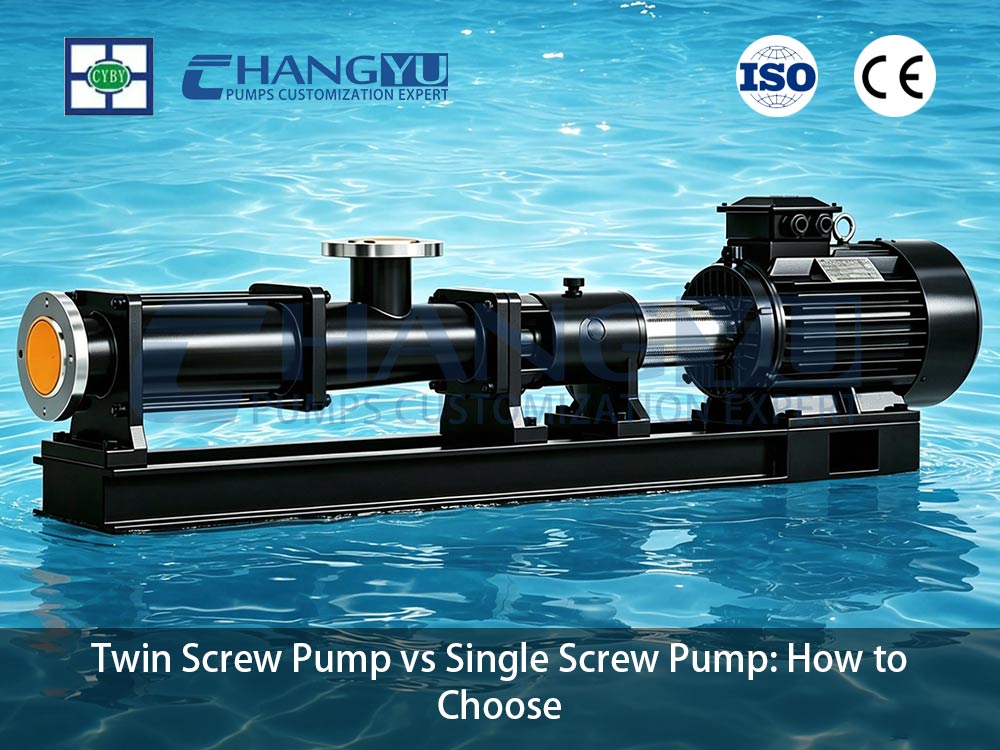
O Que É uma Bomba de Parafuso Simples e Como Ela Funciona?
Uma bomba de parafuso simples — também chamada de bomba de cavidade progressiva ou monobomba — usa um rotor metálico com uma hélice de rosca única girando excentricamente dentro de um estator elastomérico de hélice dupla. Cada rotação retém um volume fixo de fluido em uma série de câmaras seladas de 180 graus que progridem continuamente da sucção à descarga. Este design produz fluxo suave e sem pulsação em um volume previsível por revolução, em grande parte independente da pressão de descarga.
Características Principais
- Ajuste por interferência rotor-estator cria as linhas de vedação que separam cavidades sucessivas
- Movimento excêntrico requer uma junta universal ou acoplamento flexível entre o eixo de acionamento e o rotor
- O estator é um componente de desgaste consumível — normalmente elastômero NBR, EPDM, FKM ou PTFE, selecionado para compatibilidade química com o fluido bombeado
- Baixas velocidades internas (tipicamente 400–960 r/min) minimizam o cisalhamento e permitem que sólidos passem sem danos
- Autoaspirante capacidade com boa elevação de sucção
O Que É uma Bomba de Parafuso Duplo e Como Ela Funciona?
Uma bomba de parafuso duplo usa dois parafusos paralelos e entrelaçados — um parafuso motor e um parafuso movido — girando dentro de uma carcaça de ajuste preciso. Ao contrário da bomba de parafuso simples, os dois parafusos não entram em contato entre si ou com a carcaça. Engrenagens de sincronismo externas montadas em eixos separados sincronizam os parafusos, mantendo folgas precisas sem contato metal-metal. O fluido é retido nos espaços entre as roscas do parafuso e a carcaça, sendo então empurrado axialmente da sucção para a descarga.
Características Principais
- Design de parafuso sem contato significa nenhum desgaste entre os parafusos ou contra a carcaça — crítico para fluidos não lubrificantes
- Engrenagens de sincronismo externas estão localizadas em uma caixa de engrenagens separada, isolada do fluido bombeado, lubrificada por óleo
- Forças hidráulicas balanceadas — dois parafusos opostos cancelam as cargas radiais, reduzindo o estresse nos rolamentos
- Maior capacidade de velocidade do que bombas de parafuso simples, tipicamente até 3.600 r/min
- Lida com fluxo multifásico — o design sem contato permite que bolsas de gás passem sem causar danos
- Caminho de fluxo curto e previsível com cisalhamento mínimo
Por Que o Design Sem Contato é Importante
A ausência de contato entre os parafusos é a diferença definidora em relação a uma bomba de parafuso simples. Em uma bomba de parafuso simples, o ajuste por interferência rotor-estator é o que cria a vedação — mas também gera atrito, limita a tolerância a funcionamento a seco e torna o estator um item de desgaste. Em uma bomba de parafuso duplo, os parafusos nunca tocam uns nos outros ou na carcaça. Isso significa que a bomba pode funcionar a seco brevemente sem danos imediatos, pode lidar com bolsas de gás sem perder a escorva e não possui um estator que exija substituição periódica. A contrapartida é que as folgas precisas necessárias entre os parafusos tornam as bombas de parafuso duplo vulneráveis ao desgaste abrasivo e intolerantes a sólidos.
Quais São as Principais Diferenças Entre Bombas de Parafuso Simples e Duplo?
Este capítulo fornece a comparação técnica direta que forma a base da decisão entre parafuso simples e duplo. As tabelas a seguir cobrem todas as dimensões importantes para a seleção de bombas industriais. Os dados de desempenho são baseados em curvas típicas para bombas industriais padrão, conforme compilado a partir dos padrões do Hydraulic Institute (HI) e dados publicados pelos fabricantes. De acordo com o padrão HI 9.6.7, o desempenho da bomba deve ser corrigido para viscosidade usando fatores de correção derivados empiricamente.
Comparação de Desempenho Principal
Tabela: Bomba de Parafuso Simples vs Bomba de Parafuso Duplo — Comparação Técnica
| Parâmetro | Bomba de parafuso único | Bomba de dupla rosca |
|---|---|---|
| Princípio de operação | Rotor excêntrico em estator elastomérico | Dois parafusos sem contato, com sincronismo externo |
| Gama de caudais | 0–200 m³/h | 10–2.000+ m³/h |
| Capacidade de pressão | 6–12 bar (até 120 m de altura manométrica) | Até 40+ bar |
| Gama de velocidades | 400–960 r/min | Até 3.600 r/min |
| Faixa de viscosidade | 20–1.000.000+ cSt | 1–100.000 cSt |
| Manuseio de gás | Moderado — até ~20% de fração de gás | Excelente — lida com bolsas de gás transitórias de 100% |
| Manuseio de sólidos | Excelente — partículas e fibras passam | Ruim — requer filtração, tipicamente < 100 μm |
| Cisalhamento | Muito baixo | Baixa a moderada |
| Pulsação | Muito baixo | Baixo (ligeiramente maior que o de parafuso simples) |
| Tolerância de funcionamento em seco | Nenhum — estator destruído em minutos | Limitado — pode funcionar a seco por minutos |
| Autoaspirante | Excelente | Bom |
| NPSH requerido | 1–3 m | 2–5 m |
| Custo inicial | Inferior | Mais alto (tipicamente 1,5–2,5×) |
Entendendo as Diferenças de NPSH
O maior requisito de NPSH das bombas de parafuso duplo (2–5 m vs 1–3 m para parafuso simples) pode ser um fator decisivo em aplicações com altura de sucção limitada. Bombas de parafuso simples podem frequentemente operar com uma simples sucção inundada ou altura estática modesta, enquanto bombas de parafuso duplo podem exigir uma bomba booster ou tanque de alimentação elevado. Ao substituir uma bomba de parafuso simples por uma de parafuso duplo em uma instalação existente, sempre recalcule o NPSH disponível usando a viscosidade real do fluido na temperatura mínima de operação — as perdas por atrito na linha de sucção aumentam significativamente com a viscosidade, e um sistema que funciona para uma bomba de parafuso simples pode não fornecer NPSH adequado para uma alternativa de parafuso duplo.
Matriz Tridimensional de Aplicação
A tabela abaixo mapeia a adequação da bomba nas três variáveis de aplicação mais críticas: teor de gás, teor de sólidos e pressão de descarga. Use esta matriz para identificar rapidamente qual tipo de bomba corresponde ao seu envelope operacional.
Tabela: Matriz de Adequação de Aplicação — Parafuso Simples vs Duplo
| Teor de Gás | Teor de sólidos | Pressão | Bomba Recomendada | Fundamentação |
|---|---|---|---|---|
| Baixo (< 5%) | Nenhum | Baixa (< 6 bar) | Qualquer — avaliar TCO | Ambos viáveis; custo maior do parafuso duplo |
| Baixo (< 5%) | Nenhum | Alta (> 12 bar) | Parafuso duplo | Parafuso simples limitado em pressão |
| Baixo (< 5%) | Presente (abrasivo) | Qualquer | Parafuso simples | Sólidos danificam folgas do parafuso duplo |
| Baixo (< 5%) | Presente (fibroso) | Qualquer | Parafuso simples | Fibras enrolam nos eixos do parafuso duplo |
| Médio (5–20%) | Nenhum | Baixa-Média | Qualquer — parafuso simples com estator tolerante a gás ou duplo | Parafuso duplo mais robusto nesta faixa |
| Médio (5–20%) | Presente | Qualquer | Parafuso simples (com estator tolerante a gás) | Parafuso duplo não pode lidar com sólidos |
| Alto (20–100%) | Nenhum | Qualquer | Parafuso duplo | Estator do parafuso simples degrada em bolsas de gás |
| Alto (20–100%) | Presente | Qualquer | Nenhuma bomba lida bem com esta combinação | Avaliar solução de dois estágios: separação gás-líquido a montante para remover gás (então parafuso simples para sólidos) OU filtração de sólidos a montante (então parafuso duplo para gás) |
Engenheiros da Changyu Pump, com base em 20 anos de experiência de campo, oferecem esta diretriz definitiva: se o gás arrastado exceder 20% em volume nas condições de entrada da bomba, a escolha deve favorecer fortemente uma bomba de parafuso duplo. Bombas de parafuso simples dependem do fluido bombeado para lubrificar e resfriar a interface rotor-estator. Bolsas de gás deslocam este fluido, causando superaquecimento localizado que pode degradar o elastômero do estator em dias a semanas em frações moderadas de gás (20–50%), e em horas em frações altas de gás acima de 50%. Isso não é uma preferência de desempenho; é um requisito de confiabilidade.
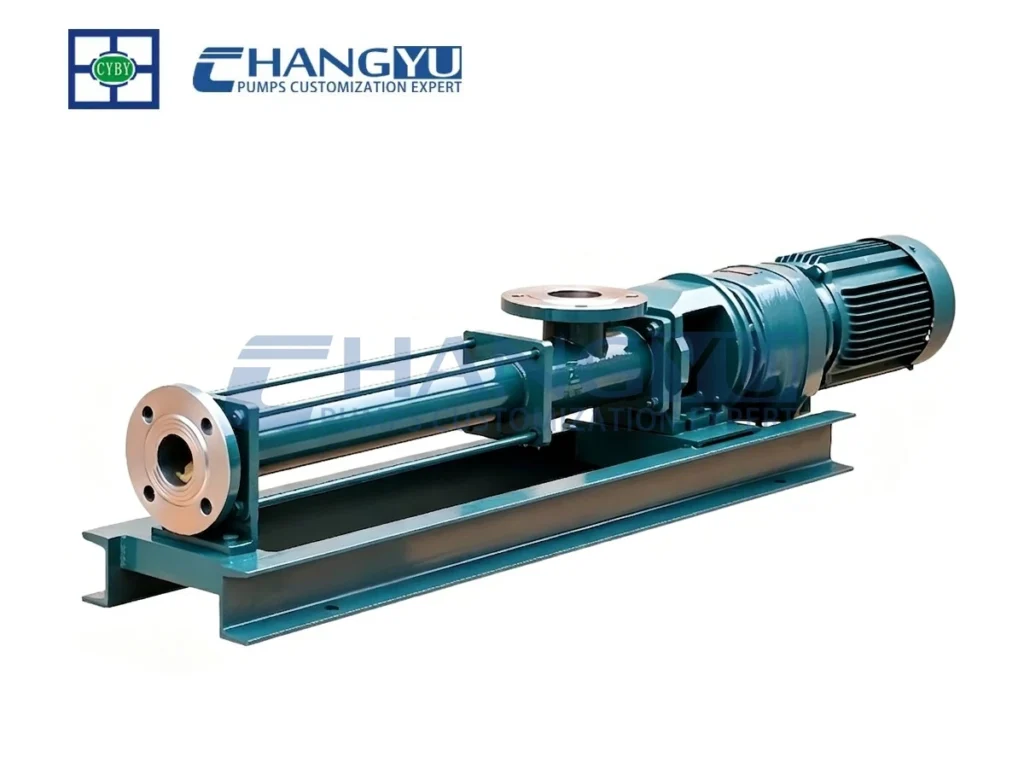
Quais São as Vantagens e Desvantagens de Cada?
Cada seleção de bomba representa uma troca. A avaliação a seguir avalia cada tipo de bomba contra os critérios que impulsionam a confiabilidade operacional e o custo de manutenção.
Bomba de parafuso único
Vantagens:
- Manuseio superior de sólidos — partículas, fibras e lamas abrasivas passam sem causar danos mecânicos
- Lida com viscosidades ultra-altas superiores a 1.000.000 cSt
- Cisalhamento muito baixo — ideal para polímeros, produtos alimentícios e emulsões sensíveis ao cisalhamento
- O desgaste do estator é previsível e detectável através do monitoramento da vazão
- Menor custo de compra inicial
- Compatibilidade química mais ampla através da seleção de elastômero (NBR, EPDM, FKM, PTFE)
- Construção mais simples — menos componentes de precisão
Desvantagens:
- Limitado em pressão a aproximadamente 6–12 bar (requer estatores multiestágio para pressões mais altas)
- Nenhuma tolerância a funcionamento a seco — estator destruído em minutos de perda de fluido
- Manuseio limitado de gás — frações de gás acima de 20% causam degradação acelerada do estator
- Maior pegada para vazão equivalente
- A substituição do estator é um evento de manutenção planejado (embora previsível)
- Capacidade de velocidade mais baixa limita a vazão máxima
Bomba de dupla rosca
Vantagens:
- Excelente manuseio de gás — opera com slugs de gás transitórios de 100% sem perder escorva ou causar danos
- Maior capacidade de pressão — até 40+ bar
- Maior capacidade de velocidade — até 3.600 r/min, permitindo vazões mais altas
- Tolerância limitada a funcionamento a seco — parafusos sem contato sobrevivem a breve perda de fluido, medida em minutos, não horas
- Sem substituição do estator — elimina esta categoria de manutenção
- Pegada compacta para vazão equivalente
- Forças hidráulicas balanceadas reduzem cargas nos rolamentos
Desvantagens:
- Baixa tolerância a sólidos — partículas abrasivas erodem as folgas de precisão do parafuso e da carcaça
- Faixa de viscosidade limitada — eficiência cai acima de 100.000 cSt
- Maior custo inicial — tipicamente 1,5–2,5× o preço de uma bomba de parafuso simples equivalente
- Engrenagens de sincronização externas requerem lubrificação a óleo e manutenção periódica
- Folgas mais apertadas exigem fluidos mais limpos e instalação mais cuidadosa
- Maior requisito de NPSH — pode exigir mais altura de sucção
Quando Você Deve Escolher uma Bomba de Parafuso Duplo em Vez de uma de Parafuso Simples?
A bomba de parafuso duplo é a escolha tecnicamente correta quando uma ou mais das seguintes condições definem seu processo. Use a lógica de decisão abaixo para determinar se sua aplicação se enquadra no território do parafuso duplo.
Caminho de Decisão para Seleção de Parafuso Duplo
Gatilho primário — teor de gás > 20% em volume:
Se o fluido do seu processo contém gás arrastado significativo, slugs de gás ou transições entre fases líquida e gasosa, a bomba de parafuso duplo é a escolha necessária. As aplicações incluem:
- Esvaziamento de tanques e descarregamento de carga — onde a bomba deve lidar com a transição de líquido para gás à medida que os tanques esvaziam
- Reforço de cabeça de poço de fluxo multifásico — óleo, água e gás não separados em uma única tubulação
- Bombeamento de tambor de flare knockout — onde o arraste de gás é imprevisível
Gatilho primário — pressão de descarga > 12 bar:
Se a pressão de descarga necessária excede o que uma bomba de parafuso simples multiestágio pode fornecer, a bomba de parafuso duplo fornece a capacidade de pressão necessária. As aplicações incluem:
- Transferência em tubulação de longa distância
- Sistemas de injeção de alta pressão
- Serviço de bomba booster
Gatilho secundário — fluido limpo com viscosidade moderada (< 100.000 cSt):
Quando o fluido está livre de sólidos abrasivos e a viscosidade está dentro da faixa ideal do parafuso duplo, o parafuso duplo oferece velocidades mais altas, dimensões mais compactas e eliminação dos custos de substituição do estator. As aplicações incluem:
- Transferência e reforço de óleo combustível
- Circulação de óleo lubrificante
- Transferência de produtos químicos limpos
- Processamento higiênico de alimentos e bebidas exigindo compatibilidade CIP
Gatilho secundário — risco de funcionamento a seco é inevitável:
Em aplicações onde a perda ocasional de fluido é inerente ao processo, a tolerância limitada a funcionamento a seco da bomba de parafuso duplo — medida em minutos, não em horas — proporciona uma breve margem de segurança operacional. O design de parafuso sem contato sobrevive a interrupções breves de fluido que destruiriam um estator de bomba de parafuso simples.
Quando a Bomba de Parafuso Duplo NÃO é a Escolha Certa
- Fluidos abrasivos — areia, finos de catalisador, partículas metálicas ou qualquer sólido duro irá erodir as folgas do parafuso e da carcaça, destruindo o desempenho da bomba
- Materiais fibrosos — fibras longas podem enrolar nos eixos do parafuso na entrada, causando bloqueios
- Viscosidade ultra-alta — acima de 100.000 cSt, o design de cavidade progressiva da bomba de parafuso simples mantém maior eficiência
- Orçamento apertado com fluido limpo e de baixa pressão — se uma bomba de parafuso simples atende aos requisitos técnicos, o custo mais alto da bomba de parafuso duplo é injustificado
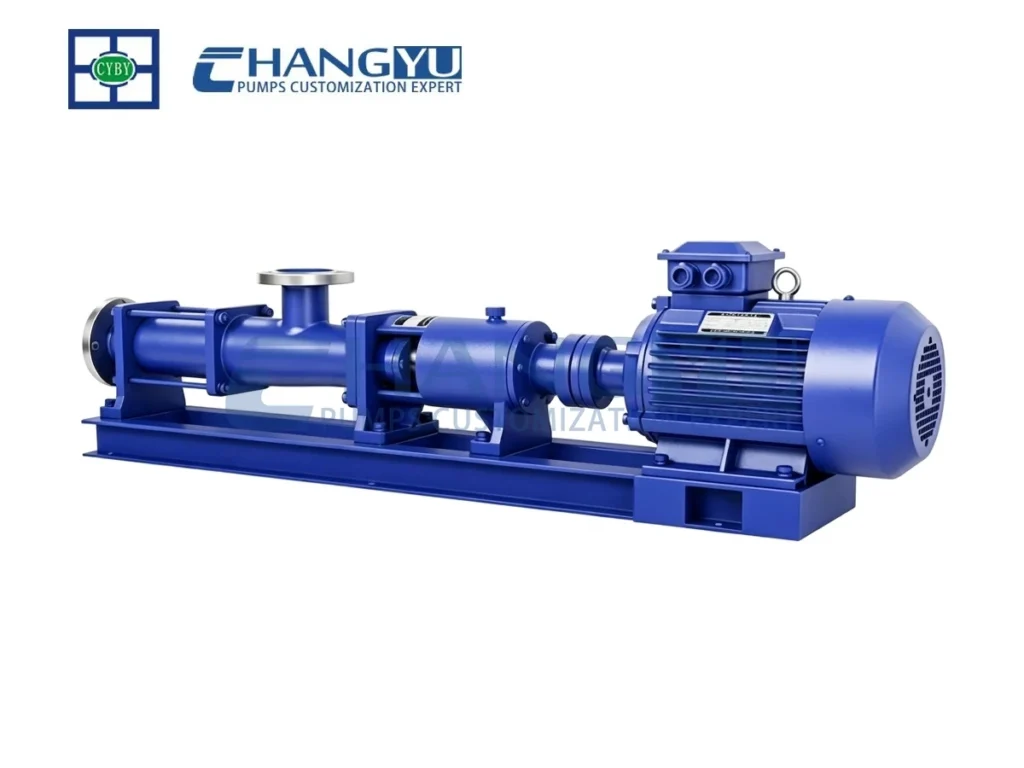
Quando a Bomba de Parafuso Simples é a Melhor Escolha?
A bomba de parafuso simples continua sendo a força de trabalho para fluidos difíceis — particularmente aqueles que contêm sólidos, fibras ou viscosidades ultra-altas. As seguintes condições definem o território da bomba de parafuso simples.
Caminho de Decisão para Seleção de Bomba de Parafuso Simples
Gatilho primário — teor de sólidos ou abrasivos:
Se o seu fluido de processo contiver algum dos seguintes, a bomba de parafuso simples é a escolha necessária:
- Areia, cascalho ou partículas minerais
- Finos de catalisador ou limalha metálica
- Materiais fibrosos — trapos, fibras vegetais, resíduos têxteis
- Sólidos cristalizantes ou polimerizantes
- Lodo com teor de cascalho
A geometria excêntrica rotor-estator passa os sólidos através da bomba sem triturá-los entre superfícies metálicas — uma capacidade que a bomba de parafuso duplo não consegue igualar.
Gatilho primário — viscosidade ultra-alta (> 100.000 cSt):
Para petróleo bruto pesado, fundidos de polímero, lodo desidratado e meios de alta viscosidade semelhantes, a bomba de parafuso simples mantém maior eficiência volumétrica. O design de cavidade progressiva reduz o deslizamento interno em alta viscosidade, enquanto as bombas de parafuso duplo experimentam aumento de vazamento através das folgas do parafuso.
Gatilho secundário — produtos sensíveis ao cisalhamento:
Para polímeros, produtos alimentícios, emulsões e fluidos biológicos onde a integridade do produto é crítica, o design de cisalhamento muito baixo da bomba de parafuso simples é a escolha mais segura. A progressão contínua da cavidade não submete o fluido aos picos de cisalhamento intermitentes que ocorrem quando os filetes do parafuso duplo passam uns pelos outros.
Gatilho secundário — altura de sucção limitada:
Com requisitos de NPSH de 1–3 m, as bombas de parafuso simples operam de forma confiável em aplicações com altura de sucção mínima, reduzindo a necessidade de tanques elevados ou bombas booster.
Equívoco Comum — “Bomba de Parafuso Duplo é Mais Avançada, Então Deve Ser Melhor”
Um equívoco que os engenheiros da Changyu Pump encontram frequentemente em campo: a suposição de que as bombas de parafuso duplo são “tecnologia mais avançada” e, portanto, a escolha superior para qualquer aplicação. Isso está incorreto e pode ser caro. Bombas de parafuso duplo e de parafuso simples são ferramentas diferentes otimizadas para diferentes janelas operacionais. Instalar uma bomba de parafuso duplo em uma aplicação de lodo abrasivo — porque “parece mais avançada” — resultará em desgaste rápido do parafuso e do rolamento, reparos caros e tempo de inatividade prolongado. A bomba certa é aquela que corresponde às características específicas do seu fluido, não aquela com o preço de compra mais alto.
Como os Custos de Manutenção e Operação se Compararam?
Os perfis de manutenção das bombas de parafuso simples e duplo diferem fundamentalmente. Compreender essas diferenças é crítico para a previsão precisa do custo total de propriedade e planejamento de manutenção.
Comparação do Modo de Manutenção
Tabela: Perfil de Manutenção — Bomba de Parafuso Simples vs Duplo
| Fator de Manutenção | Bomba de parafuso único | Bomba de dupla rosca |
|---|---|---|
| Componente de desgaste primário | Estator (elastômero) | Engrenagens de sincronismo, rolamentos, selos mecânicos |
| Mecanismo de desgaste | Abrasão e ataque químico no estator | Desgaste mecânico nas engrenagens; degradação do selo |
| Intervalo de substituição | 6 meses a 3+ anos (previsível) | 2–5 anos para engrenagens/rolamentos (dependente da carga) |
| Detecção de desgaste | Queda na vazão em velocidade constante — fácil de monitorar | Análise de vibração, análise de óleo — mais complexo |
| Complexidade da substituição | Moderada — troca do estator, sem ferramentas especiais | Maior — o sincronismo da engrenagem deve ser reajustado com precisão |
| Tempo de inatividade da substituição | 4–8 horas | 8–16 horas (o sincronismo da engrenagem adiciona complexidade) |
| Custo de consumível (por evento) | $1.500–$3.000 (estator) | $3.000–$8.000 (conjunto de engrenagens, rolamentos, selos) |
| Previsibilidade | Alta — desgaste gradual, substituição planejada | Moderada — engrenagens desgastam gradualmente, mas selos podem falhar repentinamente |
Comparação de TCO de 5 Anos
Premissas para o Caso A — Óleo Combustível Limpo (sem sólidos, < 5% gás, 200 cSt, descarga de 12 bar):
| Componente de custo | Bomba de parafuso único | Bomba de dupla rosca |
|---|---|---|
| Compra inicial | $10.000–$18.000 | $18.000–$35.000 |
| Peças de desgaste (5 anos) | $6.000–$12.000 (2–4 trocas de estator) | $6.000–$16.000 (1–2 revisões de engrenagem/rolamento) |
| Risco de tempo de inatividade | Baixa | Baixa |
| Custo total de propriedade estimado para 5 anos | $16.000–$30.000 | $24.000–$51.000 |
| Vencedor | Parafuso simples oferece TCO mais baixo | Bomba de parafuso duplo justificada apenas se alta pressão for necessária (> 12 bar) |
Premissas para o Caso B — Esvaziamento de Tanque Multifásico (20–80% gás, sem sólidos, 50 cSt, descarga de 10 bar):
| Componente de custo | Bomba de parafuso único | Bomba de dupla rosca |
|---|---|---|
| Compra inicial | $10.000–$18.000 | $18.000–$35.000 |
| Peças de desgaste (5 anos) | $9.000–$25.000 (substituição do estator a cada 3–12 meses, dependendo da fração de gás) | $6.000–$16.000 (1–2 revisões de engrenagem/rolamento) |
| Risco de parada não planejada | Elevado — falhas frequentes do estator em altas frações de gás | Baixa |
| Custo total de propriedade estimado para 5 anos | $19.000–$43.000 (mais custo significativo de tempo de inatividade em alto teor de gás) | $24.000–$51.000 |
| Vencedor | Não recomendado para este serviço | Parafuso duplo — evita falhas do estator induzidas por gás |
A análise de TCO confirma uma regra de decisão clara: para fluidos limpos e de pressão moderada, avalie ambas as opções no TCO; para fluidos abrasivos ou fibrosos, a bomba de parafuso simples é a única escolha viável; para serviço multifásico ou de alto teor de gás, a bomba de parafuso duplo é a única escolha viável. Selecionar a bomba errada para a condição de gás ou sólidos não apenas aumenta o custo — causa falha repetitiva e previsível.
Para calcular o ponto de equilíbrio para os parâmetros específicos da sua aplicação, entre em contato com a Changyu Pump para uma análise de TCO personalizada com base nas propriedades reais do seu fluido e condições operacionais.
Estudo de Caso da Changyu Pump: Selecionando a Bomba de Parafuso Certa
O caso a seguir documenta uma aplicação real onde uma bomba de parafuso duplo especificada incorretamente foi substituída por uma bomba de parafuso simples Changyu tipo G. O cenário ilustra as consequências de selecionar uma bomba com base apenas nos parâmetros de pressão e vazão, sem considerar adequadamente o teor de sólidos. Este caso reforça a diretriz de engenharia da Changyu Pump declarada na Seção 3: o teor de sólidos é uma restrição rígida para a seleção de bombas de parafuso duplo, independentemente de quão bem outros parâmetros se alinhem.
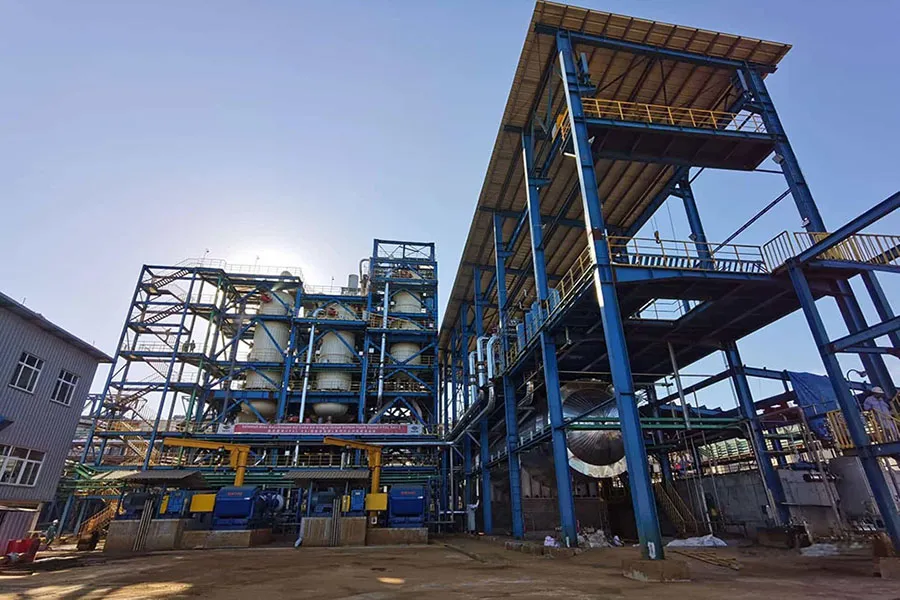
Caso: Transferência de Lodo de Catalisador — Falha da Bomba de Parafuso Duplo Devido a Desgaste Abrasivo
Aplicação: Uma planta petroquímica no Oriente Médio estava transferindo um lodo de catalisador gasto de um reator para um sistema de filtração. O lodo consistia em líquido hidrocarboneto (viscosidade ~150 cSt a 80°C) com partículas de catalisador suspensas (sílica-alumina, 5–15% em peso, tamanho de partícula 10–200 μm). O requisito de pressão de descarga era de 8 bar a 30 m³/h.
Seleção Original da Bomba — Parafuso Duplo:
A bomba original era uma bomba de parafuso duplo selecionada pelo contratante EPC com base nos requisitos de vazão e pressão. A especificação do contratante focou na capacidade da bomba de lidar com a pressão de descarga de 8 bar e a viscosidade de 150 cSt — ambas dentro da faixa nominal do parafuso duplo. A presença de sólidos de catalisador foi observada nos dados do processo, mas não foi sinalizada como uma restrição de seleção da bomba.
Parâmetros originais da falha:
- Bomba: Parafuso duplo, sincronizada externamente, carcaça de ferro fundido
- Vazão nominal: 30 m³/h a 8 bar
- Temperatura de operação: 80°C
- Cronograma de falhas: A vazão começou a diminuir após aproximadamente 8 semanas de operação; na semana 12, a vazão havia caído abaixo de 20 m³/h e a bomba foi removida de serviço
- Resultados da inspeção: As pás do parafuso apresentavam ranhuras profundas e desgaste abrasivo; as folgas da carcaça haviam aumentado além da tolerância máxima permitida pelo fabricante; as engrenagens de sincronismo mostravam sinais de sobrecarga devido ao aumento do torque do contato parafuso-carcaça
- Consequência: Parada não planejada de 72 horas para substituição da bomba; falha repetida da bomba de parafuso duplo de substituição após um intervalo semelhante; perdas de produção estimadas em $45.000 por incidente
Análise das causas fundamentais pelos engenheiros da Changyu Pump:
O projeto sem contato da bomba de parafuso duplo depende de folgas precisas entre os parafusos e a carcaça — tipicamente na faixa de 50–200 μm dependendo do tamanho da bomba. As partículas de catalisador (10–200 μm) estavam dentro da faixa de tamanho que poderia entrar e desgastar essas folgas. Com uma carga de sólidos de 5–15%, a taxa de desgaste abrasivo é acelerada proporcionalmente à concentração de partículas — concentrações mais altas dentro desta faixa levariam a falha para o extremo de 8 semanas do cronograma observado, enquanto concentrações mais baixas para o extremo de 12 semanas. À medida que as partículas passavam entre as pás do parafuso e a carcaça, atuavam como um composto de retificação, desgastando progressivamente ambas as superfícies. Uma vez que a folga aumentava além do limite de projeto, o vazamento interno (escorregamento) aumentava drasticamente, reduzindo a eficiência volumétrica e a vazão de descarga.
A bomba de parafuso duplo havia sido selecionada para a pressão e viscosidade corretas — mas para a condição de sólidos errada. Este tipo de bomba é fundamentalmente incompatível com serviço de partículas abrasivas.
Solução de bombagem Changyu:
- Substituiu a bomba de parafuso duplo por uma bomba de parafuso simples Changyu tipo G classificada para 30 m³/h a 8 bar
- Estator: NBR (nitrílico) — compatível com o líquido hidrocarboneto a 80°C, com boa resistência à abrasão para as partículas de catalisador
- Rotor: Cromado duro para resistência adicional à abrasão
- Motor: 15 kW, 480 r/min — a baixa velocidade de operação minimiza a taxa de desgaste abrasivo
- Instalou um sensor de temperatura do estator para proteção contra funcionamento a seco
- Filtro de sucção com malha de 500 μm para evitar que grandes aglomerados entrassem na bomba
Resultados após a instalação:
- Vazão estável em 28–32 m³/h mantida por mais de 14 meses antes da primeira inspeção programada do estator
- O estator apresentou desgaste abrasivo esperado aos 14 meses — substituído como manutenção planejada com aproximadamente 48 horas de parada programada
- Zero paradas não planejadas relacionadas à bomba nos primeiros 24 meses de operação
- Com base nos resultados da primeira inspeção do estator, o intervalo de substituição do estator foi estimado em 14–16 meses sob condições normais de operação
- A planta converteu três serviços adicionais de transferência de catalisador de bombas de parafuso duplo para bombas de parafuso simples no ano seguinte
Conclusão principal deste caso:
A seleção da bomba deve considerar todas as características do fluido — não apenas vazão e pressão. O teor de sólidos é uma restrição rígida para bombas de parafuso duplo. Partículas de catalisador, areia ou qualquer sólido abrasivo destruirá as folgas de precisão que fazem uma bomba de parafuso duplo funcionar. Para qualquer aplicação com teor de sólidos acima de níveis residuais, a bomba de parafuso simples é a configuração correta, independentemente de quão bem os parâmetros de pressão e vazão se alinhem com as especificações do parafuso duplo. A diferença de custo inicial é irrelevante quando a alternativa é a substituição da bomba a cada 12 semanas.
Quais São os Produtos de Bomba de Parafuso da Changyu Pump?
A Changyu Pump fabrica a bomba de parafuso simples tipo G — uma bomba de deslocamento positivo rotativa projetada especificamente para aplicações de alta viscosidade, com alto teor de sólidos e sensíveis ao cisalhamento. A série tipo G é projetada para as condições operacionais exigentes onde as bombas de parafuso simples superam as alternativas de parafuso duplo: fluidos abrasivos, lodos fibrosos e meios de ultra-alta viscosidade.
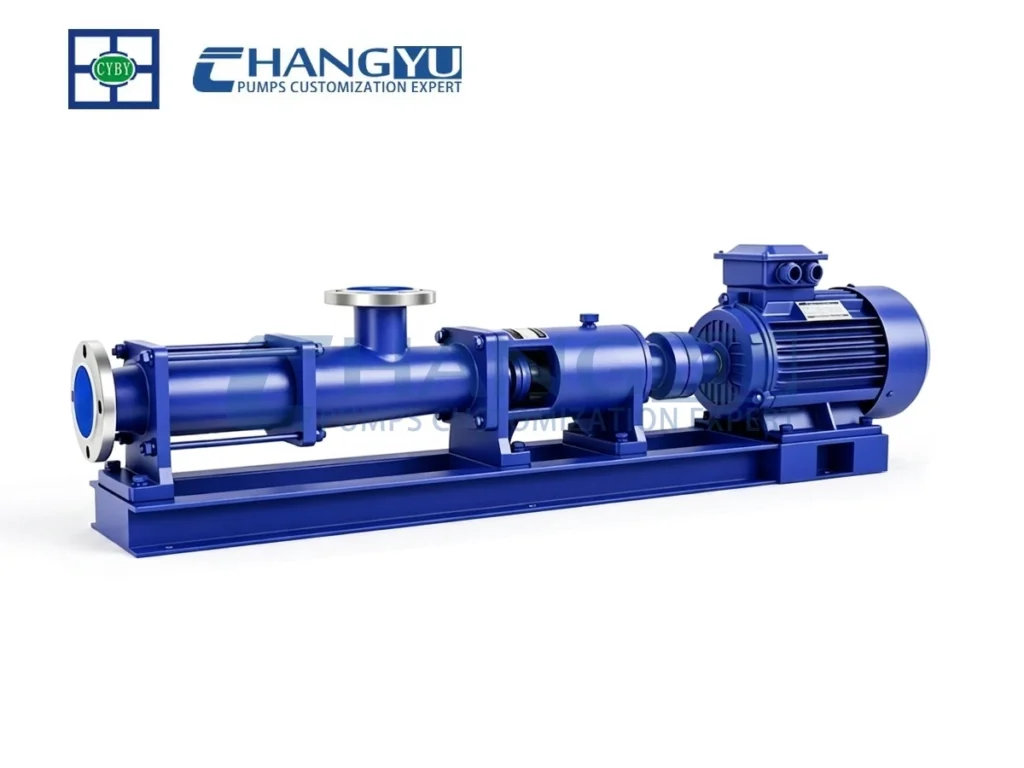
O que diferencia a série Changyu tipo G é a combinação de uma faixa de velocidade de 400–960 r/min — deliberadamente baixa para prolongar a vida útil do estator em serviço abrasivo — e a disponibilidade de todos os quatro principais elastômeros de estator (NBR, EPDM, FKM, PTFE) de uma única fonte de fabricação. Isso elimina o risco de compatibilidade com múltiplos fornecedores e garante que o elastômero correto esteja sempre disponível para seu ambiente químico específico.
Especificações da Bomba de Parafuso Único Tipo G da Changyu
Tabela: Especificações Técnicas da Bomba de Parafuso Tipo G
| Parâmetro | Especificação |
|---|---|
| Tipo de bomba | Parafuso único / cavidade progressiva |
| Gama de caudais | 0–200 m³/h |
| Gama de cabeças | 60–120 m (dependendo do modelo e dos estágios do estator) |
| Potência do motor | 0,55–37 kW |
| Gama de velocidades | 400–960 r/min |
| Temperatura média | -20°C a 150°C |
| Materiais do corpo personalizáveis | Ferro fundido, aço inoxidável |
| Elastômeros do estator disponíveis | NBR, EPDM, FKM, PTFE |
Ver as especificações do produto Bomba de Parafuso Tipo G da Changyu →
Perguntas Frequentes sobre Bombas de Parafuso Duplo vs Parafuso Simples
P: Qual é a principal diferença entre uma bomba de parafuso simples e uma de parafuso duplo?
R: Uma bomba de parafuso simples usa um rotor em um estator elastomérico com ajuste por interferência. Uma bomba de parafuso duplo usa dois parafusos metálicos sem contato sincronizados por engrenagens externas. Esta diferença fundamental de projeto impulsiona todas as distinções de desempenho — manuseio de gás, tolerância a sólidos, capacidade de pressão e perfil de manutenção.
P: Quando devo escolher uma bomba de parafuso duplo em vez de uma bomba de parafuso simples?
R: Escolha uma bomba de parafuso duplo quando seu fluido contiver mais de 20% de gás arrastado, exigir pressão de descarga acima de 12 bar, ou for limpo com viscosidade moderada e você quiser eliminar os custos de substituição do estator. Bombas de parafuso duplo também são preferidas para aplicações com risco de funcionamento a seco intermitente.
P: Por que uma bomba de parafuso duplo é melhor para aplicações multifásicas?
R: Bombas de parafuso duplo usam parafusos sem contato, então bolsões de gás passam sem causar danos ou perda de escorva. Bombas de parafuso simples dependem do líquido bombeado para lubrificar e resfriar a interface rotor-estator — o gás desloca esse fluido, causando superaquecimento e degradação rápida do estator. Para frações de gás acima de 20%, a bomba de parafuso duplo é a escolha necessária.
P: Uma bomba de parafuso duplo pode lidar com sólidos?
R: Não. Bombas de parafuso duplo exigem fluidos limpos. Partículas abrasivas erodem as folgas de precisão entre os parafusos e a carcaça. Mesmo partículas finas na faixa de 50–200 μm podem causar desgaste progressivo. Para fluidos com sólidos, uma bomba de parafuso simples é a escolha correta.
P: Qual bomba tem menores custos de manutenção?
R: Depende da aplicação. Bombas de parafuso simples exigem substituição previsível do estator a cada 6 meses a 3+ anos. Bombas de parafuso duplo exigem manutenção do engrenamento de sincronismo e rolamentos a cada 2–5 anos. Em serviço abrasivo, bombas de parafuso simples são muito mais baratas de manter. Em serviço limpo com alto teor de gás, bombas de parafuso duplo evitam falhas do estator induzidas por gás.
P: Posso substituir uma bomba de parafuso simples por uma bomba de parafuso duplo?
R: Apenas se o fluido estiver livre de sólidos abrasivos e fibras. Verifique o teor de sólidos, tamanho de partícula e dureza do material antes de considerar uma troca. Instalar uma bomba de parafuso duplo em um serviço anteriormente tratado por uma de parafuso simples geralmente requer a adição de filtração a montante.
P: Qual bomba lida com maior viscosidade?
R: Bombas de parafuso simples lidam com viscosidades superiores a 1.000.000 cSt. Bombas de parafuso duplo são tipicamente limitadas a 100.000 cSt. Para fluidos de ultra-alta viscosidade, como petróleo bruto pesado ou lodo desaguado, a bomba de parafuso simples é a escolha correta.
Lista de verificação de prevenção do engenheiro de bombas da Changyu
Com base em mais de 20 anos de experiência de campo especificando, instalando e resolvendo problemas em bombas de parafuso, os engenheiros da Changyu Pump recomendam a seguinte disciplina de seleção:
- Não selecione um tipo de bomba baseado apenas em vazão e pressão. Teor de sólidos, fração de gás e tamanho de partícula são restrições rígidas. Uma bomba de parafuso duplo que corresponde à sua vazão e pressão, mas falha em sólidos, ficará fora de serviço em semanas.
- Meça o teor de gás nas condições de entrada da bomba, não no vaso de origem. O gás se expande à medida que a pressão cai na linha de sucção. O que começa como 5% de gás no tanque pode ser 25% na entrada da bomba. Se o gás na entrada exceder 20%, favoreça fortemente uma bomba de parafuso duplo.
- Para fluidos abrasivos, selecione uma bomba de parafuso simples e especifique um rotor cromado duro. O custo adicional do cromagem é recuperado muitas vezes ao longo da vida estendida do rotor e estator.
- Não presuma que uma bomba de parafuso duplo é “melhor” porque custa mais. Bombas de parafuso duplo e simples são ferramentas diferentes otimizadas para diferentes janelas operacionais. A bomba certa corresponde ao seu fluido, não ao seu orçamento.
- Instale proteção contra funcionamento a seco em cada bomba de parafuso, independentemente do tipo. Mesmo bombas de parafuso duplo com capacidade limitada de funcionamento a seco eventualmente sofrerão danos sem fluido. Um interruptor de vazão e um sensor de temperatura do estator fornecem proteção essencial.
- Quando sólidos estiverem presentes, verifique o tamanho e a dureza das partículas antes da seleção da bomba. Partículas abaixo de 100 μm ainda podem abrasar as folgas do parafuso duplo se forem mais duras que os materiais da bomba. Solicite uma análise de partículas se estiver em dúvida.
- Planeje a substituição do estator como manutenção programada, não como reparo de emergência. O monitoramento de vazão em velocidade constante fornece aviso prévio de desgaste do estator. Agende a substituição quando a vazão cair 10% abaixo da linha de base.
- Mantenha um estator sobressalente e um selo mecânico em estoque para bombas de parafuso simples críticas. Para bombas de parafuso duplo, mantenha um selo mecânico sobressalente e um conjunto de engrenagens de sincronismo. O custo de manutenção é mínimo comparado ao custo de tempo de inatividade prolongado.
Conclusão
A escolha entre uma bomba de parafuso simples e uma bomba de parafuso duplo não é uma questão de qual bomba é “melhor” — é uma questão de qual bomba corresponde às três características definidoras do seu fluido: teor de gás, teor de sólidos e pressão. Quando o gás excede 20% ou a pressão excede 12 bar, a bomba de parafuso duplo é a escolha necessária. Quando sólidos ou abrasivos estão presentes, a bomba de parafuso simples é a única opção viável. Quando o fluido é limpo com viscosidade e pressão moderadas, ambas as bombas podem funcionar — e a decisão muda para a comparação de TCO.
A recomendação definitiva da equipe de engenharia da Changyu Pump: não deixe que o preço de compra ou percepções de sofisticação tecnológica conduzam a decisão entre simples e duplo. Deixe que as características do seu fluido ditem o tipo de bomba. Gás e sólidos são restrições rígidas — ignore-as ao custo de falha repetitiva da bomba. Se seu fluido contiver sólidos, especifique uma bomba de parafuso simples. Se contiver gás significativo, especifique uma bomba de parafuso duplo. Se contiver ambos, entre em contato com nossa equipe de engenharia para uma avaliação detalhada de suas condições específicas.
Quando você estiver pronto para selecionar a bomba de parafuso certa para seu processo, a equipe de engenharia da Changyu Pump pode fornecer uma avaliação técnica gratuita — incluindo uma análise de características do fluido, recomendação de tipo de bomba e projeção de TCO de 5 anos para seus parâmetros operacionais. Com mais de 20 anos de experiência em fabricação, um inventário completo de elastômeros de estator (NBR, EPDM, FKM, PTFE) e fabricação em conformidade com API 676, garantimos que sua seleção seja tecnicamente correta desde o primeiro dia.
Contacte os engenheiros da Changyu Pump para uma avaliação técnica gratuita →