
At a glance: An inline pump has suction and discharge connections on the same centreline. For sump duty, an external installation also needs adequate suction conditions and a reliable priming arrangement. Inline geometry alone does not establish suitability for suction lift, solids, corrosive liquids or an intermittently empty pit.
The term "inline sump pump" is used for several different products, including circulators, dry-mounted transfer pumps and backup drainage units. In this guide, we use it for an industrial dry-mounted inline centrifugal pump connected to a sump. We explain how that arrangement compares with submersible and vertical semi-submerged designs, and what to confirm before specifying one.
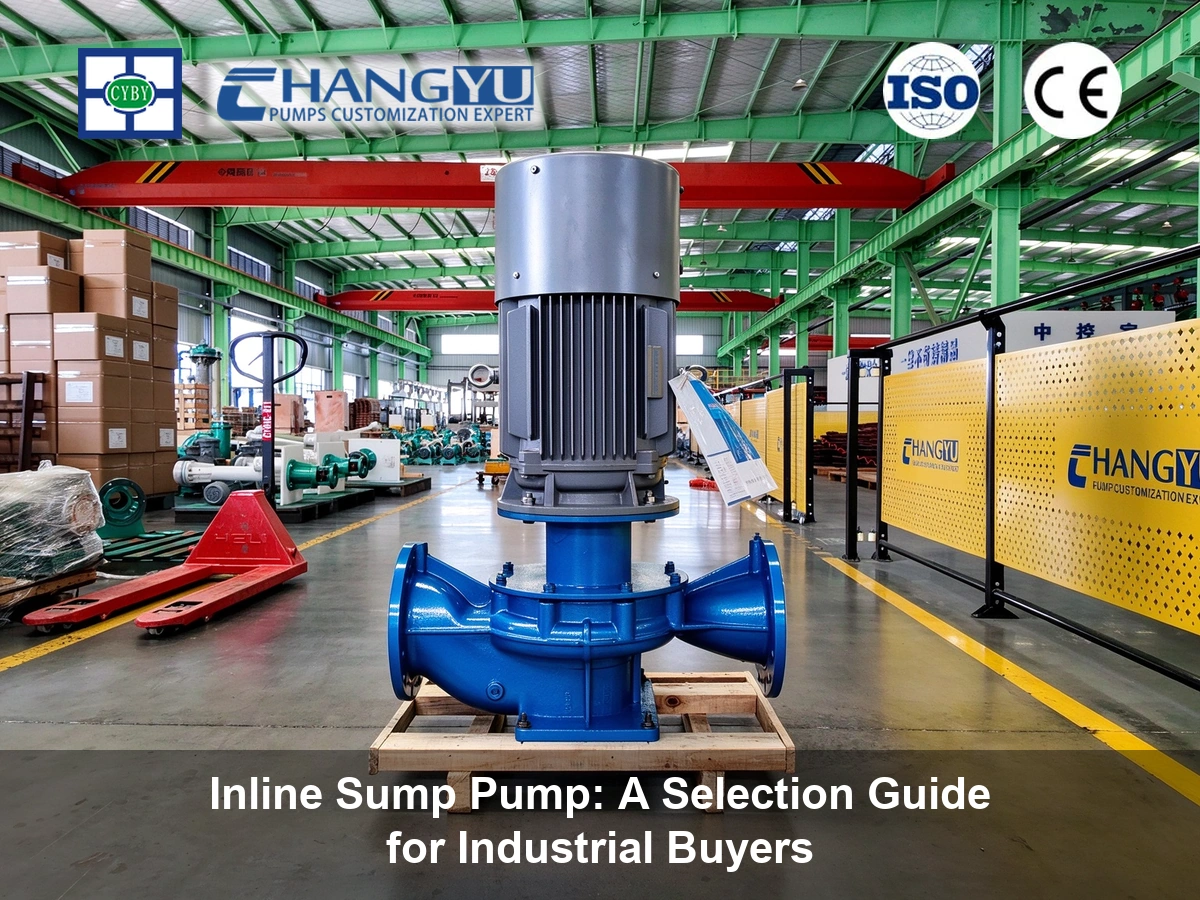
What Is an Inline Sump Pump?
An inline pump is defined by its nozzle arrangement: suction and discharge connections share a centreline. That can simplify a pipe run, but the liquid still changes direction inside many inline casings. The geometry does not, by itself, guarantee lower friction or establish a particular sump arrangement.
For the sump arrangement discussed here, the pump is installed outside the liquid and connected to a suction pipe from the pit. It may have flooded suction if placed below the minimum liquid level, or suction lift if installed above it. The motor stays dry, but priming and NPSH must be assessed separately.
Other options include a fully submersible unit, with motor and hydraulics in the pit, or a vertical semi-submerged design, with the motor above the liquid and the hydraulic section immersed. A light-duty pedestal sump pump is another category and should not be confused with an industrial long-shaft chemical pump.
Inline, submersible and vertical semi-submerged: a comparison
| Criterio | Dry-mounted inline | Fully submersible | Vertical semi-submerged |
|---|---|---|---|
| Motor location | Outside the sump | Submerged with the pump | Above the liquid |
| Suction arrangement | Flooded suction or a checked suction lift | Immersed inlet | Immersed hydraulic section |
| Acceso para mantenimiento | Floor-level access with isolation and drainage | Often retrieved by guide rails or lifting gear | Motor accessible; wet-end service may need lifting |
| Manejo de sólidos | Depends on the specified hydraulic design | Solids-handling models available | Depends on impeller and passage design |
| Corrosion exposure | Wetted end and auxiliaries | Wetted end, motor housing and cable system | Immersed components and tank interface |
| Priming | Required for suction lift unless a suitable priming system is provided | Normally not required while immersed | Normally not required while immersed |
| Main checks | NPSH, priming and dry-run protection | Materials, seals, cable and motor cooling | Shaft support, immersion depth and tank containment |
For a broader treatment of sump pump types, materials, and duty cycles, our industrial sump pump guide covers the category in more depth.
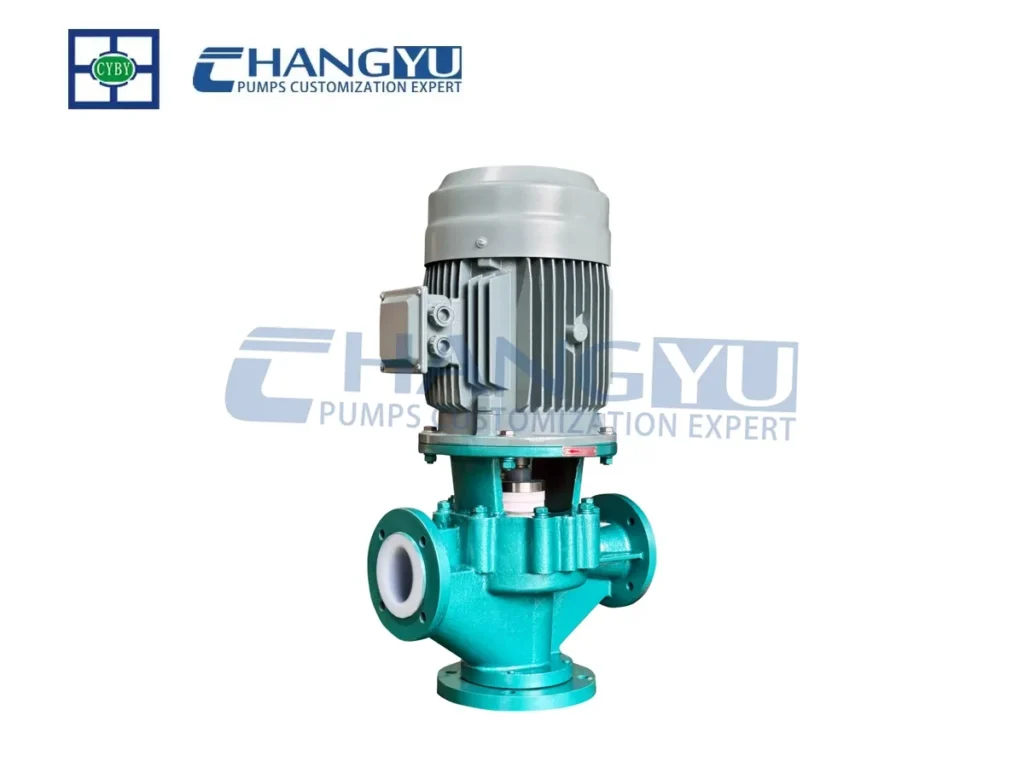
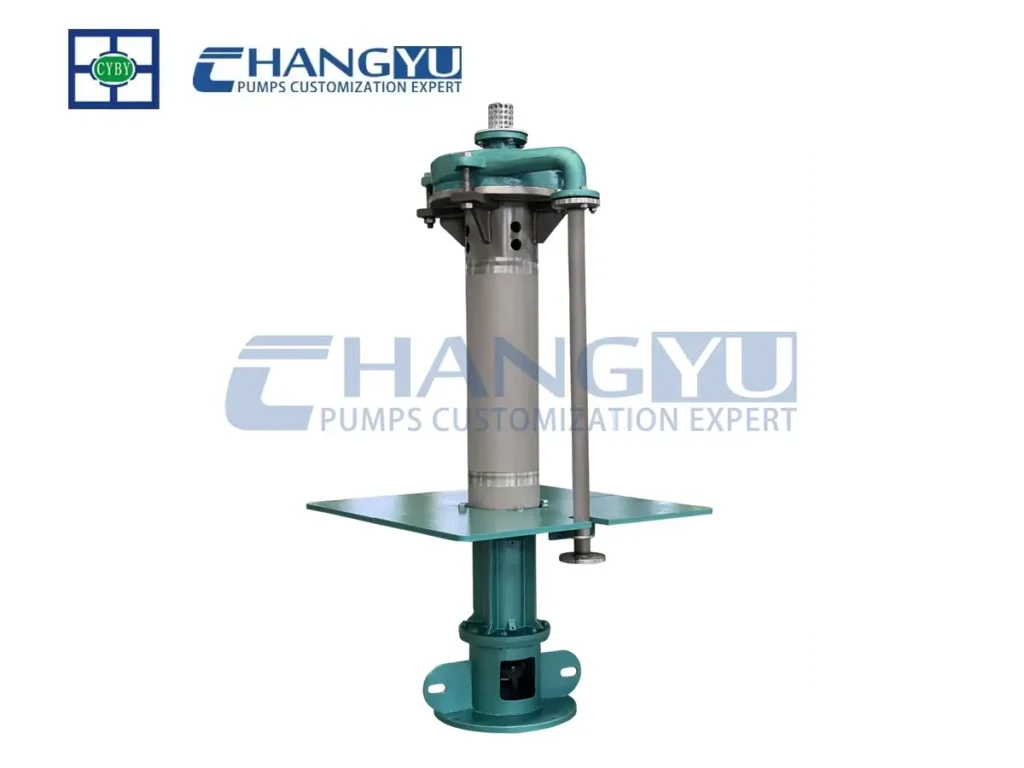
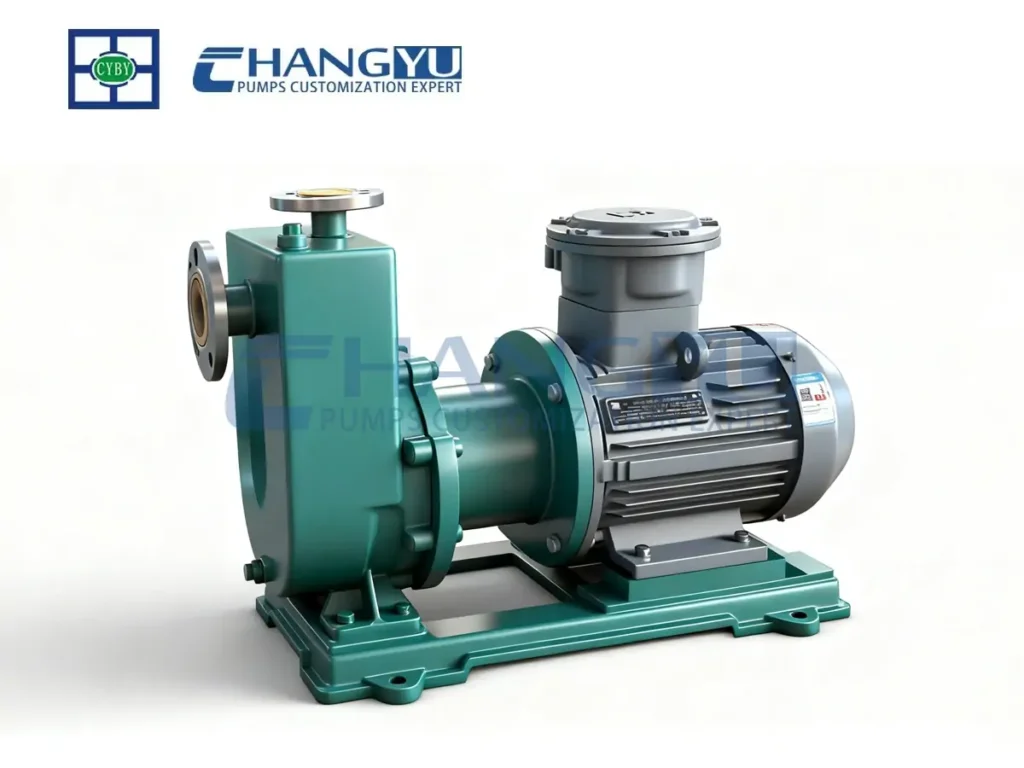
The CYL inline, FY immersed and CQZ self-priming designs below illustrate different installation routes. FY and CQZ are alternatives to review against the pit and liquid conditions; they do not share the CYL inline nozzle arrangement.
Where an Inline Sump Pump Makes Sense — and Where It Doesn't
Good fit: aggressive liquids and frequent service
A dry-mounted layout can be useful when an accessible motor and seal arrangement are priorities, especially for hot or corrosive liquids. Suitable submersible pumps also exist for demanding duties; compare each unit’s material, temperature and containment limits rather than assuming the layout alone decides suitability.
Service access is another reason to consider a dry-mounted layout. Isolation, drainage and seal inspection can often take place at floor level. Submersible units on guide rails may also be retrieved without pit entry. Where entry is required, apply the site’s confined-space procedure and, where relevant, OSHA 1910.146.
The third case is when the pit is remote or the liquid is valuable. A dry-mounted pump with an accessible suction strainer and a visible pressure gauge is far easier to monitor than a unit sitting under a metre of process fluid.
Poor fit: solids, slurry, and deep-set pits
Many standard inline pumps are intended for clean liquids or limited suspended solids. Grit, rags, fibres and settled sludge require a pump with a confirmed solids-passage and wear specification. Depending on the liquid, a non-clog submersible, vertical solids-handling or suitable self-priming pump may be a better choice.
Suction lift becomes more difficult as the pit level falls or the liquid temperature rises. There is no universal 6–7 m operating limit: atmospheric pressure, liquid vapour pressure, suction losses and the selected NPSH requirement determine the available lift. For deep pits, a bomba semisumergida places the impeller in the liquid and avoids the external suction-lift arrangement.
A third limitation is priming. Inline centrifugal pumps are not self-priming unless specifically built that way. If the suction line can drain back between cycles, you need a foot valve, a priming chamber, or a suitable bomba autocebante design. Confirm the priming method and low-level protection before the installation is approved.
Six Parameters That Decide Whether Your Inline Sump Pump Works
1. Flow rate and total dynamic head
Calculate total dynamic head from the difference between the source and destination pressures and levels, plus pipe and fitting losses at the required flow. Plot the system curve against the pump curve for minimum and maximum pit levels. Underestimating losses can leave the pump short of flow; a lower-than-expected system resistance can cause excessive flow and motor loading.
2. Suction conditions and NPSH margin
Calculate available NPSH at the lowest operating liquid level, highest liquid temperature and most demanding flow. Compare it with the selected pump’s requirement across the operating range and agree an application-specific margin with the manufacturer. A fixed 1 m allowance does not cover every volatile or hot-liquid duty. The Hydraulic Institute provides NPSH and operating-region guidance.
3. Wetted materials
Match the wetted materials to the liquid composition, concentration and temperature. Neither 304 nor 316L is a universal chemical-wastewater grade; chlorides, acids, oxidisers and contamination can change the result. A bomba revestida de flúor may be appropriate where compatible linings offer a better route. A bomba de accionamiento magnético addresses the shaft-seal arrangement, but still needs a separate material check.
4. Shaft sealing and motor protection
A sump-duty mechanical seal may experience frequent starts, abrasive fines or loss of liquid. Select seal faces, secondary seals and any flush or barrier system for those conditions. A magnetic drive removes the dynamic shaft seal, while static containment and dry-run protection remain necessary. Provide appropriate motor and low-level protection for the selected arrangement.
5. Control philosophy and redundancy
Level control by float, conductivity probe, or ultrasonic; alternation between duty and standby units; high-level alarm independent of the control loop. We specify the alarm on a separate circuit because a single failed float should not be able to both stop the pump and silence the warning. For critical pits, duty/standby with automatic alternation is standard practice, not a premium option.
6. Footprint, piping and service access
Inline geometry saves space in the pipe run, but the installation still needs a suction line, an isolation valve, a non-return valve, a drain point, and enough clearance to withdraw the rotating element. We have seen units installed so tightly against a wall that the seal could not be changed without cutting pipe. Lay it out on paper before you pour the plinth.
Material and Sealing Options for Aggressive Media
At Chuangyu Pump, we compare the liquid data with the material and installation options in our bomba centrífuga de acero inoxidable and lined ranges. FY and FYH vertical immersed designs are alternatives for suitable tank and pit duties; they are not examples of inline nozzle geometry or fully submerged motors. We confirm the actual arrangement, immersion depth and operating limits with the quotation.
Material cost needs to be assessed alongside corrosion life, inspection access and replacement downtime. A lower purchase price offers little benefit if the selected material cannot withstand the actual liquid.
For compatible chemical liquids, we can also compare an immersed FY layout with an external CQZ self-priming magnetic-drive layout. The videos show their physical arrangements; material compatibility, minimum liquid level, priming and dry-run protection still need a duty-specific review.
FY vertical immersed pump
CQZ self-priming magnetic pump
Installation Mistakes We See Most Often
The failures we are asked to diagnose cluster into a short list. Loss of prime because the suction line was never filled or the foot valve leaked. Air entrainment from a suction inlet too close to the liquid surface, producing a pump that runs but never builds head. A suction line one size too small, creating cavitation that gets blamed on the pump. Discharge pipework rigidly connected with no flexibility, so thermal movement loads the casing. And a low-level cutout set below the actual minimum submergence, so the pump runs dry on every cycle.
These symptoms can result from system layout, installation, wear or equipment damage. We ask for a pit drawing, liquid data and operating records so the cause can be checked before recommending a replacement.
What to Verify Before You Approve a Manufacturer
Ask for the hydraulic test curve for the specific unit, not a generic family curve. Ask which standards the casing and flange dimensions follow, and whether third-party inspection is accepted. Ask what the factory does between casting and dispatch — our quality control process covers dimensional checks, hydrostatic and performance testing, and material certification, and we will share the inspection records on request.
Ask us for the documentation relevant to your selected configuration, including the material schedule, agreed test scope, applicable certificates and service requirements. Our completed projects provide broader application references. The quotation should state the operating limits and the checks still needed before manufacture.
Preguntas frecuentes
¿Es una bomba de sumidero en línea lo mismo que una bomba de sumidero sumergible?
No. Una bomba de sumidero totalmente sumergible tiene un motor estanco diseñado para funcionar dentro del líquido. La configuración en línea de instalación en seco descrita en esta guía mantiene la bomba y el motor fuera del líquido y se conecta al sumidero mediante una tubería de aspiración. El término «en línea» describe la disposición de las bocas de aspiración e impulsión; no exige que el motor se sitúe sobre el foso ni implica que la bomba sea autocebante.
Can an inline pump be used in a sump pit?
A dry-mounted inline unit can serve a sump if its hydraulic design, suction conditions, priming system and materials suit the duty. The pump remains outside the pit. Solids-bearing liquid requires a confirmed solids-passage and wear specification.
What suction lift can an inline sump pump handle?
Calculate the limit from atmospheric or vessel pressure, liquid level, vapour pressure, suction losses and the pump’s NPSH requirement. A practical value for cold water cannot be transferred directly to hot or volatile chemicals. Deep or variable-level pits may favour an immersed arrangement.
Do I need a foot valve?
If the line can drain back, provide a compatible foot valve or another confirmed priming arrangement. A foot valve adds suction loss and may foul in dirty liquid, so check it against the NPSH calculation and maintenance plan.
Which materials should I specify for a chemical sump?
It depends on the specific medium, concentration, and temperature. Send us the liquid analysis and operating conditions and we will propose a wetted material set with the reasoning behind it.
Talk to Us About Your Duty Point
If you are weighing an inline sump pump against a submersible or semi-submerged layout, send us the pit dimensions, liquid analysis, required flow, and discharge conditions. We will come back with a configuration recommendation and a curve — including the case where a different pump type is the better answer. You can reach our engineering team through the página de contacto, or browse the full product range y nuestro completed projects first.
Chuangyu Pump options for different sump arrangements
These pumps represent three different installation routes. CYL has the inline nozzle arrangement; FY and CQZ are alternatives when immersion or self-priming better suits the pit. We select the layout from the liquid, minimum level and suction conditions.
Bomba centrífuga vertical en línea serie CYL
Bomba sumergible vertical – Serie FY de acero inoxidable
Bomba autocebante de acero inoxidable de la serie CQZ
Discuss your pump duty with our team
Send us the pit dimensions, minimum and maximum liquid levels, liquid composition and temperature, solids content, required flow and discharge conditions. A suction-piping sketch helps us compare inline, immersed and self-priming arrangements.
Correo electrónico: [email protected]
TEL/WA: +86-13651913727
Inside Anhui Chuangyu Pump’s factory
Watch our official CHANGYU PUMP company introduction for a look inside our manufacturing facility and pump production.