
Краткий ответ
A corrosive sludge pump
for
очистка сточных вод moves sludge that contains both abrasive solids and chemically aggressive liquids — acidic industrial effluent, alkaline process waste, or saline wastewater mixed with sand, grit, and fibrous debris. Standard pumps fail rapidly in this dual-threat environment. Key selection factors:
- Material selection is the primary defense
: Standard cast iron corrodes in acidic or alkaline sludge. Stainless steel resists corrosion but wears rapidly from abrasive solids. UHMW-PE lined pumps provide the optimal balance — the polymer lining resists acids, alkalis, and salts while the steel casing provides structural strength. For severe corrosion with fine solids, fluoroplastic-lined pumps offer universal chemical resistance.
. - Impeller design determines clog resistance
: Sludge contains rags, fibers, plastic debris, and stringy material. Closed impellers trap this debris and clog. Semi-open impellers allow solids to pass through while maintaining efficiency. Vortex impellers provide maximum clog resistance for the most debris-laden sludge.
. - Solids concentration dictates pump specification
: Thin sludge below 5% solids can use standard wastewater pumps. Thickened sludge above 15% solids requires pumps designed for high-density slurry — with wide flow passages, wear-resistant materials, and sufficient motor power for viscous flow.
.
Wastewater treatment plants handle an increasingly complex mix of domestic sewage and industrial effluent. When manufacturing facilities discharge acidic, alkaline, or saline waste into the collection system, the resulting sludge is not just abrasive — it is chemically aggressive. A standard sludge pump specified for neutral municipal sewage can fail within months in this environment, its cast iron casing corroding from the inside while abrasive grit erodes the impeller.
.
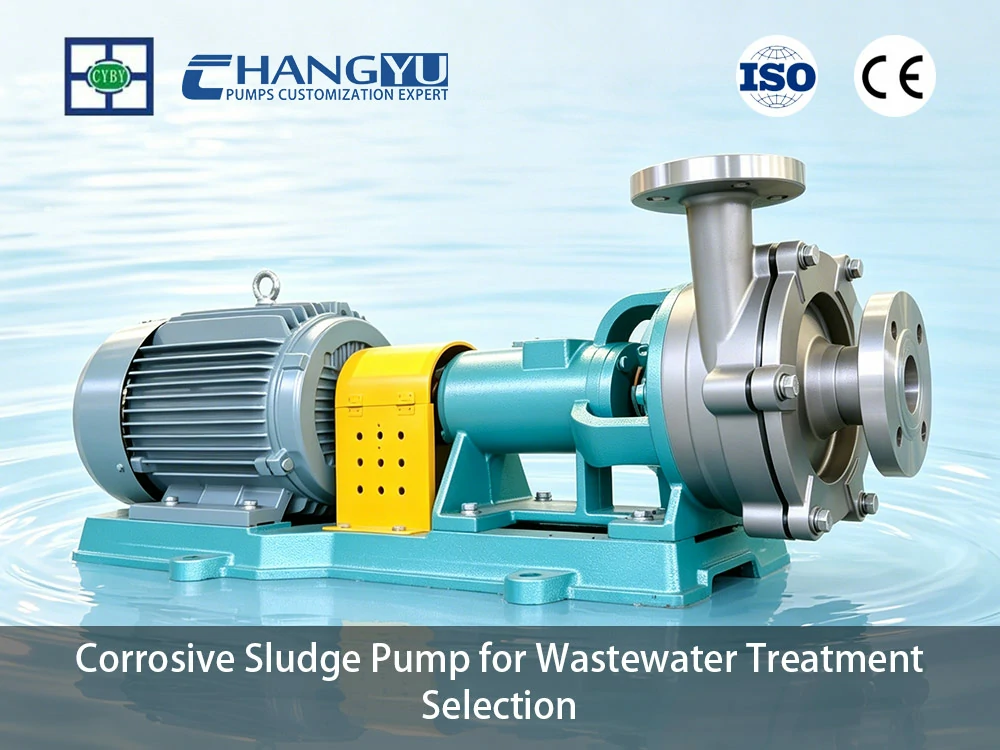
After reading this guide, you will understand the failure mechanisms that destroy standard pumps in corrosive sludge, which materials provide reliable long-term corrosion and wear resistance, how to select an impeller that resists clogging, and how to size a pump for your specific sludge characteristics. With over 20 years of pump manufacturing experience, Changyu Pump presents this selection guide for corrosive sludge applications.
.
What Is a Corrosive Sludge Pump?
A corrosive sludge transfer pump moves wastewater treatment sludge that contains both suspended solids and chemically aggressive liquids. This distinguishes it from a standard sewage pump, which is designed for neutral-pH municipal wastewater, and from a chemical pump, which handles corrosive liquids but is not designed for abrasive solids.
.
Where Corrosive Sludge Originates
Corrosive sludge is generated throughout the wastewater treatment process:
- Primary sludge
: Settled solids from primary clarifiers. Corrosive when the incoming wastewater contains industrial effluent — acidic from metal finishing plants, alkaline from food processing, saline from chemical manufacturing.
. - Secondary (waste activated) sludge
: Biological solids from the activated sludge process. Corrosive when industrial nutrients or pH adjustment chemicals alter the biological environment.
. - Химический осадок: Precipitated solids from chemical treatment processes — phosphorus removal (ferric chloride, alum), heavy metal precipitation (lime, sulfide), or neutralization. These sludges are inherently corrosive due to residual treatment chemicals.
. - Digested sludge
: Anaerobically or aerobically digested biosolids. Corrosive due to organic acids, hydrogen sulfide, and ammonia generated during digestion.
.
Why Standard Sewage Pumps Fail
A standard sewage pump is designed for grit and rags — not for acid. When corrosive sludge enters a cast iron pump, the acid attacks the metal surface, creating a rough, porous layer. Abrasive grit then scours this weakened surface, accelerating material loss. The combined corrosion-erosion mechanism removes metal far faster than either mechanism alone. Within months — sometimes weeks — the pump casing, impeller, and wear plates are worn beyond serviceable limits.
.
Why Standard Pumps Fail in Corrosive Sludge?
The failure of standard pumps in corrosive sludge follows a predictable pattern driven by the synergy between chemical corrosion and mechanical wear.
.
The Corrosion-Erosion Synergy
| Failure Mechanism | Effect on Standard Pump | Typical Time to Failure |
|---|---|---|
| Acid attack on cast iron | Uniform surface corrosion; metal loss from casing and impeller | 3–6 months for pH < 5 |
| Chloride pitting on stainless steel | Localized deep pits at crevices and stagnant zones | 6–12 months for 316L in high-chloride sludge |
| Abrasive wear from sand and grit | Impeller vane thinning; volute cutwater erosion | 6–18 months depending on grit content |
| Combined corrosion + erosion | Corroded surface scoured by grit — 3–5× faster material loss than either alone | 2–6 months in severe conditions |
Инженеры Changyu Pump отмечают: The most common failure pattern in industrial wastewater treatment plants is the rapid destruction of cast iron sludge pumps handling acidic primary sludge. The cast iron casing corrodes from pH 4–5 sludge while sand and grit erode the softened metal surface. A pump that would last 10 years in neutral municipal sludge fails within 3–4 months. For the majority of corrosive sludge applications, the solution is not a more expensive metal alloy — it is a non-metallic or lined pump construction that eliminates the corrosion mechanism entirely. For extreme abrasion with coarse solids above 30%, duplex stainless steel may be considered.
.
What Materials Are Compatible with Corrosive Sludge?
Material selection for corrosive sludge service must address both the chemical environment and the abrasive solids. No single metallic material excels at both.
.
Sludge Pump Material Comparison
| Материал | Acid Resistance (pH 2–5) | Alkali Resistance (pH 10–12) | Chloride Resistance | Устойчивость к истиранию | Лучшее приложение |
|---|---|---|---|---|---|
| Чугун | Poor — corrodes rapidly | Умеренный | Бедный | Умеренный | Neutral municipal sludge only |
| Нержавеющая сталь 316L | Хорошо | Хорошо | Moderate — pitting above 500 mg/L Cl⁻ | Poor — soft, wears quickly | Thin, clean corrosive liquids; not for abrasive sludge |
| Дуплексная нержавеющая сталь 2205 | Хорошо | Excellent — highly resistant to alkaline environments 5. Corrosive sludge with low to moderate grit 6. Excellent — inert to most acids; not recommended for strong oxidizing acids (concentrated nitric, concentrated sulfuric) or organic solvents at elevated temperatures 7. Excellent — high abrasion resistance 8. Corrosive sludge with high solids — the optimal balance 9. FEP/PFA Lined 10. Universal — resists all acids 11. Universal 12. Moderate — best for fine solids 13. Strong acids, solvents, high-purity applications 14. Material Selection by Sludge Type 15. Sludge Type 16. Typical pH 17. Acidic primary sludge (industrial) 18. 3–6 19. 2–8% 20. Acid resistance + abrasion resistance 21. Alkaline chemical sludge (lime treatment) 22. 5–15% 23. Alkali resistance + handles high solids 24. Saline sludge (coastal, industrial) 25. 2–6% 26. UHMW-PE lined or duplex 2205 27. Chloride resistance + moderate abrasion 28. Neutral municipal sludge 29. 2–10% 30. Cast iron (standard) or UHMW-PE lined for extended life 31. Standard materials acceptable; lined for longevity 32. Hot corrosive sludge (> 80°C) 33. High-temperature resistance beyond UHMW-PE limit (90°C) 34. For any corrosive sludge with pH below 5 or above 10 and solids content above 5%, a UHMW-PE lined pump is the optimal choice. The polymer lining eliminates the corrosion mechanism entirely — acids and alkalis have no effect on 35. . The material’s high abrasion resistance handles the sand, grit, and solid particles that wear through metal pumps. For extremely corrosive sludge with high temperature (> 90°C) or aggressive solvents, upgrade to an FEP or PFA fluoroplastic-lined pump. 36. 4. How to Prevent Clogging in Sludge Pumping? 37. Clogging is the most frequent operational problem in sludge pumping. The combination of fibrous material, plastic debris, and sticky biosolids creates a mixture that can block pump passages if the wrong impeller type is specified. 38. Impeller Type Clog Resistance Comparison 39. Poor — debris wraps around vanes 40. Narrow passages 41. Highest 42. Clean liquids only — not for sludge 43. Good — debris passes through 44. Wide passage; some recirculation 45. Moderate (50–65%) 46. Corrosive sludge with mixed solids — the preferred design 47. Vortex (recessed) impeller 48. Excellent — solids bypass impeller 49. Largest free passage 50. Lower (35–55%) 51. Raw sewage, stringy debris, unpredictable solids 52. Single-channel impeller 53. Moderate — single wide passage 54. Good for defined solids 55. Good (55–65%) 56. Screened sludge with known particle size 57. The Semi-Open Impeller Advantage 58. Semi-open impellers are the standard for corrosive sludge pumping because they balance three competing demands: 59. : The open vane design with a generous gap between the impeller and the volute allows fibrous material to pass through without wrapping. Unlike closed impellers, there are no confined spaces where debris can accumulate. 60. Wear tolerance 61. : As the impeller and volute wear, the clearance can be adjusted externally on many designs — restoring efficiency without replacing components. Closed impellers lose efficiency rapidly as internal clearances open. 62. : Semi-open impellers deliver higher efficiency than vortex designs while maintaining acceptable clog resistance. For continuous-duty sludge transfer, the energy savings over a vortex pump can be significant over the pump’s service life. 63. For corrosive sludge with solids content above 10% or containing fibrous debris, specify a semi-open impeller. The combination of clog resistance, wear tolerance, and efficiency provides the lowest total cost of ownership. Vortex impellers should be reserved for unscreened raw sewage or sludge with unpredictable large debris — the efficiency penalty is justified only when clog risk is the dominant concern. 64. 5. How to Select a Corrosive Sludge Pump for Wastewater Treatment? 65. Corrosive 66. sludge 67. pump selection follows a structured process from sludge characterization through material specification and pump sizing. 68. Step 1: Characterize the Sludge. 69. Measure the pH, chloride concentration, temperature, solids content, and identify any specific chemical constituents (sulfates, solvents, oils). Determine the maximum particle size and the presence of fibrous or stringy material. This information drives material selection and impeller choice. 70. Using the material compatibility guidance in Section 3, select the pump casing and impeller material based on the sludge’s chemical and abrasive characteristics. For the majority of corrosive sludge applications, UHMW-PE lined construction provides the optimal combination of chemical resistance and wear life. 71. Step 3: Select the Impeller Type. 72. Match the impeller design to the sludge’s solids characteristics using the comparison in Section 4. For most corrosive sludge applications with mixed solids, a semi-open impeller provides the best balance of clog resistance and efficiency. 73. Step 4: Specify the Seal Arrangement. 74. For corrosive sludge, the mechanical seal must resist both chemical attack and abrasion from fine particles. Double mechanical seals with an external barrier fluid provide the most reliable protection — the barrier fluid isolates the seal faces from the sludge while lubricating and cooling the seal. 75. Calculate the required flow rate and total dynamic head. Apply a viscosity correction for thickened sludge above 5% solids. Oversize the suction line for sludge above 10% solids to ensure adequate NPSH. Maintain a minimum flow velocity of 1.5 m/s in discharge piping to prevent solids settlement. 76. Sludge Pump Selection Matrix 77. Seal Arrangement 78. Acidic primary sludge 79. Alkaline chemical sludge 80. Saline industrial sludge 81. Semi-open or vortex 82. Neutral thickened sludge 83. 5–20% 84. Cast iron or UHMW-PE lined 85. Hot corrosive sludge 86. Double mechanical seal with high-temperature elastomers | Хорошо — PREN 33–36 | Умеренный | Коррозионный шлам с низким или умеренным содержанием абразива |
| Подкладка из UHMW-PE | Отлично — инертен к большинству кислот; не рекомендуется для сильных окисляющих кислот (концентрированная азотная, концентрированная серная) или органических растворителей при повышенных температурах | Превосходно | Превосходно | Отлично — высокая устойчивость к истиранию | Коррозионный шлам с высоким содержанием твердых частиц — оптимальный баланс |
| С футеровкой из FEP/PFA | Универсальный — устойчив ко всем кислотам | Универсальный | Универсальный | Умеренная — лучше всего для мелких твердых частиц | Сильные кислоты, растворители, применения с высокой чистотой |
Выбор материала по типу шлама
| Тип шлама | Типичный pH | Содержание твердых частиц | Рекомендуемый материал | Причина |
|---|---|---|---|---|
| Кислый первичный шлам (промышленный) | 3–6 | 2–8% | футеровкой из UHMW-PE | Кислотостойкость + устойчивость к истиранию |
| Щелочной химический шлам (известковая обработка) | 10-12 | 5–15% | футеровкой из UHMW-PE | Щелочестойкость + работа с высоким содержанием твердых частиц |
| Соленый шлам (прибрежный, промышленный) | 6-8 | 2–6% | Футерованный UHMW-PE или дуплекс 2205 | Устойчивость к хлоридам + умеренная устойчивость к истиранию |
| Нейтральный муниципальный шлам | 6-8 | 2–10% | Чугун (стандартный) или футерованный UHMW-PE для увеличенного срока службы | Стандартные материалы приемлемы; футеровка для долговечности |
| Горячий коррозионный шлам (> 80°C) | Переменная | 2–8% | Футеровка FEP/PFA | Высокотемпературная стойкость за пределами предела UHMW-PE (90°C) |
Инженеры Changyu Pump рекомендуют: Для любого коррозионного шлама с pH ниже 5 или выше 10 и содержанием твердых частиц выше 5%, насос с футеровкой UHMW-PE является оптимальным выбором. Полимерная футеровка полностью устраняет механизм коррозии — кислоты и щелочи не оказывают воздействия на UHMW-PE. Высокая устойчивость материала к истиранию позволяет справляться с песком, абразивными частицами и твердыми включениями, которые изнашивают металлические насосы. Для чрезвычайно коррозионного шлама с высокой температурой (> 90°C) или агрессивными растворителями перейдите на насос с фторопластовой футеровкой из FEP или PFA.
Как предотвратить засорение при перекачке шлама?
Засорение — наиболее частая эксплуатационная проблема при перекачке шлама. Сочетание волокнистого материала, пластикового мусора и липких биотвердых веществ создает смесь, которая может блокировать проходы насоса, если выбран неправильный тип рабочего колеса.
Сравнение устойчивости к засорению по типу рабочего колеса
| Тип крыльчатки | Устойчивость к засорению | Проход твердых частиц | Эффективность | Лучшее приложение |
|---|---|---|---|---|
| Закрытое рабочее колесо | Плохая — мусор наматывается на лопасти | Узкие проходы | Наивысшая | Только для чистых жидкостей — не для шлама |
| Полуоткрытое рабочее колесо | Хорошая — мусор проходит через | Широкий проход; некоторая рециркуляция | Умеренная (50–65%) | Коррозионный шлам со смешанными твердыми частицами — предпочтительная конструкция |
| Вихревое (утопленное) рабочее колесо | Отличная — твердые частицы обходят рабочее колесо | Самый большой свободный проход | Более низкая (35–55%) | Неочищенные сточные воды, волокнистый мусор, непредсказуемые твердые частицы |
| Одноканальное рабочее колесо | Умеренная — один широкий проход | Хорошо для определенных твердых частиц | Хорошая (55–65%) | Процеженный шлам с известным размером частиц |
Преимущество полуоткрытого рабочего колеса
Полуоткрытые рабочие колеса являются стандартом для перекачки коррозионного шлама, поскольку они балансируют три конкурирующих требования:
- Устойчивость к засорению: Открытая конструкция лопастей с большим зазором между рабочим колесом и улиткой позволяет волокнистому материалу проходить, не наматываясь. В отличие от закрытых рабочих колес, здесь нет замкнутых пространств, где может накапливаться мусор.
- Допуск на износ: По мере износа рабочего колеса и улитки зазор можно регулировать снаружи во многих конструкциях — восстанавливая эффективность без замены компонентов. Закрытые рабочие колеса быстро теряют эффективность по мере увеличения внутренних зазоров.
- Эффективность: Полуоткрытые рабочие колеса обеспечивают более высокую эффективность, чем вихревые конструкции, сохраняя при этом приемлемую устойчивость к засорению. Для непрерывной перекачки шлама экономия энергии по сравнению с вихревым насосом может быть значительной в течение срока службы насоса.
Инженеры Changyu Pump рекомендуют: Для коррозионного шлама с содержанием твердых частиц выше 10% или содержащего волокнистый мусор, укажите полуоткрытое рабочее колесо. Сочетание устойчивости к засорению, допуска на износ и эффективности обеспечивает наименьшую общую стоимость владения. Вихревые рабочие колеса следует применять только для неочищенных сырых сточных вод или шлама с непредсказуемым крупным мусором — потеря эффективности оправдана только тогда, когда риск засорения является доминирующей проблемой.
Как выбрать насос для коррозионного шлама для очистки сточных вод?
Коррозионный шлам Выбор насоса следует структурированному процессу от характеристики шлама до спецификации материала и выбора размера насоса.
Шаг 1: Охарактеризуйте шлам.
Измерьте pH, концентрацию хлоридов, температуру, содержание твердых частиц и определите любые специфические химические компоненты (сульфаты, растворители, масла). Определите максимальный размер частиц и наличие волокнистого или нитевидного материала. Эта информация определяет выбор материала и рабочего колеса.
Шаг 2: Выберите материалы.
Используя рекомендации по совместимости материалов из Раздела 3, выберите материал корпуса насоса и рабочего колеса на основе химических и абразивных характеристик шлама. Для большинства применений с коррозионным шламом конструкция с футеровкой UHMW-PE обеспечивает оптимальное сочетание химической стойкости и износостойкости.
Шаг 3: Выберите тип рабочего колеса.
Сопоставьте конструкцию рабочего колеса с характеристиками твердых частиц шлама, используя сравнение в Разделе 4. Для большинства применений с коррозионным шламом, содержащим смешанные твердые частицы, полуоткрытое рабочее колесо обеспечивает наилучший баланс между устойчивостью к засорению и эффективностью.
Шаг 4: Укажите тип уплотнения.
Для коррозионного шлама механическое уплотнение должно противостоять как химическому воздействию, так и истиранию мелкими частицами. Двойные механические уплотнения с внешней барьерной жидкостью обеспечивают наиболее надежную защиту — барьерная жидкость изолирует поверхности уплотнения от шлама, одновременно смазывая и охлаждая уплотнение.
Шаг 5: Подберите размер насоса.
Рассчитайте требуемый расход и полный напор. Примените поправку на вязкость для сгущенного шлама с содержанием твердых частиц выше 5%. Увеличьте диаметр всасывающей линии для шлама с содержанием твердых частиц выше 10%, чтобы обеспечить достаточный NPSH. Поддерживайте минимальную скорость потока 1,5 м/с в напорном трубопроводе, чтобы предотвратить осаждение твердых частиц.
Матрица выбора насоса для шлама
| Тип шлама | Содержание твердых частиц | Диапазон pH | Рекомендуемый материал | Тип крыльчатки | Тип уплотнения |
|---|---|---|---|---|---|
| Кислый первичный шлам | 2–8% | 3–6 | футеровкой из UHMW-PE | Полуоткрытый | Двойное механическое уплотнение |
| Щелочной химический шлам | 5–15% | 10-12 | футеровкой из UHMW-PE | Полуоткрытый | Двойное механическое уплотнение |
| Соленый промышленный шлам | 2–6% | 6-8 | Футерованный UHMW-PE или дуплекс 2205 | Полуоткрытое или вихревое | Двойное механическое уплотнение |
| Нейтральный сгущенный шлам | 5–20% | 6-8 | Чугун или футерованный UHMW-PE | Полуоткрытый | Двойное механическое уплотнение |
| Горячий коррозионный шлам | 2–8% | Переменная | Футеровка FEP/PFA | Полуоткрытый | Двойное механическое уплотнение с высокотемпературными эластомерами |
Инженеры Changyu Pump рекомендуют: For most industrial and municipal wastewater treatment plants handling corrosive sludge, a UHMW-PE lined pump with a semi-open impeller and double mechanical seal provides the optimal combination of corrosion resistance, wear life, clog resistance, and reliability. The lined construction eliminates the primary failure mechanism — corrosion — while the semi-open impeller handles the solids content without clogging.
.
Case Study of Corrosive Sludge Pump for Wastewater Treatment: Solving a Corrosive Sludge Pump Failure
An industrial park wastewater treatment plant in China treated effluent from electroplating, metal finishing, and chemical processing facilities. The combined primary and chemical sludge had a pH of 3.5–5.0, chloride levels exceeding 2,000 mg/L, and solids content of 8–12%. Original pumps: cast iron centrifugal pumps with closed impellers.
.
Within three months of commissioning, the cast iron pump casings showed severe corrosion thinning — wall thickness reduced by 30–40% in high-velocity zones. The closed impellers clogged weekly with fibrous debris and plastic fragments. Each clog required 30–60 minutes to clear, and the pumps were removed from service for casing replacement after 4–5 months.
.
Changyu Pump engineers replaced the installation with UHB Series UHMW-PE lined pumps featuring semi-open impellers and double mechanical seals. The UHMW-PE lining provided universal resistance to the acidic, high-chloride sludge — eliminating the corrosion mechanism entirely. The semi-open impeller allowed fibrous debris to pass without clogging. Double mechanical seals with an external barrier fluid isolated the seal faces from the corrosive, abrasive sludge.
.
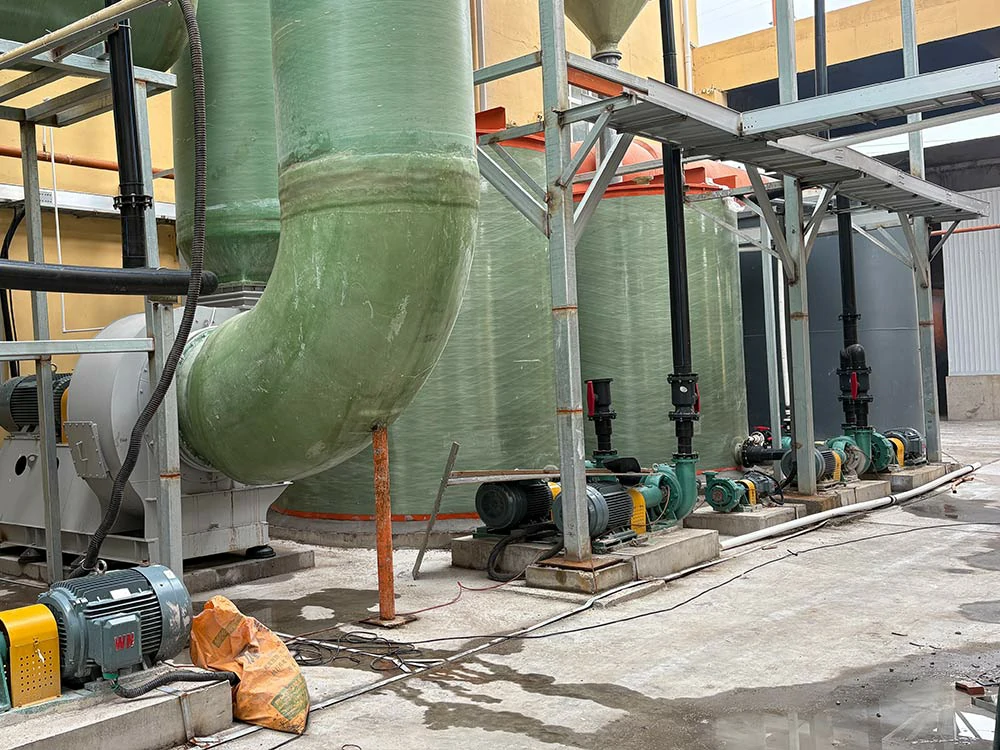
Two years after the replacement: zero casing corrosion, zero clogging events, and scheduled seal inspections extended from quarterly to annually. The plant replaced all six sludge transfer pumps with UHB Series pumps over the following maintenance cycle.
Ключевой вывод: For corrosive industrial sludge, non-metallic or lined pump construction is not an upgrade — it is a requirement. Cast iron pumps in acidic sludge service will fail predictably and rapidly regardless of thickness or coating. UHMW-PE lining eliminates the corrosion mechanism while providing the abrasion resistance needed for high-solids sludge.
Changyu Pump Corrosive Sludge Pump Solutions
Changyu Pump manufactures pump series specifically engineered for corrosive and abrasive sludge applications.
Sludge Pump Product Selection Guide
| Приложение | Первичный вызов | Рекомендуемая серия | Ключевая особенность |
|---|---|---|---|
| Corrosive sludge, pH 2–12, up to 30% solids | Corrosion + abrasion | Серия UHB | UHMW-PE lined; semi-open impeller; double mechanical seal |
| Strong acid/alkali sludge, temperatures up to 120°C | Extreme corrosion + moderate solids | Серия CYB-ZKJ | FEP/PFA lined; universal chemical resistance |
| High-temperature corrosive sludge, up to 160°C | High temperature + corrosion | Серия CYG | PFA lined; molded sintering process |
UHB Series — UHMW-PE Lined Corrosive Sludge Pump
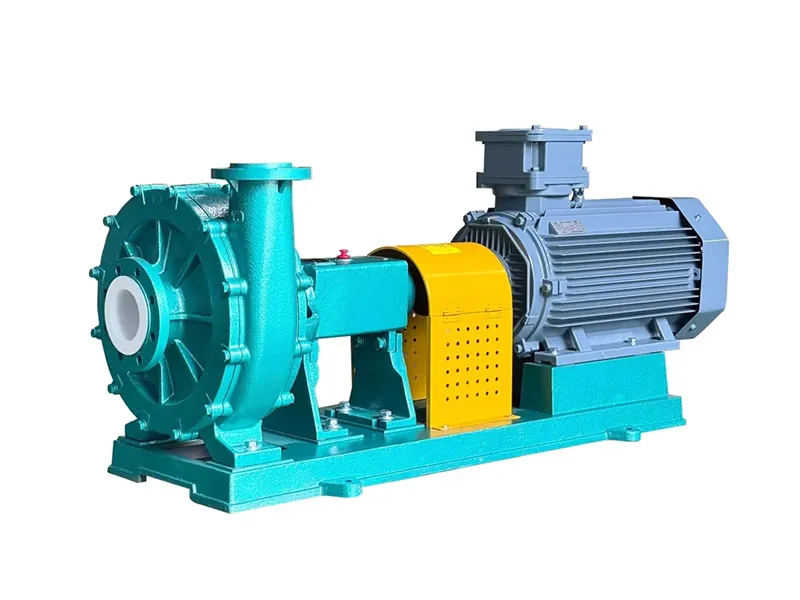
Steel-lined UHMW-PE centrifugal pump designed for corrosive and abrasive sludge. The UHMW-PE lining provides universal resistance to acids, alkalis, and salts while delivering excellent abrasion resistance against sand, grit, and solid particles. Semi-open impeller handles up to 30% solids content without clogging. Widely used in wastewater treatment, chemical processing, and metallurgical industries.
| Параметр | Технические характеристики |
|---|---|
| Скорость потока | 3-2,600 м³/ч |
| Глава | 5-100 m |
| Мощность двигателя | 0,75-300 кВт |
| Скорость | 750-2 900 об/мин |
| Температура | -20°C до 90°C |
| Материал подкладки | UHMW-PE |
FAQs about Corrosive Sludge Pumps
Q: What material is best for corrosive sludge pump construction?
A: For most corrosive sludge with pH 2–12 and solids up to 30%, UHMW-PE lined pumps provide the optimal balance of corrosion resistance and abrasion resistance. For extreme chemicals, strong solvents, or temperatures above 90°C, FEP or PFA fluoroplastic-lined pumps are required.
Q: Why does cast iron fail so quickly in corrosive sludge?
A: Чугун обладает ничтожной стойкостью к кислотам и ограниченной стойкостью к щелочам. При контакте кислого шлама с чугуном кислота разъедает поверхность металла. Абразивные твердые частицы в шламе затем истирают ослабленную поверхность, ускоряя потерю материала. Комбинированный механизм коррозии и эрозии разрушает чугунные насосы в течение нескольких месяцев.
Q: Могут ли насосы из нержавеющей стали работать с коррозионным шламом?
A: Нержавеющая сталь устойчива ко многим химическим веществам, но имеет низкую стойкость к истиранию. В шламе, содержащем песок и гравий, рабочие колеса и корпуса из нержавеющей стали быстро изнашиваются. Кроме того, нержавеющая сталь 316L уязвима для хлоридной питтинговой коррозии в соленом шламе. Футеровка из UHMW-PE обеспечивает превосходную стойкость как к коррозии, так и к истиранию.
Q: Какой тип рабочего колеса предотвращает засорение в шламе?
A: Полуоткрытые рабочие колеса обеспечивают наилучший баланс между устойчивостью к засорению и эффективностью для коррозионного шлама со смешанными твердыми частицами. Вихревые рабочие колеса обеспечивают максимальную устойчивость к засорению для непросеянного шлама с непредсказуемыми включениями. Закрытых рабочих колес следует избегать — они быстро забиваются волокнистым материалом.
Q: Как подобрать размер насоса для густого шлама?
A: Для шлама с содержанием твердых частиц выше 5% применяйте поправку на вязкость к расчетам напора и расхода. Увеличьте всасывающую линию на один диаметр трубы для шлама с содержанием твердых частиц выше 10%. Поддерживайте минимальную скорость потока 1,5 м/с в нагнетательном трубопроводе, чтобы предотвратить осаждение твердых частиц.
Q: Какая компоновка уплотнения лучше всего подходит для коррозионного шлама?
A: Двойные механические уплотнения с внешней барьерной жидкостью обеспечивают наиболее надежную защиту. Барьерная жидкость изолирует поверхности уплотнения от коррозионного, абразивного шлама, одновременно смазывая и охлаждая уплотнение. Одиночные механические уплотнения в работе со шламом быстро выходят из строя из-за проникновения твердых частиц и химического воздействия.
Контрольный список мер по предотвращению неисправностей для инженеров компании Changyu Pump
- Никогда не выбирайте чугун для коррозионного шлама с pH ниже 5 или выше 10. Скорость коррозии разрушит насос в течение нескольких месяцев.
- Подберите материал футеровки в соответствии с полным химическим составом шлама, а не только с pH. Растворители, масла и следовые химикаты влияют на совместимость материалов.
- Выбирайте полуоткрытые рабочие колеса для шлама с содержанием твердых частиц выше 10% или волокнистым мусором. Закрытые колеса засорятся.
- Убедитесь, что температура не превышает пределы материала футеровки — 90°C для UHMW-PE, 120°C для FEP, 160°C для PFA.
- Specify double mechanical seals for all corrosive sludge applications. The incremental cost is recovered within the first avoided seal failure.
. - Oversize the suction line for sludge above 10% solids. Inadequate NPSH causes cavitation damage that accelerates material loss.
. - Maintain minimum flow velocity of 1.5 m/s in discharge piping. Lower velocities allow solids to settle and eventually block the pipe.
. - Keep spare wear components in inventory — impeller, volute liner, and mechanical seal. Corrosive sludge accelerates wear even on lined pumps.
.
Заключение
A corrosive sludge pump is defined by its ability to withstand the combined attack of chemical corrosion and abrasive wear — a dual threat that destroys standard sewage pumps within months. UHMW-PE lined construction has emerged as the optimal material solution for the majority of corrosive sludge applications, providing universal resistance to acids, alkalis, and salts while delivering the abrasion resistance needed for high-solids sludge. Semi-open impellers handle the fibrous debris and solid particles that clog closed impellers, while double mechanical seals protect the pump’s most vulnerable component from the corrosive, abrasive sludge environment.
.
For wastewater treatment plants handling industrial effluent, the investment in a properly specified corrosive sludge pump is recovered through eliminated downtime, extended service life, and predictable maintenance intervals. A cast iron pump that costs less to purchase but fails every few months costs far more over its lifetime than a lined pump that operates reliably for years.
.
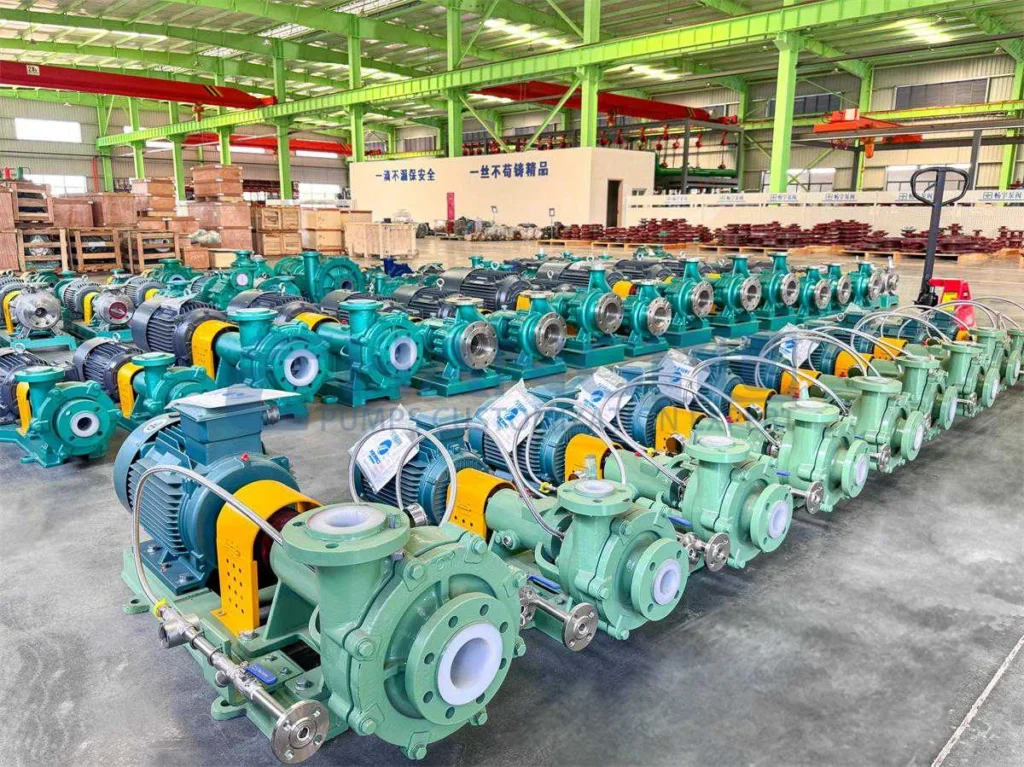
Changyu Pump’s engineering team provides tailored technical assessments for corrosive sludge pump applications — covering sludge characterization, material selection, impeller specification, and seal configuration. Two decades of manufacturing experience across wastewater, chemical, and industrial sectors inform every recommendation.
.
Свяжитесь с Changyu Pump для бесплатной технической оценки →