
At a glance: Select an aqueous ammonia pump against NH₃ concentration, temperature, suction pressure and emission requirements. Stainless steel, fluoroplastic-lined centrifugal and magnetic drive designs are possible routes. Check every wetted component, use compatible seals, and calculate NPSH with solution vapour-pressure data at the highest operating temperature.
Selecting a replacement ammonia pump often starts with a material question and ends with a suction or sealing question. We review all three together: the liquid chemistry, the pressure available at the inlet and the containment required at the shaft. This guide follows that sequence.
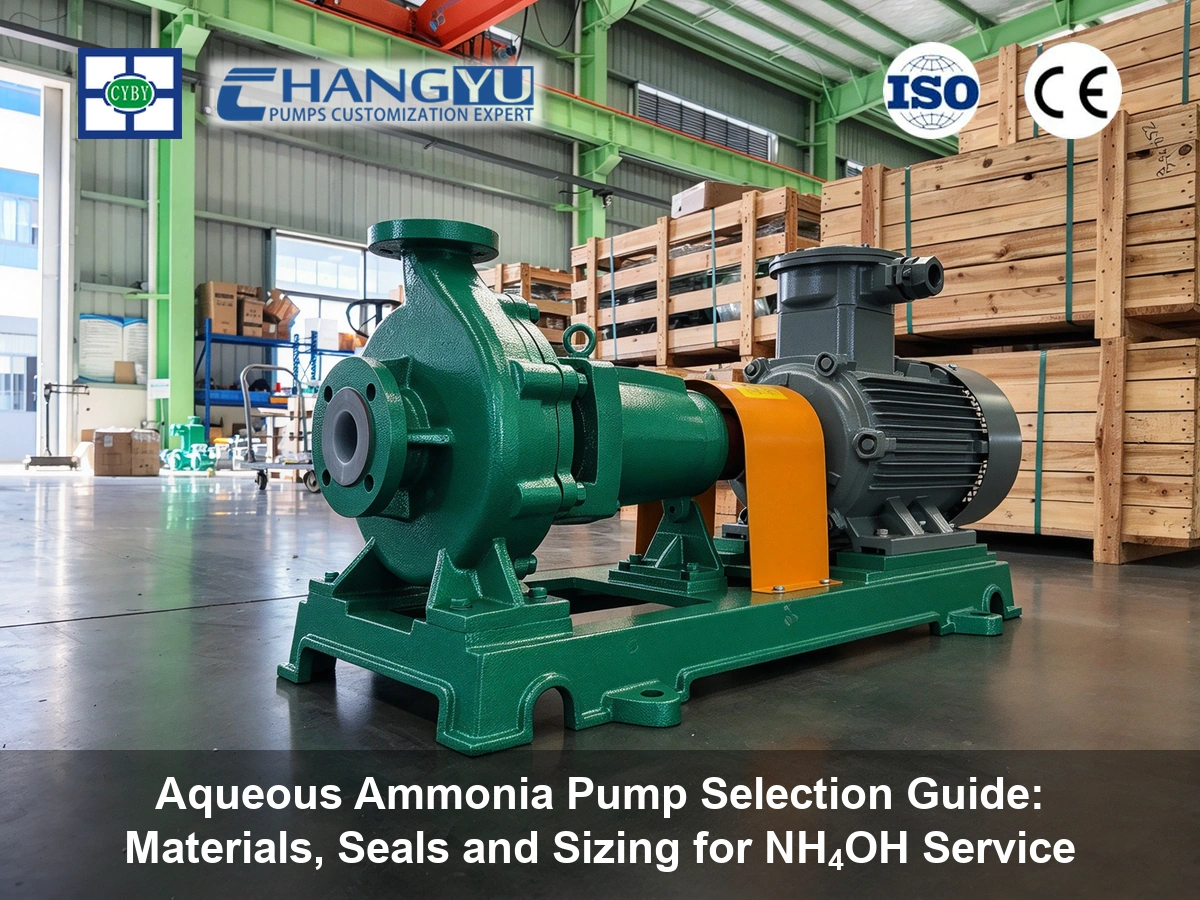
What an Aqueous Ammonia Pump Has to Do
Aqueous ammonia — ammonium hydroxide, NH₄OH — arrives on site at 10% to 30% NH₃ by weight. The 25% grade is the most common commercial strength and also the most troublesome, because vapour pressure, corrosivity and product purity all become significant at once.
Typical duties include tanker and ISO tank unloading, transfer from bulk storage to day tanks or reactor feed, metering into SCR/SNCR DeNOx systems, pH adjustment in water treatment, and feed preparation in fertiliser, feed additive and fine chemical plants.
Temperatures are usually ambient to 40 °C, but chilled storage and warm return lines both exist, and both change the pump you should buy. A unit that behaves at 15 °C on flooded suction can cavitate badly at 35 °C on the same duty.
Why ammonia needs more than a pH check
Aqueous ammonia is alkaline, but pH alone does not describe the pumping challenge. Volatility, material compatibility and density also affect selection.
Vapour pressure steals your NPSH margin
Ammonia is a gas dissolved in water, and it wants out. As the solution warms, ammonia partial pressure climbs steeply, and any pressure drop in the suction line — a strainer, an elbow, a throttled valve — pulls dissolved gas out of solution. The result is two-phase flow entering the impeller: noise, vibration, falling head, and eventually destroyed bearings and seal faces.
Two habits solve most of it. Keep the suction line short, straight and generously sized, and prefer flooded suction over a lift wherever layout allows. Where a lift is unavoidable, specify a pump with a low NPSH requirement, not one that only meets the duty point on a catalogue curve.
Check copper alloys and auxiliary materials
Copper and its alloys are unsuitable for aqueous ammonia service. Brass and bronze components can introduce corrosion and stress-corrosion risks even when the main casing material is suitable. Zinc-bearing coatings and aluminium components also require specific compatibility review and should not be assumed suitable.
The rule: no copper-bearing alloy anywhere in the wetted path. That covers the impeller, casing, seal spring, shaft sleeve, wear ring, and the small fittings nobody thinks about.
Lower density changes motor sizing
At 25% concentration the solution is around 0.91 g/cm³, roughly 9% lighter than water. Hydraulic head is unaffected, but absorbed power is, so a motor sized purely on ammonia duty is under-protected the day someone flushes the line with water during CIP. We size the motor on the densest fluid the pump will ever see.
Ammonia vapour is toxic, and odour must not be used as an exposure monitor. Ventilation, detection, containment and the site’s hazardous-area assessment belong in the system specification. The NIOSH ammonia guidance provides exposure and emergency-response reference information.
Material Selection for Aqueous Ammonia
The table below reflects how we approach material selection. Treat it as a starting point rather than a substitute for your own corrosion data, since chlorides, aeration and temperature all shift the answer.
| Material or component | Selection consideration | Ce qu'il faut vérifier |
|---|---|---|
| Acier au carbone | Possible for some ammonia duties; iron pickup may affect purity | Water chemistry, oxygen, temperature and corrosion allowance |
| La fonte grise | Requires a specific mechanical and corrosion assessment | Grade, pressure integrity and site acceptance |
| 304 / 316L stainless | Common metal options for product-contact service | Chlorides, temperature, fabrication and all auxiliary parts |
| Brass, bronze and other copper alloys | Exclude from the wetted path | Small fittings, instruments, sleeves and seal components |
| Aluminium and galvanised steel | Do not assume compatibility | Written material-supplier approval for the exact duty |
| PP / PVC | May suit some ambient-temperature duties | Exact polymer grade, joints, permeation and pressure derating |
| PVDF | Requires particular care with alkaline ammonia solutions | Supplier concentration and temperature limits; do not assume approval |
| PTFE / PFA / FEP | Chemical-resistance options for wetted linings | Lining construction, permeation, vacuum resistance and temperature limits |
| EPDM | Common secondary-seal candidate | Exact compound, temperature and contaminants |
| PTFE-based seals | Chemical-resistance option | Seal geometry, creep and manufacturer approval |
| FKM | Generally unsuitable for ammonia | Select a compatible alternative with the seal supplier |
If equipment is shared between different chemicals, review every fluid and the cleaning sequence separately. A compatible lining does not make acid–ammonia mixing safe. Segregation, drainage and controlled flushing must be addressed in the plant procedure.
Which Pump Type Fits Your Duty?
Fluoroplastic-lined centrifugal pumps
This is the workhorse for continuous transfer of 25% ammonia at ambient to moderate temperature. A metal casing with an FEP, PFA or PTFE lining gives you the pressure containment of cast metal and the chemical resistance of plastic, across the whole wetted path rather than just the casing.
Notre pompe centrifuge en fluoroplastique de la série CYF is one option to review for continuous chemical transfer. Confirm the lining, all wetted components, seal arrangement and hydraulic curve against the ammonia duty before selection. Our fluorine-lined pump overview explains the material route.
Magnetic drive pumps for improved shaft-seal containment
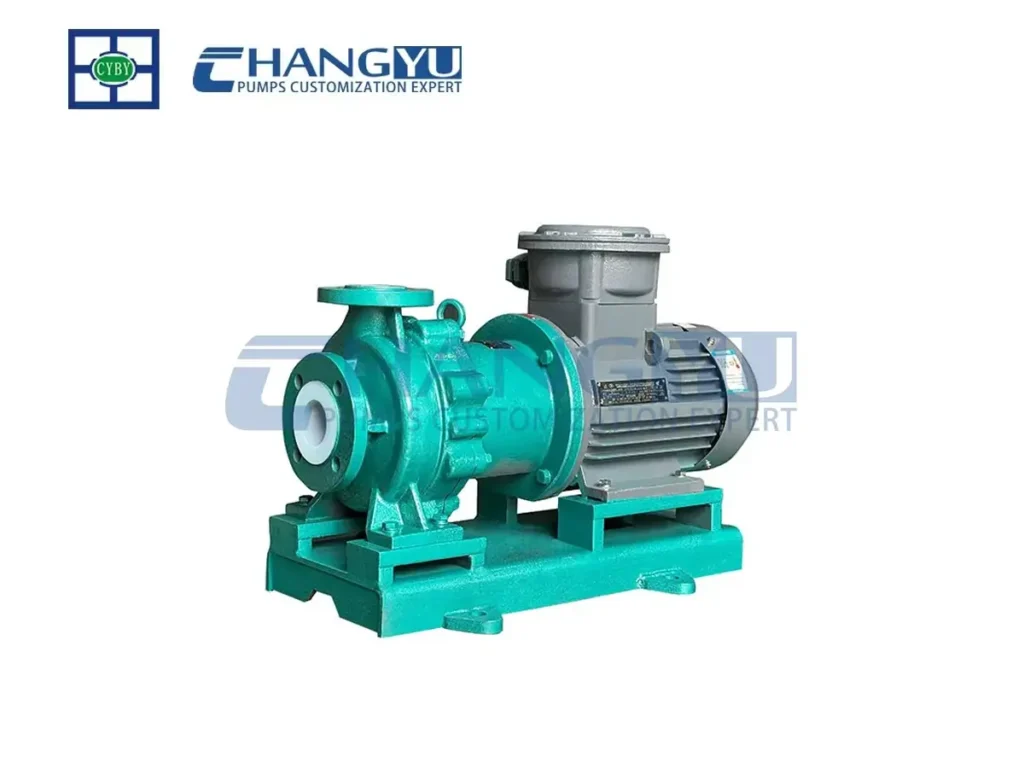
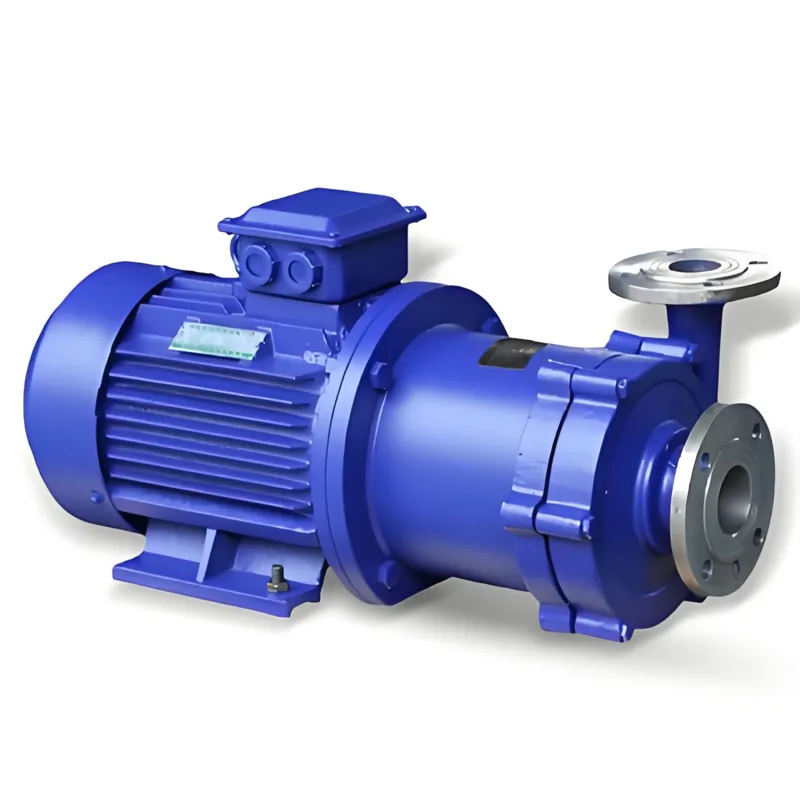
Where shaft-seal leakage is a major concern, a magnetic drive pump removes the dynamic shaft seal. Static joints, the containment shell, instruments and pipework still need suitable design, inspection and leak management.
Notre magnetic drive pump range covers the stainless and lined options used for ammonia transfer and circulation. The trade-off is dry-run tolerance — a magnetic drive pump relies on the liquid for cooling and lubricating its bearing surfaces, so a level interlock and flow check are part of the specification, not optional extras.

Self-priming and vertical pumps for tank unloading
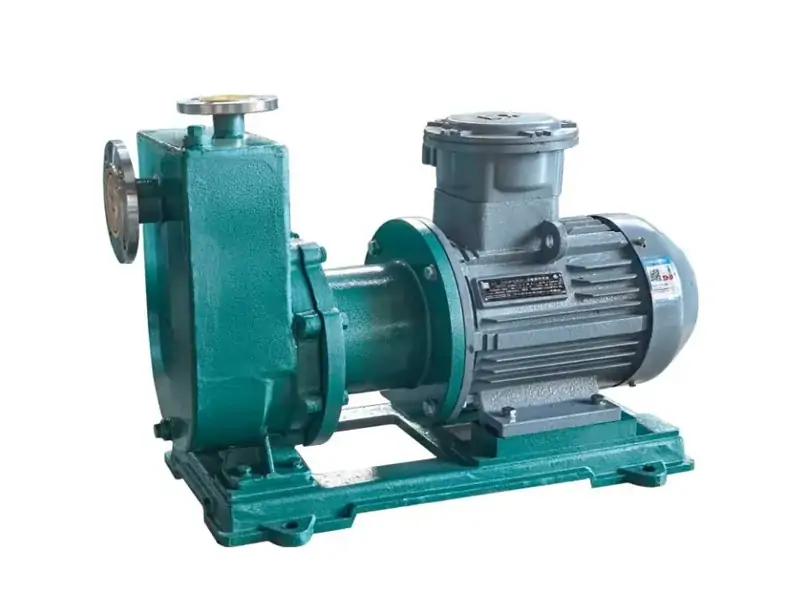
Tanker unloading and below-grade tanks may require suction lift. A pompe auto-amorçante can help establish suction, but priming time, vapour handling and NPSH must still be checked for ammonia solution. A vertical semi-submerged pump, with its hydraulic section below the minimum liquid level and motor above the tank, is another arrangement to assess. Tank vapour containment must be specified independently.
Diaphragm and immersed pumps for intermittent duties
Air-operated double diaphragm pumps can suit intermittent transfer, drum unloading and small-volume duties when the diaphragm, valve and elastomer materials are compatible. Precise dosing may require a metering pump and pulsation control. For bund evacuation, assess a chemical-resistant immersed or fully submersible design against the actual liquid and its motor protection and vapour-containment requirements.
Seals, Flush Plans and Vapour Control
Seal reliability depends on face lubrication, chamber pressure, temperature and the compatibility of every secondary seal. Dry running and flashing can damage an otherwise chemically suitable seal.
Select the seal support arrangement with the seal supplier. Plan 11 recirculates process liquid from pump discharge to the seal chamber; it is not an external clean flush. Plan 32 uses an external flush, whose compatibility, pressure and effect on product dilution must be checked. A quench serves a different function and does not replace face lubrication. Where containment requires a dual pressurised seal, specify the barrier-fluid system, monitoring and failure response together.
Do not operate the pump against a closed discharge beyond the manufacturer’s permitted duration: heat accumulation can increase flashing and damage internal components. Route vents and drains to the plant’s approved recovery or treatment system, and provide low-level and loss-of-flow protection.
The Six Numbers We Ask For Before Sizing
- Concentration and temperature range — % NH₃ by weight, plus minimum and maximum liquid temperature across the year.
- Point de fonctionnement — flow in m³/h and head in metres, or the two end conditions the pump must cover.
- Suction arrangement — flooded or lift, line size and length, NPSH available if calculated.
- Coefficient d'utilisation — continuous or batch, hours per day, whether dry running is possible.
- Loop materials — pipe material, valve types, any copper-alloy components upstream or downstream.
- Documentation and area classification — ATEX zone, material certificates, witness testing, destination-country import requirements.
These details allow us to compare pump arrangements and identify the checks needed before confirming materials and sizing.
Five failure modes to check
Cavitation after a temperature rise. The pump was sized on winter conditions. Fix the suction layout or add NPSH margin, not just a bigger motor.
Dry-running or overheating damage. Loss of liquid can damage mechanical seal faces and magnetic-drive bearings. Closed-discharge operation can overheat the pump. Specify low-level, temperature and flow protection as appropriate.
Impeller corrosion from a brass or bronze component. Often inherited from an older installation where only the casing was replaced.
Product discolouration from iron pickup. Carbon steel in the wetted path of a plant that needs a colourless product.
Leakage at the shaft seal. Review seal condition and whether the selected containment arrangement meets the indoor ventilation, detection and emissions requirements.
How Chuangyu Pump supports ammonia projects
For ammonia projects, we review concentration, temperature, contaminants and containment requirements before proposing a pump. The agreed inspection scope can include material traceability, lining checks and pressure and performance testing. Certification must match the selected model and installation; request the applicable documents with the quotation.
We can help compare lined, stainless and sealless options so the configuration follows the duty. Review our quality control process et service and technical support for the available inspection and project support routes.
Questions fréquemment posées
Une pompe centrifuge standard en acier inoxydable peut-elle pomper une solution aqueuse d’ammoniac à 25% ?
Une pompe centrifuge en acier inoxydable adaptée peut être utilisée pour une solution aqueuse d’ammoniac à 25%, à condition que la nuance exacte d’acier, chaque composant en contact avec le fluide, les joints et le dispositif de confinement soient approuvés pour cette solution et sa température. Exclure les alliages de cuivre et vérifier les contaminants, la pression de vapeur de la solution et le NPSH. La seule présence de joints secondaires en EPDM ou à base de PTFE ne suffit pas à établir que la pompe dans son ensemble est adaptée.
What is the best pump material for aqueous ammonia?
PTFE, PFA and FEP linings and suitable stainless grades are options to evaluate. The choice depends on concentration, temperature, contaminants, pressure and product-purity requirements. Exclude copper alloys and verify all seals, fittings and auxiliary materials against supplier compatibility data.
Why does my ammonia pump keep cavitating?
High solution vapour pressure, suction losses, gas release or air ingress can all cause unstable operation. Check NPSH available at the highest temperature and lowest tank level against the selected pump curve, then inspect the suction line and inlet submergence.
Can I use a magnetic drive pump for aqueous ammonia?
Yes, provided its wetted materials, containment design and hydraulic performance suit the solution. Magnetic drive removes the dynamic shaft seal, but requires protection against dry running, overheating and loss of flow.
Which seal material should I specify for ammonia?
EPDM and PTFE-based secondary seals are common options, subject to the actual temperature and solution composition. FKM is generally unsuitable for ammonia. Confirm the exact compound, seal faces and support arrangement with the seal supplier.
Choosing the Right Pump Starts With the Duty Point
Reliable ammonia transfer depends on adequate suction margin, compatible wetted parts and a seal or containment arrangement matched to the duty. Checking these together is more useful than selecting from a material chart alone.
Send us your concentration, temperature, flow and head, and we will come back with a recommended pump type, wetted materials and seal arrangement — with the reasoning attached, so your team can check it against your own process data.
Request a quote from Chuangyu Pump
Chuangyu Pump options for aqueous ammonia transfer
We compare lined, magnetic-drive and stainless steel designs against the same ammonia duty. The right choice depends on concentration, temperature, product purity, inlet conditions and the containment required by your plant.
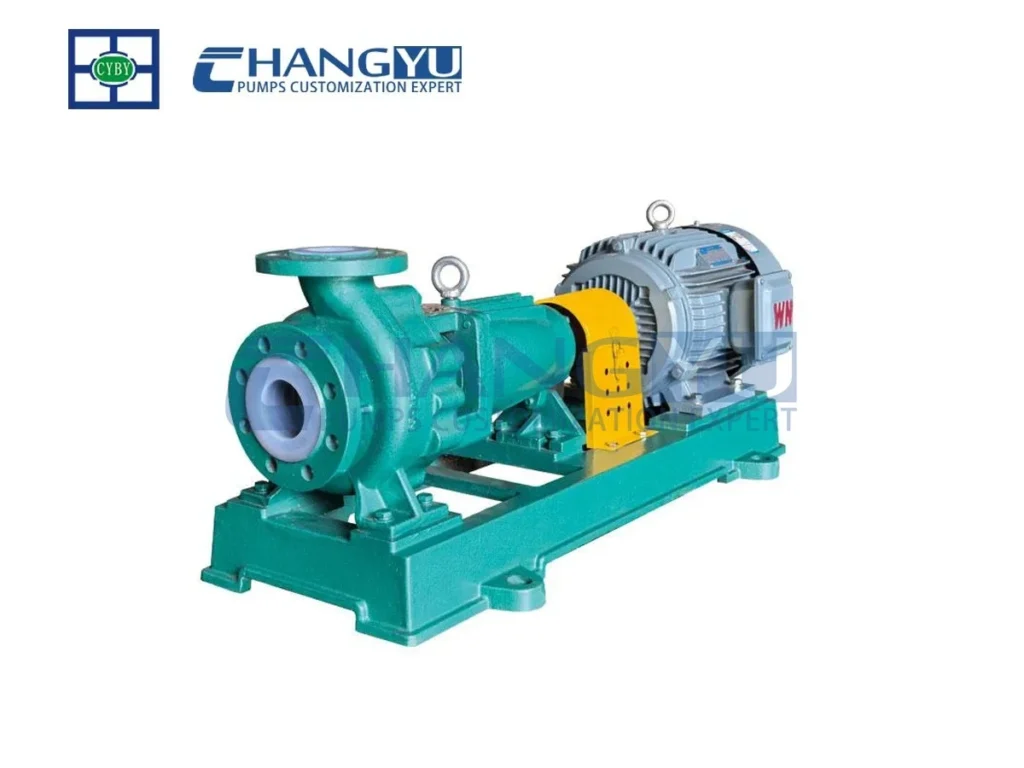
Pompe centrifuge en plastique fluoré de la série CYF
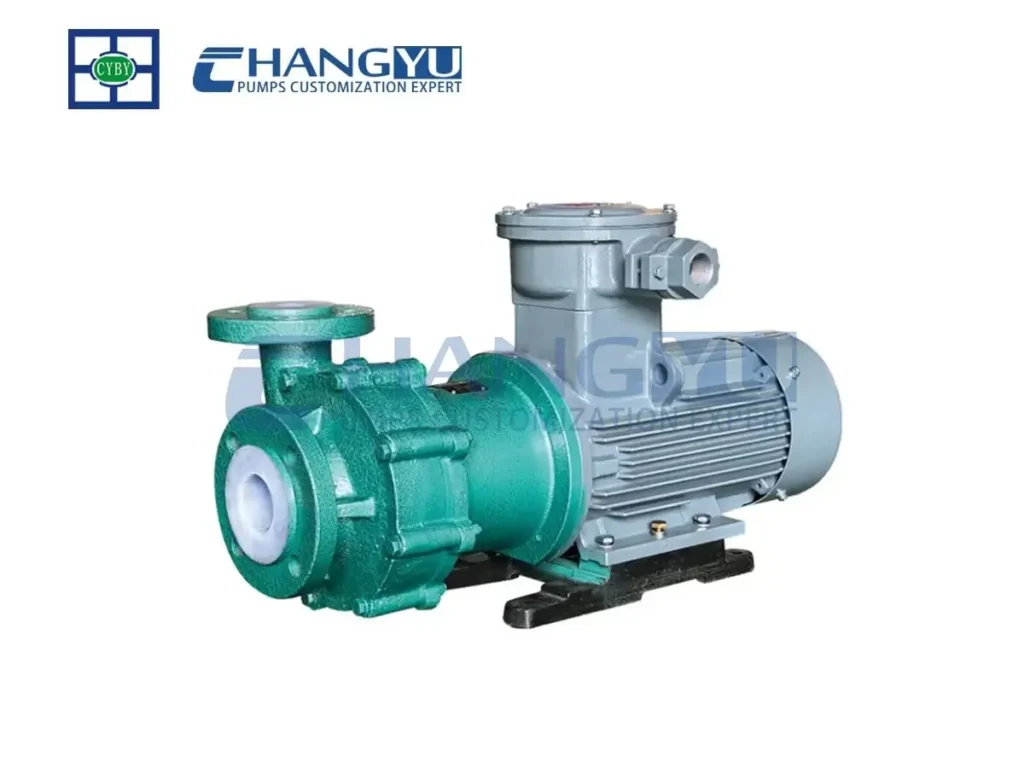
Pompe de transfert d'acide sulfurique série CYQ
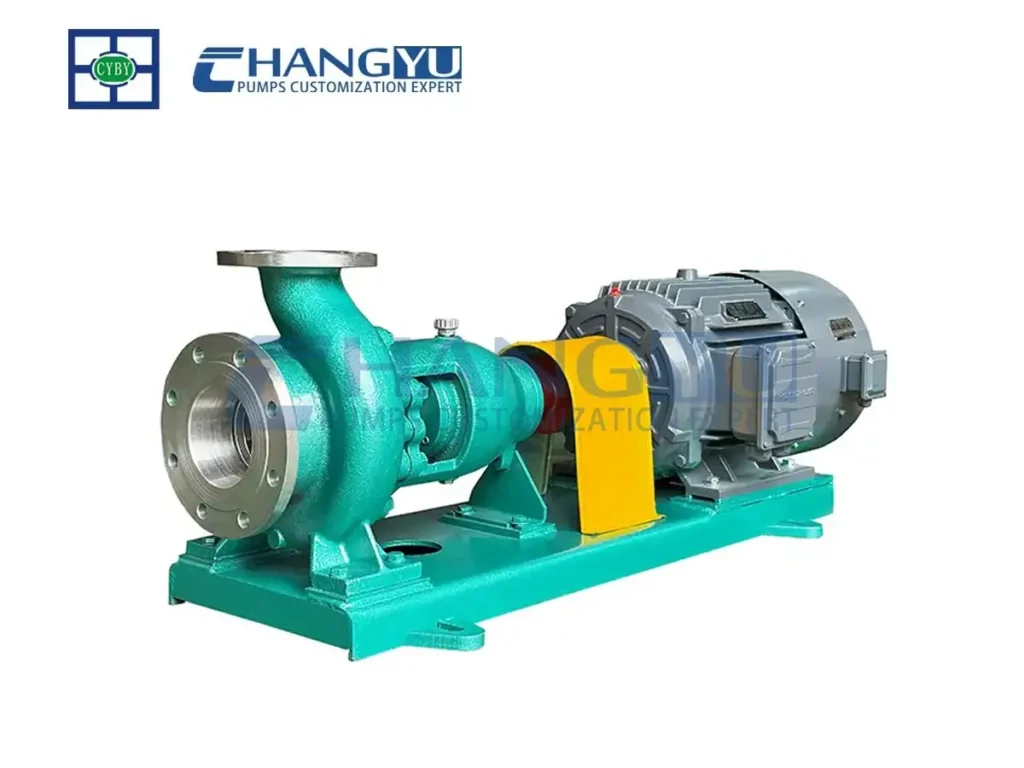
Pompe centrifuge en acier inoxydable pour produits chimiques de la série CYH
Discuss your pump duty with our team
Send us NH₃ concentration by weight, the temperature range, flow and head, minimum tank level and suction layout. Tell us the required emissions control, area classification and any contaminants or product-purity limits.
Courriel : [email protected]
TÉL/WA : +86-13651913727
Inside Anhui Chuangyu Pump’s factory
Watch our official CHANGYU PUMP company introduction for a look inside our manufacturing facility and pump production.