
Respuesta Rápida
A bomba de lodos corrosivos de fluorosilicona está diseñada para manejar una de las combinaciones de fluidos más agresivas en la industria química: fluoruro de hidrógeno, ácido clorhídrico y monómeros de clorosilano mezclados con partículas abrasivas de catalizador sólido. El acero inoxidable estándar se corroe en cuestión de días en este entorno. Las bombas estándar revestidas de fluoroplástico se desgastan en cuestión de meses debido a la abrasión del catalizador. Factores clave de selección:
- El revestimiento de UHMWPE aborda el conflicto corrosión-erosión: El polietileno de ultra alto peso molecular es químicamente inerte al ácido fluorhídrico en todas las concentraciones, al tiempo que proporciona una resistencia a la abrasión muy superior a los fluoroplásticos FEP o PFA. Esta doble capacidad lo convierte en la opción de material más práctica para lodos de fluorosilicona cargados de catalizador.
- El contenido de sólidos determina el diseño del impulsor: Las partículas de catalizador en concentraciones de sólidos del 10–30% requieren impulsores semiabiertos que resistan la obstrucción y puedan pasar sólidos con un riesgo significativamente menor de atrapamiento en comparación con los impulsores cerrados. Los impulsores cerrados atrapan partículas y fallan rápidamente.
- La selección del sello evita fugas peligrosas: Los monómeros de fluorosilicona y el ácido HF son tóxicos e inflamables. Los sellos mecánicos dobles con fluido de barrera o los diseños de accionamiento magnético sin sello eliminan las emisiones fugitivas que los sellos simples no pueden prevenir en servicio de lodos.
- La baja velocidad de operación extiende la vida útil: Operar a 750–1,450 rpm en lugar de 2,900 rpm reduce tanto las tasas de corrosión como de erosión, extendiendo directamente la vida de los componentes de la parte húmeda en servicio de fluorosilicona.
Mover una mezcla de ácido fluorhídrico y polvo de catalizador abrasivo es un desafío de ingeniería fundamentalmente diferente a mover cualquiera de los fluidos por separado. Una bomba de acero inoxidable especificada para “servicio de ácido” se corroerá en cuestión de semanas en HF. Una bomba revestida de fluoroplástico especificada para “resistencia a la corrosión” se desgastará en cuestión de meses cuando estén presentes partículas de catalizador. La bomba que sobrevive a este servicio debe resistir ambos mecanismos simultáneamente.
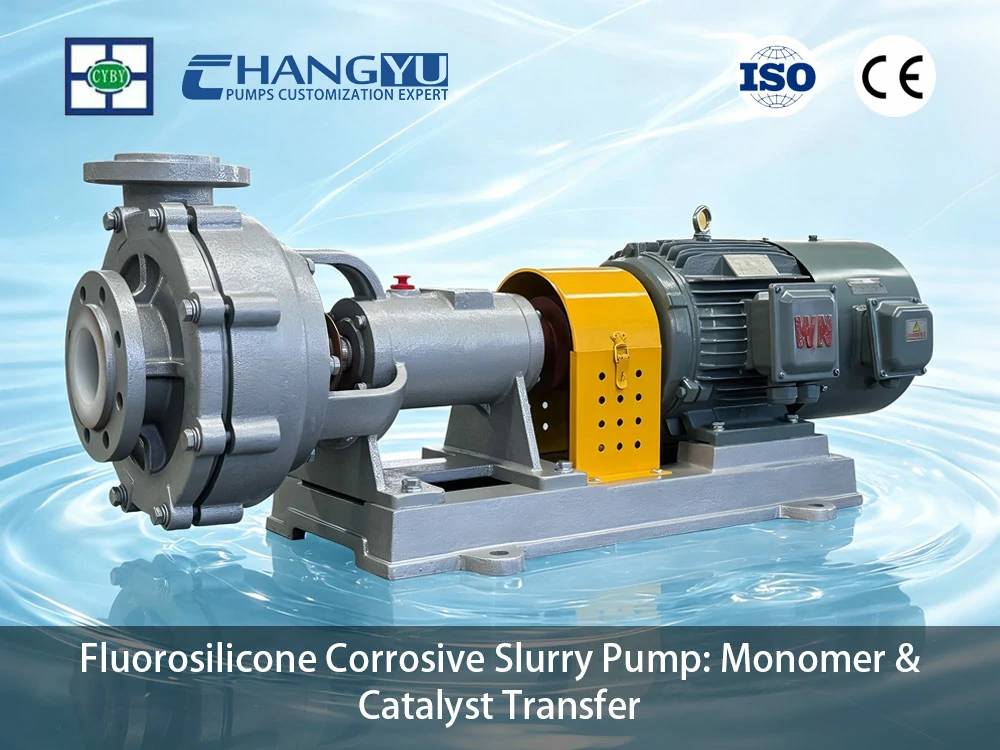
Después de leer esta guía, comprenderá por qué los lodos de fluorosilicona destruyen los materiales de bomba estándar, cómo el revestimiento de UHMWPE proporciona la resistencia combinada a la corrosión y abrasión que esta aplicación exige, cómo seleccionar la configuración correcta de impulsor y sello para la transferencia de monómero y catalizador, y qué prácticas operativas extienden la vida útil de la bomba en la producción de fluorosilicona. Con más de 20 años de experiencia en fabricación de bombas para aplicaciones de lodos corrosivos, Changyu Pump presenta esta guía de selección estructurada para la industria de la fluorosilicona.
¿Qué Hace Tan Destructivo al Lodo de Fluorosilicona?
La producción de fluorosilicona — la fabricación de monómeros de silicio orgánico, fluoropolímeros e intermedios de silano — genera fluidos de proceso que combinan el ataque químico agresivo de los ácidos que contienen fluoruro con el desgaste mecánico de las partículas sólidas de catalizador. Esta combinación destruye los materiales de la bomba a través de un mecanismo sinérgico que ni la corrosión ni la abrasión por sí solas pueden explicar.
La falla de las bombas estándar en lodos corrosivos sigue un patrón predecible impulsado por la sinergia entre la corrosión química y el desgaste mecánico.
En una bomba que maneja ácido fluorhídrico limpio, el ácido ataca la superficie del material, formando una capa delgada de corrosión. En una bomba que maneja partículas abrasivas en agua, las partículas erosionan mecánicamente la superficie. En una bomba de lodos de fluorosilicona, ambos mecanismos operan simultáneamente — y cada uno acelera al otro.
El ácido fluorhídrico ataca la matriz metálica del acero inoxidable o los materiales de relleno en los revestimientos compuestos, debilitando la estructura superficial. Las partículas sólidas de catalizador — típicamente sílice, alúmina u óxidos metálicos — luego eliminan mecánicamente la capa superficial debilitada, exponiendo material fresco a un ataque ácido adicional. Este ciclo se repite con cada revolución de la bomba, eliminando material a una velocidad que supera con creces la suma de la corrosión sola más la abrasión sola.
Características del Fluido por Etapa del Proceso
| Fase del proceso | Composición del Fluido | Temperatura | Contenido en sólidos | Desafío principal |
|---|---|---|---|---|
| Condensación / separación de monómeros | Clorosilanos, HCl, HF traza | 60–120°C | Ninguno a < 1% | Corrosión; prevención de fugas; pureza del monómero |
| Hidrólisis / escisión | HCl, HF, siloxanos | 60–100°C | 1–5% (finos de sílice) | Corrosión-erosión combinada a pH bajo rico en fluoruro |
| Circulación de lodo de catalizador | HF, HCl, partículas de catalizador (sílice, alúmina) | 40–80°C | 10–30% | Abrasión severa + corrosión por fluoruro |
| Neutralización / lavado | HCl diluido, lavado cáustico, lodo de sílice | 20–60 °C | 5–20% | pH variable; lodo de sílice abrasivo |
Cada etapa presenta un equilibrio diferente de corrosión y abrasión. La etapa de circulación de lodo de catalizador — donde las fallas de la bomba son más frecuentes — exige un material que sea simultáneamente inerte al ácido fluorhídrico y resistente al desgaste por partículas. Esta es la aplicación donde las bombas revestidas de UHMWPE han demostrado la vida útil más larga en plantas operativas de fluorosilicona.
¿Por Qué el Revestimiento de UHMWPE Supera en Lodos de Fluorosilicona?
La selección de materiales para el servicio de lodos de fluorosilicona está limitada en ambos extremos: el material debe resistir el ataque químico de los ácidos que contienen fluoruro, y debe resistir el desgaste mecánico de las partículas sólidas de catalizador. No existe un solo material perfecto — la selección es un ejercicio para encontrar el equilibrio óptimo.
Comparación de Materiales para Servicio de Lodos de Fluorosilicona
| Material | Resistencia a HF | Resistencia a la abrasión | Límite de temperatura | Factor de Costo | Veredicto para Lodo de Catalizador |
|---|---|---|---|---|---|
| Acero inoxidable 316L | Pobre — el HF disuelve la capa pasiva y ataca el metal | Moderado | ~60°C en HF | 1× | No adecuado — corrosión rápida |
| Titanio Grado 2 | Pobre en soluciones que contienen fluoruro — forma TiF₄ soluble | Bien | ~80 °C | 5–8× | No adecuado — atacado químicamente por HF |
| Revestido de FEP (CYB-ZKJ) | Excelente — químicamente inerte al HF | Pobre — fluoroplástico blando, fácilmente desgastado por partículas de catalizador | 120 °C | 2–3× | Adecuado solo para monómero limpio — no para lodo de catalizador |
| Revestido de PFA (CYG) | Excelente — químicamente inerte al HF | Pobre a moderado — ligeramente más duro que el FEP pero aún vulnerable al desgaste del catalizador | 160°C | 3–5× | Adecuado para fluidos limpios de alta temperatura — no para lodo abrasivo |
| Revestido de UHMW-PE (UHB) | Excelente — químicamente inerte al HF en todas las concentraciones hasta 90°C | Excelente — resistencia a la abrasión muy superior a los fluoroplásticos FEP y PFA, y se aproxima a la de algunas aleaciones metálicas en condiciones de desgaste por deslizamiento de baja tensión | 90 °C | 5–2× | Mejor opción — equilibrio óptimo de resistencia a HF y resistencia al desgaste del catalizador |
| Aleación de Alto Cromo | Pobre — el HF ataca los carburos de cromo | Excelente | No aplica | 2× | No adecuado — atacado químicamente por HF |
Por Qué el UHMWPE Sobresale en Esta Aplicación Específica
UHMWPE (polietileno de ultra alto peso molecular) posee una combinación única de propiedades que abordan la sinergia de corrosión y erosión de las lechadas de fluorosilicona:
- Inercia química al fluoruro: El UHMWPE es un polímero de hidrocarburo puro. Los enlaces carbono-carbono y carbono-hidrógeno no son atacados por el ácido fluorhídrico, el ácido clorhídrico o los clorosilanos en ninguna concentración. A diferencia de los metales, no existe una capa de óxido pasivo que pueda ser disuelta por los iones de fluoruro.
- Resistencia excepcional a la abrasión: Las cadenas moleculares extremadamente largas del UHMWPE (peso molecular de 3 a 6 millones) proporcionan una resistencia excepcional al desgaste por deslizamiento y al impacto de partículas. En pruebas estandarizadas de abrasión con lechada, el UHMWPE supera al FEP por un factor de 5 a 7 y se aproxima a la resistencia al desgaste de las aleaciones de alto cromo en condiciones de deslizamiento de baja tensión.
- Baja energía superficial: La superficie antiadherente del UHMWPE resiste la acumulación de partículas de catalizador y de incrustaciones de polímero. Esto evita las restricciones de flujo y el desequilibrio que afectan a las bombas metálicas y revestidas de FEP en servicio con fluorosilicona.
- Rentabilidad: Las bombas revestidas de UHMWPE suelen costar entre 1,5 y 2 veces el precio de una bomba estándar de acero inoxidable, en comparación con 5 a 8 veces para el titanio o 3 a 5 veces para las alternativas revestidas de PFA. La prima del costo del material se recupera mediante una vida útil prolongada.
Los ingenieros de Changyu Pump recomiendan: Para cualquier aplicación de lechada de fluorosilicona que contenga partículas de catalizador, independientemente del tamaño o la concentración de las partículas, especifique bombas revestidas de UHMWPE (Serie UHB) como el estándar mínimo de material. El acero inoxidable y el titanio son químicamente incompatibles con los ácidos que contienen fluoruro. Los revestimientos de FEP y PFA, aunque son resistentes químicamente, carecen de la resistencia a la abrasión necesaria para el servicio con lechada de catalizador y se desgastarán prematuramente. El UHMWPE es el material más práctico y rentable que proporciona tanto la resistencia química como la durabilidad mecánica que esta aplicación exige.
¿Cómo Seleccionar una Bomba de Transferencia de Monómero?
La transferencia de monómero puro (clorosilanos, monómeros vinílicos e intermedios antes de la adición del catalizador) presenta un conjunto diferente de requisitos de bomba que el servicio con lechada de catalizador. Sin sólidos abrasivos, la selección del material se orienta hacia la maximización de la resistencia química y la prevención de la contaminación del producto.
Requisitos de Transferencia de Monómero
| Requisito | Especificaciones | Motivo |
|---|---|---|
| Material | Revestido de FEP (CYB-ZKJ) o revestido de UHMWPE (UHB) | Ambos son químicamente inertes a los clorosilanos y al HCl |
| Tipo de sello | Sello mecánico doble o accionamiento magnético | Los monómeros son a menudo tóxicos e inflamables: se requiere cero fugas |
| Tipo de impulsor | Cerrado o semiabierto | No hay sólidos presentes: el impulsor cerrado proporciona la máxima eficiencia |
| Velocidad | 1,450–2,900 rpm | Mayor velocidad aceptable sin preocupaciones de desgaste abrasivo |
| Temperatura | Verificar contra el punto de ebullición del monómero | El sobrecalentamiento puede causar la polimerización del monómero en la bomba |
Cuándo Elegir Revestido de FEP en Lugar de UHMWPE para Servicio con Monómero
Para la transferencia de monómero puro sin sólidos, las bombas revestidas de FEP (Serie CYB-ZKJ) ofrecen una ventaja de temperatura sobre el UHMWPE (120°C frente a 90°C continuos). Si el monómero se maneja a temperaturas superiores a 90°C, como ocurre en algunos procesos de destilación y craqueo, el FEP es el material de revestimiento preferido. Para la transferencia de monómero por debajo de 90°C, el UHMWPE proporciona una resistencia química equivalente a un costo menor, con el beneficio adicional de una resistencia al desgaste superior si hay sólidos traza presentes.
Los ingenieros de Changyu Pump recomiendan: Para la transferencia de monómero limpio, seleccione bombas revestidas de FEP cuando las temperaturas del proceso superen los 90°C. Para la transferencia de monómero por debajo de 90°C, las bombas revestidas de UHMWPE proporcionan una alternativa rentable con resistencia química equivalente y durabilidad mecánica superior.
¿Cómo Manejar las Lechadas de Catalizador en la Producción de Fluorosilicona?
La circulación de lechada de catalizador (transferencia de la mezcla de ácido y partículas de catalizador sólido entre el reactor y el equipo de separación) es la aplicación de bomba más exigente en la producción de fluorosilicona. La bomba debe manejar concentraciones de sólidos del 10 al 30 % mientras mantiene la resistencia al ácido fluorhídrico a temperaturas elevadas.
Configuración de la Bomba para Lechada de Catalizador
| Componente | Especificación Recomendada | Motivo |
|---|---|---|
| Material de la carcasa | Revestido de UHMWPE (Serie UHB) | Único material que resiste tanto la corrosión por HF como la abrasión del catalizador |
| Tipo de impulsor | Semiabierto | Evita la obstrucción; pasa las partículas de catalizador con un riesgo significativamente reducido de atrapamiento en comparación con los impulsores cerrados |
| Placas de desgaste | Placas de desgaste reemplazables de UHMWPE | Componentes de desgaste sacrificial: prolongan la vida de la carcasa |
| Tipo de sello | Sello mecánico doble con fluido de barrera | Evita las emisiones fugitivas de vapores tóxicos de HF y monómero |
| Velocidad de operación | 750–1,450 rpm | Una velocidad más baja reduce tanto la tasa de corrosión como la tasa de desgaste abrasivo |
| Paso de sólidos | 20–50 mm dependiendo del tamaño de la bomba | Coincide con la distribución típica del tamaño de partícula del catalizador |
Por Qué se Requieren Impulsores Semiabiertos
Los impulsores cerrados (el estándar para fluidos limpios) atrapan las partículas de catalizador entre las cubiertas del impulsor y las placas de desgaste de la carcasa. Las partículas atrapadas rozan contra ambas superficies, acelerando el desgaste y reduciendo la eficiencia. Los impulsores semiabiertos permiten que las partículas de catalizador pasen a través de la bomba con un riesgo significativamente reducido de atrapamiento en comparación con los impulsores cerrados. La compensación es una eficiencia hidráulica ligeramente menor (aproximadamente un 5–10 % menos que un impulsor cerrado), pero esta penalización es ampliamente superada por la extensión de la vida útil.
Velocidad de Operación y Vida Útil del Desgaste
La tasa de desgaste en el servicio con lechada de catalizador aumenta desproporcionadamente con la velocidad de la bomba: reducir la velocidad de 2,900 rpm a 1,450 rpm puede reducir el desgaste en un factor de 4 a 8, y una reducción adicional a 960 rpm puede extender la vida útil del extremo húmedo en un factor de 10 o más en comparación con la operación a 2,900 rpm. Para las bombas de circulación de lechada de catalizador, especificar una bomba más grande que opere a menor velocidad, incluso si aumenta el costo de capital inicial, ofrece consistentemente el costo total de propiedad más bajo a través de una vida útil prolongada del extremo húmedo.
Los ingenieros de Changyu Pump recomiendan: Para el servicio con lechada de catalizador, especifique bombas revestidas de UHMWPE con impulsores semiabiertos que operen a 960–1,450 rpm. Seleccione un tamaño de bomba que logre el caudal requerido en la mitad inferior de su rango de velocidad. El tamaño de bomba inicial más grande se recupera a través de una vida útil prolongada: los componentes del extremo húmedo suelen durar de 2 a 4 veces más a 960 rpm en comparación con 1,450 rpm en servicio con lechada de catalizador.
¿Cómo Prevenir Fugas en Bombas de Lechada de Fluorosilicona?
Los fluidos de proceso de fluorosilicona combinan toxicidad (HF), inflamabilidad (clorosilanos) y alto contenido de sólidos (catalizador). Una fuga en la bomba no es un inconveniente de mantenimiento, es un incidente de seguridad con potencial de exposición del personal, incendio y liberación ambiental.
Selección de Sello para Servicio de Fluorosilicona
| Tipo de sello | Ideal para | Limitaciones |
|---|---|---|
| Simple sello mecánico | Transferencia de monómero limpio a temperatura moderada | No apto para lechada de catalizador: los sólidos se incrustarán en las caras del sello y causarán fallas rápidas |
| Sello mecánico doble con fluido de barrera | Servicio de lechada de catalizador; transferencia de monómero peligroso | Requiere sistema de fluido de barrera; mayor costo inicial |
| Accionamiento magnético | Transferencia de monómero con fuga cero (solo fluidos limpios) | No apto para lechada de catalizador: los sólidos erosionarán la camisa de contención y el imán interno |
Selección del Fluido de Barrera
El fluido de barrera en un sello mecánico doble cumple dos funciones: lubrica las caras del sello y proporciona una barrera de presión que evita que el fluido de proceso se fugue a la atmósfera. Para servicio de fluorosilicona, el fluido de barrera debe ser compatible con el proceso; una fuga de fluido de barrera hacia el proceso no debe contaminar el producto, y una fuga de fluido de proceso hacia el fluido de barrera debe ser detectable.
Planes de Lavado para Servicio de Lechada
El Plan API 54 (fluido de barrera externo presurizado) o el Plan 53 (depósito de fluido de barrera presurizado) son las configuraciones recomendadas para bombas de lechada de catalizador. El fluido de barrera presurizado lava continuamente las caras del sello, evitando que las partículas de catalizador se acumulen entre las caras del sello y eliminando el calor por fricción. La presión del fluido de barrera se mantiene de 1 a 2 bar por encima de la presión de la cámara del sello, asegurando que cualquier fuga a través del sello interno sea fluido de barrera limpio hacia el proceso, no fluido de proceso tóxico hacia la atmósfera.
Prácticas Operativas que Previenen Fallas
- Nunca opere una bomba de lechada en seco: Las partículas de catalizador que quedan en la bomba después de un evento de operación en seco destruirán el sello mecánico al reiniciar
- Lave la bomba antes de una parada prolongada: Desplace la lechada con fluido de lavado limpio para evitar la sedimentación y solidificación del catalizador en la carcasa de la bomba
- Monitoree el consumo de fluido de barrera del sello: El aumento en el consumo de fluido de barrera indica desgaste del sello; programe el reemplazo antes de una falla catastrófica
Caso de Estudio de Bomba de Lechada Corrosiva de Fluorosilicona: Resolviendo una Falla por Corrosión-Erosión en una Planta de Silicona
Una planta de monómero de silicona en China operaba una bomba de circulación de lechada de catalizador que transfería una mezcla de 5–8% de ácido clorhídrico, ácido fluorhídrico traza y 15–20% de partículas de catalizador de sílice-alúmina a 60–70°C. La bomba original era una bomba centrífuga de titanio seleccionada por su “resistencia a ácidos”.”
Dentro de los tres meses posteriores a la puesta en marcha, la carcasa de la bomba de titanio mostró un adelgazamiento severo por corrosión; el HF en el fluido de proceso estaba atacando el titanio, formando tetrafluoruro de titanio soluble. La bomba fue reemplazada por una bomba centrífuga revestida de FEP especificada por su “resistencia química universal”.”
Dentro de los seis meses, el revestimiento de FEP se había desgastado en el cortador de la voluta y en el cubre del impulsor. Las partículas de catalizador, suspendidas en la lechada de alta velocidad, habían erosionado el revestimiento fluoroplástico blando en los puntos de mayor velocidad de flujo. La carcasa de acero expuesta luego se corroía rápidamente por el ácido.
Los ingenieros de Changyu Pump identificaron la causa raíz como una selección de material que abordaba la corrosión y la abrasión como problemas separados en lugar de un desafío combinado. La bomba de titanio había resuelto el problema de corrosión para HCl pero falló en la resistencia al HF. La bomba revestida de FEP había resuelto el problema de resistencia a ácidos pero falló en la abrasión del catalizador. Ningún material abordó ambos mecanismos simultáneamente.
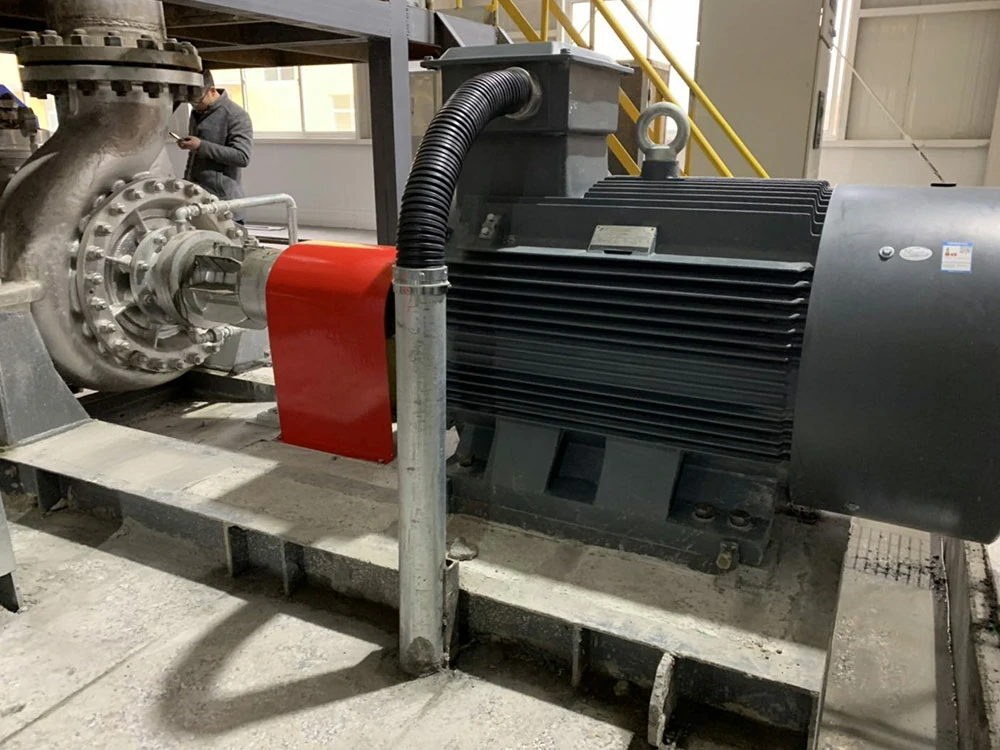
La planta reemplazó la bomba con una bomba revestida de UHMWPE de la Serie UHB de Changyu con un impulsor semiabierto que opera a 1,450 rpm. El revestimiento de UHMWPE proporcionó inercia química tanto al HCl como al HF, mientras ofrecía una resistencia a la abrasión muy superior al revestimiento de FEP que reemplazó. El impulsor semiabierto permitió que las partículas de catalizador pasaran sin quedar atrapadas entre el impulsor y la carcasa.
Durante dos años de operación continua: sin corrosión en la carcasa, sin desgaste del revestimiento que requiriera reemplazo, y sin tiempo de inactividad no programado atribuido a la bomba de circulación de catalizador. La planta convirtió las cuatro bombas de circulación de lechada de catalizador a bombas de la Serie UHB durante la siguiente parada de mantenimiento.
Conclusión clave: En servicio de lechada de catalizador de fluorosilicona, la selección de material debe abordar la corrosión y la abrasión como un desafío combinado. Un material que resuelve un problema mientras ignora el otro (titanio para corrosión, FEP para resistencia química) fallará debido al mecanismo no abordado. El UHMWPE proporciona tanto la resistencia a fluoruros como la resistencia a la abrasión que esta aplicación demanda.
Soluciones de Bomba de Lechada de Fluorosilicona UHB de Changyu Pump
Changyu Pump fabrica dos series de bombas adecuadas para aplicaciones de fluorosilicona, cada una optimizada para un equilibrio específico de resistencia a la corrosión y capacidad de manejo de sólidos.
Guía de Selección de Producto de Bomba de Fluorosilicona
| Solicitud | Características del Fluido | Series recomendadas | Material clave |
|---|---|---|---|
| Circulación de lodo de catalizador | HF, HCl, 10–30% de catalizador sólido | Serie UHB | Revestido de UHMWPE: resistencia dual a corrosión y abrasión |
| Transferencia de monómero puro / ácido | Clorosilanos, HCl, HF (sin sólidos) | Serie CYB-ZKJ | Revestido de FEP: máxima resistencia a la corrosión; temperatura hasta 120°C |
Serie UHB: Bomba de Lechada Revestida de UHMWPE para Servicio de Fluorosilicona con Carga de Catalizador
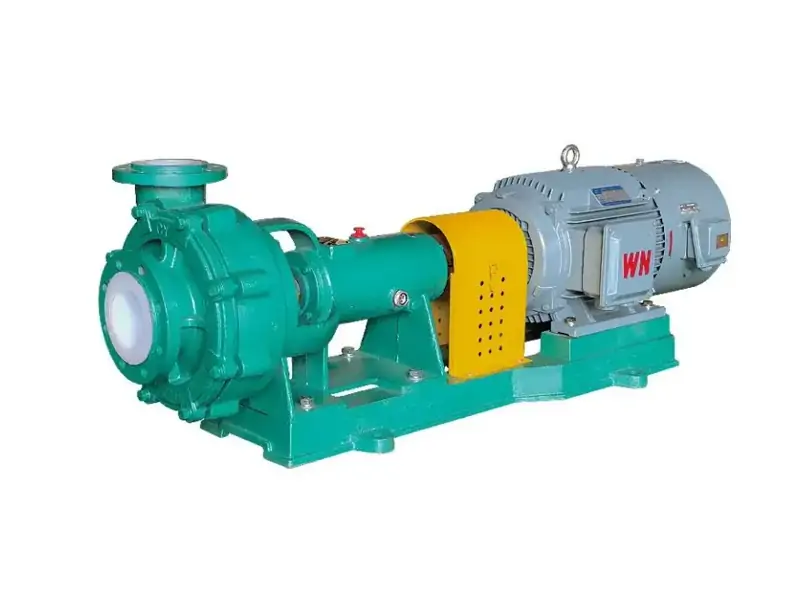
Bomba centrífuga revestida de UHMWPE reforzada con acero diseñada específicamente para lechadas corrosivas que contienen partículas sólidas abrasivas. El revestimiento de UHMWPE es químicamente inerte al ácido fluorhídrico, ácido clorhídrico y clorosilanos en todas las concentraciones hasta 90°C. El diseño de impulsor semiabierto maneja partículas de catalizador en concentraciones de hasta 30% sin obstrucciones. Placas de desgaste reemplazables protegen la carcasa de la bomba y extienden la vida útil. Ampliamente utilizada en la producción de monómero de silicona, transferencia de intermedios de fluoropolímero y circuitos de circulación de catalizador.
| Parámetro | Especificaciones |
|---|---|
| Caudal | 3–2 600 m³/h |
| Cabeza | 5–100 m |
| Potencia del motor | 0,75–300 kW |
| Velocidad | 750–2,900 r/min (960–1,450 rpm recomendado para lechada de catalizador) |
| Temperatura | De -20 °C a 90 °C |
| Material del forro | UHMW-PE |
Serie CYB-ZKJ: Bomba Revestida de FEP para Transferencia de Monómero Corrosivo Limpio
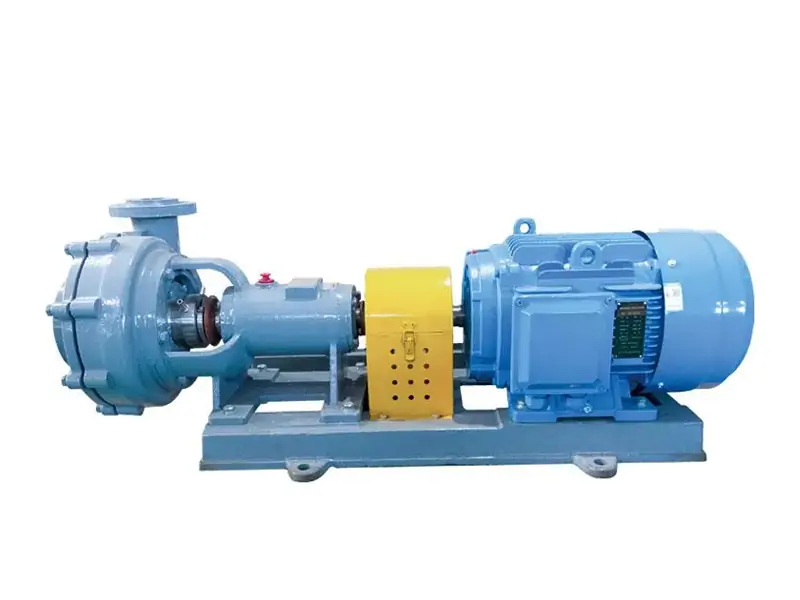
Bomba centrífuga revestida de fluoroplástico FEP para fluidos corrosivos limpios en la producción de fluorosilicona. El revestimiento de FEP proporciona resistencia química universal a clorosilanos, HCl y HF a temperaturas de hasta 120 °C, adecuada para transferencia de monómeros, alimentación de destilación y circulación de ácidos puros donde no hay sólidos abrasivos. Disponible con sello mecánico doble o accionamiento magnético para servicio de monómeros con cero emisiones.
| Parámetro | Especificaciones |
|---|---|
| Caudal | 3–2 600 m³/h |
| Cabeza | 5–100 m |
| Potencia del motor | 0,75–300 kW |
| Velocidad | 968–3 450 r/min |
| Temperatura | de -80 °C a 120 °C |
| Material del forro | FEP |
Preguntas frecuentes sobre bombas de lodos corrosivos de fluorosilicona
P: ¿Por qué no se puede usar acero inoxidable para bombas de lodos de fluorosilicona?
R: El ácido fluorhídrico, presente en la mayoría de las corrientes de proceso de fluorosilicona, disuelve la capa de óxido pasivo en el acero inoxidable y ataca el sustrato metálico. Incluso trazas de HF causarán picaduras rápidas y corrosión general en bombas de acero inoxidable. El titanio también es atacado: el HF forma tetrafluoruro de titanio soluble. Ninguno de los metales es adecuado para servicios que contengan fluoruro.
P: ¿Cuál es el mejor material para bombear ácido HF con sólidos de catalizador?
R: El revestimiento de UHMWPE (polietileno de peso molecular ultraalto) proporciona la combinación óptima de resistencia al HF y resistencia a la abrasión del catalizador. El UHMWPE es químicamente inerte al HF en todas las concentraciones hasta 90 °C, y su resistencia a la abrasión supera con creces la de los fluoroplásticos FEP o PFA.
P: ¿Puedo usar una bomba de accionamiento magnético para lodos de catalizador?
R: No. Las bombas de accionamiento magnético están diseñadas para fluidos limpios. Las partículas de catalizador abrasionarán la carcasa de contención y dañarán el rotor del imán interno. Para servicio de lodos de catalizador, use una bomba revestida de UHMWPE con un sello mecánico doble y sistema de fluido de barrera.
P: ¿Cómo evito que las partículas de catalizador se asienten en la bomba durante la parada?
R: Enjuague la bomba con fluido limpio compatible antes de una parada prolongada. Para bombas de servicio intermitente, instale una secuencia de enjuague automática que desplace el lodo después de cada parada. Para bombas que estarán inactivas más de 24 horas, enjuague a fondo y considere llenar la bomba con fluido limpio para evitar la consolidación del catalizador.
P: ¿A qué velocidad debe operar una bomba de lodos de catalizador?
R: Opere a 960–1,450 rpm para servicio de lodos de catalizador. Reducir la velocidad de 2,900 rpm a 1,450 rpm puede reducir el desgaste en un factor de 4 a 8, y una reducción adicional a 960 rpm puede extender la vida útil de los componentes húmedos en un factor de 10 o más. Una bomba a 960 rpm generalmente logra de 2 a 4 veces la vida útil de los componentes húmedos de la misma bomba a 1,450 rpm.
Lista de verificación de prevención del ingeniero de Changyu Pump
- Nunca especifique acero inoxidable o titanio para ninguna bomba que maneje ácido fluorhídrico. Ambos metales son atacados químicamente por el HF, independientemente de la concentración.
- Nunca especifique bombas revestidas de FEP o PFA para servicio de lodos de catalizador. Los revestimientos de fluoroplástico blando carecen de la resistencia a la abrasión necesaria para fluidos cargados de partículas.
- Especifique bombas revestidas de UHMWPE para todas las aplicaciones de lodos de catalizador en la producción de fluorosilicona. Esto proporciona tanto resistencia al fluoruro como resistencia a la abrasión del catalizador.
- Opere bombas de lodos de catalizador a 960–1,450 rpm. Una velocidad más baja extiende directamente la vida útil de los componentes húmedos.
- Use impulsores semiabiertos para servicio de lodos de catalizador. Los impulsores cerrados atrapan partículas entre las cubiertas y las placas de desgaste, acelerando el desgaste.
- Especifique sellos mecánicos dobles con fluido de barrera presurizado para bombas de lodos de catalizador. Los sellos simples fallan rápidamente por la intrusión de sólidos.
- Enjuague las bombas de lodos de catalizador antes de una parada prolongada. Las partículas de catalizador se asentarán y consolidarán en la carcasa de la bomba, causando arranques difíciles y daños en el sello al reiniciar.
- Mantenga componentes húmedos de repuesto (impulsor, placas de desgaste, sello mecánico) en inventario para bombas críticas de circulación de catalizador. Las bombas revestidas de UHMWPE tienen intervalos de desgaste predecibles; el reemplazo planificado evita tiempos de inactividad no planificados.
Conclusión
La producción de fluorosilicona crea una aplicación de bomba que los materiales estándar no pueden satisfacer. El acero inoxidable y el titanio fallan por ataque químico del ácido fluorhídrico. Los revestimientos de fluoroplástico FEP y PFA fallan por abrasión mecánica de las partículas de catalizador. El revestimiento de UHMWPE, implementado en la Serie UHB de Changyu, proporciona la resistencia dual (inercia química a ácidos que contienen fluoruro y resistencia a la abrasión que supera con creces la de los fluoroplásticos convencionales) que esta aplicación exige.
Las decisiones de ingeniería que determinan la confiabilidad de la bomba en servicio de fluorosilicona son directas: revestimiento de UHMWPE para lodos de catalizador, revestimiento de FEP para transferencia de monómeros limpios por encima de 90 °C, impulsores semiabiertos para el paso de sólidos, sellos mecánicos dobles para control de emisiones y velocidades de operación bajas para una vida útil prolongada. Estas especificaciones, aplicadas de manera consistente, transforman la bomba de circulación de catalizador de un punto de falla recurrente a un activo de proceso confiable.
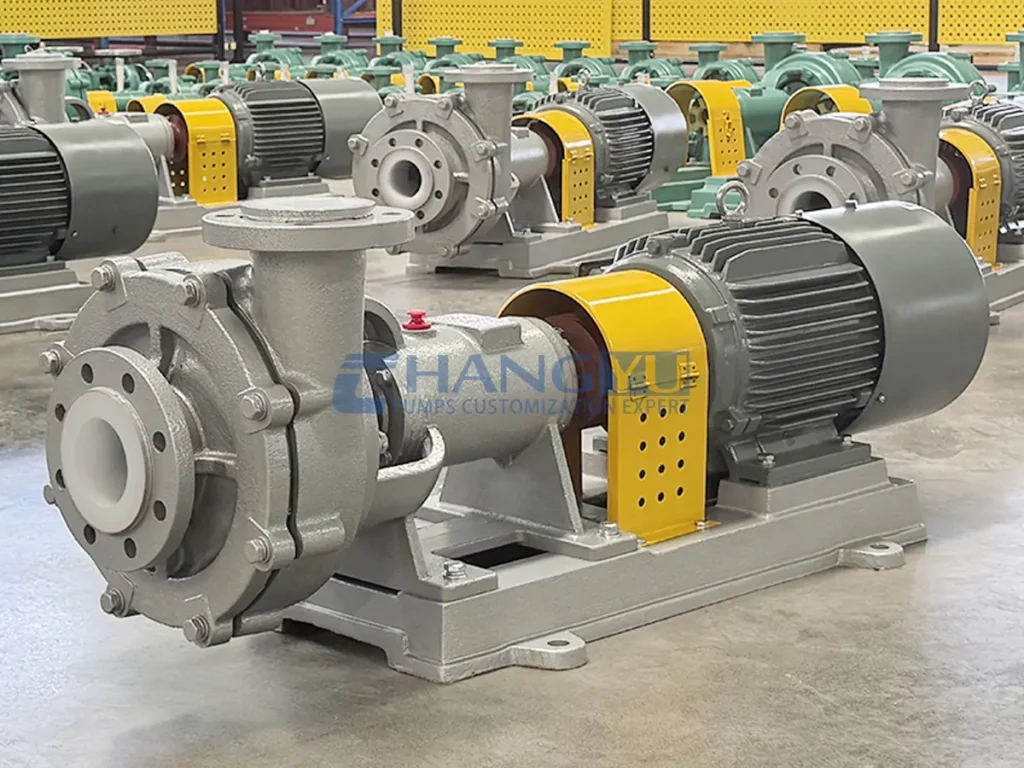
El equipo de ingeniería de Changyu Pump proporciona evaluaciones técnicas personalizadas para aplicaciones de bombas de fluorosilicona, que cubren análisis de química de fluidos, verificación de compatibilidad de materiales y selección de bombas adaptadas a sus condiciones de proceso específicas. Dos décadas de experiencia en fabricación en aplicaciones de lodos corrosivos respaldan cada recomendación.
Contacte a Changyu Pump para una evaluación técnica gratuita →