Pompe à sulfate d'aluminium La sélection des produits exige plus qu'une simple résistance à la corrosion. Sulfate d'aluminium, communément appelé alun liquide, est l'un des produits chimiques industriels les plus répandus au monde. Il est largement utilisé dans le traitement des eaux municipales et des eaux usées, ainsi que dans l'industrie de la pâte à papier et du papier.
L'alun liquide est notoirement difficile à pomper car il est très acide, plus lourd que l'eau et sujet à la cristallisation. Le choix d'une mauvaise pompe peut entraîner une corrosion rapide, l'éclatement des garnitures mécaniques, la surcharge des moteurs et des temps d'arrêt coûteux.
Pour pomper l'alun liquide en toute fiabilité, les ingénieurs de procédé doivent aller au-delà de la simple résistance à l'acide et choisir la technologie de pompage adaptée aux conditions d'exploitation réelles. La meilleure solution dépend de la nature du transfert, du dosage ou de la manipulation d'un liquide contenant des cristaux et des résidus.
Pourquoi les pompes à eau standard échouent-elles dans le service de sulfate d'aluminium ?
L'alun liquide est généralement fourni sous la forme d'une solution aqueuse de 48,5%. Bien qu'il s'écoule comme de l'eau, ses propriétés chimiques et physiques détruisent immédiatement les pompes à eau centrifuges standard.
1. Corrosion acide sévère
L'alun liquide est très acide, avec un pH compris entre 2,0 et 3,5. Si une pompe en fonte, en bronze ou en acier au carbone standard est utilisée, le sulfate acide dissoudra les composants en contact avec le liquide en quelques jours. Bien que l'acier inoxydable 316 puisse supporter l'alun dilué à basse température, il souffre souvent de corrosion par piqûres au fil du temps. Plastiques non métalliques (fluoroplastiques, PP, UHMWPE) sont les seuls choix fiables pour le traitement à long terme de l'alun.
2. Cristallisation et destruction des garnitures mécaniques
Lorsque l'alun liquide est exposé à l'air, à l'évaporation ou à une baisse de température, il se précipite hors de la solution et forme des cristaux durs et abrasifs. Dans une pompe centrifuge standard, ces cristaux pénètrent dans l'espace microscopique de la garniture mécanique de l'arbre. Les cristaux durs marquent les faces de la garniture, ce qui entraîne des fuites rapides et irréparables.
3. Surcharge du moteur due à une densité élevée
C'est l'erreur la plus fréquente commise par les acheteurs inexpérimentés. L'alun liquide est dense ; sa densité (SG) est généralement de l'ordre de 1.33 (ce qui signifie qu'il est 33% plus lourd que l'eau). Si vous achetez une pompe avec un moteur dimensionné pour l'eau (SG 1.0), la pompe consommera un ampérage excessif, surchauffera et déclenchera les disjoncteurs ou grillera complètement le moteur.
Critères d'ingénierie clés pour le choix de la pompe à sulfate d'aluminium
Pour relever ces défis, il est nécessaire de mettre en place un pompe à alun liquide doit être configuré conformément aux spécifications techniques suivantes :
- Matériaux en contact avec le sol : Spécifier des pièces en contact avec le fluide entièrement non métalliques. Le polypropylène (PP), le PTFE, le FEP, le PVDF et l'UHMWPE offrent une excellente résistance au sulfate d'aluminium acide sans risque de piqûre métallique.
- Technologie d'étanchéité : Pour lutter contre la cristallisation, évitez les garnitures mécaniques standard. Utiliser pompes à entraînement magnétique sans garniture pour l'alun propre, ou pompes à boues résistantes à l'abrasion si l'alun contient des impuretés et des précipités lourds.
- Dimensionnement correct du moteur : Informez toujours le fabricant de la pompe que le fluide est de l'alun liquide (SG 1,33) afin qu'il puisse augmenter la puissance du moteur pour gérer la densité plus élevée du fluide sans surcharge.
Top 3 des solutions de pompes à sulfate d'aluminium de Changyu Pump
Au Pompe Changyu, Avec l'alun, nous fournissons des solutions spécialisées pour le traitement des fluides dans les industries du traitement de l'eau et des produits chimiques. L'alun étant manipulé différemment selon l'étape du processus - de la livraison en vrac au transfert dans un réservoir - nous recommandons trois technologies de pompe distinctes.
1. Pompe centrifuge auto-amorçante en plastique fluoré de la série FZB - Pour le transfert et la circulation d'alun propre
Pour le transfert en vrac de l'alun liquide propre des réservoirs de stockage vers les réservoirs journaliers, les Changyu Pump FZB Series Fluoroplastic Self-Priming Centrifugal Pump est un excellent choix. Il est doté d'un revêtement FEP/PFA et d'une hauteur d'aspiration de 5 m, ce qui le rend adapté au transfert de liquides corrosifs lorsque l'auto-amorçage et la résistance à la corrosion sont tous deux importants.
Pourquoi elle excelle dans le service aux alumni :
- Commodité de l'auto-amorçage : La série FZB peut évacuer l'air automatiquement, ce qui simplifie la mise en route et la rend pratique pour les applications de transfert de réservoir avec un fonctionnement intermittent.
- Forte résistance à la corrosion : Son revêtement en plastique fluoré FEP/PFA offre une protection fiable contre la nature acide du sulfate d'aluminium.
- Meilleure application : Transfert d'alun liquide propre, alimentation des réservoirs journaliers et systèmes de circulation pour lesquels une pompe auto-amorçante pour liquides corrosifs est préférable.

2. Pompe à boue horizontale UHB (revêtement UHMWPE) - Pour l'alun avec impuretés et forte cristallisation
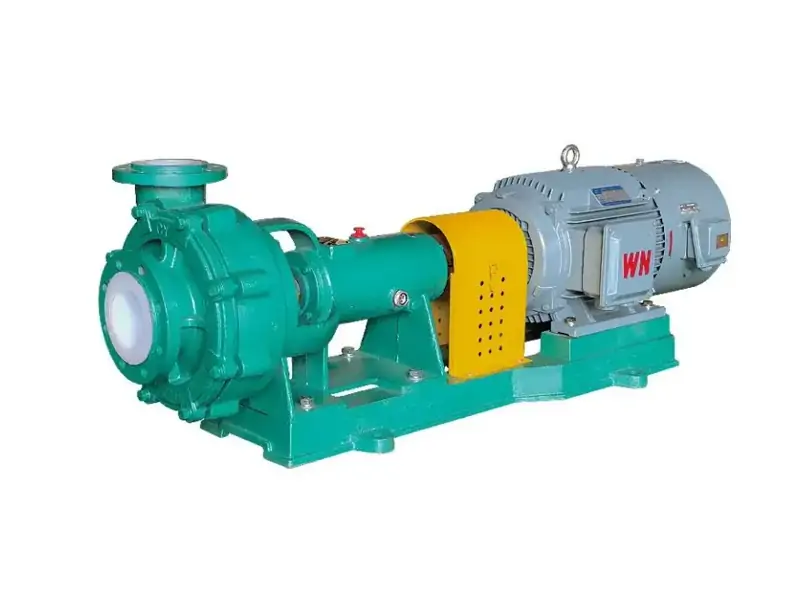
Le sulfate d'aluminium de qualité commerciale contient souvent des traces d'impuretés, des solides non dissous ou forme des boues cristallines lourdes au fond des réservoirs de stockage. Une pompe chimique standard s'étouffe avec cette boue abrasive. Le Changyu Pump Pompe à boues pour acide phosphorique série UHB est spécialement conçu pour ces conditions difficiles.
Pourquoi elle excelle dans le service aux alumni :
- Résistance à l'abrasion et à l'acide : Les parties en contact avec le liquide sont revêtues de polyéthylène à poids moléculaire très élevé (UHMWPE). Ce matériau résiste non seulement à l'acidité de l'alun, mais aussi à l'usure abrasive causée par les particules d'alun cristallisées.
- Conception anti-clogging : Doté d'une roue semi-ouverte, l'UHB passe facilement les boues, les solides non dissous et les précipités cristallins sans se colmater ni perdre ses performances hydrauliques.
- Meilleure application : Pompage du fond des réservoirs de stockage d'alun en vrac, traitement des boues de traitement des eaux usées et transfert d'alun commercial de qualité inférieure contenant des particules.
| Modèle | Plage de débit (m³/h) | Hauteur de chute (m) | Vitesse (r/min) | Plage d'efficacité (%) | Gamme de puissance | Plage de diamètre de la roue (mm) |
|---|---|---|---|---|---|---|
| 32UHB | 5 - 10 | 10 - 30 | 2900 | 17% - 28% | 1,1KW-2 - 3KW-2 | 100 - 165 |
| 40UHB | 10 - 15 | 10 - 30 | 2900 | 25% - 35% | 2,2KW-2 - 4KW-2 | 140 - 165 |
| 50UHB | 10 - 20 | 15 - 40 | 2900 | 20% - 35% | 4KW-2 - 7,5KW-2 | 140 - 190 |
| 65UHB | 25 - 30 | 20 - 60 | 2900 | 25% - 35% | 5,5KW-2 - 18,5KW-2 | 155 - 235 |
| 80UHB | 20 - 60 | 10 - 80 | 2900 | 22% - 50% | 5,5 kW-4 - 30 kW-2 | 145 - 260 |
| 100UHB | 50 - 110 | 10 - 80 | 2900 | 20% - 45% | 15KW-2 - 55KW-2 | 160 - 250 |
| 125UHB | 100 - 140 | 18 - 80 | 2900 | 34% - 48% | 22KW-2 - 75KW-2 | 180 - 268 |
| 150UHB | 150 - 280 | 20 - 50 | 1450 | 40% - 52% | 22KW-4 - 75KW-4 | 260 - 380 |
| 200UHB | 200 - 450 | 6 - 50 | 1450 / 980 | 25% - 58% | 22KW-6 - 90KW-4 | 325 - 380 |
| 250UHB | 300 - 650 | 6 - 60 | 1450 / 980 / 750 | 28% - 65% | 11KW-8 - 160KW-4 | 280 - 420 |
3. Pompe pneumatique à double membrane BFQ - Pour le déchargement et le dosage de conteneurs IBC
Les distributeurs de produits chimiques livrent généralement l'alun liquide dans des conteneurs IBC de 275 gallons ou des fûts de 55 gallons. Les opérateurs ont besoin d'une pompe portable à amorçage automatique pour décharger en toute sécurité ces conteneurs dans le système de stockage de l'usine. Le système Changyu Pump Pompe à double membrane pneumatique (AODD) série BFQ est l'outil idéal pour ce travail.
Pourquoi elle excelle dans le service aux alumni :
- Auto-apprentissage exceptionnel : La conception de l'AODD permet d'obtenir une hauteur d'aspiration élevée, ce qui facilite l'aspiration de l'alun liquide lourd vers le haut et hors d'un conteneur IBC sans amorçage manuel.
- Gère la viscosité et les cristaux : L'action du diaphragme pousse doucement le fluide sans dépendre de jeux internes serrés. Il gère facilement la viscosité plus élevée de l'alun froid et passe facilement les solides cristallisés.
- Débit réglable : En réglant simplement la pression de l'air comprimé entrant, les opérateurs peuvent utiliser la pompe BFQ à la fois pour le déchargement en vrac à grande vitesse et pour le dosage lent et précis dans les canaux de traitement de l'eau.
- Meilleure application : Déchargement de fûts et de conteneurs, transfert d'utilitaires, nettoyage de déversements et opérations de dosage à débit variable.

| Non. | Nom | Non. | Nom | Non. | Nom | Non. | Nom |
|---|---|---|---|---|---|---|---|
| 01 | Bague d'étanchéité de la tête de porc | 02 | Tête de cochon | 03 | Grand curseur | 04 | Petit curseur |
| 05 | Douille de tige d'assistance | 06 | Manchon de piston | 07 | Tige d'assistance | 08 | Joint torique de la tige d'assistance |
| 09 | Bague en V du piston | 10 | Piston | 11 | Grand joint torique de la glissière | 12 | Grand siège coulissant |
| 13 | Bloc de guidage | 14 | Joint du bloc de guidage | 15 | Couvercle supérieur (sortie) | 16 | Soupape à bille |
| 17 | Siège de la balle | 18 | Bague d'étanchéité du siège de la bille | 19 | Couvercle de soupape d'air | 20 | Joint de couvercle de soupape d'air |
| 21 | Colonne | 22 | Vis de la plaque de serrage | 23 | Plaque de serrage Joint torique | 24 | Plaque de serrage extérieure |
| 25 | Membrane en téflon | 26 | Triple membrane | 27 | Plaque de serrage intérieure | 28 | Plaque de membrane |
| 29 | Silencieux | 30 | Couvercle inférieur (entrée) | 31 | Couvercle de soupape d'air | 32 | Arbre de la bielle |
| 33 | Anneau en V | 34 | Bague de la tige de connexion | 35 | Joint de couvercle de soupape d'air |
Tableau de sélection rapide des pompes à sulfate d'aluminium
| Scénario de pompage | Pompe Changyu recommandée | Principaux avantages en matière d'ingénierie |
|---|---|---|
| Transfert en vrac d'alun liquide propre | Pompe magnétique en plastique fluoré CQB-F | La conception sans joint empêche les fuites ; le plastique fluoré garantit une immunité totale à la corrosion. |
| Pompage de boues d'alun, de cristaux ou d'impuretés | Pompe à boues horizontale UHB | Le revêtement en UHMWPE résiste à la fois à la corrosion acide et à l'abrasion cristalline sévère. |
| Déchargement de conteneurs IBC et transfert intermittent | Pompe à membrane pneumatique BFQ | Auto-amorçante, entraînée par l'air, elle traite facilement la viscosité et les solides sans les endommager. |
FAQ sur les pompes à sulfate d'aluminium
Quel est le meilleur matériau de pompe pour le sulfate d'aluminium liquide (alun) ?
L'alun liquide est très acide (pH 2,0 - 3,5). Les matériaux non métalliques constituent le meilleur choix. Les fluoroplastiques (PTFE, FEP, PVDF), le polypropylène (PP) et l'UHMWPE offrent une résistance exceptionnelle à la corrosion. La fonte et l'acier au carbone standard se corrodent rapidement et doivent être évités.
Pourquoi les garnitures mécaniques tombent-elles rapidement en panne lors du pompage de sulfate d'aluminium ?
Le sulfate d'aluminium a tendance à précipiter et à former des cristaux abrasifs lorsqu'il est exposé à l'air ou à des baisses de température. Ces cristaux durs se coincent entre les faces des garnitures mécaniques standard, les rayent et provoquent des fuites rapides. L'utilisation d'une pompe à entraînement magnétique sans garniture ou d'une pompe à boues conçue pour les abrasifs résout ce problème.
Pourquoi le moteur de ma pompe à sulfate d'aluminium ne cesse-t-il de se déclencher ou de brûler ?
L'alun liquide est nettement plus lourd que l'eau, avec une gravité spécifique (SG) qui se situe généralement autour de 1,33. Si vous utilisez une pompe avec un moteur standard dimensionné pour l'eau (densité 1,0), le moteur consommera trop d'ampérage et se surchargera. Vous devez spécifier la densité lors de la commande afin que le fabricant de la pompe puisse équiper la pompe d'un moteur plus puissant.
Puis-je utiliser une pompe à double membrane à commande pneumatique (AODD) pour l'alun ?
Oui. Les pompes AODD sont largement utilisées pour décharger l'alun liquide des conteneurs IBC et des fûts de 55 gallons. Elles sont auto-amorçantes, peuvent supporter la viscosité élevée de l'alun et résistent aux dommages causés par les solides cristallisés. Veillez à ce que la membrane et le corps en contact avec le produit soient fabriqués dans des plastiques compatibles tels que le PP ou le PTFE.
L'alun liquide nécessite-t-il une pompe à enveloppe thermique ?
Dans les climats froids, oui. L'alun liquide standard commence à geler et à cristalliser entre -15°C et -9°C (5°F et 15°F) en fonction de la concentration. Si votre pompe est installée à l'extérieur dans un environnement glacial, un traçage thermique ou un corps de pompe à enveloppe thermique est nécessaire pour empêcher le fluide de se solidifier à l'intérieur de la volute.
Quel est le meilleur type de pompe pour le dosage de l'alun dans le traitement de l'eau ?
Pour un dosage précis du traitement de l'eau, les pompes doseuses ou les pompes AODD reliées à un système de contrôle sont idéales. Pour le transfert en vrac vers les réservoirs de dosage, une pompe centrifuge à entraînement magnétique en plastique fluoré (comme la Changyu FZB) est la solution la plus efficace et la plus fiable.
Erreurs courantes lors du pompage du sulfate d'aluminium
- Utilisation de moteurs standard : En oubliant que l'alun liquide a une densité d'environ 1,33. L'utilisation d'un moteur de pompe à eau standard entraînera une surcharge immédiate du moteur et une combustion.
- Choix de l'acier inoxydable 304 : En supposant que l'acier inoxydable de base soit “assez bon” pour l'alun acide, l'acier inoxydable 304 s'abîmera et se détériorera rapidement. L'acier inoxydable 304 s'abîme et se détériore rapidement. Il faut toujours spécifier des matériaux non métalliques (fluoroplastiques, PP, UHMWPE).
- Ignorer les températures de congélation : Dans les climats froids, l'alun liquide gèle et se cristallise à l'intérieur de la volute de la pompe pendant l'hiver. En cas d'installation à l'extérieur, s'assurer que la tuyauterie et le corps de la pompe sont isolés ou calorifugés.
- Défaut de rinçage des garnitures mécaniques : Si vous devez utiliser une pompe à étanchéité mécanique au lieu d'une pompe à entraînement magnétique, le fait de ne pas installer un plan de rinçage à l'eau propre permettra la formation de cristaux d'alun qui détruiront les faces d'étanchéité pendant l'arrêt.
Conclusion : Pompage fiable de l'alun liquide avec la pompe Changyu
Le pompage du sulfate d'aluminium nécessite une approche technique qui respecte l'acidité, la densité et la cristallisation abrasive du fluide. Que votre installation de traitement de l'eau ait besoin de la précision sans fuite du Pompe à entraînement magnétique CQB-F, La résistance à l'abrasion de la Pompe à boues UHB, ou la puissance de déchargement polyvalente du Pompe BFQ AODD, Changyu Pump propose des solutions éprouvées.
Ne vous souciez plus des joints éclatés, des carters corrodés et des moteurs grillés. Contacter Changyu Pump aujourd'hui avec le débit, la hauteur de refoulement et la température de fonctionnement requis. Nos experts en ingénierie des fluides dimensionneront la pompe à sulfate d'aluminium idéale avec le moteur robuste approprié pour garantir des années de fonctionnement sans entretien.