
To choose a filter press diaphragm pump, check its flow at the actual backpressure, the available compressed air, particle size, and wear at the check valves. Our BFQ is an air-operated double-diaphragm pump. If the press has a large chamber volume and a short target filling time, compare it with our UHFM-HJ and UHB centrifugal pumps under the same slurry and filter cycle conditions.
When you search for “filter press diaphragm pump,” you are typically looking to convey sludge or slurry to a filter press. Therefore, you need to know whether the pump has self-priming capability, whether it can maintain a steady feed as pressure increases, how much compressed air is required, and whether particulates will clog the valves. The pump type matters: our BFQ is an air-operated double-diaphragm (AODD) pump, while UHFM-HJ is a single-stage or two-stage centrifugal filter press feed pump. Both may serve a filter press system, but they work differently and have different pressure limits and maintenance needs.
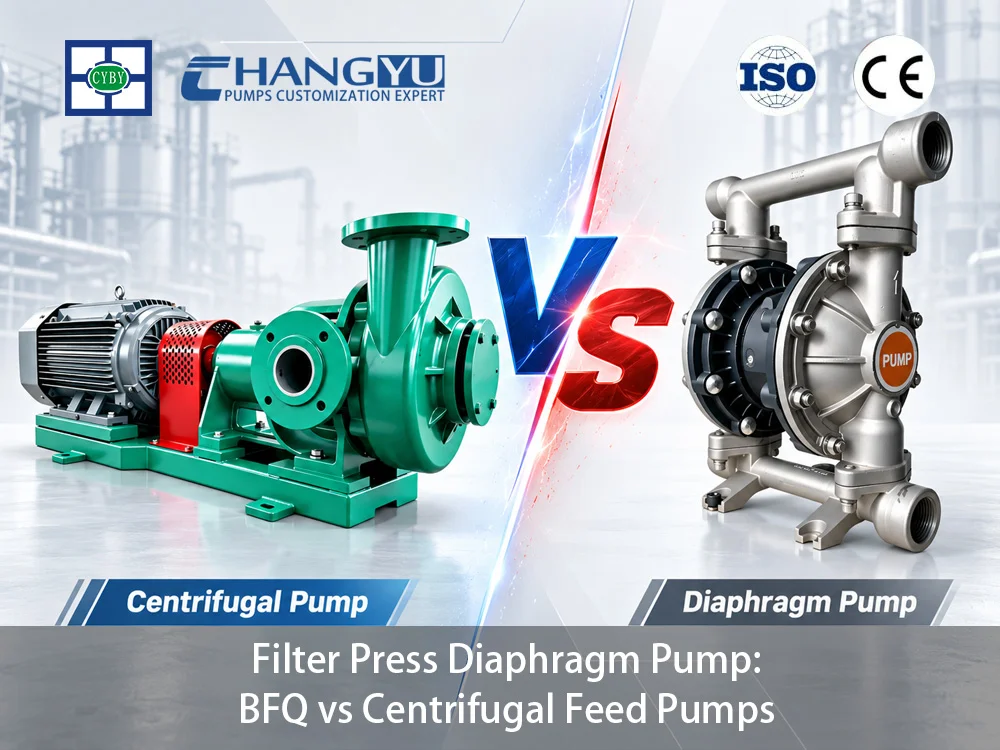
How a filter press diaphragm pump feeds a press
Compressed air drives two diaphragms alternately. One chamber draws in slurry while the other discharges it through a check valve. During initial chamber filling, the pump may deliver relatively high flow. As the filter cake forms and backpressure rises, its stroke rate falls. Air pressure and supply capacity determine the operating point that can actually be achieved. The pump has no centrifugal-pump shaft seal, but its diaphragms, valve balls, valve seats, and air valve still need inspection.
This arrangement may suit intermittent sludge transfer, smaller presses, or sites with difficult suction conditions. For a large press that must fill quickly, calculate flow at the required backpressure instead of relying on the maximum flow shown for the series. Supply pressure, available air volume, air-line pressure drop, and exhaust silencing are all part of selection.
Check BFQ performance and materials by model
Notre BFQ series lists a series maximum working pressure of 0.84 MPa and a series maximum flow of 1,041 L/min. These are separate limits; they do not mean one model delivers maximum flow at maximum pressure. The BFQ-25, BFQ-40, BFQ-50, and BFQ-80 models also differ in connection size, flow, and allowable particle size. Request performance information for the selected model at the required duty rather than putting series maxima into a purchase guarantee.
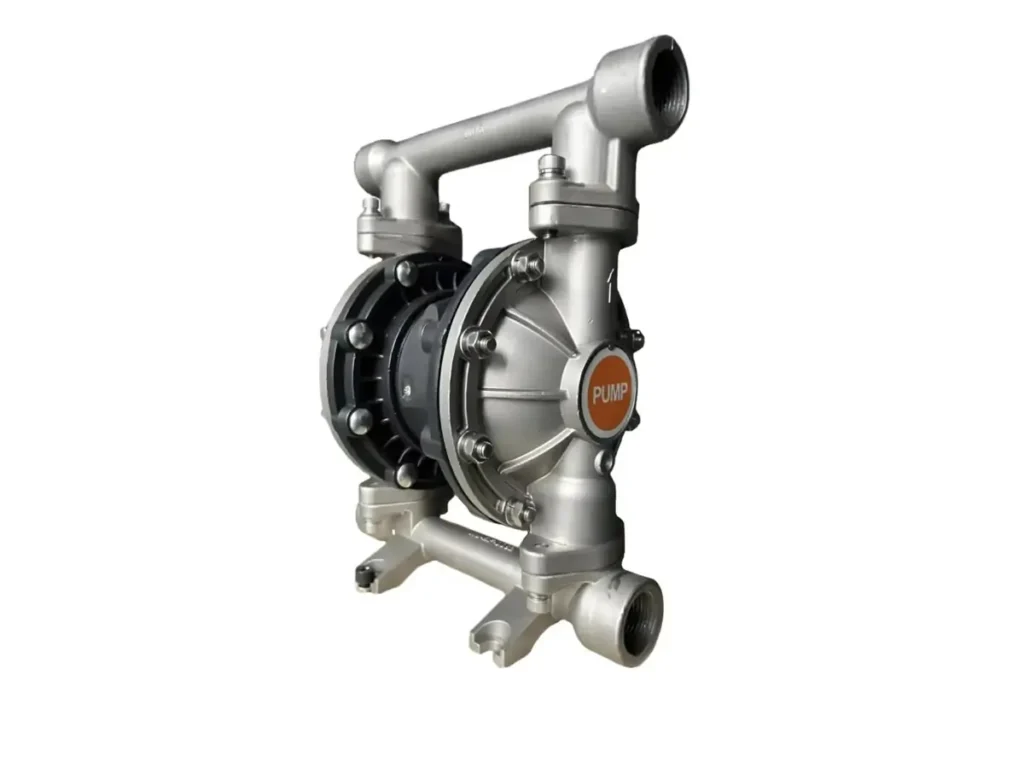
Available BFQ body materials include acier moulé, fonte ductile, alliage d'aluminium, PP, acier inoxydable et PVDF. The acids, alkalis, solvents, and particles in the slurry affect the choice of body, diaphragm, and valve-ball materials. Maximum passable particle size answers only whether a particle can pass. Hard particles can still wear the valve seats, while fibers and settled solids can interfere with the check valves.
The filter press’s rated pressure is not the entire pressure the pump must produce. Discharge piping, valves, and elevation add losses. If the required pressure at the press inlet is already near the pump’s upper limit, there may be too little operating margin. Start with the required press inlet pressure, calculate the pump discharge pressure, and then check the corresponding flow and air supply.
BFQ compared with centrifugal feed pumps
| Candidate | Type de pompe | Check first |
|---|---|---|
| BFQ | Air-operated double-diaphragm | Flow at backpressure, compressed air, valve balls, and diaphragms |
| UHFM-HJ | Single-stage or two-stage centrifugal feed pump | Cycle pressure, initial flow, seal, and suction conditions |
| Série UHB | Corrosion- and abrasion-resistant centrifugal slurry pump | Medium, exact model, cycle pressure, and suction conditions |
Notre UHFM-HJ filter press feed pump uses an impeller to move slurry continuously. It can be considered where the press needs high initial filling flow and then operates at lower flow and higher pressure as cake resistance increases. We offer UHFM-I single-stage and UHFM-II two-stage arrangements, with the latter considered for higher pressure duties. Whether a specific model reaches the required final pressure must still be checked against its pump curve and motor selection.
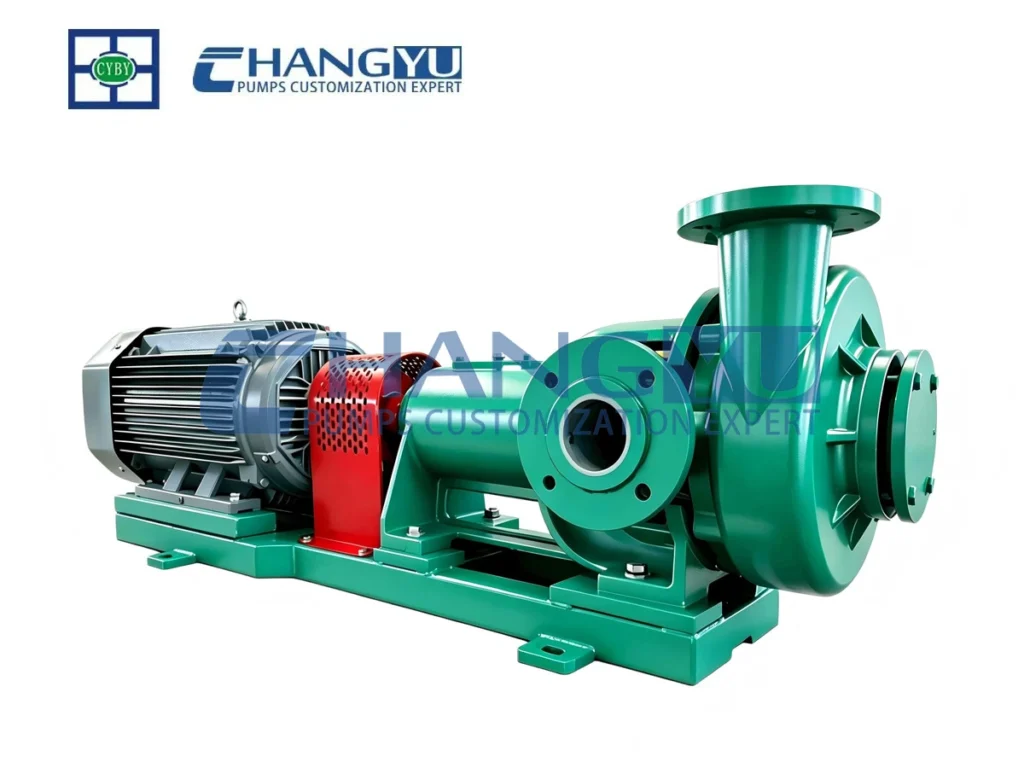
For UHFM-HJ, wetted-part wear, corrosion, and shaft-seal selection are central. Material options include UHMWPE, fluoroplastics, polyurethane, and some stainless-steel configurations. HJ1 single mechanical seals and HJ2 cartridge double mechanical seals are available arrangements. Their existence does not make either seal suitable for every solids-bearing medium. Specify the seal against particle loading, crystallization, dry-running risk, and any flushing requirements.
Notre Série UHB is also a centrifugal candidate for filter press feed. A UHB-ZK lead-zinc smelting filter press application provides an example. UHB is not a diaphragm pump; it appears here as a centrifugal option for comparison. The specific duty and model determine whether it fits.
When to choose a diaphragm pump and when to compare a centrifugal pump
For low to moderate flow, intermittent operation, a wish to limit final pressure through air pressure, and sufficient plant compressed air, first calculate the BFQ AODD option. For a large fill volume, short filling target, slurry that a centrifugal pump can move reliably, and a final pressure within a matching model’s range, first assess UHFM-HJ or UHB. “First” describes an engineering screening order, not a promise that a model will fit.
If sustained filter press feed pressure exceeds the BFQ series limit, simply increasing air pressure is not a solution; compare other pump types. Likewise, do not force a centrifugal pump into the application if it would spend too long near shutoff or if viscous slurry prevents stable operation during filling and low-flow stages. Piston diaphragm and hose pumps may then be worth evaluating, including their valve, diaphragm, or hose maintenance costs.
Maintenance also affects the choice. Diaphragm pumps require checks of the diaphragms, check-valve parts, and air valve. Centrifugal pumps require monitoring of the impeller, casing cover, shaft seal, and bearings. Where compressed air is unreliable, a lower initial AODD pump price may be offset by the need for an air supply. If slurry settles or crystallizes rapidly after shutdown, either pump type needs flushing and draining procedures compatible with the process.
Five duty details to send before requesting a quote
- Filter press cycle. Provide chamber volume, required filling time, final feed pressure, and how long that pressure must be maintained. “An 8 bar filter press” does not define the initial flow duty.
- Available utilities. BFQ performance depends on compressed-air supply. UHFM-HJ and UHB require checks of motor power, voltage, speed control, and current margin. Compare energy use for the same filtration task and local utility prices.
- Slurry properties. Give the medium and its chemistry, concentration, temperature, density, solids content, maximum particle size, particle shape, and settling behavior. Check valve balls and seats particularly for BFQ, and the impeller, casing cover, and seal for centrifugal models.
- Suction arrangement. An AODD pump can self-prime, but actual suction lift depends on the medium, pipework, and air supply. For our UHFM-HJ, we recommend flooded suction from an elevated tank rather than suction lift from a low-level tank through a foot valve. Confirm the installation before comparing prices if it cannot be changed.
- Controls and protection. Both types must be coordinated with the press pressure rating, valve sequence, and shutdown logic. An air pump stalling does not remove the need for pressure protection; a centrifugal pump must not run for long against a closed discharge. Define monitoring, interlocks, and operating margin.

Conclusion
A filter press diaphragm pump is a specific pump-type request, and BFQ is worth evaluating within its pressure, flow, and particle limits. If the central problem is filling a large press quickly while pressure rises later in the cycle, include UHFM-HJ and UHB in the comparison. The most useful quotations apply the same slurry and filter cycle data to each option, show where each pump operates and approaches its limits, and identify the expected wear parts. Comparing two prices alone will not answer those questions.
Contactez nous
If you have questions about pump selection, contact ChangYu Pump with the press specifications, slurry data, and installation conditions. Our technical team can help check suitable pump types and models.
Courriel : [email protected]
TÉL/WA : +86-13651913727
FAQ
What type of filter press diaphragm pump is the BFQ?
Our BFQ is an air-operated double-diaphragm (AODD) pump. Compressed air alternately drives two diaphragms, and inlet and outlet check valves control slurry flow. It is different from a piston or plunger diaphragm pump and from our UHFM-HJ and UHB centrifugal feed pumps.
How does a filter press diaphragm pump’s flow change as backpressure rises?
The stroke rate and flow generally fall as the cake forms and discharge backpressure rises. If backpressure approaches the available air pressure, the pump may stall. Check a model-specific performance curve at the required pressure and actual compressed-air supply; the free-flow figure does not describe late-cycle feed.
Does BFQ’s 0.84 MPa maximum mean it delivers 1,041 L/min at that pressure?
No. Those are separate series maximum values, not a guaranteed combined operating point. BFQ models differ in size and capacity. Give us the required flow and discharge pressure so the selected model can be checked at one real duty point, with adequate operating margin.
Can an AODD pump fill a large filter press quickly?
It can only be judged from the chamber volume, target filling time, and the pump’s flow at the corresponding backpressure. A filter press diaphragm pump such as our BFQ may suit intermittent or modest-flow service, but a large press with a short filling target may need comparison with UHFM-HJ or UHB centrifugal models. Compare each candidate over the same cycle, not just at its maximum advertised flow.
Can BFQ self-prime from any suction arrangement?
AODD pumps can self-prime, but achievable suction lift is limited by the slurry, suction pipe, air supply, and installation. Viscous or settling slurry and long, restrictive pipework can reduce reliable feed. Send the tank level and suction layout when requesting a selection.
Can abrasive particles jam or wear an AODD pump?
Yes. A particle that passes through the port can still wear a valve ball or seat; coarse solids, fibers, or settled material may prevent a check valve from sealing. Check the selected BFQ model’s allowable particle size and choose diaphragm, body, ball, and seat materials for both the liquid chemistry and solids.
If an AODD pump stalls at high backpressure, is pressure protection unnecessary?
No. Stalling is an operating behavior, not a substitute for a verified pressure limit or protective design. Coordinate air pressure, regulators, discharge piping, valve sequence, and shutdown controls with the press’s rated pressure. Also check the effect of a blocked line or unexpected valve closure.
References
- Hydraulic Institute, Pump FAQs — background on pump selection, operating points, and pressure protection.