
Introduction
Pompe à eaux usées industrielles La sélection est dictée par une seule exigence primordiale : la pompe doit transporter des liquides chargés de solides, de longues fibres et souvent de substances chimiquement agressives—sans colmatage et sans fuite. Les pompes à eaux usées sont des pompes centrifuges spécialement conçues pour transporter des liquides contenant des particules solides ou de longues fibres. Elles sont généralement disponibles en configurations horizontales ou submersibles et offrent d'excellentes performances anti-colmatage. Les roues et les chemins d'écoulement des pompes à eau conventionnelles ne sont pas optimisés pour la manipulation des solides. Lorsque des pompes standard sont utilisées pour transporter des eaux usées, l'entrée de la pompe se bouche souvent, et les longues fibres et débris présents dans les eaux usées colmatent également fréquemment la roue. Les pompes à eaux usées industrielles répondent à cela grâce à des passages d'écoulement élargis, des géométries de roue spécialisées et des matériaux résistants à l'usure que les pompes centrifuges standard ne fournissent pas.
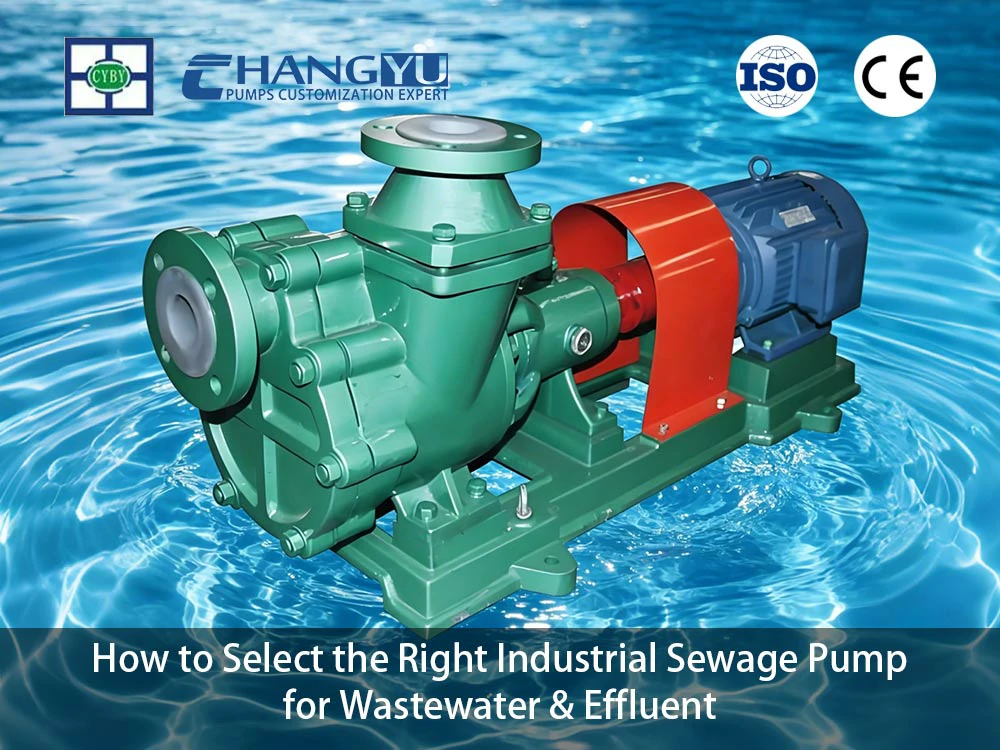
Ces exigences expliquent pourquoi la sélection d'une pompe à eaux usées industrielles est fondamentalement différente de la sélection d'une pompe à eau propre. Les systèmes résidentiels nécessitent des unités compactes et silencieuses ; les applications municipales privilégient un débit élevé et une résistance au colmatage ; les installations industrielles impliquent souvent des fluides corrosifs ou abrasifs. Une pompe qui traite des eaux usées municipales tamisées peut tomber en panne en quelques semaines lorsqu'elle est réaffectée à un effluent industriel non tamisé contenant des particules abrasives, de l'eau de procédé acide ou des déchets fibreux filandreux.
Ce guide fournit une référence structurée couvrant les types de roues de pompes à eaux usées industrielles, la technologie anti-colmatage, les matériaux et joints, les configurations d'installation, un cadre de sélection en six étapes, les protocoles de maintenance et une étude de cas quantitative. S'appuyant sur plus de deux décennies d'expérience en ingénierie des pompes, Changyu Pump apporte une expertise approfondie dans la spécification de solutions de pompes résistantes à la corrosion et à l'usure pour les applications exigeantes de traitement des eaux usées.
Qu'est-ce qu'une Pompe à Eaux Usées Industrielles ?
1.1 Définition de la carotte
Un pompe à eaux usées industrielles est une pompe centrifuge spécialement conçue pour transférer les eaux usées brutes ou partiellement traitées, les effluents de procédé et les boues dans les installations industrielles. Contrairement aux pompes à eau centrifuges standard—qui utilisent des roues fermées avec des passages étroits optimisés pour l'efficacité de l'eau propre—les pompes à eaux usées industrielles emploient des passages d'écoulement élargis et des géométries de roue spécialisées pour faire passer les solides sans colmatage. Les ingénieurs optimisent la roue et le chemin d'écoulement de la pompe à eaux usées en augmentant le diamètre de la roue et en élargissant le canal d'écoulement, obtenant ainsi une excellente capacité anti-colmatage.
Pour répondre aux besoins du transport à long terme de matériaux abrasifs, les ingénieurs utilisent généralement des matériaux en alliage à haute résistance à l'usure pour fabriquer les pompes à eaux usées, maximisant ainsi la durée de vie des pompes à eaux usées. Des moteurs robustes sont généralement utilisés pour éviter le colmatage lors du transport d'eaux usées visqueuses et chargées de solides. Des joints durables, résistants à l'usure et à la corrosion empêchent la défaillance des joints et les fuites de liquide dues à un contact prolongé avec le liquide.
2 En Quoi la Conception des Pompes à Eaux Usées Industrielles Diffère des Pompes Centrifuges Standard
| Fonctionnalité | Pompe centrifuge standard | Pompe à eaux usées industrielles |
|---|---|---|
| Type de roue | Roue fermée avec des passages étroits (haute efficacité) | Vortex, monocanal, bicanal, semi-ouverte, broyeuse ou à couteaux (passage de solides) |
| Débit Largeur de passage | Étroite ; optimisée pour l'efficacité de l'eau propre | Agrandi ; dimensionné pour le diamètre maximal attendu des particules solides |
| Manipulation des solides | Minimal (liquides propres uniquement) | 65-80 mm de solides sphériques pour les modèles à vortex ; jusqu'à 100 mm pour les grandes roues à canal |
| Construction de l'enveloppe | Volute standard pour l'efficacité | Volute avec jeu d'entretoise élargi ; alliage résistant à l'usure ou acier inoxydable |
| Système d'étanchéité | Garniture mécanique simple ; élastomères standard | Joint mécanique double avec chambre d'huile ; faces en carbure de silicium ; élastomères résistants aux produits chimiques ; détection d'humidité dans la chambre d'huile pour une surveillance précoce des joints |
| Protection contre l'usure | Minime | Bagues d'usure remplaçables, lèvres de volute trempées, plaques d'usure sacrificielles |
3 Types Typiques d'Eaux Usées Industrielles et Défis de Pompage
| L'industrie | Caractéristiques typiques des effluents | Défi du pompage primaire | Matériau recommandé |
|---|---|---|---|
| Galvanisation et finition des métaux | Acide (pH 1–5), contient des ions de métaux lourds | Corrosion chimique ; contamination par ions métalliques | PP, PVDF, revêtement en plastique fluoré |
| Traitement chimique | pH variable (0-14), solvants organiques, acides mixtes | Résistance chimique à large spectre | Revêtement PTFE/PFA ou UHMW-PE |
| Décapage de l'acier | HCl ou H₂SO₄ chauds (jusqu'à 90°C) avec dépôt d'oxyde de fer | Corrosion combinée à haute température et abrasion des particules | Acier inoxydable duplex CD4MCu ou UHMW-PE |
| Teinture textile | Alcalin (pH 9–12), couleur élevée, peluches fibreuses | Colmatage par fibres ; attaque chimique alcaline | Fonte ou acier inoxydable avec roue vortex |
| Alimentation et boissons | Solides organiques, graisses, huiles, pH variable | Manipulation des graisses et solides ; corrosion due aux produits de nettoyage chimiques | Acier inoxydable 316L |
| Exploitation minière et traitement des minerais | Eau de résidus acide ou alcaline, abrasion élevée | Abrasion sévère combinée à une corrosion modérée | Centrifugeuse à revêtement UHMW-PE |
Comment les Types de Roues Affectent-ils les Performances des Pompes à Eaux Usées ?
Le type de roue détermine si une pompe à eaux usées fonctionne en continu ou nécessite des interventions fréquentes de décolmatage. Chaque conception représente un compromis d'ingénierie différent entre la résistance au colmatage, l'efficacité hydraulique et la capacité de manipulation des solides. Le type de roue (vortex, canal, semi-ouverte, broyeuse) détermine les capacités de manipulation des solides de la pompe.
1 Roues Vortex
Les roues vortex sont encastrées hors du chemin d'écoulement principal, créant un tourbillon qui aspire le fluide et les solides en suspension à travers la pompe tandis qu'une seule partie des solides entre en contact avec la roue. Une roue vortex produit un vortex (effet tourbillon) qui permet à la boue, aux matériaux fibreux longs et aux déchets solides de passer, sans contact avec la roue.
Le principal avantage est une résistance maximale au colmatage—les roues vortex font passer des solides sensiblement plus gros que ce que les roues à canal de taille équivalente peuvent accommoder. Le compromis est l'efficacité hydraulique, typiquement 40–55% contre 60–75% pour une roue à canal comparable. Dans les applications d'eaux usées industrielles, cette pénalité d'efficacité est acceptée car le coût d'un seul événement de colmatage—intervention d'un opérateur, récupération de la pompe, dégagement manuel—dépasse de loin le coût énergétique supplémentaire de la roue moins efficace.
2 Roues Monocanal
Les roues monocanal présentent un grand passage d'écoulement de l'œil de la roue à la périphérie. La conception monocanal offre un grand passage libre qui réduit le risque de colmatage tout en maintenant une efficacité hydraulique plus élevée que les alternatives vortex (60–75%).
3 Roues Bicanal
Les roues bicanal offrent un équilibre entre efficacité (65–78%) et passage de solides, mais les conceptions bicanal fermées sont très sensibles au colmatage par des matériaux fibreux qui s'enroulent autour des aubes de la roue. Pour cette raison, les roues bicanal sont mieux réservées aux applications d'effluents traités et d'eaux usées tamisées où le contenu en solides est prévisible et les matériaux fibreux ont été éliminés.
4 Pompes Broyeuses et à Couteaux
Les pompes broyeuses intègrent un mécanisme de coupe en amont de la roue qui macère les solides en une fine boue avant que le fluide n'entre dans la pompe. Elles sont équipées de mécanismes de coupe pour déchiqueter les solides et sont idéales pour les réseaux d'assainissement sous pression où le colmatage est une préoccupation. Les pompes à couteaux utilisent un anneau de coupe fixe contre lequel les aubes de la roue cisaillent les solides entrants. Les deux types éliminent complètement la limitation de la taille de passage mais consomment de l'énergie supplémentaire et nécessitent un remplacement périodique des surfaces de coupe.
5 Roues Semi-Ouvertes
Les roues semi-ouvertes ont une plaque avant retirée, exposant les aubes d'un côté. Cette conception est moins sujette au colmatage que les roues fermées car il n'y a pas de passage confiné où les solides peuvent se coincer entre les plaques. La conception de roue semi-ouverte à aubes courbées vers l'arrière offre un équilibre entre la capacité de passage des solides et l'efficacité pour les eaux usées industrielles à teneur mixte en solides.
6 Comparaison des Types de Roues
| Type de roue | Passage des solides | Résistance au colmatage | Efficacité | Meilleure application |
|---|---|---|---|---|
| Vortex | Jusqu'à 80 mm sphérique | Excellent | 40–55% | Eaux usées brutes non tamisées, boues, déchets filandreux/fibreux |
| Canal unique | Jusqu'à 100 mm (S-tube®) | Bon | 60-75% | Eaux usées dégrillées, boues primaires |
| Deux canaux | Jusqu'au diamètre de passage de la roue | Modéré (les solides fibreux peuvent se colmater) | 65-78% | Effluents traités, eaux usées filtrées |
| Meuleuse/Coupeuse | Solides macérés - pas de limite de passage | Excellent (solides détruits) | Plus faible (consommation d'énergie accrue) | Réseaux d'assainissement sous pression, conduites de refoulement de petit diamètre |
| Semi-Ouverte | Matières solides fines à moyennes | Modéré | 55-70% | Eaux usées industrielles, fluides chargés de sable |
Quels Matériaux et Joints Sont les Meilleurs pour les Eaux Usées Industrielles ?
1 Matériaux du Corps et de la Roue
La sélection des matériaux pour une pompe à eaux usées industrielles doit répondre simultanément à l'abrasion due au sable, à la corrosion due aux eaux usées à pH variable et aux contraintes mécaniques dues à l'impact des solides.
La fonte grise est le matériau de base pour les applications standard d'assainissement municipal, offrant une bonne résistance à l'usure à un coût modéré. La fonte ductile offre une résistance aux chocs améliorée et est spécifiée pour les corps de pompe plus grands. Pour les eaux usées corrosives ou agressives, des matériaux de qualité supérieure sont nécessaires.
Acier inoxydable 316L offre une bonne résistance aux effluents légèrement acides ou alcalins mais a des limites documentées avec les flux riches en chlorures.
L'acier inoxydable duplex CD4MCu est spécialement conçu pour un service combiné de corrosion-abrasion.
UHMW-PE (Polyéthylène de très haut poids moléculaire) Les pompes revêtues fournissent une barrière chimique qui isole le corps de pompe des milieux agressifs tout en absorbant l'énergie d'impact des particules. Dans des conditions standardisées de test d'usure abrasive, la résistance à l'usure du PE-UHMW est environ 7 à 10 fois supérieure à celle de l'acier au carbone et de l'acier inoxydable. Pour les tâches les plus sévères de corrosion-abrasion combinée — eaux usées industrielles acides avec des solides abrasifs — les pompes revêtues de PE-UHMW offrent la meilleure protection combinée.
2 Systèmes de Garniture Mécanique
La garniture mécanique est le composant le plus vulnérable d'une pompe à eaux usées. Pour le service des eaux usées industrielles, les doubles garnitures mécaniques avec une chambre barrière remplie d'huile sont la spécification standard. Un système à double garniture, souvent avec une chambre d'huile entre les deux, ajoute de la redondance et protège contre les surpressions ou les mouvements inattendus de l'arbre. Deux jeux de faces de garniture en carbure de silicium tournent contre des sièges en carbure de silicium, la chambre d'huile fournissant lubrification, refroidissement et détection précoce de la dégradation de la garniture par analyse d'huile.
3 Sélection des Matériaux de Garniture et d'Élastomère
| Type d'élastomère | Meilleur pour | Gamme de pH | Temp. max. | Application typique |
|---|---|---|---|---|
| EPDM | Eaux usées alcalines, eaux usées générales | pH 5-14 | ~120°C | Eaux usées municipales standard, joints toriques, joints statiques |
| Viton (FKM) | Eaux usées acides, solvants | pH 2-10 | ~150°C | Eaux usées industrielles contenant des substances chimiques |
| FFKM (Kalrez) | Résistance chimique maximale | pH 0-14 | ~200°C | Effluents industriels agressifs, déchets chimiques mixtes |
| Nitrile (NBR) | Eaux usées contenant des hydrocarbures | pH 3-10 | ~100°C | Stations de pompage contaminées par des produits pétroliers |
4 Référence rapide pour la sélection des matériaux
| Matériau | Meilleur pour | Gamme de pH | Temp. max. | Application typique |
|---|---|---|---|---|
| Fonte | Eaux usées municipales générales | pH 5-10 | ~120°C | Eaux usées brutes standard, effluents filtrés |
| ACIER INOXYDABLE 316L | Eaux usées légèrement corrosives | pH 3-10 | ~120°C | Effluents industriels, eaux usées d'usines chimiques |
| CD4MCu Duplex SS | Corrosion-abrasion combinée | pH 2-12 | ~110°C | Eaux usées chargées de gravillons, eaux usées de FGD |
| Doublure en UHMW-PE | Combinaison de corrosion sévère et d'abrasion | Large (acide, alcali, sel) | ~90°C | Eaux usées industrielles acides contenant des solides abrasifs |
Quelle Configuration d'Installation Convient à Votre Application ?
1 Pompes à Eaux Usées Submersibles
Les pompes centrifuges submersibles pour eaux usées fonctionnent complètement immergées dans les eaux usées collectées, le moteur et la pompe étant intégrés dans une seule unité étanche. Utilisées dans les contextes résidentiels, municipaux et industriels, les pompes submersibles offrent des solutions polyvalentes et rentables. Leur conception leur permet d'être complètement immergées dans le fluide, réduisant le bruit, simplifiant l'installation et éliminant le besoin d'amorçage externe. L'installation ne nécessite ni fosse sèche ni plaque de base — la pompe est simplement descendue dans le puisard sur des rails de guidage.
2 Pompes à Eaux Usées Horizontales en Fosse Sèche
Les pompes centrifuges horizontales pour eaux usées en fosse sèche sont installées dans une chambre sèche adjacente au puisard. Cette configuration permet un accès complet à la pompe pour la maintenance sans avoir à retirer l'unité d'une position immergée. Les pompes en fosse sèche offrent généralement un rendement plus élevé que les alternatives submersibles, et le moteur fonctionne dans un environnement propre et sec.
3 Pompes à Eaux Usées Auto-Amorçantes
Les pompes centrifuges auto-amorçantes pour eaux usées peuvent évacuer l'air de la conduite d'aspiration et aspirer le fluide vers le haut sans amorçage manuel. Elles sont installées au-dessus du niveau du liquide — généralement au niveau du sol — avec une conduite d'aspiration s'étendant dans le puisard ou la fosse.
4 Pompes à Eaux Usées Verticales Cantilever
Les pompes verticales cantilever placent le moteur et les roulements au-dessus du couvercle du puisard, avec un long arbre s'étendant vers le bas jusqu'à une roue immergée. Aucun roulement ni garniture ne fonctionne sous le niveau du liquide, ce qui rend cette conception adaptée aux puisards profonds et aux eaux usées corrosives ou à haute température.
5 Guide de Sélection de la Configuration d'Installation
| Configuration | Accès pour la maintenance | Besoin d'espace | Meilleure application |
|---|---|---|---|
| Submersible | Nécessite la récupération de la pompe | Minimal (pas de fosse sèche) | Puits humides, stations de relevage, puisards profonds |
| Fosse sèche horizontale | Accès complet à la chambre sèche | Nécessite une fosse sèche adjacente | Stations permanentes, applications en service continu |
| Auto-amorçage | Accès complet au niveau scolaire | Empreinte au sol | Stations de relevage, pompage de dérivation, applications portables |
| Porte-à-faux vertical | Moteur accessible au-dessus du puisard | Espace au sol minimal | Puisards profonds, eaux usées corrosives/à haute température |
Comment Sélectionner la Bonne Pompe à Eaux Usées Industrielles : Un Cadre en 6 Étapes
Un processus de sélection structuré garantit l'alignement entre les performances de la pompe et les exigences réelles.
Étape 1 : Caractériser les eaux usées
Documentez le profil physique et chimique complet : type de solides (organiques, fibreux, sable), taille maximale des particules solides, pH, température, teneur en sable/particules abrasives, et la présence de tout produit chimique industriel. S'agit-il d'eaux grises, d'eaux noires, de ruissellement pluvial ou d'effluents industriels ? La teneur en solides, la composition chimique et la température auront un impact sur vos choix de matériaux et de conception. Le profil des solides détermine le type de roue ; le profil chimique détermine la fenêtre de compatibilité des matériaux.
Chiffres clés : Type de solides, taille max des particules, pH, température, teneur en sable.
Étape 2 : Définir le point de fonctionnement
Calculez le débit requis et la hauteur manométrique totale, en tenant compte de la hauteur d'élévation statique depuis le puisard ou la fosse, des pertes par frottement dans la tuyauterie de refoulement, et de toute exigence de pression à la destination. Définissez le point de fonctionnement de votre système (débit et pression). Utilisez des calculs hydrauliques ou consultez des ingénieurs pour une estimation précise.
Chiffres clés : Débit (GPM ou m³/h), HMT, hauteur d'élévation statique, pertes par frottement.
Étape 3 : Adapter le type de roue au profil des solides
Pour les eaux usées brutes non tamisées avec des matériaux fibreux et filandreux → roue vortex. Pour les eaux usées tamisées ou les boues primaires → roue monocanal. Pour les réseaux d'assainissement sous pression avec des conduites de refoulement de petit diamètre → pompe broyeuse. Pour les eaux usées industrielles mixtes → roue semi-ouverte. Le choix de la roue détermine la fiabilité à long terme de la pompe.
Logique de décision : Fibrous solids → vortex; screened wastewater → single-channel; pressure sewer → grinder; mixed media → semi-open.
2. Match the casing and impeller materials to the wastewater chemistry at its maximum operating temperature. For general municipal sewage, cast iron is sufficient. For corrosive or abrasive industrial wastewater, specify CD4MCu duplex stainless or UHMW-PE lined components. Select double mechanical seals with silicon carbide faces for all continuous-duty industrial sewage applications.
3. pH 5–10, low grit → cast iron; pH 2–12, grit-laden → CD4MCu duplex SS; pH 0–14, abrasive solids → UHMW-PE lined.
4. Step 5: Choose the Installation Configuration
5. Match the installation type to the site conditions. Is the installation in a confined wet well? Are you dealing with corrosive atmospheres, explosive zones, or temperature extremes? Submersible pumps require no dry pit; self-priming pumps provide above-ground access; vertical cantilever pumps eliminate submerged bearings.
6. Confined wet well → submersible; above-ground access needed → self-priming; deep corrosive sump → vertical cantilever; permanent station → dry-pit horizontal.
7. Don’t just evaluate purchase price. Consider maintenance intervals, seal accessibility, part availability, and mean time between failure (MTBF). A vortex impeller pump with lower efficiency but zero clogging events will routinely deliver lower TCO than a high-efficiency pump requiring frequent unclogging interventions.
8. Energy (60–70% of lifetime cost), wear parts, maintenance labor, downtime cost.
9. The most frequent failure modes in industrial sewage pump service are: impeller clogging from fibrous solids or large debris; seal leakage from grit ingress between seal faces; bearing failure from water contamination due to seal degradation; cavitation damage from insufficient NPSH margin; and excessive vibration from unbalanced impeller due to uneven wear or solids accumulation.
10. A life-cycle cost evaluation for an industrial sewage pump should factor in capital cost, energy consumption (typically 60–70% of lifetime cost), wear part replacement frequency, maintenance labor, and the production cost of unplanned downtime caused by clogging or failure. High-efficiency motors and VFD compatibility can cut long-term operating costs. A pump with a higher initial price but substantially longer service life in the specific wastewater chemistry routinely delivers lower TCO than a budget alternative requiring frequent rebuilds.
11. The UHB Series is a cantilevered, single-stage, single-suction centrifugal pump with a steel-lined
12. casing. Its advanced “steel-lined plastic” construction leverages UHMW-PE’s exceptional wear resistance—approximately 7–10 times that of carbon steel and stainless steel under standardized abrasive wear test conditions—combined with broad chemical compatibility across the full pH spectrum at temperatures up to 90°C. For industrial wastewater applications where the effluent contains both aggressive chemicals and abrasive solids—such as mining tailings water, phosphoric acid wastewater, and chemical plant effluent—the UHMW-PE lining provides combined corrosion and wear protection that neither a pure metal pump nor a pure plastic pump can deliver alone.
13. FZB Series Self-Priming Fluorine-Lined Centrifugal Pump
14. CYQ Series Magnetic Drive Sealless Pump
15. —it serves as an ideal replacement for traditional corrosion-resistant fluorine-lined pumps. For industrial wastewater applications where the chemistry is moderately corrosive and a metallic wetted path is compatible with the process stream, the CYH Series provides a durable, standards-compliant solution.
16. Industrial Sewage Pump Selection Quick Reference
17. Combined corrosion-abrasion industrial wastewater with fine solids
18. Self-priming fluorine-lined centrifugal
19. Corrosive wastewater below grade; suction lift required
20. Toxic, flammable, high-value chemical wastewater
21. Moderate-corrosion industrial wastewater
22. 304, 316, 316L, Duplex.
Étape 4 : Sélection des matériaux et de la configuration des joints
Faites correspondre les matériaux du carter et de la roue à la chimie des eaux usées à sa température de fonctionnement maximale. Pour les eaux usées municipales générales, la fonte suffit. Pour les eaux usées industrielles corrosives ou abrasives, spécifiez des composants en acier inoxydable duplex CD4MCu ou revêtus d'UHMW-PE. Sélectionnez des garnitures mécaniques doubles avec faces en carbure de silicium pour toutes les applications d'eaux usées industrielles en service continu.
Logique de décision : pH 5–10, faible teneur en sable → fonte ; pH 2–12, chargé de sable → acier inoxydable duplex CD4MCu ; pH 0–14, solides abrasifs → revêtement UHMW-PE.
Étape 5 : Choisissez la configuration d'installation
Faites correspondre le type d'installation aux conditions du site. L'installation se fait-elle dans un puisard humide confiné ? Avez-vous affaire à des atmosphères corrosives, des zones explosives ou des températures extrêmes ? Les pompes submersibles ne nécessitent pas de fosse sèche ; les pompes auto-amorçantes offrent un accès hors sol ; les pompes verticales en porte-à-faux éliminent les roulements immergés.
Logique de décision : Puisard humide confiné → submersible ; accès hors sol nécessaire → auto-amorçante ; puisard profond corrosif → verticale en porte-à-faux ; station permanente → horizontale en fosse sèche.
Étape 6 : Évaluer le coût total de possession
N'évaluez pas seulement le prix d'achat. Tenez compte des intervalles de maintenance, de l'accessibilité des garnitures, de la disponibilité des pièces et du temps moyen entre défaillances (MTBF). Une pompe à roue vortex avec une efficacité moindre mais sans colmatage offrira généralement un coût total de possession (TCO) inférieur à celui d'une pompe à haute efficacité nécessitant des interventions fréquentes de décolmatage.
Facteurs clés : Énergie (60–70 % du coût de durée de vie), pièces d'usure, main-d'œuvre de maintenance, coût des temps d'arrêt.
Maintenance, Troubleshooting, and Life-Cycle Cost Management
6.1 Modes de défaillance courants
Les modes de défaillance les plus fréquents dans le service des pompes à eaux usées industrielles sont : le colmatage de la roue par des solides fibreux ou de gros débris ; la fuite de la garniture due à l'infiltration de sable entre les faces ; la défaillance des roulements due à la contamination par l'eau résultant de la dégradation de la garniture ; les dommages par cavitation dus à une marge NPSH insuffisante ; et les vibrations excessives dues à un déséquilibre de la roue causé par une usure inégale ou une accumulation de solides.
6.2 Calendrier d'entretien préventif
| Intervalle | Tâche |
|---|---|
| Quotidiennement | Contrôler le courant du moteur et la pression de refoulement ; vérifier l'absence de vibrations ou de bruits inhabituels. |
| Hebdomadaire | Vérifier l'état de l'huile d'étanchéité (rechercher une contamination par l'eau - une huile laiteuse indique une fuite du joint intérieur) ; vérifier la température du roulement. |
| Mensuel | Mesurer le jeu entre la roue et le carter ; inspecter les bagues d'usure pour vérifier qu'elles ne sont pas rainurées ou amincies ; vérifier l'état des joints toriques et des joints d'étanchéité. |
| Trimestrielle | Inspection complète de l'extrémité humide ; remplacement du lubrifiant des paliers ; vérification de l'intégrité du joint par un essai de pression. |
| Annuellement | Démontage complet de la pompe ; mesure et remplacement de tous les composants d'usure (roue, bagues d'usure, joints, paliers) ; vérification de l'intégrité du corps et de l'arbre. |
6.3 Guide de dépannage rapide
| Symptôme | Cause probable | Mesures recommandées |
|---|---|---|
| La pompe se bouche de manière répétée | Type de roue inadapté au profil des solides | Passer à une roue vortex ; vérifier que le diamètre de passage libre est supérieur à la taille de la plus grande particule solide. |
| Diminution progressive du débit | Usure de la roue ou augmentation des jeux internes | Ajuster le jeu de la roue ; remplacer les bagues d'usure si le jeu dépasse la limite fixée par le fabricant. |
| Fuite du joint | Pénétration de gravillons entre les faces du joint ; élastomère dégradé | Inspecter les faces des joints pour vérifier l'absence de rayures ; vérifier l'absence de contamination dans la chambre à huile ; remplacer les joints. |
| Vibrations excessives | Roue déséquilibrée ; cavitation ; détérioration des roulements | Nettoyer la roue ; vérifier la marge NPSH ; inspecter les paliers pour déceler des piqûres ou des écaillages. |
| Déclenchement de la surcharge du moteur | Bourrage de solides ; augmentation de la viscosité ; grippage des roulements | Dégager la roue ; vérifier que la viscosité de l'effluent est conforme aux valeurs nominales de la pompe ; inspecter les roulements. |
4 Life-Cycle Cost Evaluation
Une évaluation du coût du cycle de vie pour une pompe à eaux usées industrielles doit prendre en compte le coût d’investissement, la consommation d’énergie (généralement 60–70 % du coût total), la fréquence de remplacement des pièces d’usure, la main-d’œuvre de maintenance et le coût de production des temps d’arrêt imprévus causés par un colmatage ou une défaillance. Les moteurs à haut rendement et la compatibilité VFD peuvent réduire les coûts d’exploitation à long terme. Une pompe avec un prix initial plus élevé mais une durée de vie nettement plus longue dans la chimie spécifique des eaux usées offre généralement un TCO inférieur à celui d’une alternative économique nécessitant des reconstructions fréquentes.
Changyu Pump Industrial Sewage Pump Solutions
Les séries suivantes de pompes Changyu répondent aux principaux défis de pompage des eaux usées évoqués ci-dessus, chacune étant adaptée aux caractéristiques spécifiques des effluents et aux exigences opérationnelles.
Série UHB Pompe centrifuge à revêtement UHMW-PE

La série UHB est une pompe centrifuge cantilever, monocellulaire et à simple aspiration avec un carter en acier doublé UHMW-PE de plastique. Sa construction avancée “ acier doublé plastique ” exploite la résistance exceptionnelle à l’usure de l’UHMW-PE—environ 7 à 10 fois celle de l’acier au carbone et de l’acier inoxydable dans des conditions standardisées de test d’usure abrasive—combinée à une large compatibilité chimique sur toute la gamme de pH à des températures allant jusqu’à 90 °C. Pour les applications d’eaux usées industrielles où l’effluent contient à la fois des produits chimiques agressifs et des solides abrasifs—tels que les eaux de résidus miniers, les eaux usées d’acide phosphorique et les effluents d’usines chimiques—le revêtement en UHMW-PE offre une protection combinée contre la corrosion et l’usure qu’une pompe purement métallique ou purement plastique ne peut offrir seule.
Principales spécifications : Débit 3-2,600 m³/h | Hauteur de chute 5-100 m | Puissance 0.75-300 kW | Température -20°C à 90°C
Série FZB Pompe centrifuge auto-amorçante à revêtement fluoré
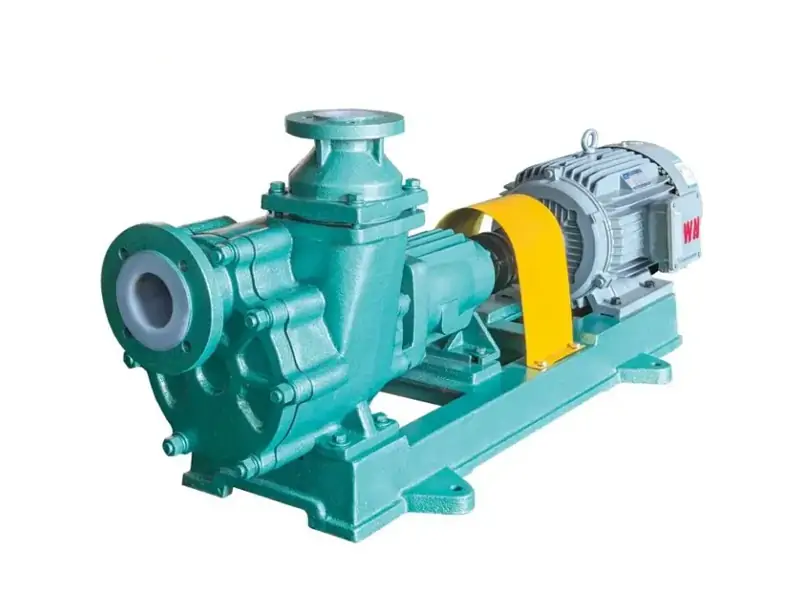
La série FZB est une pompe centrifuge auto-amorçante avec des composants à circulation interne revêtus d'un revêtement en acier inoxydable. FEP (F46) ou PFA. It is designed for corrosive liquid transfer where suction conditions are difficult or the fluid level is below the pump inlet. Once initially filled, the pump can automatically evacuate air from the suction line and maintain continuous operation under demanding chemical conditions. For industrial sewage applications where the pump must lift corrosive or chemically aggressive wastewater from below-grade sumps or pits, the FZB Series provides the combined advantages of self-priming hydraulics, fluoroplastic corrosion resistance, and above-ground maintenance access.
Principales spécifications : Débit 2,5-100 m³/h | Hauteur de chute 15-50 m | Puissance 0,75-55 kW | Température -20°C à 150°C
Série CYQ Pompe sans joint à entraînement magnétique
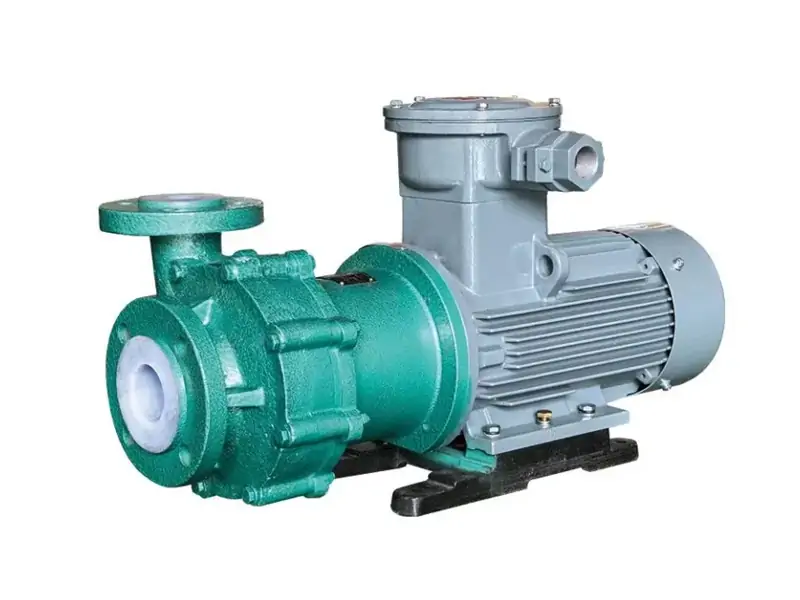
La série CYQ est une pompe à entraînement magnétique sans garniture, dont les composants en contact avec le liquide sont revêtus d'une couche d'aluminium. FEP, PFA ou PTFE. Torque is transmitted from a standard motor across a stationary isolation sleeve via a permanent magnet rotor, enclosing the process fluid in a fully sealed chamber and achieving zero leakage by design. For industrial sewage applications containing toxic, flammable, or high-value chemicals—where even minor mechanical seal leakage is unacceptable—the magnetic drive design eliminates the mechanical seal and its associated leak path entirely, providing the zero-leakage containment required for safe, compliant operation.
Principales spécifications : Débit 3-800 m³/h | Hauteur de chute 15-125 m | Puissance 2.2-110 kW | Vitesse 2,950 r/min | Température -20°C à 180°C
Pompe centrifuge en acier inoxydable pour produits chimiques de la série CYH
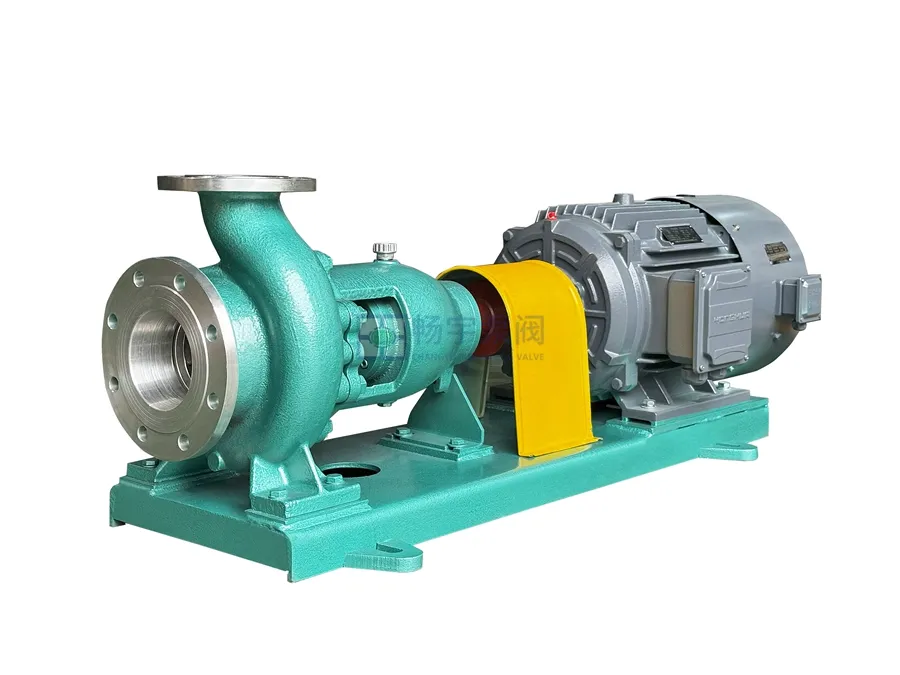
La série CYH est une pompe centrifuge en porte-à-faux mono-étagée et mono-aspiration, conçue et étiquetée conformément aux normes de l'Union européenne. ISO 2858-1975(E). Constructed from stainless steel—Acier inoxydable 304, 316, 316L ou duplex—elle sert de remplacement idéal pour les pompes traditionnelles à revêtement fluoré résistantes à la corrosion. Pour les applications d’eaux usées industrielles où la chimie est modérément corrosive et où un chemin mouillé métallique est compatible avec le flux du procédé, la série CYH offre une solution durable et conforme aux normes.
Principales spécifications : Débit 0,8–750 m³/h | Hauteur 3–130 m | Puissance 2,2–110 kW | Température -20°C à 165°C
Guide de sélection rapide des pompes à eaux usées industrielles
| Série de pompes | Type | Meilleure application | Matériaux clés |
|---|---|---|---|
| UHB | Centrifugeuse à revêtement UHMW-PE | Eaux usées industrielles combinant corrosion et abrasion avec des solides fins | UHMW-PE |
| FZB | Pompe centrifuge auto-amorçante à revêtement fluoré | Eaux usées corrosives sous le niveau du sol ; hauteur d’aspiration requise | FEP (F46), PFA |
| CYQ | Entraînement magnétique sans joint | Eaux usées chimiques toxiques, inflammables et de grande valeur | FEP, PFA, PTFE |
| CYH | Centrifugeuse en acier inoxydable | Eaux usées industrielles à corrosion modérée | 304, 316, 316L, Duplex |
Case Study: Solving Clogging Issues in an Industrial Wastewater Treatment Plant
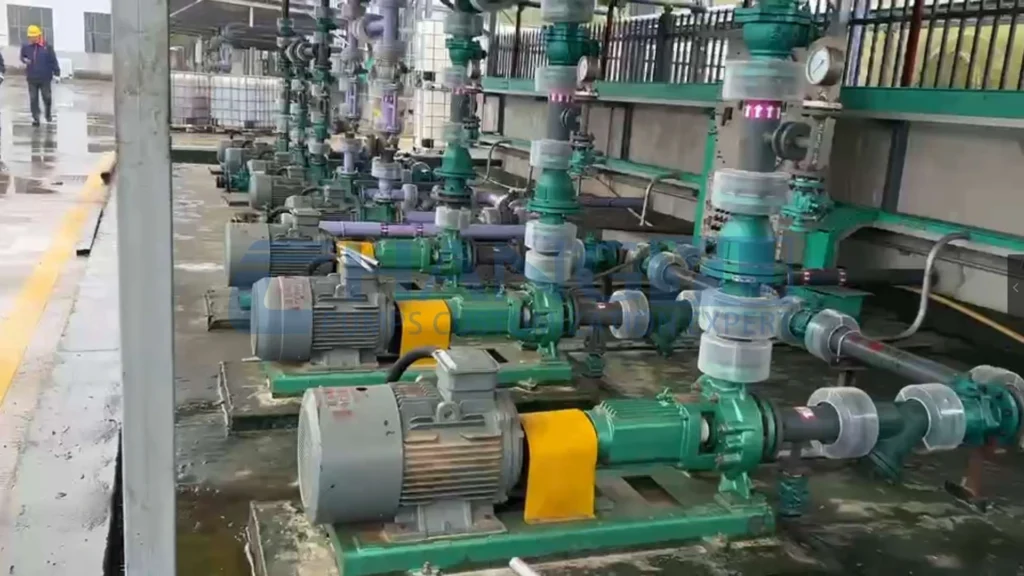
Le défi du client : Une usine de traitement chimique en Asie du Sud-Est subissait des colmatages chroniques de ses pompes centrifuges standard manipulant des effluents industriels. Le flux d'eaux usées contenait un mélange d'eau de procédé acide (pH 3–5), de solides fibreux provenant de médias filtrants et de particules abrasives de catalyseur. Les pompes étaient équipées de roues fermées à deux canaux, qui se colmataient à plusieurs reprises sur les matériaux fibreux. Les pompes se colmataient trois à quatre fois par mois, nécessitant une intervention de l'opérateur à chaque fois. Après 14 mois de fonctionnement, l'usure des roues due à l'attaque chimico-mécanique combinée avait réduit l'efficacité de la pompe d'environ 35%, et les garnitures mécaniques avaient cédé trois fois en raison de l'attaque acide sur les élastomères des garnitures.
Analyse d'ingénierie : Les ingénieurs de Changyu Pump ont évalué les données de fonctionnement et le profil chimique et physique complet des eaux usées. La cause première du colmatage était la roue fermée à deux canaux, qui était sensible à l'enroulement des solides fibreux autour des aubes. Le fluide porteur acide (pH 3–5) attaquait également le corps en fonte et les élastomères standard des garnitures EPDM, accélérant la perte de matière par le mécanisme combiné de corrosion-abrasion.
Solution déployée : Changyu Pump a remplacé les pompes existantes par Série UHB Pompes centrifuges à revêtement UHMW-PE qui présente les modifications de conception suivantes :
- Corps chemisé en UHMW-PE : A éliminé entièrement le contact acide avec le corps de la pompe, supprimant la composante de corrosion de l'équation d'usure tout en absorbant l'énergie d'impact des particules des solides abrasifs du catalyseur.
- Roue tourbillonnaire avec un passage libre de 65 mm : La roue en retrait permettait aux solides fibreux de traverser la pompe sans contact direct avec la roue, éliminant le colmatage qui avait affecté la conception à canaux fermés.
- Garniture mécanique double en carbure de silicium avec élastomères FFKM : Les joints toriques FFKM (Kalrez) offraient une compatibilité chimique vérifiée avec le fluide porteur acide à la température de fonctionnement, et la chambre barrière remplie d'huile offrait une redondance contre la défaillance de la garniture avec une capacité de détection précoce de l'humidité.
Résultats quantifiés (évaluation à 18 mois) :
| Métrique | Avant la mise à niveau | Après la mise à niveau | Amélioration |
|---|---|---|---|
| Événements de clogging par mois | 3–4 | < 0,2 (un tous les 5–6 mois) | ~94% de réduction |
| Durée de vie de la roue | 14 mois | > 30 mois (toujours en service) | 2×+ extension |
| Défaillances de joints par an | 2.6 | Zéro | Réduction 100% |
| Coût annuel d'entretien | 15 600 USD | 5 200 USD | ~67% de réduction |
| Disponibilité des stations | 91% | > 99% | 8+ points de pourcentage |
Foire aux questions sur les pompes à eaux usées industrielles
Q1 : Quelle est la différence entre une pompe centrifuge standard et une pompe à eaux usées industrielle ?
R : Les pompes centrifuges standard utilisent des roues fermées avec des passages étroits optimisés pour l'efficacité de l'eau propre. Les pompes à eaux usées industrielles utilisent des roues vortex, à canal unique ou semi-ouvertes avec des passages d'écoulement élargis et des matériaux résistants à l'usure pour faire passer les eaux usées chargées de solides sans colmatage. Les roues et les chemins d'écoulement des pompes à eau conventionnelles ne sont pas optimisés pour la manipulation des solides ; les fibres longues et les débris colmatent fréquemment les roues standard.
Q2 : Quel est le meilleur type de roue pour les eaux usées brutes non filtrées ?
R : Les roues vortex offrent la meilleure résistance au colmatage pour les eaux usées brutes non tamisées. La roue est en retrait du chemin d'écoulement principal, créant un tourbillon qui fait passer les solides sans contact direct avec la roue. Les roues vortex peuvent faire passer des solides sphériques jusqu'à 80 mm et constituent la spécification standard pour les eaux usées brutes, les boues contenant des solides filandreux et les eaux usées industrielles à teneur imprévisible en solides.
Q3 : Quels matériaux résistent à la fois à la corrosion et à l'abrasion dans les eaux usées industrielles ?
R : L'acier inoxydable duplex CD4MCu offre une résistance combinée à la corrosion-abrasion pour les eaux usées légèrement acides chargées de sable à des températures allant jusqu'à 110°C. Les pompes chemisées en UHMW-PE offrent la meilleure protection combinée pour les eaux usées fortement acides ou alcalines contenant des solides abrasifs à des températures allant jusqu'à 90°C. La résistance à l'usure de l'UHMW-PE est environ 7 à 10 fois supérieure à celle de l'acier au carbone et de l'acier inoxydable.
Q4 : Quelle est la différence entre une pompe broyeuse et une pompe à couteaux ?
R : Les pompes broyeuses utilisent un disque de coupe et une bague de broyage pour macérer les solides en une boue fine avant que le fluide n'entre dans la roue. Elles sont idéales pour les réseaux d'assainissement sous pression. Les pompes à couteaux utilisent une bague de coupe fixe contre laquelle les aubes de la roue cisaillent les solides entrants. Les deux éliminent le colmatage mais nécessitent un remplacement périodique des surfaces de coupe.
Q5 : Quand dois-je choisir une pompe submersible plutôt qu'une pompe auto-amorçante ?
R : Choisissez une pompe submersible pour les puisards profonds et confinés où la pompe doit fonctionner complètement immergée et où l'espace pour une fosse sèche n'est pas disponible. Choisissez une pompe auto-amorçante lorsque l'accès à la maintenance hors sol est requis, lorsque la hauteur d'aspiration est dans la capacité de la pompe (généralement jusqu'à 25 pi), ou lorsque la pompe doit être portable pour des applications de dérivation.
Q6 : Quelle configuration de garniture est recommandée pour les eaux usées industrielles ?
R : Les garnitures mécaniques doubles avec une chambre barrière remplie d'huile et des faces en carbure de silicium sont la spécification standard pour les applications continues d'eaux usées industrielles. La chambre d'huile fournit la lubrification, le refroidissement et la détection précoce de la dégradation de la garniture. Les joints toriques FFKM (Kalrez) doivent être spécifiés pour les eaux usées chimiquement agressives.
Q7 : À quelle fréquence une pompe à eaux usées industrielle doit-elle être entretenue ?
A : Quotidiennement : contrôle du courant du moteur et de la pression de refoulement. Chaque semaine : contrôle de l'état de l'huile d'étanchéité et de la température des paliers. Mensuellement : mesure du jeu de la roue et inspection des bagues d'usure. Trimestriellement : inspection complète de la partie humide. Chaque année : démontage complet, remplacement des pièces d'usure et renouvellement de la lubrification des paliers.
Q8 : Qu'est-ce qui cause la défaillance des garnitures des pompes à eaux usées et comment peut-elle être évitée ?
R : Les principaux mécanismes de défaillance sont l'infiltration de sable entre les faces de la garniture et l'attaque chimique des élastomères de la garniture. Les garnitures mécaniques doubles avec une chambre barrière remplie d'huile offrent une redondance — si la garniture externe tombe en panne, la garniture interne maintient le confinement, et la contamination de l'huile fournit un avertissement précoce. L'adaptation des matériaux élastomères (EPDM, Viton, FFKM) à la chimie spécifique des eaux usées empêche la dégradation chimique.
Recommandations d'experts pour la sélection des ingénieurs de Changyu Pump
- Adaptez le type de roue au profil des solides, et non à la courbe d'efficacité. Une roue vortex avec une efficacité hydraulique inférieure qui fonctionne sans colmatage offrira un coût total de possession inférieur à celui d'une roue fermée à haute efficacité qui se colmate chaque semaine. Le coût d'un seul événement de colmatage — intervention de l'opérateur, récupération de la pompe et dégagement manuel — dépasse de loin le coût énergétique supplémentaire.
- Sélectionnez les matériaux pour l'environnement combiné de corrosion-abrasion. Lorsque le pH est inférieur à 4 ou supérieur à 10, la fonte standard se corrode aux joints de grains, et le taux de perte de matière combiné peut dépasser l'usure par abrasion pure d'un facteur de 2 à 5. Les pompes revêtues de PE-UHMW ou en acier inoxydable duplex CD4MCu offrent la protection combinée requise.
- Spécifiez des doubles garnitures mécaniques avec chambres d'huile pour les applications en service continu. Une seule défaillance de garniture sur une pompe à eaux usées industrielles crée à la fois un rejet environnemental et un risque de contamination des roulements. Les doubles garnitures avec faces en carbure de silicium et élastomères FFKM adaptés à la chimie des eaux usées offrent la redondance et la résistance chimique requises.
- Choisissez la configuration d'installation en fonction de l'accès pour la maintenance, et pas seulement des contraintes d'espace. Une pompe auto-amorçante avec accès hors sol sera entretenue plus fréquemment et plus minutieusement qu'une pompe submersible nécessitant le retrait par grue d'un puisard profond.
- Évaluez le coût total de possession sur un horizon de 3 à 5 ans, et non le seul prix d'achat. Tenez compte de l'énergie (60 à 70 % du coût sur la durée de vie), des pièces d'usure, de la main-d'œuvre de maintenance et du coût de production des temps d'arrêt causés par le colmatage. Une pompe avec un prix initial plus élevé mais une durée de vie sensiblement plus longue dans la chimie spécifique des eaux usées offre systématiquement un coût total de possession inférieur.
11. Conclusion
Un pompe à eaux usées industrielles est défini par la conception de sa roue et son choix de matériaux — deux décisions qui déterminent si la pompe fonctionne en continu ou nécessite des interventions de décolmatage fréquentes et coûteuses. Les roues vortex offrent un passage maximal des solides et une résistance au colmatage pour les eaux usées brutes non dégrillées. Les roues à un canal offrent le meilleur équilibre entre rendement et passage des solides pour les eaux usées dégrillées. Les pompes broyeuses et dilacératrices éliminent le colmatage dans les applications de réseaux d'assainissement sous pression.
Le choix des matériaux complète la spécification. La fonte sert pour les eaux usées municipales générales. L'acier inoxydable duplex CD4MCu offre une résistance combinée à la corrosion et à l'abrasion pour les eaux usées industrielles. Les pompes revêtues de PE-UHMW offrent la meilleure protection combinée pour les effluents chimiques agressifs contenant des solides abrasifs. Les doubles garnitures mécaniques avec faces en carbure de silicium et chambres de barrière remplies d'huile sont la norme pour le service continu.
L'étude de cas quantitative démontre ce que les ingénieurs observent dans la pratique : une pompe qui se colmate trois à quatre fois par mois coûte bien plus en possession totale qu'une pompe non colmatante bien spécifiée. La roue vortex avec revêtement en PE-UHMW a réduit les événements de colmatage d'environ 94 %, prolongé la durée de vie de la roue de plus du double et réduit le coût annuel de maintenance d'environ 67 %.
Contacter Changyu Pump avec vos paramètres d'eaux usées et vos exigences de procédé. Notre équipe d'ingénierie fournira une recommandation de pompe détaillée et un devis adapté à votre application de pompe à eaux usées industrielles.