
For many titanium dioxide slurry duties, an air-operated double diaphragm pump is a practical answer: it self-primes, survives dry running, has no rotating shaft seal, and passes solids that would jam a close-clearance pump. What it will not do is treat every TiO₂ stream as one fluid. A milled pigment slurry at high solids, a dilute letdown line and a tank bottom that has settled overnight are three different problems, and the diaphragm, valve and body that suit one can be wrong for another — which is why sizing an AODD pump for slurry titanium dioxide duty starts with the medium, not the model. If the choice is not obvious after reading this, our engineers will work through it with you; that is the part of the job more than 20 years in this business has made routine.
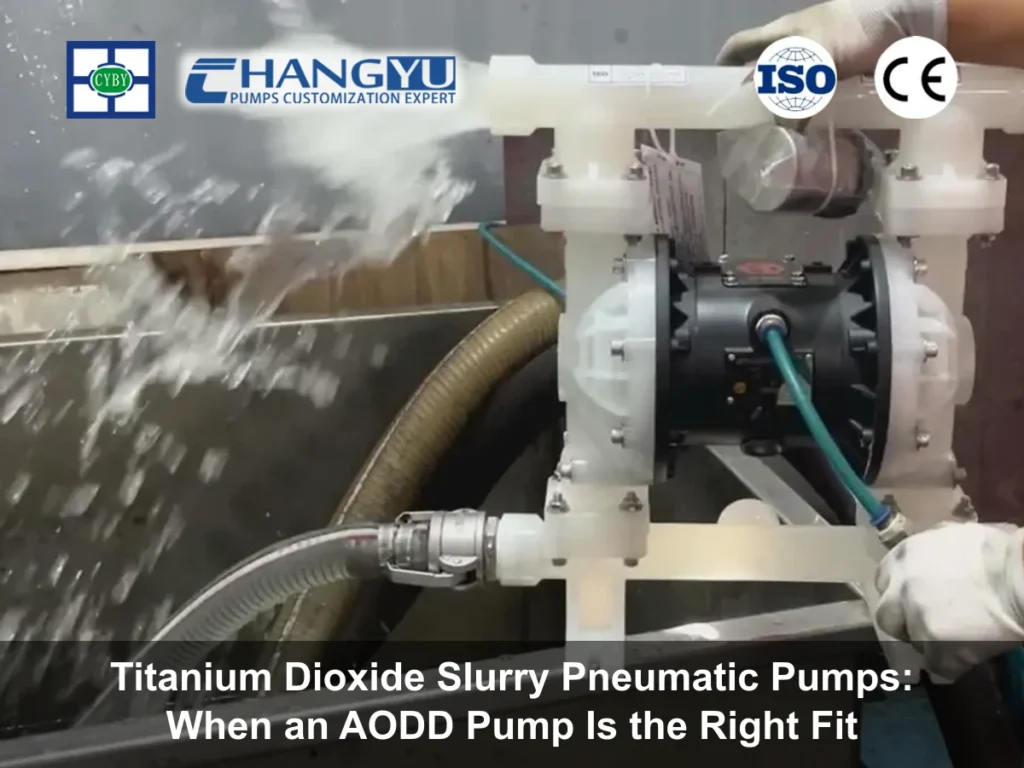
Can pneumatic pumps move titanium dioxide slurry reliably?
They can, if the slurry stays in suspension long enough to reach the pump and the pump is sized on the discharge pressure it will actually see. TiO₂ is a fine, chemically stable white powder, and most of it goes into paints, plastics and coatings (Titanium Dioxide Manufacturers Association). In a plant it appears as dry pigment, as a dispersant-stabilized milled slurry, or as a dilute stream after letdown and washing. That is wide territory for pneumatic pumps for titanium dioxide, and one plant often runs two different configurations on two lines.
Because the particles are fine, the wear mechanism is not impact. It is slow abrasion of anything flexible or seating, plus solids settling in low-velocity pipework and in the valve chest between batches.
How does an air-operated diaphragm pump move TiO₂ slurry?
Compressed air pushes one diaphragm, the linked diaphragm opposite pulls, and four check valves turn that reciprocation into suction and discharge.
An air distribution valve alternates air between the two chambers, so one side discharges while the other fills. Each stroke moves a fixed volume, so capacity is set by air pressure and stroke rate rather than by a throttle valve. The process fluid never reaches the air valve; the wetted geometry is the chamber, valve chest and manifold. There is no impeller and no close clearance, so an agglomerate that would damage a centrifugal impeller passes through.
Our published maximum solids size is 3.2 mm for the BFQ4-25 and up to 9.4 mm for larger standard BFQ models, which puts most pigment slurries well inside the passage limit. The real constraint is rarely the ball passage. It is settling, and it is the air supply.
Where do titanium dioxide slurry pneumatic pumps wear first?
At three points an AODD cannot fully protect: the diaphragm flex zone, the check valve seating line and the valve chest.
A diaphragm flexes twice per cycle where it is clamped, and particles trapped between diaphragm and clamp plate act like lapping compound — the failure starts as a crease and ends as a pinhole. Ball check valves seal on a narrow contact band, so one embedded particle holds the ball slightly off its seat. The pump keeps cycling but delivers less: first slow transfer, later a pump that runs fast and moves almost nothing. That is the symptom behind most diaphragm pump titanium dioxide slurry complaints when a set of balls and seats would have fixed it. Bridged solids in the valve chest stop a chamber filling, so the pump cycles erratically and slams its diaphragms at the end of every stroke. This points to condition-based inspection rather than a fixed interval. We do not publish a diaphragm life figure for pigment slurry; it depends on solids loading, stroke rate, air quality and temperature in a way one number cannot capture.
If a pump has lost flow without an obvious cause, describe it and send photos of the valve chest and diaphragms. More than 20 years of abrasive and corrosive duty work makes that diagnosis fairly quick for our engineers, and it often prevents a pump being replaced when only the wear parts were due.
How do viscosity, solids and particle size change the pump you need?
Viscosity shows up on the suction side, because an AODD lifts liquid by vacuum. Thixotropic slurry sitting in a sump may not enter the suction line until it is agitated. The fixes are flooded suction, a larger suction pipe, a slower stroke rate, and a larger pump running gently rather than a small one flat out. A datasheet viscosity is a starting point: slurry at rest and slurry in motion are not the same fluid.
Solids content drives density, settling and abrasion, so size on mass flow. Particle size and shape decide how much damage each particle does; fine pigment is gentler than hard agglomerates or grit carried over from upstream. A strainer protects the valve chest but adds cleaning and pressure drop, so choose it deliberately.
Most inquiries arrive without a viscosity curve, and that is normal. A solids percentage and a description of how the slurry behaves in the tank are enough for us to start sizing a pneumatic pump for titanium dioxide duty.
Why do air supply, suction and pulsation matter so much?
Because most problems blamed on the pump start there.
Pressure and volume are different things, and a pump stalling mid-stroke is usually air-starved, not worn out. Air demand rises with discharge pressure and stroke rate, so undersized lines, long runs, clogged filters and wet air all cut what reaches the pump. Compressed air is made on site and is one of the costlier utilities to produce (Compressed Air and Gas Institute), so compensating for a restricted suction line with maximum air pressure costs twice: once in energy, once in wear.
On suction, keep the run short, straight and below liquid level where the layout allows, and avoid high points where gas collects. Air entering the suction makes the pump run fast and hit its diaphragms hard at the end of every stroke.
Pulsation is the third. Discharge pulses at stroke frequency — fine for tank transfer, not fine for a flow meter, an in-line filter or a coating feed line that needs steady pressure. A dampener near the discharge solves most of it, and the fourth-generation BFQ4 integrates dampening into the pump assembly.
Email: [email protected]
TEL/WA: +86-13651913727
How should you choose the body, diaphragm and valve materials?
From the complete medium — chemistry, temperature, solids and cleaning regime — not from the words “titanium dioxide”.
Our BFQ range is built in cast steel, ductile iron, aluminum alloy, PP, stainless steel and PVDF. In pigment service the choice usually narrows to PP, PVDF or stainless steel. PP is economical for many aqueous slurries at moderate temperature; PVDF extends the chemical and temperature window; stainless steel is chosen where robustness or higher temperature is needed and chloride levels allow. Aluminum and cast iron are rarely right for a pigmented product, for corrosion and contamination both. Diaphragms are a genuine trade-off. PTFE resists a wide chemical range but tolerates repeated flexing less well than elastomers; elastomers flex better with a narrower chemical window. Our standard construction uses a PTFE diaphragm in a multi-piece assembly, and the right choice depends on which limit you are closer to.
Valve balls and seats must resist abrasion and chemical attack at once, and those pull in opposite directions: a seat soft enough to seal against fine particles wears faster, while one hard enough to resist abrasion may seal poorly once a particle is trapped. That is why we ask for the full medium rather than a pH value. If you are weighing options and cannot tell which your duty needs, send the details and let our engineers narrow it down with you.
When is an electric diaphragm pump or a centrifugal slurry pump better?
Think in duty, not pump type.
An AODD suits intermittent transfer, variable duty, portable or sump-mounted service, solids in suspension, and areas where removing the motor from the pump is worth something. It is also the easiest to start against a partly empty line.
The BFD series electric diaphragm pump is a different machine, with a motor, a gear reducer and a crankshaft-slider drive. It gives steady flow and continuous duty at lower energy per cubic meter and is easier to instrument. In exchange it needs power at the pump, its published particle passage is smaller at 2.5 mm across the range, and it is not an air-operated pump.
A centrifugal slurry pump such as our UHB series UHMWPE corrosion resistant pump delivers high flow at moderate head with smooth, pulse-free discharge. It needs flooded suction or priming, it shears the product, and it loses head as flow rises. It suits some TiO₂ slurry duties and is wrong for high-head, low-flow service or solids that settle in the line.
Rough rule: steady high flow into a header, centrifugal; steady moderate flow with tight control, electric diaphragm; intermittent, self-priming, solids-laden or hazardous-area duty, air-operated. Real installations blur those lines. If your duty point sits near a boundary — low flow at high head, or a line that drains between batches — describe it before you order, because that is the usual reason a pump gets blamed for a system problem.
Tentang Changyu Pump
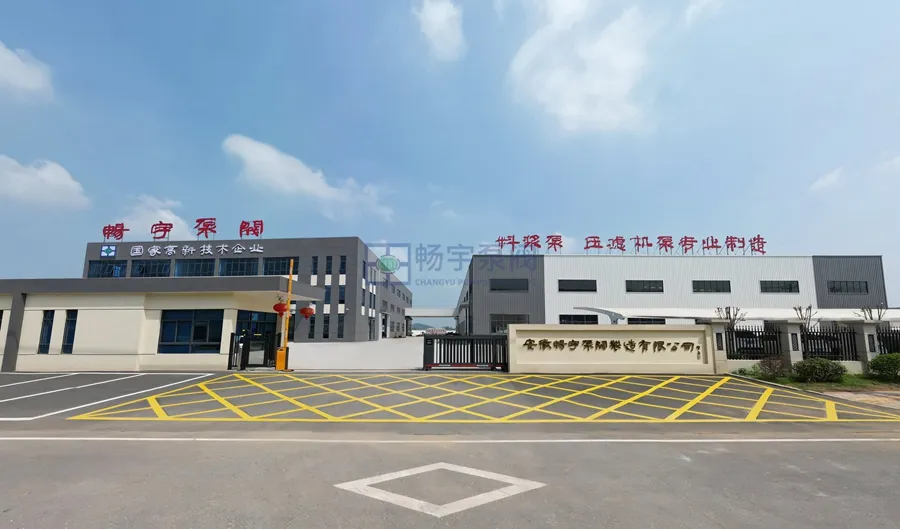
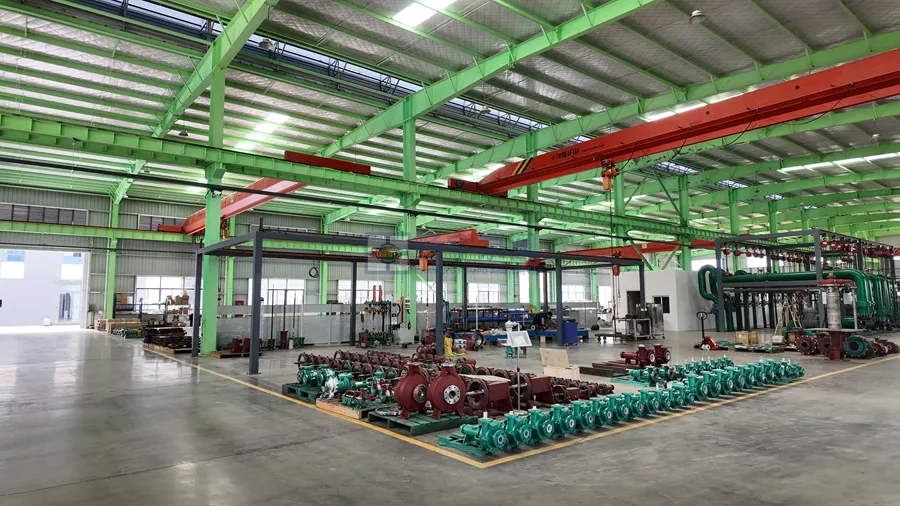
Anhui Changyu Pump and Valve Manufacturing Co., Ltd. has been building industrial pumps in Xuancheng, Anhui Province since 2006. Our 20,000 m² factory produces more than 20,000 pumps a year across slurry, centrifugal, magnetic, semi-submersible and diaphragm ranges, with ISO 9001, CE and ATEX certification and more than 25 patented designs. Around 100 people work here, including a technical team focused on material selection and custom configurations for corrosive and abrasive duty. We export to the United States, Europe, South Africa and Southeast Asia. Most projects start with a customer’s medium data and site constraints rather than a model number, which suits us.




BFQ series: our air-operated double diaphragm pump for TiO₂ bubur
The BFQ series air operated double diaphragm pump is the AODD pump for TiO₂ slurry that we quote most often for pigment transfer. It runs entirely on compressed air, with two diaphragms on a common rod and a pilot air valve that reverses at each stroke end. There is no shaft seal and no motor at the pump, it self-primes, and it tolerates dry running and sudden shutdowns.
Published reference values for the standard range are a maximum working flow of 1041 L/min, maximum working pressure of 0.84 MPa, maximum suction lift of 7.6 m and maximum solids size of 9.4 mm. Treat those as individual limits for the range, not one operating point: a pump will not deliver maximum flow at maximum pressure and maximum suction lift simultaneously, and the figures for your duty must be confirmed against the actual slurry.
Where pulsation is a problem, the fourth-generation BFQ4 combines pump and pulsation dampener in one assembly, reducing pulse-related vibration and the external pipework a separate dampener would need. Its published maximum particle size is 3.2 mm.
For continuous duty with reliable power at the pump, the BFD series electric diaphragm pump is worth comparing on energy and flow stability. It is electrically driven, not an AODD pump, and the two should not be treated as interchangeable without checking suction conditions, particle size and area classification.
What should you send us before you request a quote?
- Slurry composition: TiO₂ grade, dispersants or additives, and whether the stream is fresh, recycled or settled
- Solids content by weight, and whether it varies through the batch
- Viscosity, and whether the slurry is thixotropic or shear-thinning
- Temperature in normal operation and during cleaning
- pH, chlorides and any other corrosive species
- Typical particle size and the largest agglomerate you expect
- Flow at normal and maximum demand, plus discharge pressure or head
- Suction condition: flooded or lifting, line length and diameter, and whether it drains between batches
- Compressed air pressure and available flow at the pump, plus dew point and oil content
- Duty cycle, starting method, and area classification
With that we can propose a configuration, explain the trade-offs and quote. Without it, any recommendation is a guess dressed up as engineering.
Pertanyaan yang sering diajukan
Q: Can an AODD pump handle TiO₂ slurry at high solids loading?
A: Usually yes, if the slurry can be drawn into the pump and the discharge pressure is realistic. High solids raise density, settling and abrasion, so size the pump and air supply on mass flow rather than a clean-liquid figure.
Q: What is the largest particle a BFQ pump can pass?
A: Published maximum solids size is 3.2 mm for the BFQ4-25 and up to 9.4 mm for larger standard BFQ models. Pigment particles are far smaller; the number matters for agglomerates and upstream debris.
Q: Will the diaphragms wear out quickly on pigment slurry?
A: They are a wear part in any abrasive service, and we will not quote a life in hours for your slurry. Inspect at a set interval, track the trend, then adjust once you have your own data.
Q: Can the pump run dry?
A: Yes. The BFQ tolerates dry running and sudden shutdowns and needs no oil lubrication. Long dry periods still flex the diaphragms without moving product, so it is tolerated rather than desirable.
Q: Is an air-operated pump suitable for a hazardous area?
A: Removing the electric motor helps, and our pumps are supplied with ATEX certification where the configuration requires it. Area classification, grounding, bonding and air supply condition still have to be assessed for the installation as a whole.
Q: How do I reduce discharge pulsation?
A: Fit a pulsation dampener close to the discharge, or specify the BFQ4, which integrates dampening into the pump assembly. Correct air pressure and a steady supply also reduce stroke amplitude.
Q: Should I choose air-operated or electric for TiO₂ slurry?
A: Air-operated for intermittent duty, sump self-priming, solids in suspension, or where you want no motor at the pump. Electric diaphragm for steady continuous flow where power is available and energy matters more.
Q: Can one pump handle both the milled slurry and the dilute letdown stream?
A: Sometimes, but check the range. A pump sized for dilute transfer will be slow on thick slurry, and one sized for thick slurry may wear faster on the dilute stream. Tell us both duties and we will advise.
Hubungi Changyu Pump
If you are comparing titanium dioxide slurry pneumatic pumps for a new line, a replacement or a debottlenecking project, send your slurry data through our contact form below: composition, temperature, viscosity, solids content, particle size, flow, discharge pressure, suction conditions and compressed air conditions.
You do not need a complete datasheet to start. A description of the duty, a photo of the existing installation and whatever test data you already have is enough for our engineers to say what is realistic, what the trade-offs are and what they would need next. Our team has more than 20 years of experience with corrosive and abrasive media, and we will tell you plainly if a different pump type is the better fit.
Email: [email protected]
TEL/WA: +86-13651913727