
Which metal should you choose for a nitric acid pump—304 or 316L stainless steel? When we assess nitric acid pump material options for a transfer application, we first check the acid concentration, maximum operating temperature and impurities before selecting materials for the casing, impeller and other wetted components. For many pure nitric acid applications, 304/304L stainless steel is worth considering first.
After selecting the materials, we match the flow rate, head, suction conditions and leakage-control requirements to a Changyu metal chemical centrifugal pump or metal magnetic drive pump. Below, we connect nitric acid pump material selection with practical pump recommendations so that purchasing teams, equipment engineers and process engineers can review the same proposal.
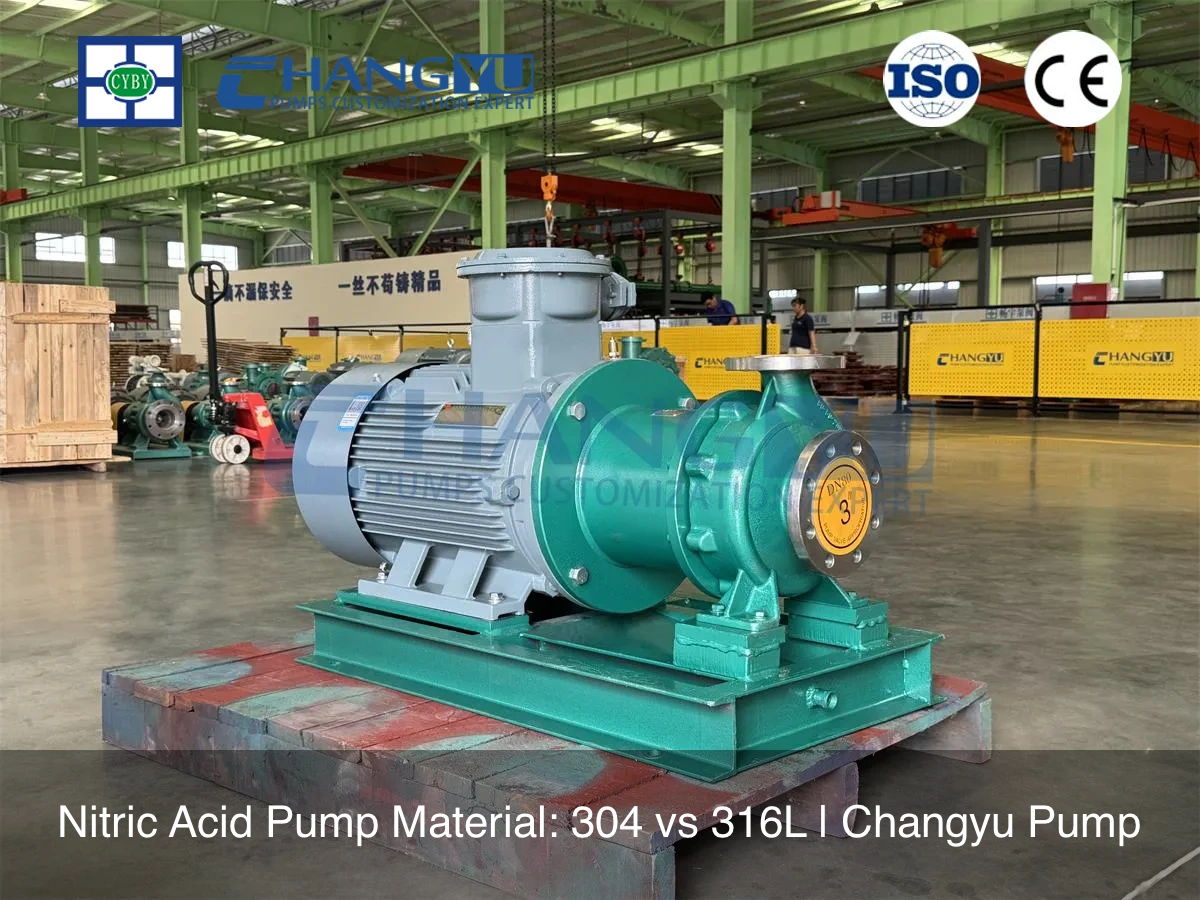
1. Nitric Acid Pump Material Selection: Why Not Specify 316L by Default?
Nitric acid is a strongly oxidizing acid. In many nitric acid environments, stainless steel relies on a surface passive film for corrosion resistance. Whether a nitric acid pump material can remain in service depends on whether that protective condition can be maintained at the actual concentration, temperature, impurity levels and operating conditions.
The molybdenum in 316/316L can improve corrosion resistance in certain chloride-containing media, but that advantage does not automatically carry over to pure nitric acid service. The British Stainless Steel Association states that 304 types are generally preferable to 316 types for nitric acid applications. [1]
For a 304 vs 316 nitric acid comparison, our advice is to specify acid concentration, maximum temperature and impurities before comparing 304, 304L, 316L and other nitric acid pump material options. Do not judge corrosion resistance by the price of the alloy alone.
2. How Do We Compare Common Nitric Acid Pump Material Options?
The following table provides an initial screening direction. It does not replace corrosion data for the specific concentration and temperature. The special metals illustrate possible nitric acid pump material selection routes; they are not available as standard options across all Changyu series.
| Metal material | Descrição | Our selection advice | Main limitations |
|---|---|---|---|
| 304 / 304L | Chromium-nickel austenitic stainless steel; 304L is the low-carbon type | An initial candidate for many pure nitric acid duties; consider low-carbon grades where welding and sensitization are concerns | Assess hot concentrated acid, evaporation/condensation and chloride- or fluoride-containing media separately |
| 316 / 316L | Molybdenum-containing austenitic stainless steel; 316L is the low-carbon type | Compare when supported by corrosion data, verified equipment experience or requirements for other media | Molybdenum content does not mean better resistance to pure nitric acid than 304 |
| 321 / 347 | Austenitic stainless steels stabilized with titanium and niobium, respectively | Assess for specific welding, heat-treatment and sensitization-resistance requirements | Not a universal upgrade for hot concentrated nitric acid |
| High-silicon stainless steel | Stainless steels with higher silicon content, developed for specific strongly oxidizing media | A specialist material route to assess for highly concentrated nitric acid | Confirm the exact grade, product form, welding and manufacturing capability |
| Ferro fundido com alto teor de silício | Corrosion-resistant cast iron with high silicon content; different from high-silicon stainless steel | A traditional material for certain nitric acid pump duties | Check brittleness, thermal-shock and mechanical-load limitations |
| Aluminum and selected aluminum alloys | Lightweight metals that can remain passive under specific concentrated nitric acid conditions | Assess only for high-concentration duties supported by applicable data | Do not extend suitability to dilute acid, mixed acids or arbitrary aluminum alloys |
| Titanium and titanium alloys | Corrosion-resistant metals used in some oxidizing-acid environments | Consider only after a specific review of composition, water content and temperature | Fuming nitric acid presents special compatibility risks; do not assume suitability for fluoride-containing or mixed-acid duties |
| Ordinary carbon steel | Common structural steel | Not our default nitric acid pump material for wetted components | Passivation under specific conditions is not a general guarantee for pumping service |
304 vs 304L: What Does the Difference Mean for Nitric Acid Pump Material Selection?
The “L” in 304L means low carbon. Lower carbon content helps reduce sensitization risks associated with welding or certain thermal histories. It does not mean resistance to nitric acid at every concentration and temperature.
We also review chemical composition, casting or machining condition, heat treatment, welding and the configuration of every wetted component. The nitric acid pump material shown on the drawing must match the material documentation supplied. Castings, plate and bar may use different standards and grade designations, so the purchase specification should state the applicable material standard rather than simply “stainless steel.”
Does Hot Concentrated Nitric Acid Automatically Require a Special Alloy?
We first check relevant corrosion data before deciding whether to consider high-silicon stainless steel, a dedicated nitric-acid-grade stainless steel or another corrosion-resistant alloy. Nitric acid pump material selection requires concentration and temperature to be assessed together. Simple rules such as “switch to high-nickel steel above 68.4%” or “high-silicon steel is mandatory above 85%” are not sufficient.
If a technical document mentions an unfamiliar grade such as NS311, it can initially be understood as a nickel-chromium corrosion-resistant alloy rather than a common 304/316 stainless steel. Verify grade equivalence, composition and application limits against formal standards and material certificates. For purchasing discussions, specifying the material category, standard, grade and wetted-component list is more useful than providing a code alone.
3. Five Operating Conditions We Check Before Confirming Nitric Acid Pump Material
Concentration and Maximum Temperature
Provide the nitric acid concentration by weight, together with normal and maximum operating temperatures. Transferring 68% nitric acid at ambient temperature and circulating it hot require separate assessments. We also check whether startup, shutdown or cleaning creates different combinations of concentration and temperature.
Pure Nitric Acid, Recovered Acid or Mixed Acid?
Chlorides, fluorides or free hydrofluoric acid can make a nitric acid pump material that suits pure acid unsuitable for the actual liquid. [1] For pickling solutions or recovered waste acid, we need a composition analysis rather than a decision based only on the presence of nitric acid.
Flow Rate, Head and Actual Operating Point
Once corrosion compatibility has been assessed, we check the operating point, suction conditions and cavitation risk. Cavitation, solids wear and local flow impact can act together with corrosion. Experience with a storage tank or pipe therefore cannot directly replace a pump assessment.
Every Wetted Component, Not Only the Casing
Our nitric acid pump material review covers the casing, impeller, cover, shaft sleeve, seal faces and gaskets. For magnetic drive pumps, it also includes the containment shell, sleeve bearings and wetted encapsulation of the inner magnet assembly. Rubber, graphite, ceramics and hard materials with different binders must also be checked against the actual nitric acid conditions.
Leakage Control and Maintenance Requirements
For duties with stricter leakage-control requirements, we focus on metal magnetic drive pumps. For process systems needing a wider flow range and convenient mechanical-seal maintenance, we assess metal chemical centrifugal pumps and their sealing arrangements alongside the nitric acid pump material requirements.
Correio eletrónico: [email protected]
TEL/WA: +86-13651913727
4. Changyu Pump Recommendations: Match Nitric Acid Pump Material to Pump Design
We confirm wetted materials before selecting the hydraulic model, motor and mechanical-seal or magnetic drive configuration. The table below shows our published series ranges for initial screening. Not all maximum values are available together in one model, one nitric acid pump material configuration or one operating duty.
| Changyu metal pump series | Requirements we assess first | Faixa de vazão | Gama de cabeças | Nitric acid selection checks |
|---|---|---|---|---|
| Bomba centrífuga química em aço inoxidável CYH | Process transfer, circulation and a wider flow range | 0,8–750 m³/h | 3–130 m | Wetted metals, mechanical seal and suction conditions |
| Bomba de acionamento magnético em aço inoxidável para serviço pesado CYC | Shaft-seal leakage control and continuous operation | 3,6–100 m³/h | 20–80 m | Containment shell, sleeve bearings, magnetic torque and internal circulation |
| Bomba de acionamento magnético em aço inoxidável CQ | Small-to-medium flow and compact installation within its load capacity | 1.2–60 m³/h | 5-50 m | Liquid density and magnetic drive load, as well as material compatibility |
CYH Stainless Steel Chemical Centrifugal Pump: Verified Materials for Transfer and Circulation
For applications with a clearly defined composition and supporting evidence of metal compatibility, we first consider our Bomba centrífuga química em aço inoxidável CYH for continuous transfer or process circulation.
CYH uses a single-stage, single-suction cantilever design, with metal options including 304, 316 and 316L. For nitric acid pump material selection, we first assess whether a 304-series grade is suitable, then confirm the configuration against sealing, temperature and hydraulic requirements. If the project specifies 304L, we need to separately confirm availability for that model, the applicable material standard and material documentation.
Consider a CYH inquiry when you need a wider choice of flow rates, the liquid is relatively clean and your site can maintain the specified mechanical seal. Where leakage-control requirements are stricter, we also compare a magnetic drive option.
CYC Heavy-Duty Stainless Steel Magnetic Drive Pump: Focus on Shaft-Seal Leakage Control
For nitric acid transfer systems that need to reduce mechanical shaft-seal leakage risks, we assess our Bomba de acionamento magnético em aço inoxidável para serviço pesado CYC.
Magnetic drive eliminates the conventional through-shaft mechanical seal, but the containment shell, static seals, bearings and internal cooling circulation still require suitable materials and design. A magnetic drive does not remove the need for nitric acid pump material compatibility or operating protection.
Consider a CYC inquiry when the composition is known, the solids conditions suit the configuration and you want to reduce mechanical-seal maintenance. We calculate power and magnetic torque from nitric acid density, temperature, flow and head, and discuss low-level, dry-running and overheating protection. Magnetic drive pumps must not run dry.
CQ Stainless Steel Magnetic Drive Pump: Check Density Limits for Smaller Flow Duties
For equipment packages, test circulation or compact installations, we also offer the Bomba de acionamento magnético em aço inoxidável CQ. We do not recommend it for concentrated nitric acid solely because its flow and head match.
Some CQ configurations currently specify a liquid specific gravity of approximately 1.2, whereas approximately 65% nitric acid has a specific gravity of about 1.40. [1] Concentrated-acid projects therefore require the motor load, magnetic torque and specific model capacity to be checked again. A standard CQ configuration cannot simply be applied. Alongside the nitric acid pump material review, we confirm capacity before recommending CQ or assessing CYC, CYH or another option.
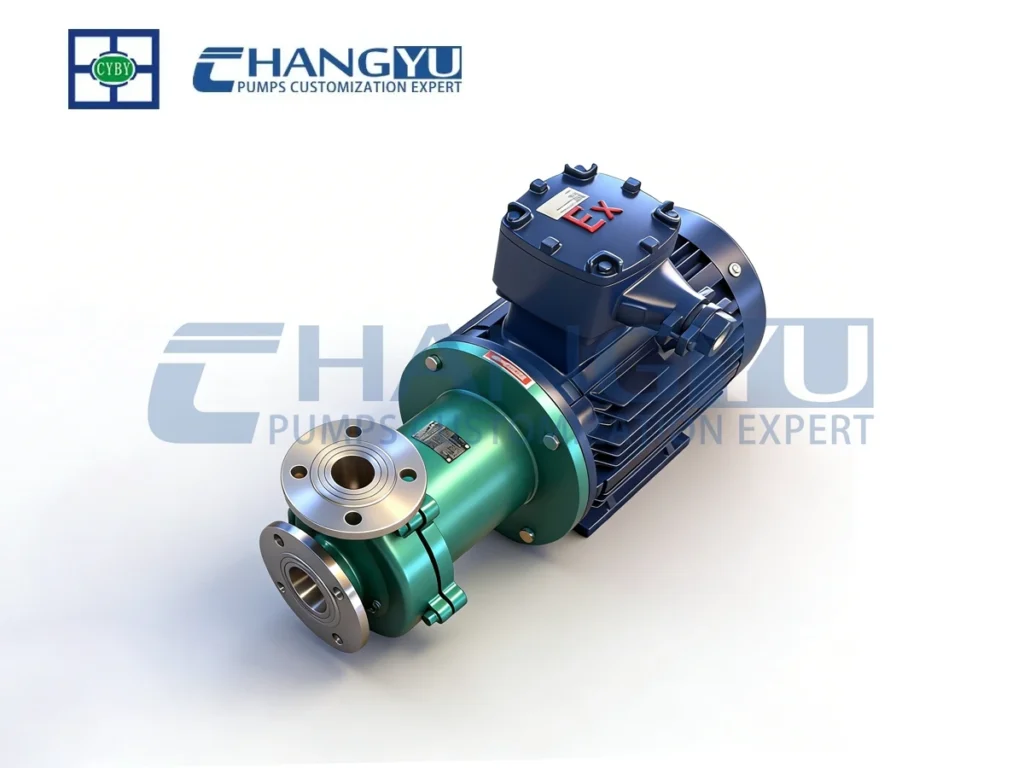
If a metal design does not suit the actual mixed-acid or impurity conditions, we also discuss other corrosion-resistant constructions. This article remains focused on metal nitric acid pumps with verified material compatibility.
Correio eletrónico: [email protected]
TEL/WA: +86-13651913727
5. Why Discuss Nitric Acid Pump Material and Selection with Changyu?
Review the Duty, Materials and Complete Pump Together
Our Changyu Pump factory was established in 2006 and is located in Jing County, Xuancheng, Anhui, China. We have approximately 20,000 m² of factory space, with CNC machining equipment, machining centers and pump testing systems. [2]
For nitric acid pumps, these capabilities allow us to discuss wetted materials, component machining, assembly and performance testing as one configuration. We can translate purchasing requirements into specific component and inspection-document requirements.
Turn Nitric Acid Pump Material Requirements into Verifiable Deliverables
Our quality-control process includes metal composition verification, impeller dynamic balancing and factory testing. [3] For nitric acid projects, we recommend specifying wetted-component materials, supply standards, material certificates and required inspection and reporting items in the technical agreement.
For low-carbon grades such as 304L, material documentation and suitable verification methods are particularly important. XRF can help identify major alloying elements, but it normally cannot independently confirm a low-carbon grade.
Address Performance Testing and Corrosion Verification Separately
We discuss agreed performance tests and delivery documents for flow, head, power and other requirements. A clean-water performance test checks hydraulic performance; it does not replace nitric acid pump material corrosion verification under the actual acid conditions. For high-temperature duties, complex impurities or applications without an established service basis, we include material data or testing requirements in the initial review.
Compare Quotations Against Actual Operating Costs
We help customers compare purchase cost, energy consumption, seal or bearing maintenance, spare parts and downtime implications. The right metal and pump design for the duty matter more than simply choosing a more expensive alloy or a larger motor.
6. Send Your Duty for Nitric Acid Pump Material and Model Advice
Send us the information below. Existing equipment nameplates, liquid-analysis reports and piping drawings are also welcome.
| Information needed | O que fornecer |
|---|---|
| Líquido | Fresh nitric acid, recovered acid or mixed acid; nitric acid concentration by weight and other constituents |
| Temperature and impurities | Normal/maximum temperature, chlorides, fluorides and solids |
| Desempenho | Normal/maximum flow, required head or inlet and outlet pressures |
| Instalação | Minimum liquid level, pump elevation, inlet pressure and suction piping conditions |
| Project requirements | Operating hours, leakage control, existing materials, failure symptoms and document requirements |
Correio eletrónico: [email protected]
TEL/WA: +86-13651913727
7. Frequently Asked Questions
O 304 ou o 316L é o Melhor Material para Bomba de Ácido Nítrico?
Para muitos serviços com ácido nítrico puro, avaliamos primeiro o 304/304L. O molibdênio no 316L não significa melhor resistência ao ácido nítrico. Selecionamos materiais com base na concentração, temperatura máxima, impurezas e dados de corrosão relevantes.
2. Can a Stainless Steel Pump Handle 68% Nitric Acid?
A stainless steel pump can be considered, but 68% concentration alone is not enough to confirm a model. We also need temperature, impurities, flow, head, suction conditions and sealing requirements before confirming nitric acid pump material compatibility and the complete configuration.
3. Is 304L Always a Better Nitric Acid Pump Material than 304?
The low carbon content of 304L helps reduce sensitization-related risks, but it is not automatically more suitable under every nitric acid condition. We assess manufacturing condition, heat treatment, welding and corrosion data, and confirm whether the model can be supplied to the agreed material standard.
4. Can a 316L Pump Be Used Directly for Nitric Acid Containing Chlorides or Hydrofluoric Acid?
No direct conclusion can be made. Chlorides, fluorides and hydrofluoric acid can significantly change compatibility. We need complete composition and temperature information before assessing the nitric acid pump material, seals and other wetted components.
5. Should I Choose a Metal Magnetic Drive Pump or a Mechanically Sealed Centrifugal Pump?
For stricter shaft-seal leakage control, we focus on metal magnetic drive pumps. For a wider flow selection or established mechanical-seal maintenance capability, we compare metal chemical centrifugal pumps such as CYH. Density, solids, suction conditions and operating protection still need checking alongside the nitric acid pump material. Magnetic drive pumps must not run dry.
6. What Information Does Changyu Need for a Nitric Acid Pump Quotation?
Provide acid concentration, normal and maximum temperatures, impurities, flow, head and suction conditions. We then confirm the appropriate nitric acid pump material, series, motor and sealing or magnetic drive configuration. State any material-certificate or test-report requirements when requesting a quotation.
Technical and Product References
- British Stainless Steel Association: Selection of Stainless Steels for Handling Nitric Acid. Supports the comparison of 304 and 316, impurity effects and consideration of low-carbon grades. Storage-application data do not directly guarantee pump suitability.
- Changyu Pump Factory Information.
- Changyu Pump Quality Inspection Process.
- CYH Stainless Steel Chemical Centrifugal Pump, CYC Heavy-Duty Stainless Steel Magnetic Drive Pump e Bomba de Acionamento Magnético em Aço Inoxidável CQ. Published product ranges are for reference; the technical confirmation documents govern the actual supplied configuration.