
Most requests we receive for a stainless steel water pump start the same way. A plant needs to move clean water from a tank to a process line, or top up a utility header, and someone has been asked to pick a model. The pump is rarely the difficult part. The difficult part is proving the water is what everyone assumes it is, and that the unit being quoted actually matches the duty.
So we work in a fixed order. First, what is in the water and at what temperature. Second, what the system demands in flow and total head at its worst case, not its average. Third, which parts of the specific model being quoted are actually stainless. A catalog page answers the third question in general terms and the first two hardly at all.
One definition before we start. In this guide, clean water means industrial water whose solids content and viscosity are compatible with a clear-liquid pump: utility water, softened water, condensate, near-clear process water, closed-loop cooling water. It says nothing about potable-water approval, sanitary design, or chemical compatibility. Those are separate reviews, and we flag them where they matter.
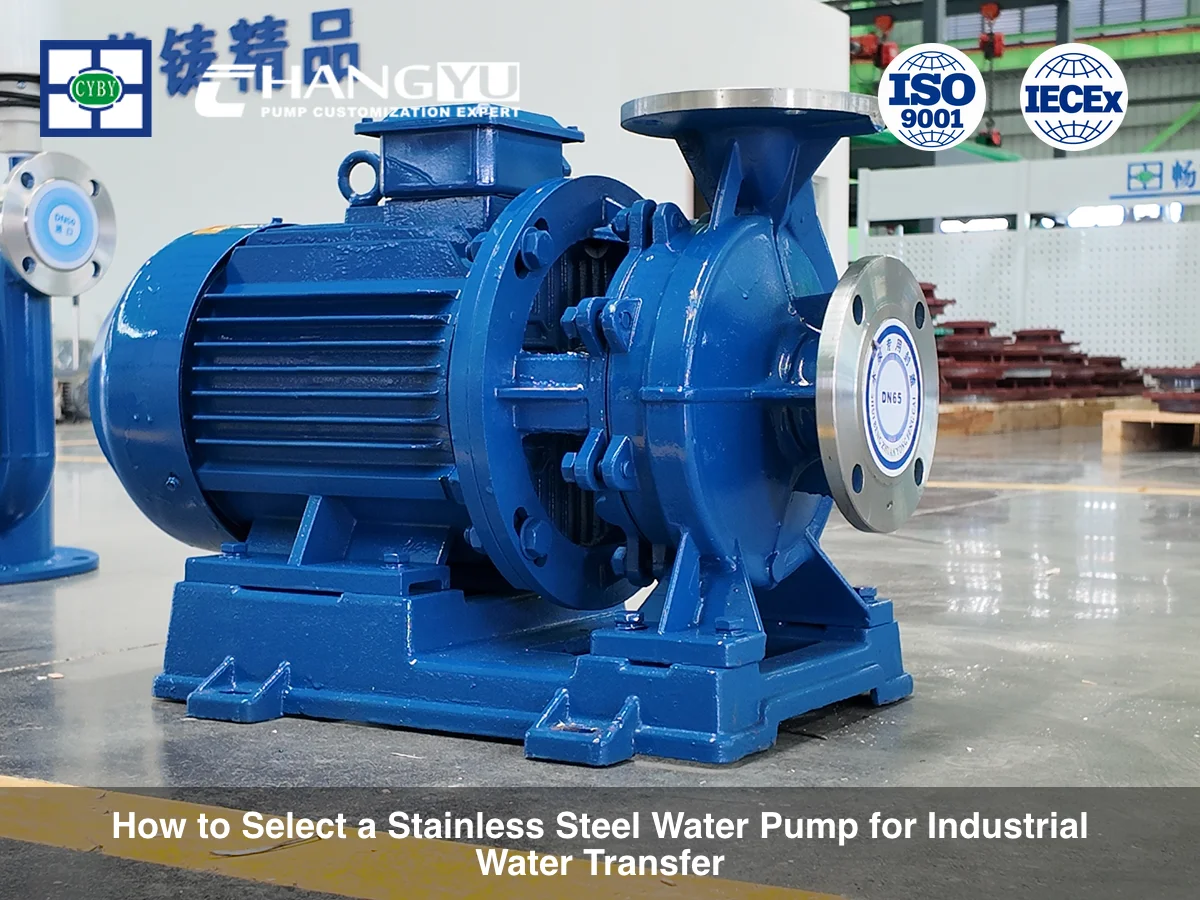
Start With the Water, Then the Duty
A pump that has served reliably on municipal makeup water may corrode or suffer seal damage after a change in the biocide program. The new treatment chemistry warrants a review of the wetted materials and seals.
What we ask for, roughly in this order: where the water comes from and how it is treated (municipal supply, well, softener, RO permeate, condensate return, closed loop); the temperature range, including cleaning cycles and long idle periods; pH; chloride concentration; treatment chemicals such as biocides, scale inhibitors, and antifreeze; solids, their size and their nature; dissolved iron; and how long the water sits still in the line. Each answer has a mechanical consequence. Chloride and temperature drive the alloy question. Treatment chemistry drives gasket and elastomer selection. Stagnation drives both, because a line that sits full and idle for weeks behaves differently from one that runs continuously.
Duty comes second, and it has to be a range rather than a number. We need the minimum, normal, and maximum flow the process will actually draw, the corresponding total head at each, and the duty cycle — continuous, batch, seasonal. A pump selected on the average will be wrong at both ends: oversized at low demand, where it runs far from its best efficiency point and may drop below its minimum allowable flow, and incapable at peak, when a strainer loads up or a second line opens. We also need the installation: indoor or outdoor, flooded suction or lift, available floor area, electrical supply, and how much clearance the maintenance team will have when a seal finally needs replacing.
Cast Iron vs. Stainless Steel Water Pump: Which Material Does Your Water Justify?
Cast iron remains the economical choice for neutral, continuously wetted, chemically compatible water where no one is measuring iron pickup. Stainless steel earns its premium when rust staining, particulate, washdown, treatment chemistry, or a documented materials standard make iron unacceptable — or when the cost of one unplanned shutdown is larger than the price difference between the two.
The failure that pushes plants toward stainless is rarely a casing rusting through. It is discoloration and particulate in product water, a filter loading faster than it should, or a customer audit that asks for the wetted-materials list. If your water is neutral and your process tolerates iron, cast iron with bronze or stainless trim is a defensible, well-understood choice, and we still quote it.
| Water condition | Starting material to evaluate | Verify before ordering |
|---|---|---|
| Neutral utility water, continuous wetting, no iron-pickup limit | Cast iron body with bronze or stainless trim is normally adequate | Chloride, pH and temperature range; seal and gasket materials; whether any iron surface touches product water |
| Process water with visible rust, discoloration complaints, or washdown nearby | SS304 as the starting point | Chloride level, cleaning agents, stagnation periods, and a full wetted-parts list — not just the casing |
| Water with fluctuating chlorides, cleaning-agent returns, or mixed utility headers | SS316 or SS316L | The chloride–temperature–stagnation combination, weld details, gaskets and elastomers; 316 is not immune to localized corrosion |
| Softened or demineralized water in a closed loop | SS304, or 316 where treatment chemistry points that way | Treatment chemicals (softening addresses hardness only), oxygen control, and idle periods |
Two cautions on reading that table. A materials table lists options; it does not describe the pump in the crate. And softening changes hardness, not chloride, so softened water is not automatically a reason to pay for a higher alloy.
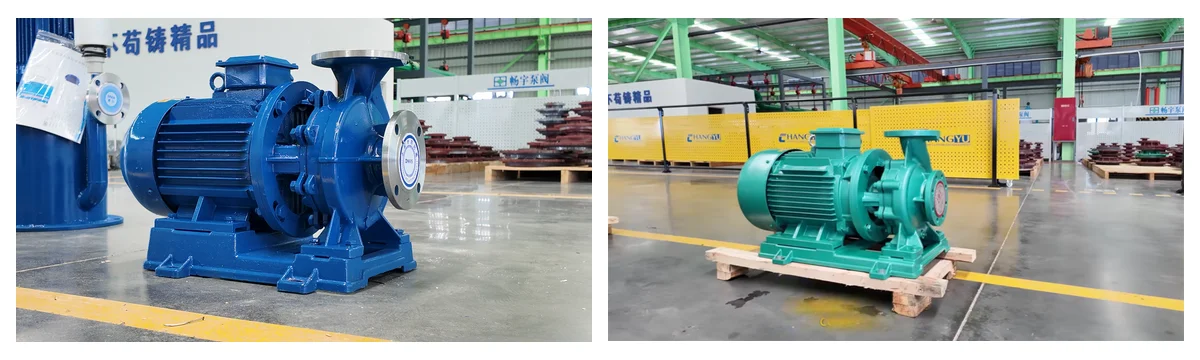
Is 304 or 316 the Better Choice for Process Water?
SS304 is the general-purpose starting point for neutral industrial water and is adequate across a wide range of utility and process duties. SS316 adds molybdenum for better resistance to chlorides and to the localized corrosion that chlorides encourage. SS316L is the low-carbon variant, and its advantage shows up on welded assemblies, where lower carbon reduces the risk of chromium carbide precipitation in the heat-affected zone; that is why fabricated parts and welded spools are often specified 316L even when a cast casing is 316.
Neither grade is immune. Pitting and crevice corrosion still occur on 316 under the wrong combination of chloride, temperature, deposits, and stagnant water, and a 316 stainless steel water transfer pump can pit in a line that sits idle with chloride-rich water in it. We therefore do not publish a universal chloride limit or a pH threshold, because the risk is a combination rather than a single number.
Сайт British Stainless Steel Association’s discussion of 316 in seawater is useful for exactly one point: chloride, temperature, and stagnation change localized corrosion risk, and 316 itself suffers localized corrosion. Its seawater figures describe immersion in seawater and should not be transferred to plant water. For your line, the check is a water analysis plus the temperature range, the stagnation pattern, and the cleaning chemistry — applied to every wetted part, not only the casing and impeller.
How to Size a Pump for Industrial Water Transfer
Sizing starts from a duty point, not a model number. Total dynamic head is the sum of four things: static head, pressure head, friction losses, and velocity head. Velocity head at the free surfaces of an open tank is small enough to neglect in most transfer work, which leaves three terms to establish honestly.
Here is a worked example with assumed numbers. Water moves from a vented source tank to a vented receiving tank. The liquid level in the source sits 36 ft below the level in the receiver. At design flow, pipe, valve, fitting, and entrance/exit losses total 14 ft. Both tanks are open to atmosphere, so the pressure difference is zero.
| Артикул | Assumed value |
|---|---|
| Расчётный расход | 100 US gpm (about 22.7 m³/h) |
| Static head, liquid level to liquid level | 36 ft (about 11.0 m) |
| Pipe, valve, fitting and entrance/exit losses at design flow | 14 ft (about 4.3 m) |
| Pressure difference between tanks | 0 psi — both vented |
| Velocity head at the free surfaces | Neglected |
| Общий динамический напор | 50 ft (about 15.2 m) |
| First-pass duty point | 100 US gpm at 50 ft (22.7 m³/h at 15.2 m) |
That 50 ft figure is a first-pass duty point, not a selection. It is the number you take to a curve. The calculation uses assumed values throughout and is here so your own engineers can rerun it with site data.
When the System Is Not Two Open Tanks
Static head is measured between liquid levels, not between pipe connections. If the source liquid level is at pump centerline and the receiver liquid level is 20 ft higher, static head is 20 ft even when the discharge pipe is 36 ft long. Use the pipe length to estimate friction losses.
A pressurized receiver adds pressure head. Multiply the pressure difference in psi by 2.31 to get feet of water, and add it to the static and friction terms. A closed loop behaves differently again: with the static column balanced on both sides, total head is essentially the loop’s friction loss at design flow, while the loop’s fill pressure and the pump’s casing rating become the real design constraints. Circulating and boosting duties therefore need their own system logic, not a transfer calculation with different numbers in it.
Suction Conditions and the Rest of the Curve
Nothing in the table above lets you calculate net positive suction head available. NPSHa depends on the entire suction side: the source level relative to the pump centerline, the suction pipe losses at design flow, the water temperature and its vapor pressure, and the site altitude. Without that data there is no NPSHa, and without NPSHa there is no way to confirm the margin over the pump’s required NPSH. We ask for it before quoting a duty that is close to the edge.
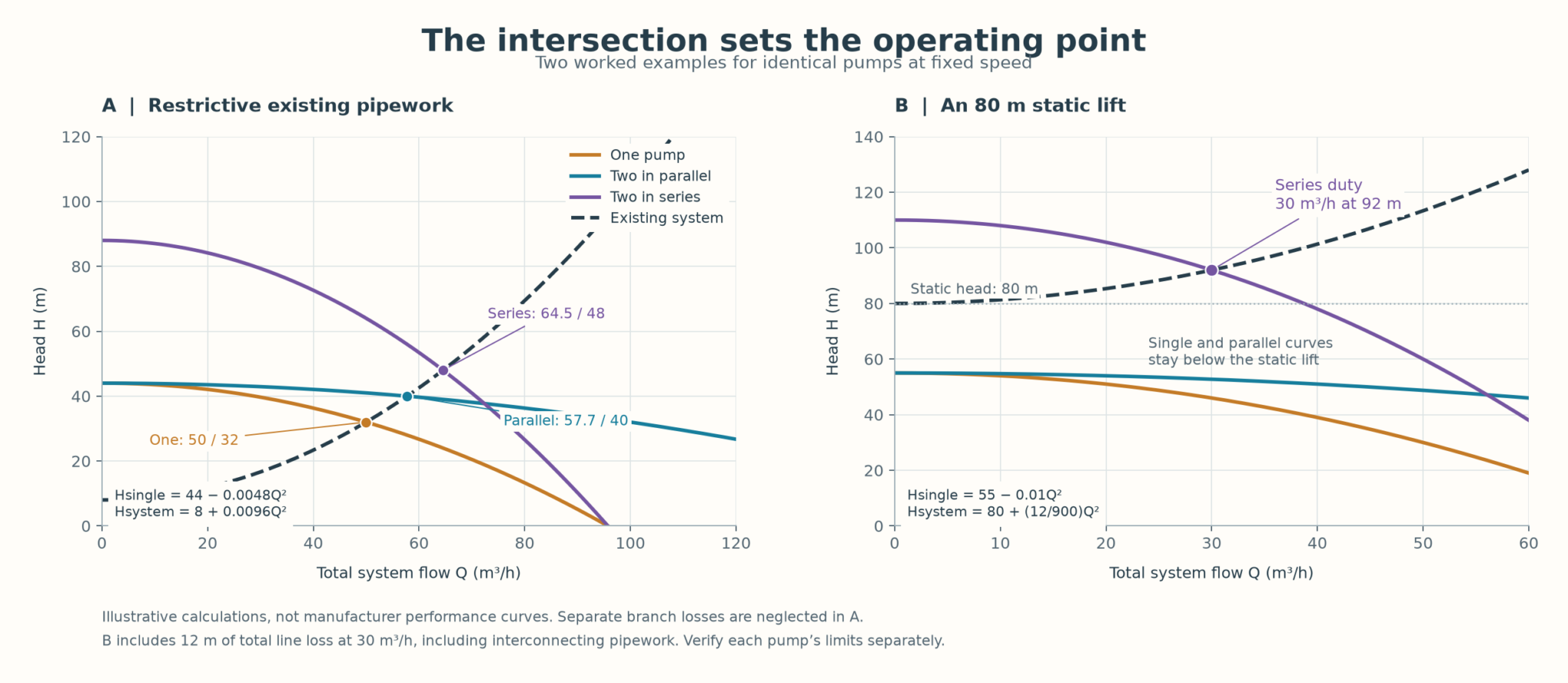
The duty point is also one point on a curve, not a description of the pump. Ask for the operating range around it, the best efficiency point, the power draw at duty, and the minimum allowable flow for the selected model. Hydraulic power follows from the duty point: 100 gpm at 50 ft is about 1.26 hp, and at 60 percent pump efficiency the shaft demand is roughly 2.1 hp before motor margin. Final motor sizing comes from the selected curve, not from that arithmetic.
One more habit worth adopting: the highest flow on a published curve occurs at the lowest head, and the highest head occurs at zero flow. A datasheet that lists a maximum flow and a maximum head side by side is describing two opposite ends of the same curve, not one operating condition. The pump you need is the one whose curve passes through your duty point. The Hydraulic Institute’s pump curve fundamentals explain BEP, NPSHr, and preferred operating ranges, the U.S. Department of Energy’s руководство по подбору насосов covers liquid properties, system requirements, and piping losses, and our guide to reading a centrifugal pump curve walks through the same terms from the selection side.
Which Setup Fits Clean Process Water and Plant Utility Transfer?
For tank-to-line transfer, utility makeup, and near-clear process water at moderate head, a horizontal single-stage stainless steel centrifugal water pump is the first comparison we make. Vertical multistage becomes the better fit as required head rises and floor space shrinks. If chemicals or cleaning agents change the water chemistry, check whether a chemical-duty pump is needed. If solids are the concern, verify solids handling separately.
| Приложение | Серия Changyu | Что необходимо проверить |
|---|---|---|
| Plant utility water, softened water, circulating cooling water, near-clear process water — the default starting point | CYW horizontal centrifugal water pump | Casing, impeller, shaft or shaft sleeve, seal faces, and elastomers by model and configuration; the range lists SS304 and SS316 alongside cast iron, ductile iron, and bronze options |
| Same duty where maintenance access, wetted parts, or shaft seal favor a back-pull-out layout | CYA | Compare on its own curve at the same duty point; confirm which 304, 316, or 316L options reach which parts; confirm the clearance the rotating element needs to be pulled |
| Higher head transfer or boosting in a compact footprint | CDL vertical multistage centrifugal pump | Required flow, discharge pressure, stage count and curve, pressure rating, minimum allowable flow, and the actual wetted materials — the series includes iron and stainless configurations, so do not assume every build is all-stainless |
| Water carrying chemicals, cleaning agents, or persistent corrosive constituents | CYH нержавеющий центробежный химический насос — a transfer branch, not an upgrade | Composition, concentration, temperature, variability, leakage requirement; every wetted part and the shaft seal |
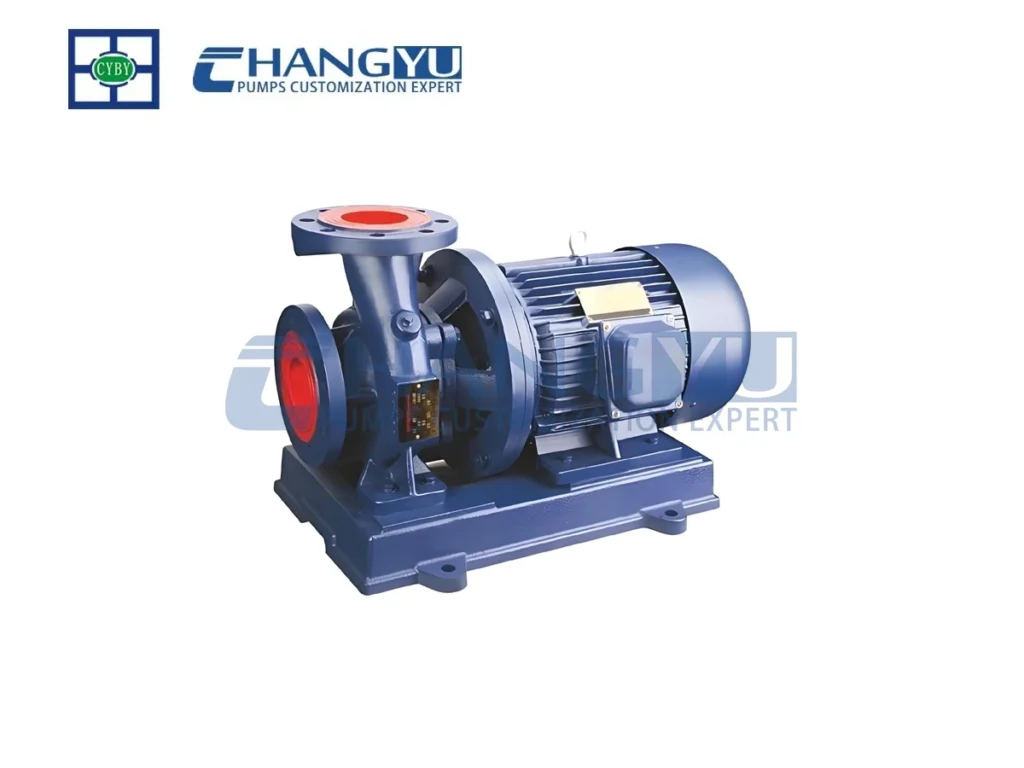 Горизонтальный центробежный водяной насос серии CYW
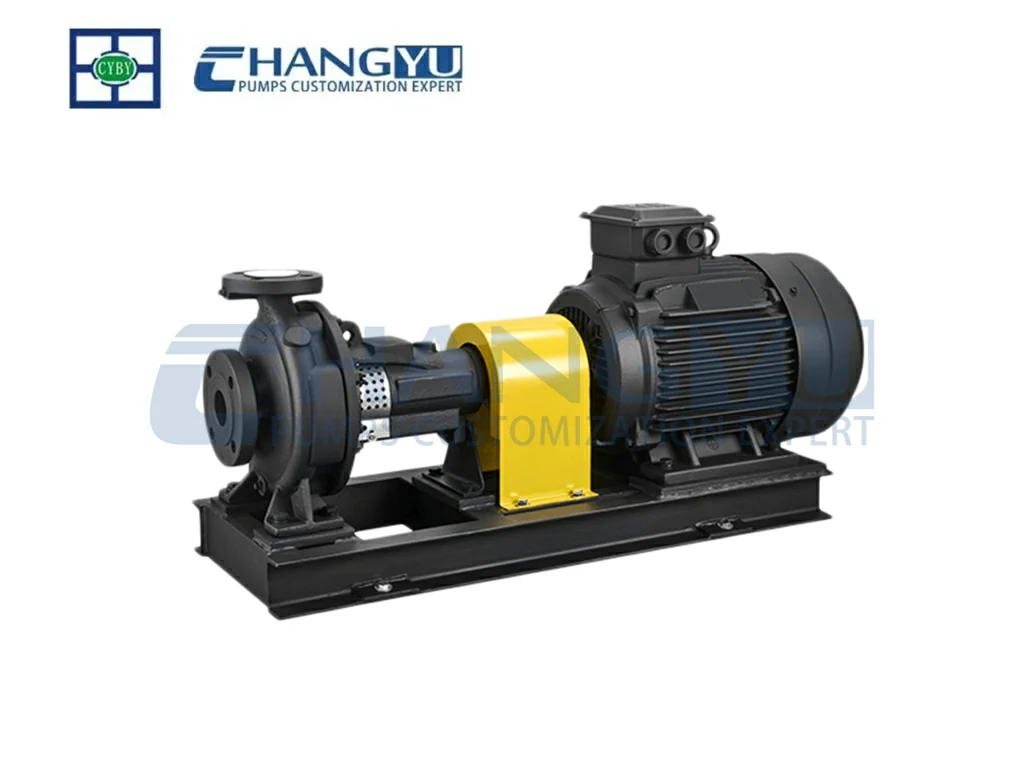 CYA
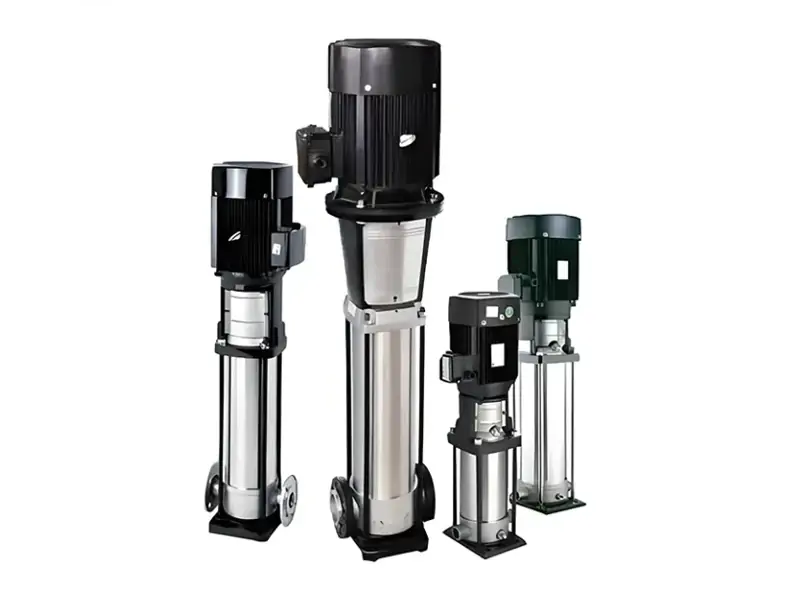 CDL
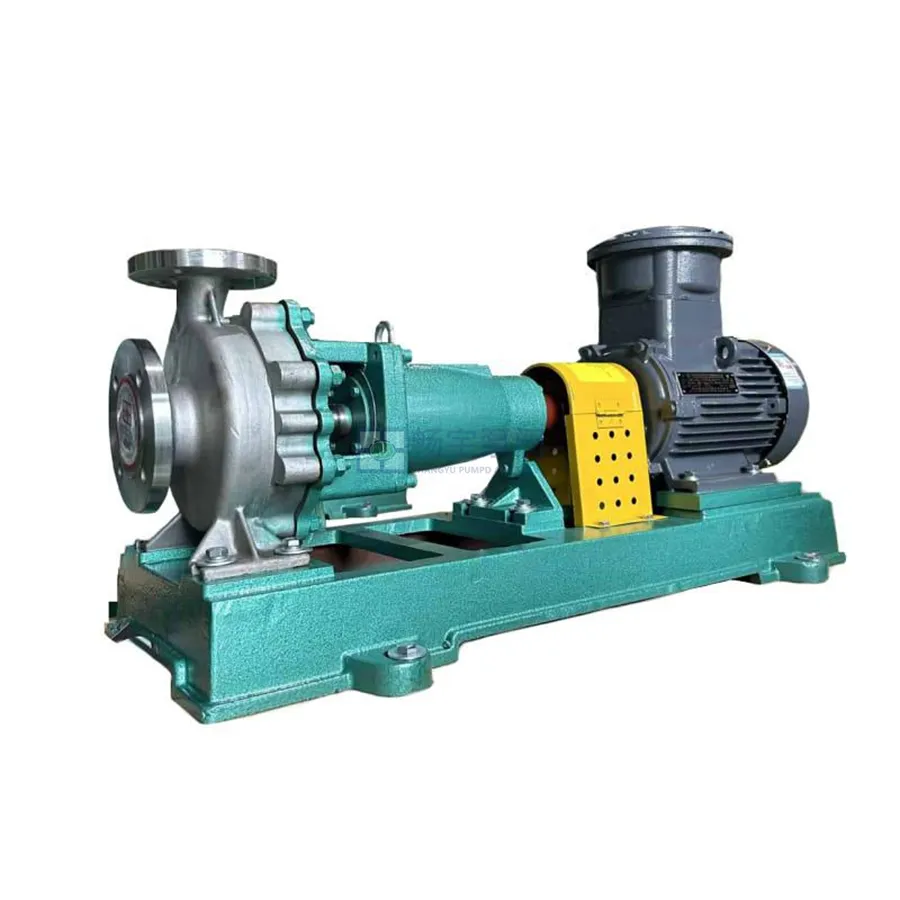 CYH
Horizontal and vertical machines are not interchangeable at the same duty. A horizontal end-suction pump with suitable service clearance can offer easier seal access, while a vertical multistage unit packs high head into a small plan area and is often easier to fit into a skid. Confirm suction requirements on the selected curves for either layout. Our end suction pump selection guide covers the curve and layout trade-offs in more detail.
What a Real Project Looked Like: Softened Water in Corn Processing
A corn processing plant in Jilin needed to move softened water and circulate cooling water across the site. The plant selected CYW units, and the project record sets out the reasoning in the same order this guide uses.
The scenario was continuous operation on treated water feeding both transfer and cooling circuits, with flow and head requirements that varied between services. The selection logic ran through water quality first, then solids, continuous operation, required flow and head, water temperature, operating pressure, and installation conditions — the same checklist, in the same sequence, that we apply to a single line. The transferable lesson is the one worth taking to your own plant: softening addresses hardness. A similar installation still needs separate checks for chloride, cleaning agents, and actual water conditions before the wetted materials are specified.
The published case gives reference values. The installed duty figures, the exact model designations, and the wetted alloys used on that project are not public, so treat the case as an illustration of the method rather than a specification to copy. We have also shipped CYA units to a systems integrator in Bulgaria for HVAC and industrial liquid circulation; the record documents the shipment, not the final installed materials, duty points, or energy results.
When the Water Stops Being Clean
If the stream picks up cleaning agents, carries chemical residue, or holds a corrosive constituent even intermittently, the clear-water series is the wrong place to start — and a chemical pump is not automatically the right answer either. The question becomes the medium itself: composition, concentration, temperature, how much it varies, and what leakage would mean at that location. Our руководство по подбору химических насосов из нержавеющей стали works through medium, materials, and shaft seal together; use it before treating a chemical-duty pump as an upgrade to a water pump.
Worth stating plainly: we quote per configuration and per duty point. A series page describes what a family of stainless steel water pumps can be built to, not what is in stock or what a specific curve will deliver at your flow. The range overview lists the current series and the material options offered on each; the quotation fixes the rest.
How We Review a Stainless Steel Water Pump Before Quoting
Changyu Pump has supplied centrifugal pumps and water pumps to industrial customers since 2006. Our engineers review a candidate against four things before it reaches a quotation: the water quality, the duty point, the installation, and the maintenance plan. That review is where material grade, seal arrangement, and pump type are settled together, because changing one usually moves the others.
Within a project scope we can confirm materials, shaft seal arrangement, factory test requirements, and spare-parts support against confirmed documents. Certifications, lead times, efficiency figures, test scope, and warranty terms are stated as documented for the specific order rather than as general claims, and our technical support и контроль качества pages describe how that review is handled.

What to Send With a Quotation Request
Buyers who are ready to buy stainless steel corrosion-resistant water pumps usually already know the flow and the pipe route. What is often missing is the water chemistry and the suction conditions. Here is the list that lets us return a real answer instead of a range:
- Medium source and a water sample: temperature range, pH, chloride, treatment chemicals, solids
- Required minimum, normal, and maximum flow
- Полный напор, or the pipe size, length, and elevation that let us calculate it
- Liquid levels and pressures at both ends of the system
- Pump location, and whether suction is flooded or lifts
- Supply voltage, frequency, and phase
- Duty cycle: continuous, batch, seasonal
- Wetted-material and shaft seal requirements, including any plant standard
- Доступ для технического обслуживания and the space available for pulling the rotating element
Send these details to our engineering team using the form below so we can review the configuration, performance curve, and quotation assumptions.
Электронная почта: [email protected]
ТЕЛ/WA: +86-13651913727
Часто задаваемые вопросы
Q: Can a stainless steel chemical pump be used for clean water?
A: Physically, yes — provided the curve fits the duty, the wetted parts and shaft seal suit the medium and temperature, and the installation matches the site. But for low-solids clean water, compare the clear-water series first on the same duty point. A chemical pump carries a different mechanical and materials basis, and it is not a default upgrade for ordinary water.
Q: Does a stainless steel water pump have all-stainless wetted parts?
A: Not necessarily. Check the casing, impeller, shaft or shaft sleeve, seal faces, seal elastomers, gaskets, wear rings, and fasteners individually. On many ranges the casing and impeller are stainless while the shaft is another alloy and the seal faces are carbon against silicon carbide. Ask for the wetted-parts list per order configuration; a materials table lists options and does not describe the unit being shipped.
Q: What should I submit when requesting a quotation?
A: At minimum: the water source with temperature, pH, chloride, treatment chemicals and solids; the required minimum, normal and maximum flow; total head or the pipe route that allows it to be calculated; liquid levels and pressures at both ends; supply voltage and frequency; duty cycle; and the wetted-material and seal requirements your plant enforces.
Q: Is 316 stainless steel required for softened water?
A: No. Softening removes hardness, not chloride or dissolved chemistry, so the alloy decision does not follow from the softener. It follows from chloride level, temperature, stagnation, and treatment chemicals. SS304 is adequate on many softened-water duties; specify 316 or 316L when the chloride and cleaning picture calls for it, and confirm the parts it actually covers.
Q: Should I choose a single-stage or a multistage pump?
A: Let head and space decide. Single-stage horizontal pumps handle higher flows at moderate head with easier seal access. Multistage verticals reach higher head in a smaller footprint. Compare both at your actual duty point rather than at their catalog maximums, and include maintenance access in the comparison.
Q: Why can’t I use the maximum flow and maximum head from one datasheet?
A: They occur at opposite ends of the curve: highest flow at the lowest head, highest head at zero flow. A single condition described by both numbers does not exist on that pump. Take your duty point from the curve — at the flow you need, with the head the system imposes.
Q: How do I decide between 304 and 316 without a lab analysis?
A: You cannot settle it without knowing the water. Get at least chloride, pH, temperature range, and the treatment and cleaning chemicals, and sample the line if records are missing. If the picture stays uncertain, the answer is not automatically the higher alloy: 316 also pits under deposits and stagnant chloride, so seal choice, drainage, and flushing matter as much as grade.
Q: How do I confirm potable or food-grade requirements?
A: Treat it as a separate certification path. Name the standard your customer or authority requires — for example NSF/ANSI 61 for drinking-water components, lead-free compliance for wetted brass and bronze, or a sanitary design standard for food contact — and ask for documented certification of the exact model. A general-purpose stainless water pump is not automatically compliant.