
Lime slurry transfer is one of the more demanding duties in industrial pump applications. The medium is alkaline, often abrasive, prone to settling, and capable of causing scaling and wear that shorten pump life quickly when the wrong equipment is selected. This guide explains what makes lime slurry difficult to handle, how to match pump type and material to your application, and which lime slurry transfer pump designs work best in typical industrial systems.
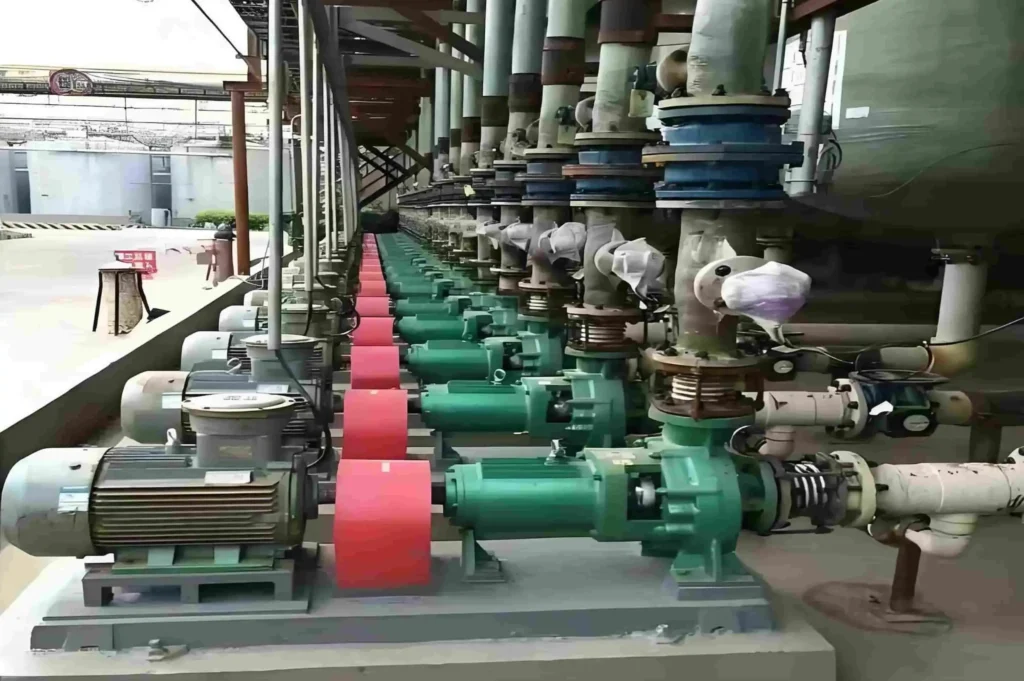
Why Lime Slurry Transfer Pumps Fail — and What to Do About It
Lime slurry looks simple on paper, but in practice it creates problems that standard pumps are not designed to handle well. Understanding the failure risks before selecting a lime slurry transfer pump is the most reliable way to avoid early maintenance issues.
The four main challenges in lime slurry transfer are:
- Abrasion — Undissolved lime particles continuously wear down impellers, casings, and linings, especially at higher solids concentrations or flow velocities.
- High pH — Alkaline conditions affect material compatibility, particularly for pump linings, seals, and gaskets not rated for chemical service.
- Solids settling — When flow slows or the system stops, solids can settle inside the pump and pipework, causing blockages on restart.
- Scaling and buildup — Lime has a tendency to deposit and harden on internal surfaces, which reduces hydraulic efficiency and accelerates wear over time.
Any lime slurry transfer pump selected for this service should address at least two or three of these challenges simultaneously.
What Types of Lime Slurry Transfer Pumps Are Available?
There is no single pump type that fits every lime slurry application. The right choice depends on solids content, flow rate, temperature, and whether chemical corrosion is also a factor.
| Pump Type | Best For | Key Limitation |
|---|---|---|
| Horizontal centrifugal slurry pump | High-flow continuous transfer | Needs correct lining for chemical resistance |
| Vertical sump pump | Sump or tank transfer, limited space | Less suitable for long-distance high-pressure runs |
| Peristaltic pump | Low-flow dosing or chemical feed | Higher cost per unit flow at large scale |
| FEP/PTFE-lined centrifugal pump | Corrosive slurry, mixed chemical service | Not always optimal for highest abrasion duty |
| UHMW-PE-lined centrifugal pump | Highly abrasive slurry transfer | Temperature range narrower than fluoropolymer options |
For most industrial lime slurry transfer duties — FGD, water treatment, mineral processing — a centrifugal slurry pump with the correct lining material is the most practical and widely used solution.
Key Features to Look for in a Lime Slurry Transfer Pump
A pump spec sheet alone is not enough to make a good selection for lime slurry service. The features below have the most direct impact on performance and service life.
Material of wetted components:
- UHMW-PE offers excellent abrasion resistance for high-solids slurry
- FEP/PTFE-lined designs are preferred when corrosion from acids or alkalis is also a concern
- PFA lining extends the operating range to higher temperatures when needed
Seal arrangement:
- Standard packing may not hold well in high-pH slurry
- A mechanical seal or dynamic seal rated for alkaline/corrosive media reduces leakage risk
- K-type dynamic seals are specifically suited to corrosive fluid conveyance
Flow passage design:
- Wide, smooth passages reduce the risk of clogging from solids
- Recessed or open impeller designs improve performance with higher-viscosity or higher-solids slurry
Operating range:
- Confirm flow rate, head, and temperature range before final selection
- Temperature range matters — some UHMW-PE designs are limited to 90°C, while FEP/PTFE options can handle up to 120°C or higher
How to Select the Right Lime Slurry Transfer Pump Step by Step
The selection process for lime slurry transfer pumps is more straightforward when broken into clear steps.
- Identify the main challenge — Is abrasion, corrosion, or a combination of both the primary concern in your system?
- Confirm slurry characteristics — Solids concentration, particle size, and pH determine lining material requirements.
- Define hydraulic requirements — Flow rate, head, pipeline length, and any elevation changes need to be confirmed before sizing.
- Check temperature range — Operating temperature affects both lining selection and seal compatibility.
- Assess operating pattern — Continuous systems have different requirements from intermittent or batch transfer applications.
- Match pump construction to conditions — Once the above is confirmed, match pump type, material, and seal to the application rather than selecting on flow and head alone.
Best Lining Materials for Lime Slurry Transfer Pumps in High-pH Service
Choosing the right lining material is often the most important single decision in pump selection for lime slurry and corrosive slurry applications.
| Material | Abrasion Resistance | Chemical Resistance | Temp. Range | Best Application |
|---|---|---|---|---|
| UHMW-PE | Excellent | Good (alkali/acid limited) | -20°C to 90°C | Highly abrasive slurry transfer |
| FEP/PTFE | Moderate | Excellent | -80°C to 120°C | Corrosive slurry, mixed chemical service |
| PFA | Moderate | Excellent (high temp) | -80°C to 150°C+ | High-temperature corrosive chemical transfer |
| High-chrome alloy | Very high | Limited | Standard industrial | Very high-wear mineral slurry |
| Rubber lining | Good | Moderate | Standard industrial | Mild abrasive, non-chemical slurry |
For lime slurry transfer specifically, UHMW-PE and FEP/PTFE are the two most commonly selected options because they address the abrasion and chemical challenges most directly.
Where Lime Slurry Transfer Pumps Are Used Across Industries
Lime slurry pumps appear across several industries where pH control, mineral processing, or flue gas treatment is required.
- Flue gas desulfurization (FGD) — Lime slurry is used as the absorbent in wet scrubbers to remove sulfur dioxide from exhaust gas.
- Water and wastewater treatment — Milk of lime is widely used for pH adjustment, softening, and chemical precipitation.
- Metallurgy and smelting — Lime slurry is used in neutralization circuits to manage acidic process streams.
- Phosphate fertilizer production — Corrosive mineral slurries and dilute acids require pumps with strong chemical resistance.
- Environmental protection systems — Industrial effluent treatment and acid mine drainage neutralization are common lime slurry applications.
Common Problems with Lime Slurry Transfer Pumps and How to Fix Them
Even well-selected pumps can encounter problems if the system design or operation is not well managed.
| Problem | Common Cause | Recommended Action |
|---|---|---|
| Excessive wear | Wrong lining material, high solids velocity | Switch to UHMW-PE or higher-wear-rated construction |
| Scaling and buildup | Lime depositing on internal surfaces | Use flush connections, reduce dead legs in pipework |
| Solids settling | Low flow or extended shutdown | Use recirculation lines, flush before long stops |
| Seal leakage | Standard seal not suited to alkaline or abrasive media | Upgrade to K-type dynamic seal or appropriate mechanical seal |
| Reduced efficiency | Impeller wear or scaling buildup | Schedule regular inspection and replace wet-end components as needed |
Best Lime Slurry Transfer Pumps from Changyu Pump
Changyu Pump offers three pump series that cover the main scenarios encountered in lime slurry transfer and related corrosive slurry service. The right choice depends on the dominant challenge in your system.
UHB Series Abrasive Slurry Pump — Best for High-Abrasion Lime Slurry Transfer
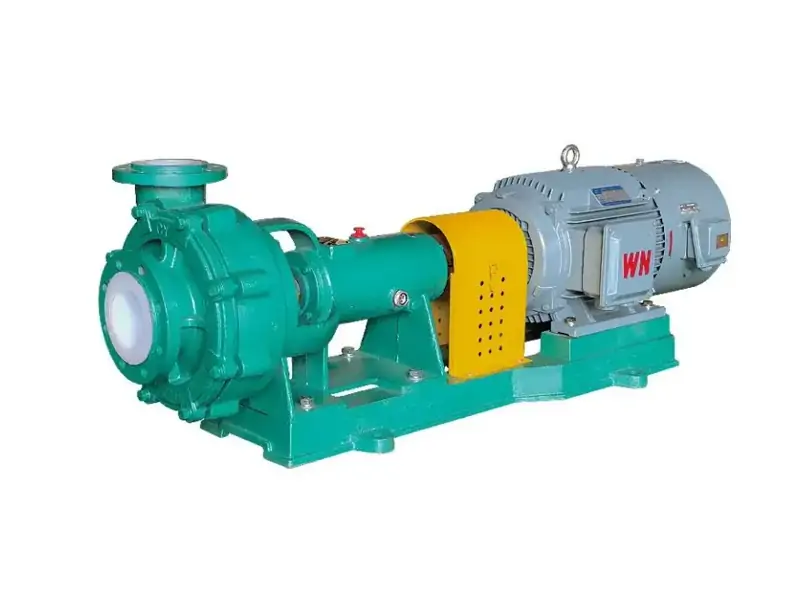
The UHB Series is a cantilevered, single-stage, single-suction centrifugal pump built around UHMW-PE “steel-lined plastic” construction. It is designed specifically for highly abrasive media and fine-particle slurry where conventional metal pumps wear out too quickly.
Key specifications:
- Flow rate: 3–2600 m³/h
- Head: 5–100 m
- Motor power: 0.75–300 kW
- Speed: 750–2900 r/min
- Temperature range: -20°C to 90°C
- Lining material: UHMW-PE
Best fit for: Mining and smelting slurry, phosphate fertilizer slurry, abrasive lime slurry in environmental protection systems, and any application where abrasion resistance is the primary selection driver.
CYB-ZKJ Corrosion Resistant Horizontal Slurry Pumps — Best for Corrosive Lime Slurry Systems
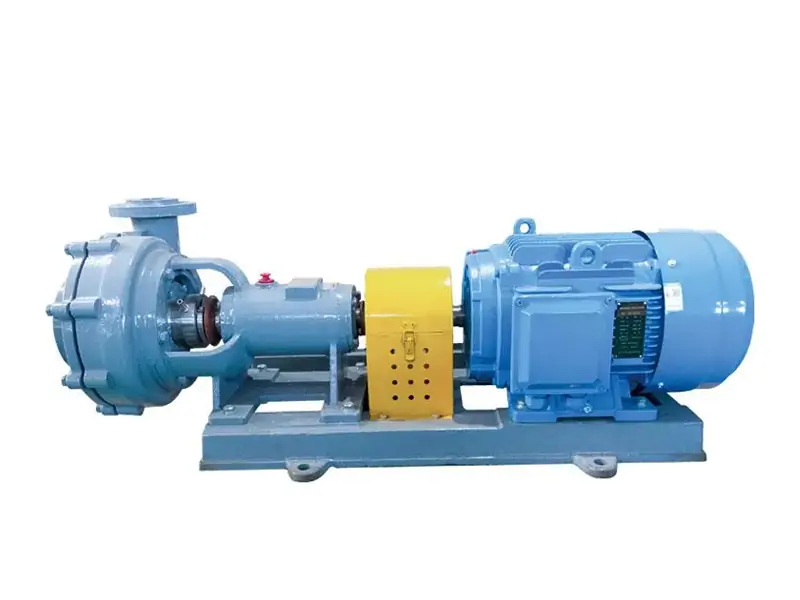
The CYB-ZKJ Series Corrosion Resistant Horizontal Slurry Pump uses imported FEP/PTFE material with an optimised pump casing and flow-through design built for highly corrosive fluids. It can be configured with a K-type dynamic seal for stable, leak-controlled operation.
Key specifications:
- Flow rate: 3–2600 m³/h
- Head: 5–100 m
- Motor power: 0.75–300 kW
- Speed: 968–3450 r/min
- Temperature range: -80°C to 120°C
- Lining material: FEP/PTFE
Best fit for: Alkaline or acidic lime slurry systems, corrosive mineral pulps, sewage with chemical content, and mixed slurry/corrosive fluid duties where both chemical resistance and solids handling are needed.
CYB-ZKJ Corrosive Chemical Transfer Pump — Best for Mixed Chemical and Lime Slurry Transfer
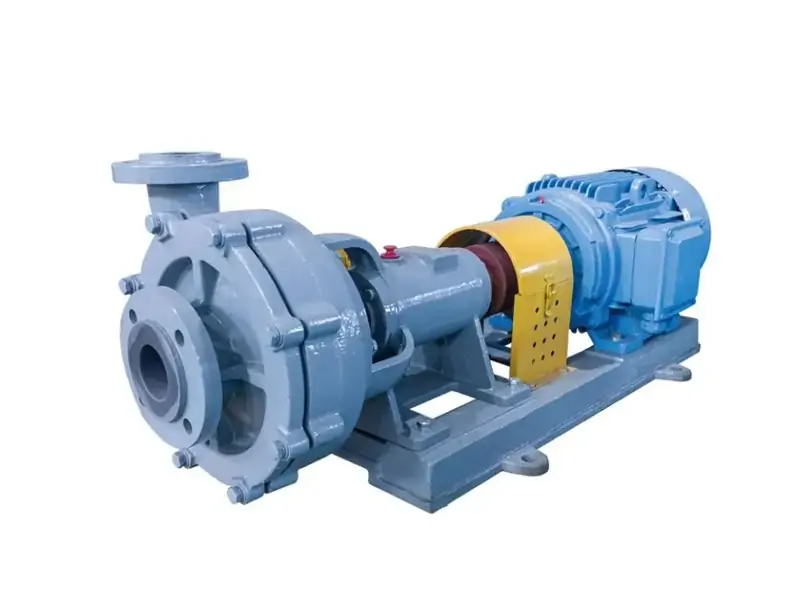
The CYB-ZKJ Series Corrosive Chemical Transfer Pump uses FEP lining, with PFA lining available for high-temperature conditions. It is rated for corrosive media of varying concentrations and can handle liquids containing up to 20% flexible solid particles.
Key specifications:
- Flow rate: 3–2600 m³/h
- Head: 5–100 m
- Motor power: 0.75–300 kW
- Speed: 968–3450 r/min
- Temperature range: -80°C to 120°C
- Lining material: FEP (PFA available)
Best fit for: Corrosive chemical transfer with suspended solids, dilute acid service in sulfuric acid and phosphate fertilizer industries, wastewater treatment involving strong chemicals, and any application requiring the widest chemical resistance with solids tolerance.
Quick Selection Guide: Which Lime Slurry Transfer Pump Is Right for Your Application?
| Application Condition | Recommended Series | Material | Temp. Range |
|---|---|---|---|
| Highly abrasive lime slurry, moderate chemistry | UHB Series | UHMW-PE | -20°C to 90°C |
| Corrosive lime slurry, acid/alkali liquid + solids | CYB-ZKJ Horizontal Slurry | FEP/PTFE | -80°C to 120°C |
| Mixed chemical + solids, high-temp corrosive transfer | CYB-ZKJ Chemical Transfer | FEP / PFA | -80°C to 120°C+ |
Frequently Asked Questions About Lime Slurry Transfer Pumps
What is the best pump for lime slurry transfer?
The best choice depends on whether abrasion, corrosion, or both are the main concern. UHMW-PE slurry pumps suit high-abrasion duty, while FEP/PTFE-lined designs are better for corrosive lime slurry systems.
Can a standard centrifugal pump handle lime slurry?
A standard centrifugal pump is generally not suitable for long-term lime slurry service. It lacks the wear-resistant linings, appropriate seal design, and wide flow passages needed for reliable operation in abrasive or alkaline slurry conditions.
How do you prevent lime slurry from settling in the pump?
Use recirculation lines or flush water to keep solids in suspension during low-flow periods. Avoid long dead legs in pipework and flush the pump before extended shutdowns.
Which material is better for lime slurry — UHMW-PE or FEP/PTFE?
UHMW-PE offers superior abrasion resistance and is the better choice for highly abrasive slurry. FEP/PTFE provides broader chemical compatibility and a wider temperature range, making it more suitable when corrosion is also a significant factor.
How do you reduce scaling in a lime slurry transfer system?
Regular flushing, eliminating dead zones in the piping, and selecting pump internals that are easy to inspect and clean are the most effective ways to reduce lime scaling and buildup over time.
What industries use lime slurry transfer pumps most often?
The most common industries are flue gas desulfurization, water and wastewater treatment, metallurgy, phosphate fertilizer production, and environmental protection systems.
Choosing the Right Lime Slurry Transfer Pump Comes Down to Knowing Your Application
Lime slurry transfer is a duty that punishes the wrong pump selection quickly. Abrasion wears through standard materials, alkaline chemistry attacks incompatible linings, and solids settling can block a system overnight. The engineers and buyers who get this right consistently follow the same approach: they identify whether abrasion, corrosion, or both dominate the application, confirm the operating range, and then match the pump construction — lining material, seal type, and flow passage design — to the real process conditions rather than the nameplate alone.
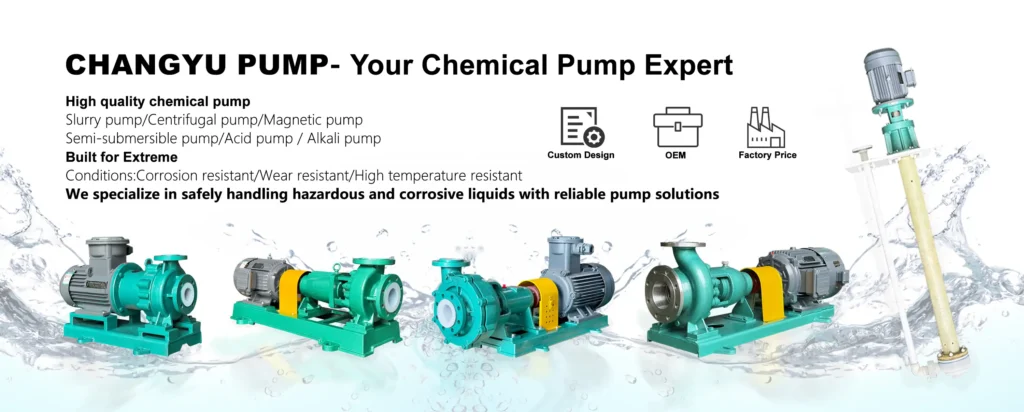
Changyu Pump’s UHB Series and CYB-ZKJ Series were developed specifically for these demanding conditions. Whether your system runs highly abrasive lime slurry, mixed corrosive slurry, or chemically aggressive media with suspended solids, there is a pump configuration built to handle it reliably.
Ready to find the right lime slurry transfer pump for your system?
Share your flow rate, head, operating temperature, and medium composition with the Changyu Pump team. We will match the right pump series and lining material to your application and provide a fast, detailed recommendation tailored to your process conditions.
👉 Contact Changyu Pump for a Free Application Review