

| Products
Home >> Products >> Self-priming Pump
Product Categories
Request a Quote
Self-Priming Pump Types
At Changyu Pump, self-priming pump selection is not simply based on structure, but on real operating conditions such as corrosion level, sealing requirement, and field stability demand. Based on our long-term application experience in chemical plants, wastewater systems, and industrial fluid transfer projects, the self-priming pump models are classified into the following engineering-oriented categories.
Stainless Steel Magnetic Drive Self-Priming Pump
The CQZ series is a stainless steel magnetic drive self-priming pump designed for applications where both corrosion resistance and zero-leakage operation are required. In actual engineering projects, this model is commonly used in chemical circulation systems, clean liquid transfer, and enclosed industrial processes.
From Changyu’s field experience, stainless steel provides stable mechanical strength under continuous operation, while the magnetic drive structure eliminates mechanical seal wear. This combination makes it suitable for systems that require long-term reliability with minimal maintenance intervention.
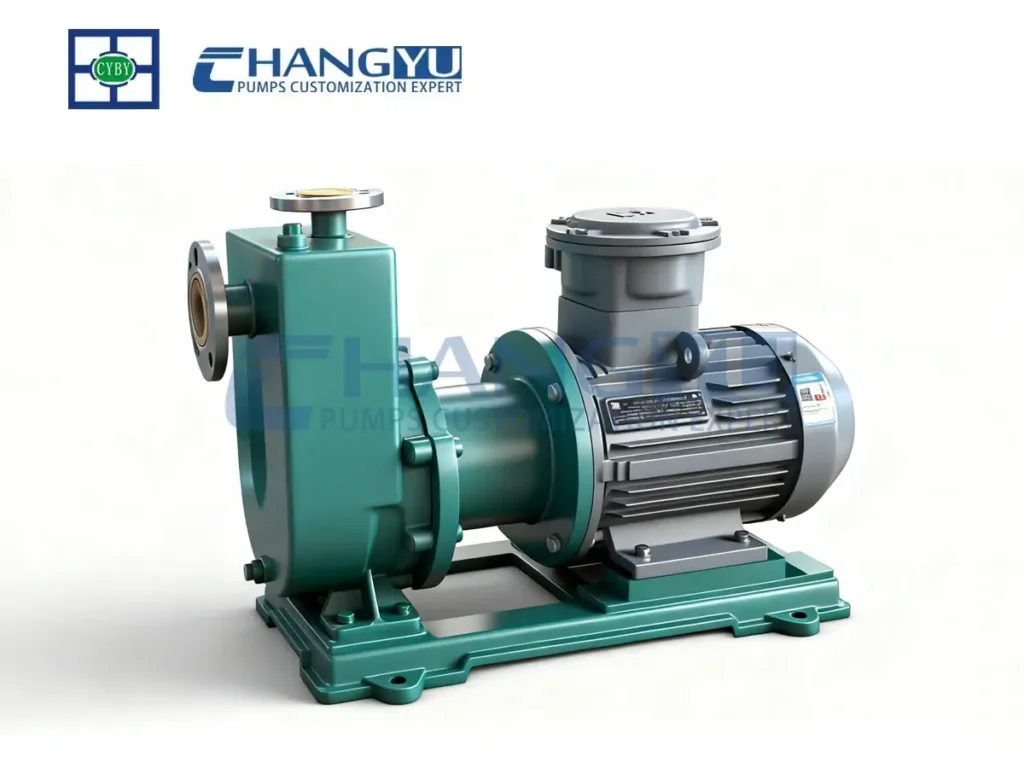
Our overview of self-priming stainless steel pump types explains where self-priming magnetic-drive designs fit and why priming capability does not remove dry-running restrictions.
Fluoroplastic Centrifugal Self-Priming Pump (FEP / PTFE / PFA Series)
This type is designed for highly corrosive chemical environments where metal materials cannot meet service life requirements. Depending on the chemical concentration and operating temperature, wetted parts can be selected from FEP, PTFE, or PFA-lined structures.
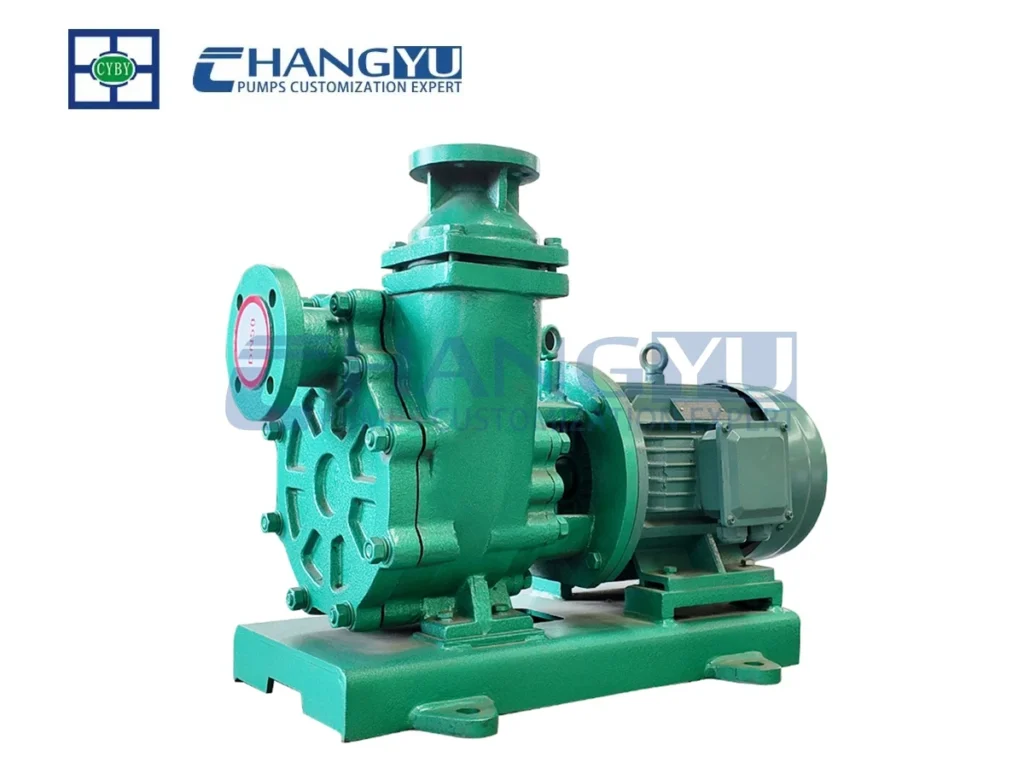
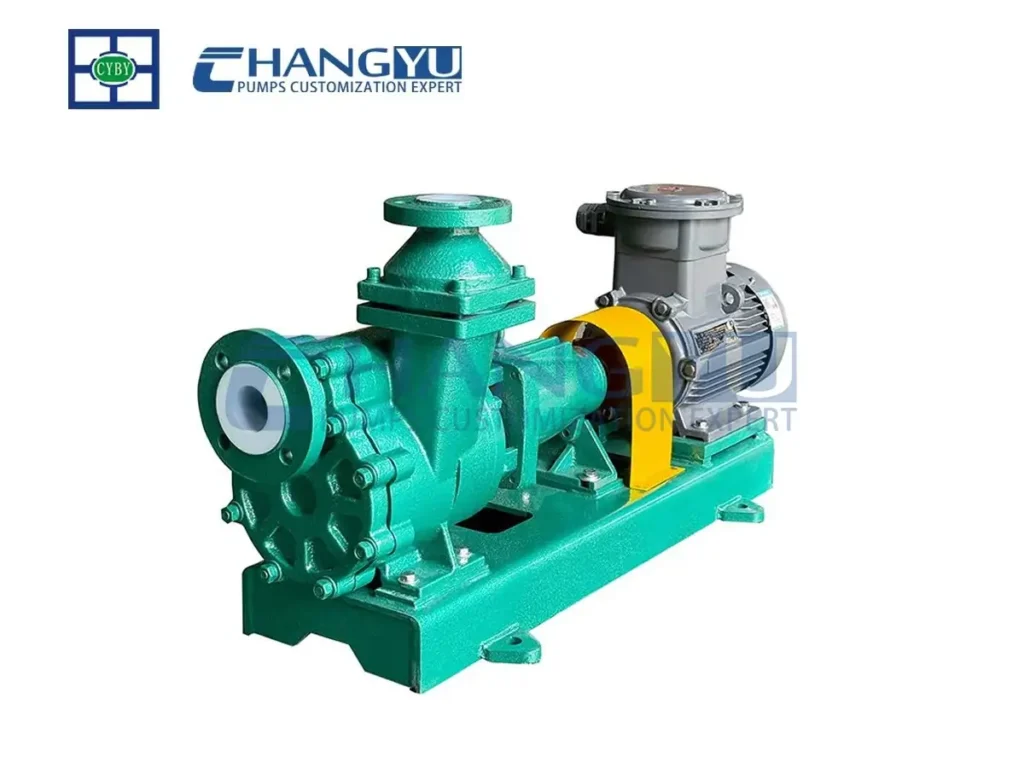
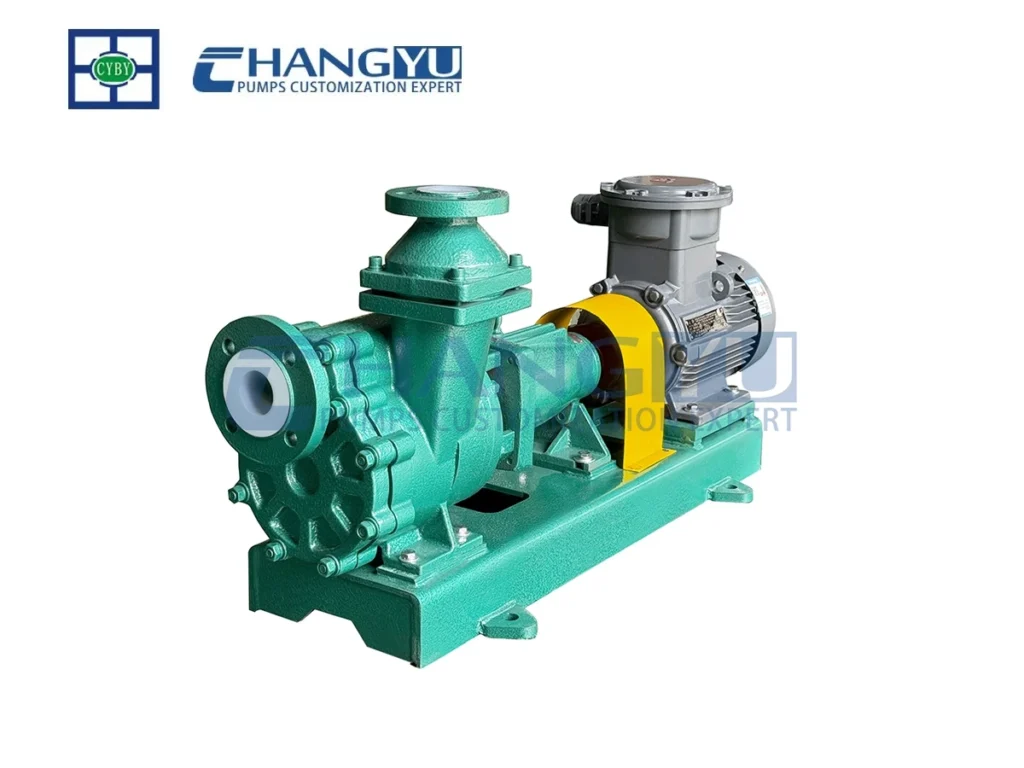
In real applications, PTFE-lined pumps are typically used for high-concentration acid transfer, while FEP-lined versions are more commonly applied in stable chemical circulation systems. This series is widely used in acid storage tank unloading, chemical dosing, and corrosive wastewater treatment.
Magnetic Drive Self-Priming Pump (ZCQ Series)
The ZCQ series is designed for hazardous or toxic fluid transfer where leakage cannot be tolerated. The magnetic coupling system completely isolates the motor from the pumped medium, achieving true zero shaft seal operation.
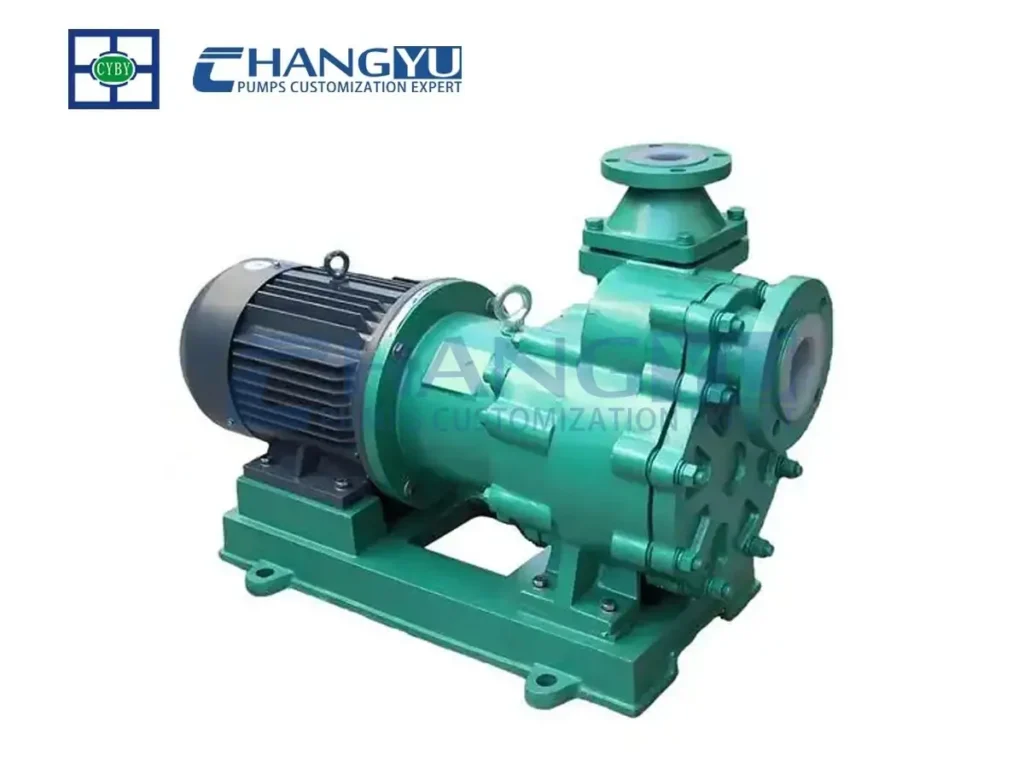
In real engineering projects, this pump is often selected for solvent transfer systems, toxic liquid handling, and reactor feed/discharge lines. The key value of this design is not flow capacity, but operational safety under continuous industrial conditions.
CYE Series Self-Priming Transfer Pump
The CYE series is a general-purpose industrial self-priming pump used for water-based and light chemical transfer applications. It is commonly applied in municipal systems, auxiliary industrial processes, and non-critical chemical transfer lines.
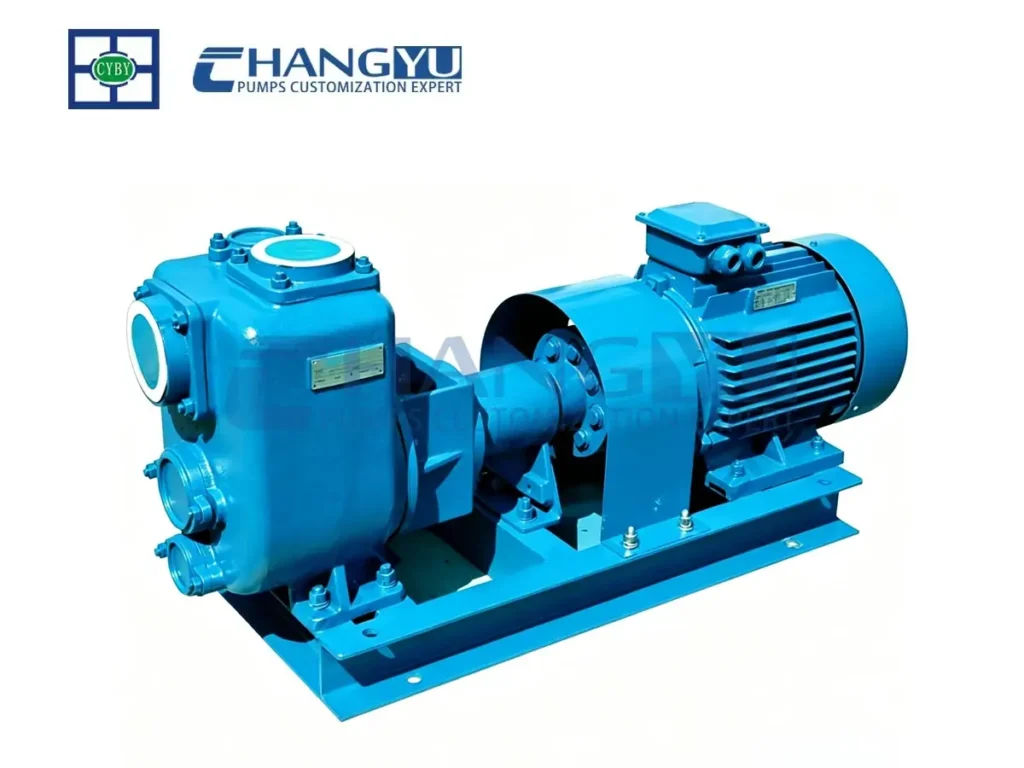
In real installations, this model is valued for its fast restart self-priming capability, stable intermittent operation performance, and relatively simple maintenance structure, making it suitable for general industrial utility systems.
What is a Self-priming Pump?
A Self-priming Pump is a type of centrifugal pump that can remove air from the suction pipe and draw liquid into the pump without repeated manual priming. Before the first start-up, the pump casing only needs to be filled with liquid once. After that, the remaining liquid inside the casing creates the vacuum needed to expel air and lift liquid from a lower level whenever the pump restarts. Unlike standard centrifugal pumps, a Self-priming Pump does not normally require a foot valve, making installation simpler and reducing maintenance requirements. This design is particularly suitable for applications where pumps stop and start frequently or where the suction pipe may contain air.
Thanks to its dependable self-priming performance, straightforward operation, and compact structure, the pump is widely used in wastewater treatment, chemical processing, industrial water transfer, agricultural irrigation, mining, municipal engineering, food production, pharmaceutical manufacturing, and environmental protection.
Choosing the right Self-priming Pump depends on factors such as flow rate, head, suction lift, liquid characteristics, operating temperature, and the material used for wetted components. For corrosive chemicals or liquids containing solids, selecting the proper pump material is just as important as selecting the correct hydraulic performance, helping improve service life while reducing maintenance and operating costs.
How Does a Self-Priming Pump Work?
The operating principle of a Self-priming Pump is based on its ability to automatically remove air from the suction pipeline without requiring repeated manual priming or a foot valve. After the pump casing is filled with liquid during the initial start-up, the pump continuously performs air-liquid mixing, gas-liquid separation, air discharge, liquid recirculation, and vacuum generation until the suction line is filled with liquid. Once priming is complete, the pump operates like a standard centrifugal pump and delivers a continuous flow of liquid.
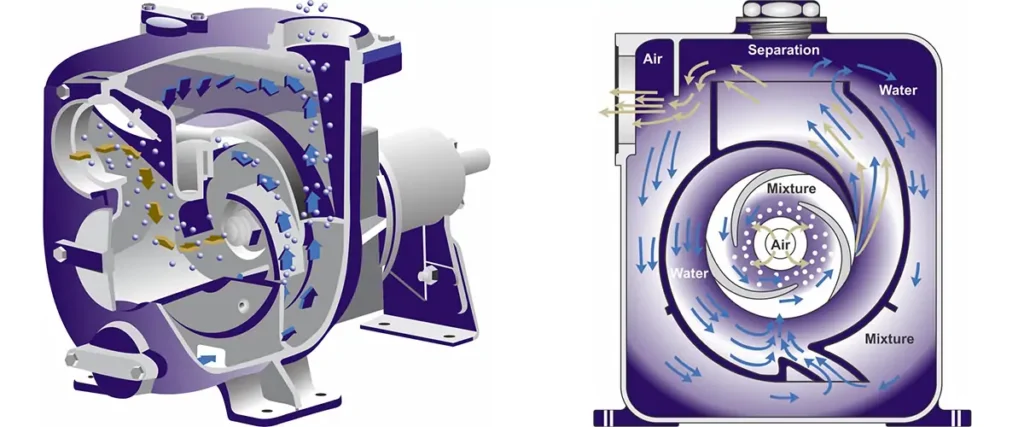
Step 1: Initial Priming: Before the first start-up, the pump casing or priming chamber must be filled with enough liquid to cover the impeller completely. This liquid serves as the working medium for the self-priming process. Under normal operating conditions, the liquid retained inside the casing after shutdown is sufficient for the next start, eliminating the need for repeated manual priming.
Step 2: Air-Liquid Mixing: When the motor starts, the impeller rotates at high speed, circulating the liquid stored inside the pump casing. At the same time, air trapped in the suction pipeline is drawn into the pump and mixes with the circulating liquid. This creates an air-liquid mixture that flows through the impeller passages and volute casing.
Step 3: Gas-Liquid Separation: The air-liquid mixture enters the gas-liquid separation chamber, which is the key feature that distinguishes a Self-priming Pump from a conventional centrifugal pump. As the flow velocity decreases inside the chamber, the lighter air separates from the heavier liquid. The air is discharged through the discharge pipeline or air release passage, while the liquid remains inside the pump.
Step 4: Liquid Recirculation: The separated liquid flows back to the impeller through an internal recirculation passage, where it mixes with the remaining air in the suction pipeline. This cycle of mixing, separating, venting, and recirculating repeats continuously, removing more air from the suction line with each cycle and gradually increasing the vacuum at the pump inlet.
Step 5: Normal Pumping Operation: As the air is completely expelled, atmospheric pressure pushes the liquid into the suction pipeline and pump casing. Once the suction line is filled with liquid, the self-priming process is complete. The pump then operates as a standard centrifugal pump, providing continuous and stable liquid transfer. Depending on the suction lift, pipeline configuration, and liquid properties, a typical Self-priming Pump completes the entire self-priming process within 30 to 120 seconds.
Based on Changyu Pump’s engineering experience, maintaining sufficient liquid inside the pump casing after shutdown, minimizing air leakage in the suction pipeline, and using a properly designed suction system are the most effective ways to ensure fast priming, stable performance, and long-term operational reliability.
Core Technical Parameters (Changyu Self-Priming Pump Range)
The following are the actual operating conditions for Changyu’s general-purpose pumps in real-world engineering applications, not theoretical maximum values. If you are interested in our products, please contact us today, and we will provide you with customized self-priming pump specifications tailored to your specific operating conditions. The parameters below are for reference only.
| Parameter | Typical Range / Engineering Notes |
|---|---|
| Self-Priming Height | 3 – 8 m (depends on liquid density and suction design) |
| Flow Rate | 3 – 100 m³/h (varies by CQZ / FZB / CYE configuration) |
| Head Range | 15 – 80 m |
| Temperature Range | -20°C to 150°C (PTFE/FEP models support higher corrosion resistance limits) |
| Wetted Materials | SS304 / SS316 / PTFE / FEP / PFA |
| Drive Type | Magnetic drive / Direct coupling motor |
| Sealing Type | Mechanical seal / Magnetic coupling (zero leakage option) |
| Solid Handling Capacity | Up to 10–15% (depends on impeller structure) |
| Self-Priming Time | 30–120 seconds under standard installation conditions |
| Restart Capability | Automatic restart with retained casing liquid |
Engineering note from Changyu field work:
Self-priming performance is not only determined by pump design, but heavily affected by suction line sealing, pipe length, and residual liquid retention inside the casing. In chemical plant commissioning, more than 60% of priming delay issues come from pipeline air leakage rather than pump structure itself.
Email: [email protected]
TEL/WA: +86-13651913727
Industrial Applications
When handling low-level storage tanks, tanker unloading, or hazardous chemical sumps, the key challenge is maintaining stable suction without dry running or mechanical seal failure.
From Changyu Pump’s 20+ years of field experience in chemical fluid transfer systems, pump reliability mainly depends on correct configuration matching rather than oversized performance parameters. For highly corrosive media, fluoroplastic-lined structures such as FEP or PFA are commonly selected to ensure long-term chemical resistance. For higher temperature or structural load conditions, SS316L or duplex stainless steel is preferred for better mechanical stability.
In sealing systems, magnetic drive (seal-less) designs are typically used where zero leakage is required, while reinforced mechanical seals are applied in applications that require higher pressure stability and continuous duty operation.
In real installations, proper material and sealing selection is what ensures stable self-priming performance and prevents downtime caused by leakage, dry running, or suction instability in high-risk chemical environments.
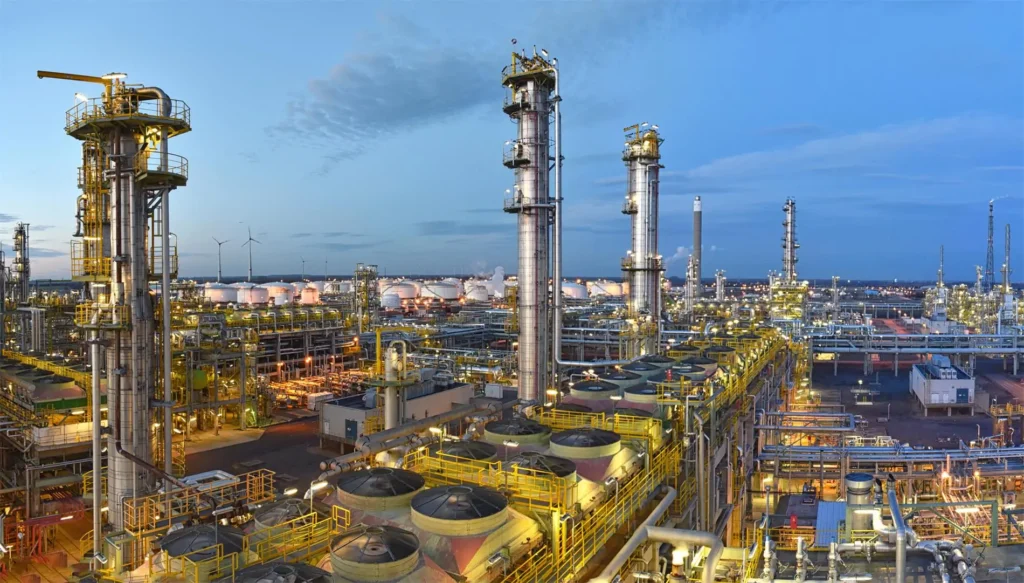 Chemical Industry
 Pharmaceutical and fine chemical industries
 New Energy Industry
 Electroplating Wastewater
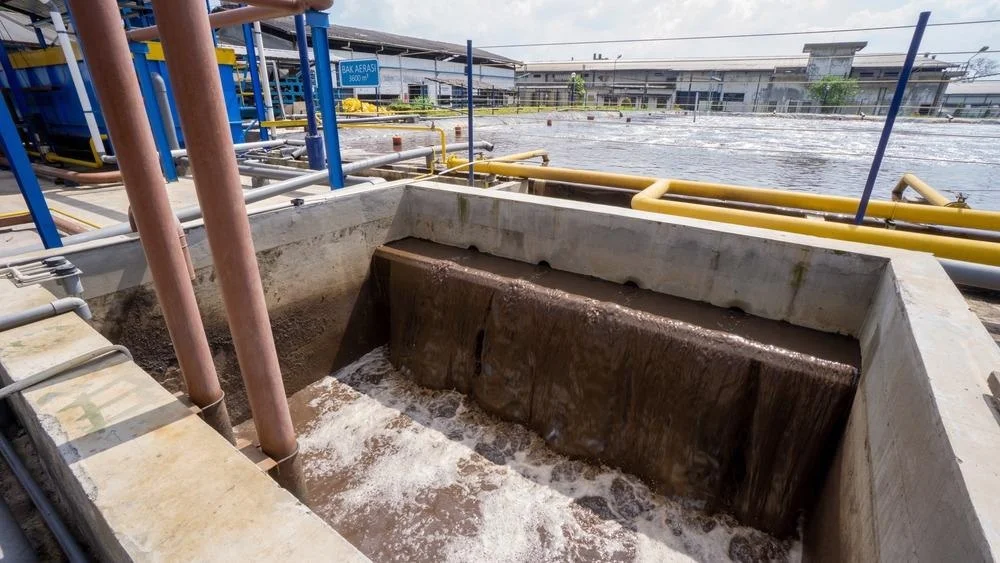 Wastewater
 Environmental protection and wastewater treatment
Below are the application scenarios we commonly handle and pump selection guidelines for your reference.
| Target Industry | Common Media & Complex Fluids | Critical Site Conditions | Recommended Changyu Pump Series | Engineering Selection |
|---|---|---|---|---|
| Chemical & Petrochemical Processing | Concentrated Sulfuric Acid (H₂SO₄), Hydrochloric Acid (HCl), Nitric Acid, Volatile Organic Solvents (Acetone, Ethanol, Toluene) | Underground sumps, closed transfer systems, frequent start-stop cycles, high vapor emission | ZCQ Series (Fluoroplastic Magnetic Drive) / FZB Series (Fluorine-Lined Centrifugal) | For volatile solvents and high-purity acids, we typically recommend the ZCQ magnetic drive series to eliminate leakage risk. For bulk transfer with minor solids content, FZB fluorine-lined pumps provide stronger mechanical robustness in long-term operation. |
| New Energy & Lithium Battery Manufacturing | Battery electrolytes, acidic metal slurries, cathode/anode wastewater | High purity requirements, zero cross-contamination, continuous process lines | ZCQ Series (PFA / FEP Lined) | Lithium battery electrolyte systems require zero metal ion contamination. We often specify full PFA lining to ensure chemical purity while maintaining stable suction performance up to 5 meters in real plant conditions. |
| Electroplating & Surface Treatment | Pickling acids, chromium baths, nickel/copper/zinc solutions, corrosive rinse water | Intermittent suction, high chloride content, variable temperature fluids | CQZ Series (Stainless Steel Magnetic) / FZB Series (Fluoroplastic Lined) | For high chloride or HF-containing solutions, stainless steel will fail due to pitting corrosion. In these cases, fluoroplastic systems are required. For high-temperature plating solutions above 100°C with low chloride levels, CQZ stainless steel provides better structural stability. |
| Environmental Protection & Wastewater Lifting | Industrial wastewater, acidic/alkaline effluents, dosing chemicals, neutralization liquids | Underground sumps, 3–5 m negative suction height, dry-start risk, unstable pH | FZB Series (Heavy-Duty Fluorine Lined) | Wastewater sumps often operate under unstable suction conditions. The FZB series is designed with a gas-liquid separation chamber, allowing automatic air evacuation and stable self-priming without a foot valve, typically within 150–250 seconds. |
| Pharmaceutical & Fine Chemical Production | High-purity solvents, sterile intermediates, bio-based liquids | GMP environments, zero leakage requirement, batch contamination risk | ZCQ Series (PFA Lined) / CQZ Series (316L / 904L Stainless Steel) | In pharmaceutical systems, even minor leakage can cause batch loss. We use magnetic coupling seal-less designs combined with high-purity ceramic isolation components to ensure zero contamination and stable long-term operation. |
Why Engineering Teams Partner with Changyu Pump
Decades of Industrial Fluid Expertise: Solving the Critical Failure Points in Chemical Self-Priming Systems
In industrial chemical transfer applications, a self-priming pump is not just equipment—it is a critical safety component that directly impacts leakage control, environmental compliance, and plant uptime.
In real-world operations, standard self-priming pumps often fail under conditions that are not visible in catalog specifications. Typical issues include thermal stress leading to fluoroplastic liner cracking, dry-running damage caused by insufficient gas-liquid separation, and magnetic coupling instability under high torque or temperature conditions.
At Changyu Pump, with over 20 years of engineering experience in chemical fluid systems, we focus on eliminating these failure modes at the design and manufacturing stage. By combining reinforced structural design, high-performance NdFeB / SmCo magnetic coupling systems, and precision fluoroplastic molding technology, our self-priming pump systems are engineered for stable air evacuation, zero-leakage operation, and long service life under aggressive chemical conditions.
The Changyu Engineering Edge vs. Standard Industrial Pumps
| Engineering Challenge | Standard Market Pumps (Common Issues) | Changyu Engineering Solution | Real-World Operational Impact |
|---|---|---|---|
| Volute Lining Cracking & Delamination | Many fluorine-lined pumps use low-grade or recycled materials, with thin linings that crack or separate under thermal cycling (>80°C) or vacuum stress. | We use 100% virgin PFA/FEP materials with a high-pressure lining process ensuring uniform thickness (>4mm), reinforced with internal steel mesh structures. | Stable operation under vacuum suction and thermal shock conditions up to 150°C without blistering, cracking, or delamination. |
| Magnetic Coupling Failure & Demagnetization | Low-cost magnetic drives use ferrite magnets that lose strength under heat, leading to torque slip or complete drive failure. | High-coercivity NdFeB and SmCo permanent magnets are used, protected by carbon fiber or Hastelloy isolation sleeves to reduce eddy current heating. | Zero torque slip and stable synchronous transmission even under continuous high-load operation. |
| Slow Self-Priming & Dry-Start Burnout | Small separation chambers lead to long priming times (5–8 minutes), increasing risk of seal overheating and dry-running damage. | Enlarged gas-liquid separation chamber with optimized reflux structure reduces priming time to 120–180 seconds. | Fast air evacuation, stable suction performance, and reduced startup wear with 4–5 m suction lift capability. |
| Frequent Shaft Seal Leakage | Conventional mechanical seals wear quickly when handling abrasive, corrosive, or crystallizing fluids. | ZCQ/CQZ series use magnetic drive seal-less design; FZB series uses heavy-duty externally mounted bellows mechanical seals. | Eliminates leakage risk in critical systems, reduces maintenance frequency, and improves operator safety in toxic environments. |
If you have any questions about self-priming pumps, please feel free to contact us right away. We will respond to your inquiry within 24 hours.
Email: [email protected]
TEL/WA: +86-13651913727