
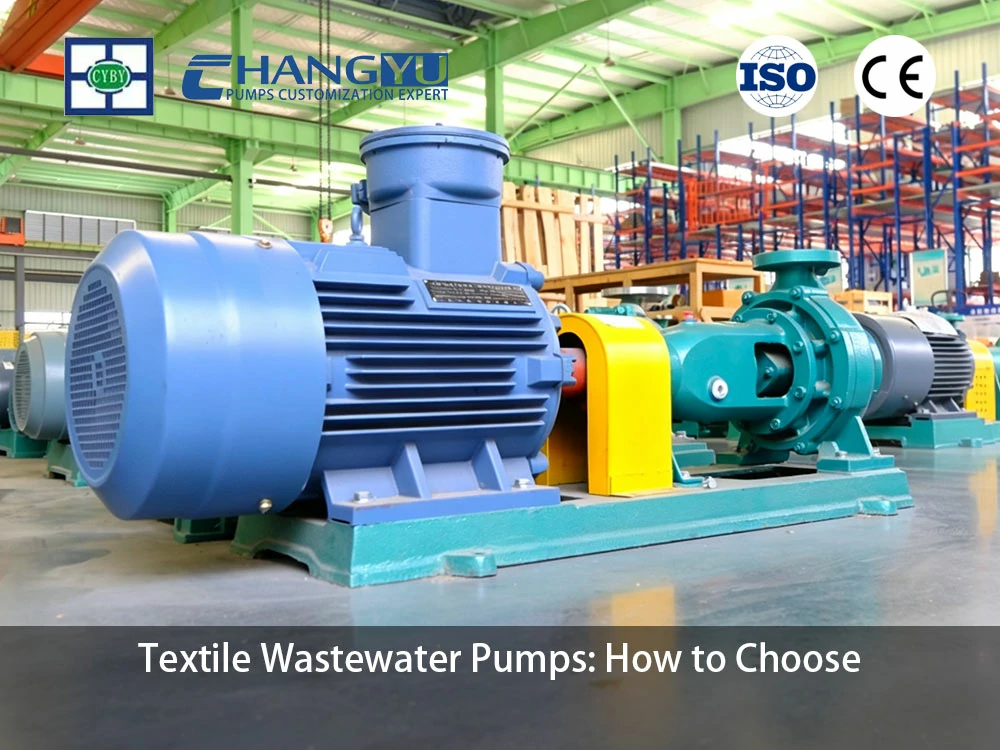
Bombas para aguas residuales textiles son una categoría especializada de bombas centrífugas resistentes a la corrosión, diseñadas para manejar efluentes agresivos, cargados de fibras y de alta temperatura generados en operaciones de procesamiento textil en húmedo. A diferencia de las bombas industriales estándar, deben soportar condiciones alternas de acidez y alcalinidad, temperaturas elevadas y sólidos propensos a obstrucciones, todo simultáneamente. Este artículo proporciona una guía práctica de selección para ingenieros de planta y profesionales de adquisiciones que necesitan elegir la bomba adecuada para su aplicación de aguas residuales textiles.
Conclusiones clave
- Las aguas residuales textiles presentan un conjunto de desafíos de bombeo particularmente exigente debido a sus amplias fluctuaciones de pH, temperaturas elevadas y composición química compleja. — El pH fluctúa ampliamente entre condiciones ácidas y alcalinas, las temperaturas alcanzan 60–90°C, y el efluente contiene colorantes, fibras, álcalis y solventes orgánicos que atacan los materiales convencionales de las bombas.
- La selección de materiales es una decisión crítica: el fluoroplástico (FEP/PFA/PTFE) es la opción preferida para corrientes mixtas de ácido-álcali, mientras que el UHMWPE sobresale en lodos abrasivos con alto contenido de fibra.
- Cuatro tipos de bombas de Changyu Pump cubren la mayoría de las aplicaciones de aguas residuales textiles — FYH para drenaje de sumideros y fosas de tinte, CYF para transferencia química, FZB para descarga autocebante de tanques y UHB para corrientes con lodos y sólidos.
- En general,no una sola bomba puede manejar todas las etapas del proceso textil; igualar el tipo de bomba al paso específico del proceso es esencial para la confiabilidad y la vida útil.
¿Qué hace que las aguas residuales textiles sean un desafío para las bombas?
El procesamiento textil en húmedo genera aguas residuales con una combinación de propiedades únicamente agresiva. Comprender estas características es el primer paso para seleccionar la bomba de aguas residuales textiles.
adecuada.
| Propiedades clave que afectan el rendimiento de la bomba | Rango Típico | Propiedad |
|---|---|---|
| pH | Impacto en la bomba | Fluctúa entre ácido y alcalino |
| Temperatura | Corrosión de piezas metálicas; ataque acelerado en revestimientos inadecuados | 60–90°C (licor de tinte, blanqueo) |
| Suspended solids | Degradación térmica de sellos; mayor riesgo de cavitación | Fibras, pelusa, partículas de colorante |
| Obstrucción del impulsor; falla del sello mecánico | Contenido químico | Colorantes, pigmentos, solventes orgánicos, sales |
| Ataque químico en piezas húmedas | Cloruros | Elevados (de agentes blanqueadores) |
Corrosión por picaduras del acero inoxidable Los ingenieros de Changyu Pump recomiendan:.
Siempre analice el rango completo de pH y la temperatura máxima de su corriente de aguas residuales, no solo los valores promedio. Una bomba seleccionada para condiciones promedio puede fallar en semanas bajo cargas máximas. Fuente de datos: .
Las aguas residuales del procesamiento textil típicamente contienen corrientes alternas de ácido-álcali de las etapas de teñido, blanqueo y acabado, con contenido de fibra que causa obstrucciones en bombas estándar.
- Modos comunes de falla de bombas en plantas textiles Corrosión por picaduras
- Obstrucción por fibra — Los cloruros de los agentes blanqueadores atacan el acero inoxidable 304/316L
- — La pelusa y el hilo se enrollan alrededor del impulsor, causando falla del sello y quemado del motor Choque térmico
- Cavitación — Los ciclos intermitentes de calor-frío degradan los elastómeros y causan fugas en los sellos
— La operación a alta temperatura con márgenes bajos de NPSH daña las superficies del impulsor
¿Qué material se recomienda para la construcción de bombas de aguas residuales textiles? El principio es sencillo:. fluoroplástico o UHMWPE para aguas residuales textiles; el acero inoxidable solo generalmente no se recomienda para corrientes mixtas de ácido-álcali.
Aquí está la justificación técnica.
Fluoroplástico (FEP/PFA/PTFE) — Para corrientes mixtas de ácido-álcali .

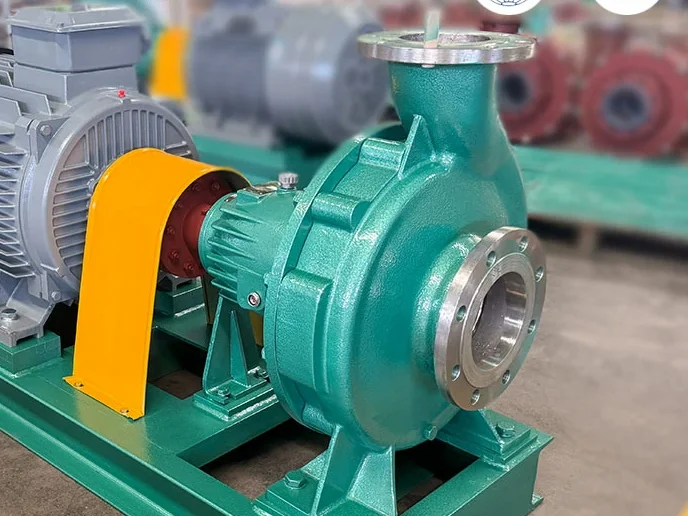
Corrosión por picaduras del acero inoxidable Los revestimientos de fluoroplástico proporcionan una resistencia química excepcionalmente amplia, lo que los hace adecuados para una amplia gama de medios agresivos en el proceso de tratamiento de aguas residuales textiles. Manejan cualquier concentración de ácidos, álcalis y solventes orgánicos sin degradación. La serie CYF, por ejemplo, opera continuamente de -20°C a 180°C con revestimiento de FEP/PFA/PTFE, manejando "ácido sulfúrico, ácido clorhídrico, ácido nítrico, ácido fluorhídrico, álcalis, agentes oxidantes, solventes orgánicos y aguas residuales corrosivas" — todos los químicos presentes en el procesamiento textil en húmedo. La serie FYH utiliza aleación de fluoroplástico en todas las piezas húmedas, lo que la hace adecuada para el drenaje de fosas de teñido donde el pH oscila entre ácido y alcalino. .
Para corrientes donde la temperatura supera los 120°C — como líneas de licor de tinte presurizado o agentes blanqueadores — especifique revestimiento de PFA en lugar de FEP estándar. El PFA mantiene la integridad mecánica hasta 180°C, mientras que el FEP comienza a ablandarse por encima de 150°C.
Ultra-high molecular weight polyethylene (UHMWPE) offers more than 9× the wear resistance of carbon steel . The UHB series features 8–20 mm thick UHMWPE lining with a semi-open impeller that prevents fiber clogging . This combination of abrasion resistance and anti-clog design makes it the preferred choice for sludge transfer and fiber-laden textile wastewater.
H3: Material Selection Quick Guide
| Condición | Material recomendado | Fundamentos técnicos |
|---|---|---|
| Mixed acid-alkali, minimal solids | FEP/PFA/PTFE | Broadest chemical resistance, -20°C to 180°C |
| Abrasive slurry with fibers | UHMWPE | 8–20mm lining, 9× carbon steel wear resistance |
| High-temperature (>120°C) | PFA | Thermal stability up to 180°C |
| Neutral pH, low chloride | 316L (limited scope) | Only for non-aggressive, low-chloride streams |
When Should You Use Each of the 4 Textile Wastewater Pump Types?
En Bomba Changyu, we recommend matching the pump type to the specific process stage. Here are the four pump series that cover the majority of textile wastewater applications.
① FYH Series — Why Choose a Fluoroplastic Submersible Pump for Dye Pits?
Recomendado para: Dyeing pit drainage, sump lifting, fiber-containing wastewater, acidic and alkaline effluent collection.
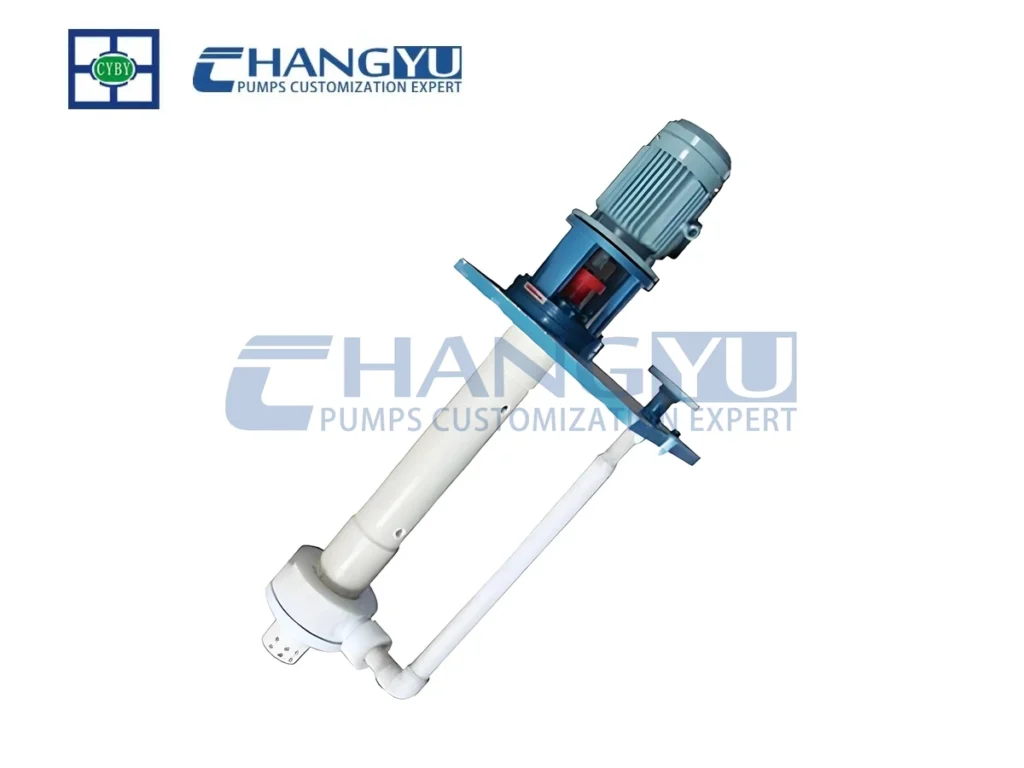
When the liquid level is below ground or in a deep pit, the FYH series is the appropriate choice. Its long-shaft vertical design allows the pump inlet to be submerged directly in the fluid, eliminating the need for priming. The open double-balanced impeller handles fibers and solids without clogging, making it particularly suited to textile sump applications .
| Parámetro | Range |
|---|---|
| Caudal | 5–400 m³/h |
| Cabeza | 5–50 m |
| Temperatura | De -20 °C a 90 °C |
| Materiales | FEP, UHMWPE, PTFE (customizable) |
| Impulsor | Open double-balanced (anti-clog) |
Why it fits: The FYH is explicitly listed for “textile dyeing” applications, and its fluoroplastic construction resists the alternating acid-alkali streams common in dyeing processes . The vertical installation also saves floor space in crowded plant areas.
Corrosión por picaduras del acero inoxidable For dye pits deeper than 3 meters, specify the extended shaft option. The FYH’s submerged hydraulic end eliminates the need for a suction pipe, reducing pressure losses and preventing air entrainment common in long suction lines .
Product link: Bomba sumergible resistente a productos químicos de la serie FYH
② Serie CYF — How Does a Fluoroplastic Centrifugal Pump Handle Chemical Dosing?
Recomendado para: Acid and alkali dosing, bleaching chemical transfer, high-temperature dye liquor circulation.
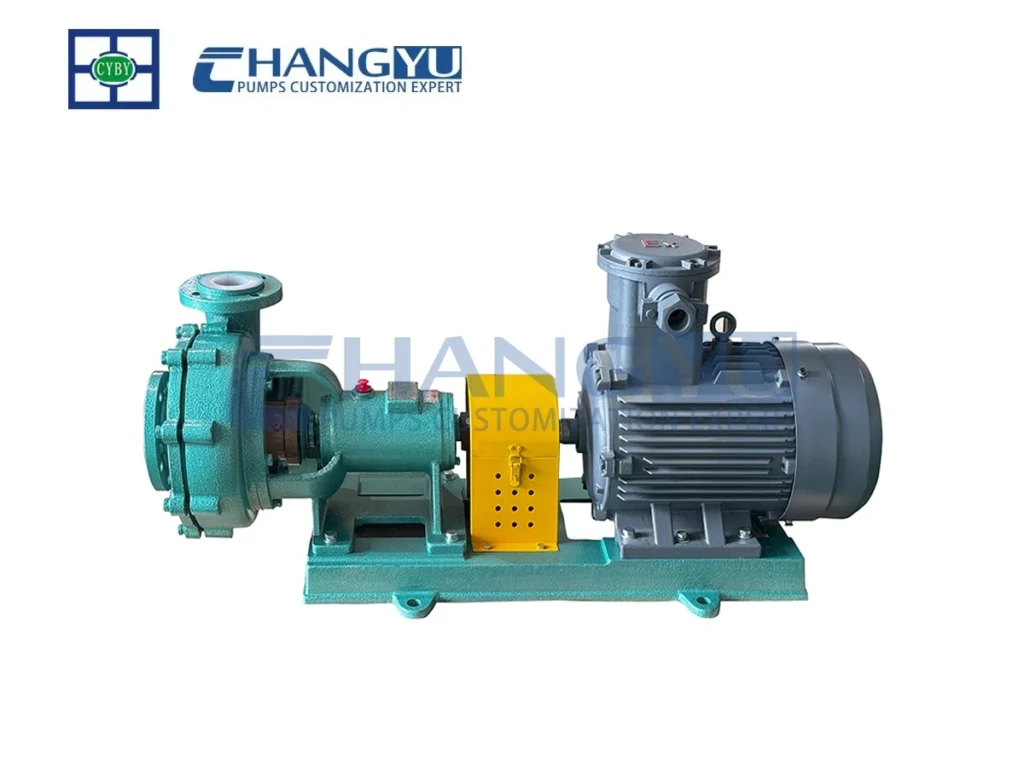
For above-ground, continuous transfer of corrosive chemicals, the CYF series is our standard recommendation. It is a single-stage, single-suction centrifugal pump designed to ISO standards, with FEP/PFA/PTFE lining and an external bellows mechanical seal .
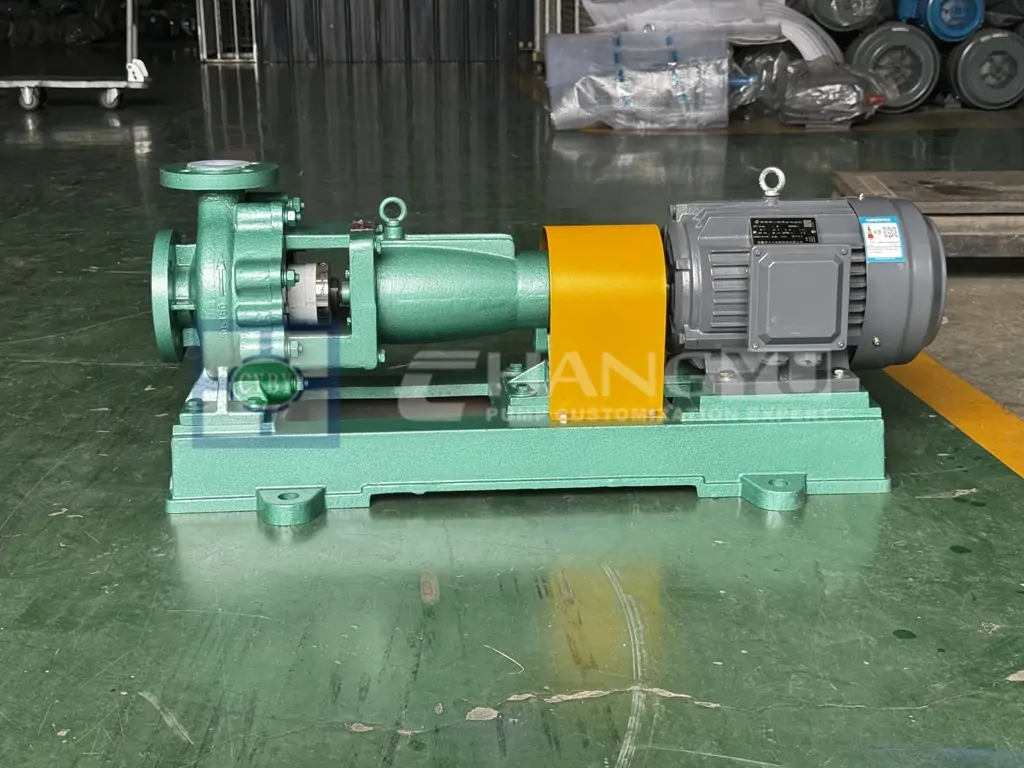
| Parámetro | Range |
|---|---|
| Caudal | 1.6–2600 m³/h |
| Cabeza | 5–130 m |
| Temperatura | De -20 °C a 180 °C |
| Materiales | FEP, PFA, PTFE lining |
| Sello | Sello mecánico de fuelle externo |
Why it fits: The CYF handles “sulfuric acid, hydrochloric acid, nitric acid, hydrofluoric acid, alkalis, oxidizing agents, organic solvents, and corrosive wastewater” — all chemicals found in textile wet processing . Its 180°C temperature tolerance covers the hottest dye liquor and bleaching streams.
Corrosión por picaduras del acero inoxidable When the CYF is used for intermittent dosing of bleaching chemicals (e.g., sodium hypochlorite or hydrogen peroxide), install a flushing line at the mechanical seal. This prevents crystal buildup during standby periods, which is a common cause of seal failure in textile plants .
Product link: Bomba centrífuga de fluoroplástico serie CYF
③ FZB Series — What Makes a Self-Priming Pump Suitable for Underground Tank Unloading?
Recomendado para: Underground tank unloading, intermittent chemical transfer, printing paste transfer, drum unloading.
When the liquid source is below the pump level — such as underground storage tanks or drums — a self-priming pump eliminates the need for foot valves or manual priming. The FZB series achieves automatic suction up to 5 meters (7 meters with foot valve) after initial filling .
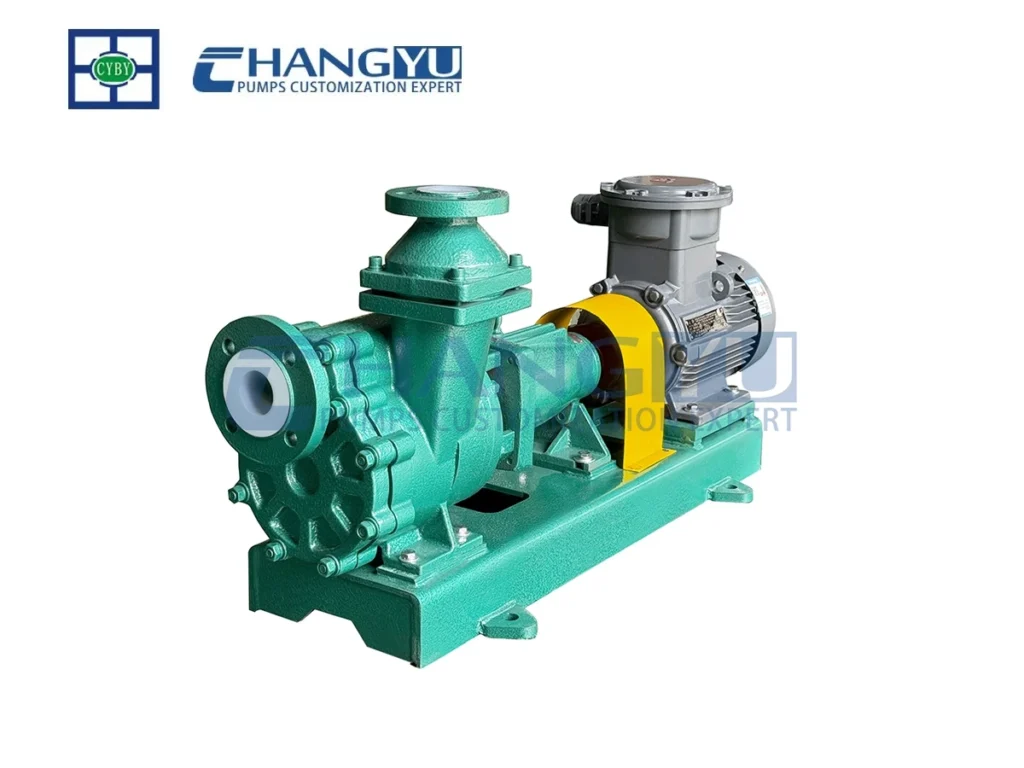
| Parámetro | Range |
|---|---|
| Caudal | 2,5–100 m³/h |
| Cabeza | 15–50 m |
| Temperatura | De -20 °C a 150 °C |
| Altura de autocebado | Up to 5 m (7 m with foot valve) |
| Materiales | FEP, PFA, PTFE lining |
Why it fits: The FZB series is explicitly listed for “textile printing and dyeing” industry applications, including pumping corrosive liquids from underground tanks and unloading chemical tankers . Its self-priming capability is essential for plants with below-grade chemical storage.
Corrosión por picaduras del acero inoxidable For self-priming applications involving printing paste or viscous dye solutions, select the FZB with a larger suction pipe diameter than the pump inlet. This reduces flow velocity at the suction line, minimizing friction losses during the priming phase and ensuring reliable restart after each batch .
Product link: Bomba centrífuga autocebante de plástico fluorado de la serie FZB
④ UHB Series — Where Should You Use a UHMWPE-Lined Slurry Pump?
Recomendado para: Sludge transfer, sand-containing effluent, high-abrasion wastewater, fiber-laden slurry.
When the wastewater contains abrasive solids, fibers, or crystalline particles, the UHB series is the most durable option. Its UHMWPE lining (8–20 mm thick) provides more than 9× the wear resistance of carbon steel, and the semi-open impeller prevents clogging .
| Parámetro | Range |
|---|---|
| Caudal | 3–2600 m³/h |
| Cabeza | 5–100 m |
| Temperatura | De -20 °C a 90 °C |
| Lining thickness | 8–20 mm UHMWPE |
| Impulsor | Semi-open, anti-clog |
| Sello | K-type dynamic seal with cooling jacket |
Why it fits: The UHB series is designed for “corrosive and abrasive media” where standard pumps fail. Changyu Pump’s product catalog lists “textile wastewater” and “dyeing industries” among its applications . The semi-open impeller and K-type dynamic seal make it particularly effective for fiber-laden textile wastewater.
Corrosión por picaduras del acero inoxidable For textile wastewater containing both abrasive particles (>5% by weight) and long fibers, the UHB with a K-type dynamic seal is the preferred configuration. The dynamic seal creates a centrifugal barrier that prevents particles from reaching the seal faces — a critical feature when conventional mechanical seals would fail within weeks
Product link: Bomba para lodos abrasivos de la serie UHB
How to Match Textile Wastewater Pump to Application — A Quick Selection Chart
| Escenario de aplicación | Bomba recomendada | Material | Fundamentos técnicos |
|---|---|---|---|
| Dyeing pit sump drainage | FYH | FEP/UHMWPE | Vertical submersible, handles fibers, no priming required |
| Acid dosing (HCl, H₂SO₄) | CYF | FEP/PFA | High flow, 180°C temperature limit, ISO standard dimensions |
| Alkali transfer (NaOH) | CYF | FEP/PFA | Resists caustic soda at any concentration |
| High-temperature dye liquor (80–150°C) | CYF | PFA | Temperature tolerance up to 180°C |
| Sludge with fibers and solids | UHB | UHMWPE | 8–20mm anti-abrasion lining, anti-clog impeller |
| Underground tank unloading | FZB | FEP/PFA | Self-priming up to 5m, automatic restart |
| Printing paste transfer | FZB | FEP/PFA | Self-priming design handles viscous media |
What Seal System Should You Use for Textile Wastewater Pumps?
The seal is the most vulnerable component in any pump handling textile wastewater. Changyu Pump offers three sealing approaches, each suited to different conditions.
- Sello mecánico de fuelle externo — Standard on CYF and FZB series. The stationary ring uses 99.9% alumina ceramic or silicon carbide; the rotating ring uses PTFE-filled material. Suitable for clean to slightly dirty liquids .
- Junta dinámica tipo K — Standard on UHB series. Creates a centrifugal barrier that prevents particles from reaching the seal faces. Includes a cooling water jacket for high-temperature operation. Recommended for slurry and fiber-laden wastewater .
- Sealless vertical design — The FYH series eliminates mechanical seals through its semi-submersible design: the motor is mounted above the liquid level, and the pump shaft extends down into the fluid. This removes the primary leakage path and reduces maintenance .
Corrosión por picaduras del acero inoxidable For textile plants handling multiple chemical batches, standardize on the external bellows mechanical seal (CYF/FZB) for clean chemical transfer and the K-type dynamic seal (UHB) for slurry and fiber-laden streams. Using the correct seal type for each application reduces the total cost of ownership more than any other single decision.
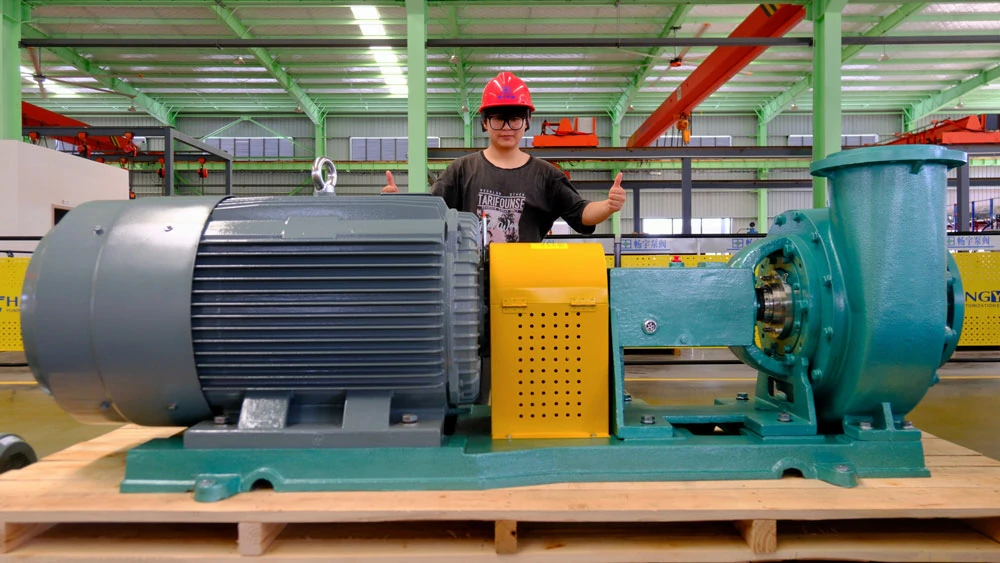
How to Install and Maintain Textile Wastewater Pumps
Submersible (FYH) vs. Horizontal (CYF/FZB/UHB) Installation
- FYH (vertical submersible): Mount directly on the tank top or pit cover. The pump shaft extends down into the liquid. No foundation or priming required. Suitable for confined spaces and deep pits .
- CYF/FZB/UHB (horizontal): Require a concrete foundation and suction piping. Suitable for above-ground installations where pump access is needed for routine maintenance.
Dealing with Intermittent Operation in Batch Processes
Textile plants often operate in batches. Frequent start-stop cycles can cause thermal shock and seal damage. Changyu Pump recommends:
- Install a minimum recirculation line to maintain flow during standby
- Use a check valve to prevent backflow and reverse rotation
- For the FZB series, the self-priming design allows automatic restart without manual intervention
Routine Inspection Checklist
| Frecuencia | Check Item |
|---|---|
| Diario | Motor current, vibration, visible leakage |
| Semanal | Strainer or filter cleaning, seal flush flow |
| Mensual | Impeller clearance, lining thickness (UHB series) |
| Trimestral | Mechanical seal condition, bearing grease replacement |
| Anualmente | Full pump overhaul, lining inspection, shaft alignment |
Conclusion: Get the Right Textile Wastewater Pump for Your Plant
Elegir el adecuado bomba de aguas residuales textiles comes down to three decisions: material (fluoroplastic or UHMWPE), tipo de bomba (FYH, CYF, FZB, or UHB), and seal system (mechanical, dynamic, or sealless). Get these three decisions right, and the pump will serve reliably for years in even the most demanding textile environments.
En Bomba Changyu, we have been manufacturing corrosion-resistant pumps since 2006. Our ISO 9001 and CE-certified facility in Anhui, China, produces over 20,000 units annually, serving customers in textile, chemical, metallurgical, and environmental industries worldwide . Our engineering team has deployed fluoroplastic and UHMWPE-lined pumps in hundreds of textile plants across Asia, Europe, and Africa.
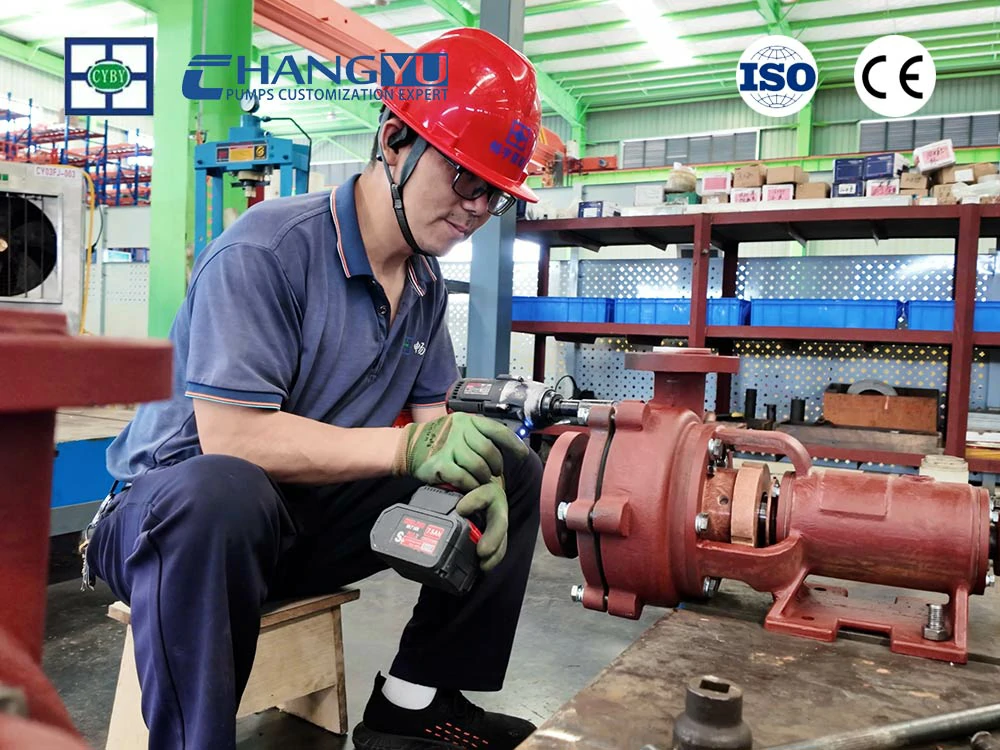
We are ready to help you select the right pump for your specific textile wastewater application. Send us your process parameters — flow rate, head, media composition (including pH range and temperature), and solids content — and our engineering team will provide a customized recommendation within 24 hours.
Contact us today:
- Correo electrónico: [email protected]
- WhatsApp/Phone: +86-13651913727
Let Changyu Pump be your partner in reliable, corrosion-resistant fluid handling.
Terminology
📖 Fluoroplastic-Lined Pump
A centrifugal pump whose wetted parts are lined with fluoropolymers such as PTFE, FEP, or PFA. These materials are nearly inert to all chemicals except molten alkali metals and fluorine gas at high temperatures. Fluoroplastic-lined pumps are the standard choice for handling mixed acids, alkalis, and organic solvents in chemical processing, textile dyeing, electroplating, and pharmaceutical industries. They typically operate at temperatures from -20°C to 180°C and are available in horizontal, vertical, and self-priming configurations. (See also: Fluoropolymer on Wikipedia)
📖 UHMWPE Lining (Pump)
A layer of ultra-high molecular weight polyethylene (UHMW-PE) bonded to the inner surface of a metal pump casing, typically 8–20 mm thick. UHMWPE offers more than 9× the abrasion resistance of carbon steel combined with chemical resistance to acids and alkalis (up to 80% sulfuric acid, 50% nitric acid). It is the standard material for slurry pumps handling abrasive, corrosive, or fiber-laden media in chemical processing, mining, and textile wastewater treatment. Operating temperature range is typically -20°C to 90°C (up to 120°C with modified grades) . (See also: UHMWPE on Wikipedia)
📖 Dynamic Seal (Centrifugal Pump)
A non-contacting sealing device used in centrifugal pumps handling abrasive or particle-laden fluids. It uses a rotating impeller-like disc to create centrifugal force that pushes solid particles away from the seal faces, preventing wear. A stationary throttle bushing or wear plate completes the seal. Dynamic seals are commonly found in slurry pumps and are often paired with a cooling water flush system to handle high-temperature applications up to 90°C . (See also: Mechanical seal on Wikipedia)
Preguntas frecuentes
Q: Can I use a stainless steel pump for textile wastewater?
A: Stainless steel (304/316L) is suitable only for neutral pH, low-chloride streams. For the mixed acid-alkali dyeing wastewater typical of textile plants, fluoroplastic (FEP/PFA/PTFE) or UHMWPE lining is required.
Q: How to prevent fiber clogging in textile wastewater pumps?
A: Choose pumps with open or semi-open impellers. The FYH series uses an open double-balanced impeller, and the UHB series uses a semi-open impeller — both are designed to handle fiber-containing media .
Q: Self-priming vs submersible — which is better for textile plants?
A: Use submersible (FYH) for deep pits and sumps where the liquid level is below ground. Use self-priming (FZB) for underground tank unloading and intermittent transfer where the pump must be mounted above the liquid level. Each design addresses a different installation scenario.
Q: What material is recommended for high-temperature dye liquor?
A: PFA (perfluoroalkoxy) is the preferred material for high-temperature applications, with a temperature tolerance up to 180°C. The CYF series is available with PFA lining .