
Korosi sumuran yang berulang pada pompa air laut, tekanan suplai yang tidak memadai setelah filtrasi, peningkatan kebisingan dan getaran saat air surut, atau ketidakpastian mengenai jenis pompa saat penyusunan penawaran sering kali mengarah pada masalah yang sama: kita belum menyesuaikan posisi pompa suplai air laut dalam sistem dengan kondisi operasi aktual dan material komponen yang bersentuhan dengan fluida.
Di changyupump, kami menyarankan untuk terlebih dahulu menentukan apakah pompa digunakan untuk pengambilan air, suplai ke tahap prapengolahan, peningkatan tekanan dalam pipa, atau suplai bertekanan tinggi di sisi hulu membran SWRO. Selanjutnya, kami menentukan laju aliran, tinggi tekan, kondisi sisi masuk, dan material. Artikel ini membantu Anda membedakan tugas-tugas tersebut, memahami risiko korosi dan kavitasi, serta mengidentifikasi kondisi yang memungkinkan seri CYH, CQZ, dan CYC kami untuk disertakan dalam perbandingan pemilihan Anda.
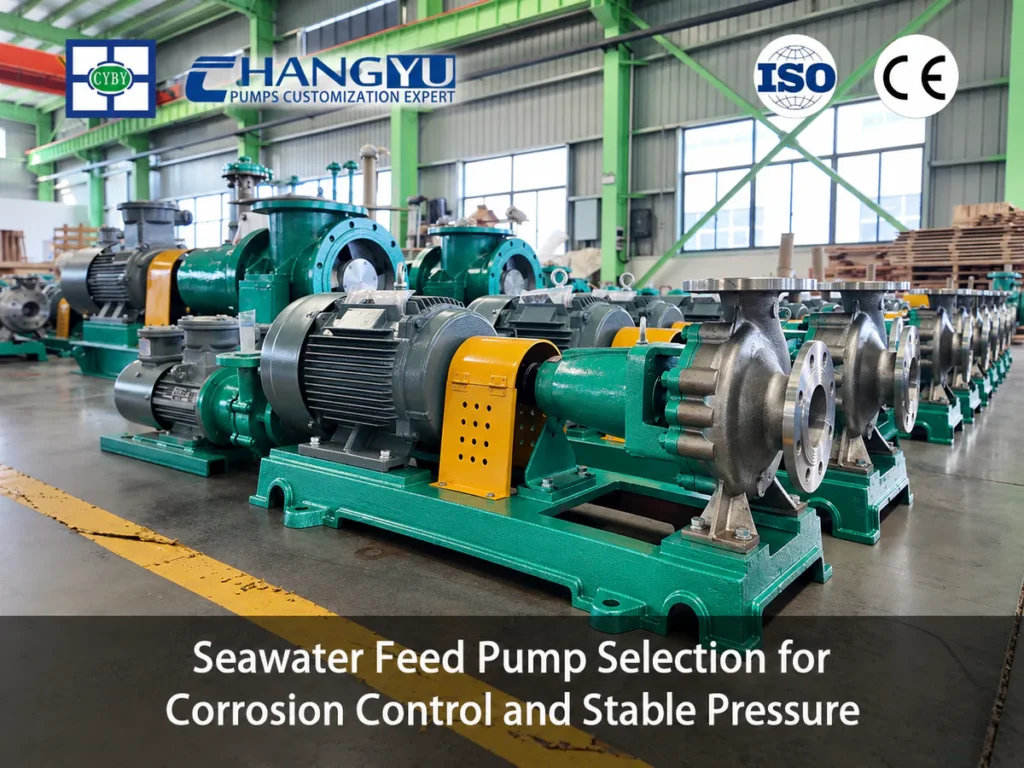
Jika Anda sudah memiliki data proyek, Anda dapat memulainya dengan memberikan informasi kepada teknisi kami tentang laju aliran, tinggi tekan yang diperlukan atau tekanan masuk dan keluar, suhu air maksimum, level cairan minimum, dan kualitas air. Kami akan membahas opsi berdasarkan data tersebut, alih-alih merekomendasikan model hanya berdasarkan istilah pompa air laut.
Apa Itu Pompa Suplai Air Laut dan Bagaimana Cara Kerjanya?
Pompa suplai air laut memasok air laut secara kontinu ke sistem proses. Nama tersebut menjelaskan tugas pompa; dengan sendirinya, nama itu tidak menentukan konstruksi, rating tekanan, atau materialnya.
Salah satu prinsip kerja yang umum digunakan adalah prinsip pompa sentrifugal: motor memutar impeler, yang mentransfer energi ke cairan. Casing dan saluran aliran kemudian mengubah sebagian energi kecepatan menjadi tekanan, sehingga air laut mengalir melalui perpipaan menuju peralatan di sisi hilir. Jika diperlukan tinggi tekan yang lebih besar, pompa sentrifugal multitahap yang sesuai memungkinkan cairan melewati beberapa impeler secara berurutan untuk memperoleh energi.

Dokumen proyek juga dapat menggunakan istilah pompa suplai air laut, pompa transfer air laut, dan pompa penguat tekanan air laut. Dua istilah pertama menekankan fungsi suplai dan transfer, sedangkan istilah terakhir menekankan peningkatan tekanan; konstruksi pompa yang sama dapat menjalankan fungsi-fungsi tersebut. Para insinyur kami terlebih dahulu meninjau diagram alir sistem dan parameter operasi untuk menentukan kebutuhan aktual di balik istilah yang digunakan.
Aplikasi umum mencakup suplai air laut untuk pengambilan dan prapengolahan pada proses desalinasi, serta suplai air pendingin untuk penukar panas menggunakan pompa pendingin air laut. Sistem balas, air pemadam kebakaran, dan sistem lainnya juga dapat menggunakan air laut, tetapi pengaturan operasi, persyaratan unit pompa, dan sertifikasi yang berlaku perlu dikonfirmasi secara terpisah.
Apa Perbedaan antara Pompa Umpan Air Laut dan Pompa Tekanan Tinggi SWRO?
Perbedaan utamanya adalah posisi pompa dalam sistem dan tekanan diferensial yang diperlukan. Istilah pompa umpan osmosis balik air laut terkadang merujuk pada pompa yang menyediakan suplai masuk yang stabil ke pompa tekanan tinggi, dan terkadang merujuk pada pompa yang secara langsung memberikan tekanan pada modul membran. Oleh karena itu, dokumen pengadaan perlu menentukan peralatan yang terhubung ke sisi masuk dan sisi keluar pompa.
SWRO adalah singkatan dari osmosis balik air laut. Sistem ini menggunakan tekanan efektif yang melebihi tekanan osmotik terkait untuk melewatkan sebagian air melalui membran, sementara sebagian besar garam tertahan di sisi konsentrat. Tekanan yang diperlukan untuk pompa tekanan tinggi di sisi hulu membran harus ditentukan berdasarkan faktor-faktor yang mencakup salinitas, suhu air, desain sistem membran, produksi permeat, dan tingkat pemulihan.
| Posisi dalam Sistem | Jenis Pompa yang Umum Digunakan | Dasar Utama Pemilihan |
|---|---|---|
| Pengambilan air laut menuju tangki air baku atau sistem pengolahan | pompa pengambilan air laut / pompa transfer air laut | Elevasi pasang surut, kondisi sisi masuk, laju alir, partikel, dan hambatan perpipaan |
| Tangki air baku menuju peralatan filtrasi dan prapengolahan | pompa umpan air laut / pompa prapengolahan air laut | Laju alir pengolahan, kehilangan tekanan pada peralatan, dan tekanan yang diperlukan pada titik akhir |
| Memberikan tekanan masuk tambahan untuk peralatan di hilir | pompa penguat air laut / pompa penguat SWRO | Tekanan masuk minimum, kebutuhan di hilir, dan rentang penyesuaian operasi |
| Memasok air laut bertekanan tinggi ke modul membran SWRO | pompa umpan RO bertekanan tinggi | Tekanan sistem membran yang diperlukan, tekanan umpan, sifat air laut, dan persyaratan rating tekanan |
Periksa terlebih dahulu satuan tinggi tekan dan tekanan. Untuk air laut dengan perkiraan densitas sekitar 1.025 kg/m³, tinggi tekan 60–80 m setara dengan tekanan diferensial sekitar 6–8 bar. Nilai ini tidak boleh dinyatakan sebagai tekanan umpan tinggi 60–80 bar di hulu membran SWRO. Jika pompa itu sendiri harus menghasilkan tekanan diferensial sebesar 60–80 bar, tinggi tekan yang setara adalah sekitar 600–800 m. Dalam operasi aktual, tekanan masuk juga harus diperhitungkan: tekanan keluar pompa tidak sama dengan tekanan diferensial yang dihasilkan oleh pompa.
Oleh karena itu, kami menilai pengambilan air untuk desalinasi, peningkatan tekanan pada praperlakuan, dan umpan bertekanan tinggi ke membran secara terpisah. Kesesuaian suatu seri pompa untuk aplikasi pompa desalinasi air laut tidak berarti seri tersebut mencakup setiap tugas dalam sistem desalinasi.
Bagaimana Menentukan Ukuran Pompa Umpan Air Laut Berdasarkan Laju Alir dan Tinggi Tekan?
Kami terlebih dahulu menetapkan laju alir operasi normal, minimum, dan maksimum, lalu menghitung tinggi tekan dinamis total yang harus disediakan pompa. Perhitungan ini harus mencakup perbedaan elevasi, hambatan pipa dan katup, kehilangan tekanan pada peralatan filtrasi, serta kebutuhan tekanan pada titik akhir, dengan memperhitungkan kontribusi tekanan masuk yang ada.
Untuk pompa sistem filtrasi air laut, kehilangan tekanan pada filter berubah dari kondisi bersih hingga saat filter perlu dibersihkan. Pemilihan yang hanya didasarkan pada kondisi filter bersih dapat mengakibatkan aliran tidak mencukupi di kemudian hari. Sebaliknya, menambahkan setiap kemungkinan variasi sebagai margin berlebih dapat menyebabkan pompa beroperasi di luar rentang yang wajar dalam waktu lama. Para insinyur kami membandingkan kurva sistem dan kurva pompa dalam berbagai kondisi operasi.
Tiga kondisi yang sering terabaikan perlu dijelaskan saat meminta penawaran:
- Aliran air yang ditangani pompa dalam proyek desalinasi. Debit permeat membran, debit umpan membran, dan debit total air masuk ke instalasi biasanya berbeda dan perlu dihitung secara terpisah berdasarkan tingkat pemulihan, kehilangan pada praperlakuan, dan kebutuhan pencucian balik.
- Cara pengoperasian beberapa pompa. Pengoperasian satu pompa, pengoperasian paralel, peralihan ke pompa siaga, dan pengendalian kecepatan variabel mengubah titik operasi aktual. Membandingkan hanya debit maksimum pada pelat nama tidaklah memadai.
- Apakah kondisi minimum pada sisi masuk telah ditentukan. Kondisi air surut terendah, level tangki minimum, dan kehilangan tekanan pada saringan isap semuanya memengaruhi tekanan sisi masuk dan debit yang dapat dicapai.
Kami juga mempertimbangkan BEP, atau titik efisiensi terbaik: titik efisiensi tertinggi pompa pada kecepatan dan konfigurasi impeler tertentu. Pemilihan harus memastikan kondisi operasi utama tetap berada dalam rentang operasi yang diizinkan oleh produsen dan sedekat mungkin dengan wilayah efisiensi yang sesuai, sehingga mengurangi konsumsi energi, getaran, dan resirkulasi internal. Densitas air laut bervariasi sesuai salinitas dan suhu, sehingga daya motor juga harus diperiksa berdasarkan cairan aktual.
Material Apa yang Cocok untuk Pompa Air Laut Tahan Korosi?
Pendekatan kami dalam pemilihan material pompa air laut mensyaratkan penilaian kualitas air, pola operasi, dan seluruh komponen yang bersentuhan dengan fluida secara menyeluruh. Klorida dalam air laut alami dapat menyebabkan korosi sumuran, yaitu terbentuknya lubang-lubang lokal yang menembus semakin dalam ke logam. Sementara itu, korosi celah umumnya terjadi di bawah gasket, di celah antara permukaan yang saling bersinggungan, atau di bawah endapan. Beberapa material juga dapat mengalami retak korosi tegangan, yaitu keretakan akibat gabungan lingkungan korosif dan tegangan tarik.
Karena itu, kami tidak menganggap semua baja tahan karat cocok untuk air laut. Perbandingan berikut membantu menentukan material mana yang perlu dibahas. Konfigurasi spesifik tetap harus dikonfirmasi berdasarkan kualitas air, temperatur maksimum, klorinasi, air laut yang tertahan selama penghentian operasi, dan kondisi manufaktur. [1]
| Pilihan Material | Peran dalam Pemilihan Material untuk Air Laut | Kondisi yang Kami Prioritaskan |
|---|---|---|
| Baja tahan karat 316L | Dapat sesuai untuk aplikasi tertentu yang mengandung klorida dengan dasar penggunaan yang telah terbukti; bukan pilihan standar untuk layanan air laut alami secara kontinu | Korosi sumuran, celah, temperatur, endapan, dan kondisi saat penghentian operasi |
| Baja tahan karat dupleks 2205 | Umumnya menawarkan ketahanan yang lebih baik terhadap korosi klorida lokal dibandingkan 316L dan dapat dimasukkan dalam perbandingan untuk proyek air laut | Klorinasi, temperatur, celah, struktur fase, dan kualitas manufaktur |
| 2507 baja tahan karat super dupleks | Salah satu opsi utama untuk dibandingkan pada kondisi air laut yang lebih berat | Actual corrosion environment, casting standards, heat treatment and inspection requirements |
| 254SMO / 6Mo stainless steel | A high-alloy option for comparison; suitability cannot be confirmed by grade designation alone | Water quality, temperature, wetted parts and availability for the specific model |
| titanium / nickel aluminium bronze | Options for some seawater projects, with a different basis for suitability from stainless steel | Liquid compatibility, velocity, contaminants, galvanic relationships and construction conditions |
PREN stands for pitting resistance equivalent number. It uses elements such as chromium, molybdenum and nitrogen to estimate the relative pitting resistance of certain stainless steels and can support initial material screening. PREN is not a universal seawater service-life score, and titanium or bronze should not be ranked using the same formula. It cannot independently determine allowable water temperature, sand content or maintenance intervals. [1]
When comparing a duplex stainless steel seawater pump with a super duplex seawater pump, we work through the parts list: the casing, impeller, cover, shaft sleeve, wetted seal metals, fasteners and static sealing materials. Common grade names such as 2507 must also be matched to the applicable casting or other product-form standard. A generic material name on a quotation is not sufficient.
How Can You Reduce Seawater Pump Corrosion and Cavitation?
Our approach to seawater pump corrosion protection starts with suitable materials and construction, supported by operating and maintenance measures. Seawater retained after shutdown, deposits, biological fouling and crevices can all change the local environment. Our engineers discuss draining, flushing and standby-pump management according to system conditions. Chlorination also requires checking compatibility with metals, seals and the downstream membrane system.
Dissimilar-metal connections also need inspection. The term galvanic corrosion describes what occurs when different metals are electrically connected in an electrolyte, potentially accelerating corrosion of the more active metal. When carbon-steel piping connects to a corrosion-resistant alloy pump, the approach should account for area ratio, coatings, electrical connections and the protection system. Insulation or cathodic protection, which protects metal by making it the cathode in an electrochemical system, must follow the system design and cannot replace a review of wetted materials.
Corrosion and cavitation require separate diagnosis. The term cavitation describes what occurs when a local pressure drop forms vapor bubbles in the liquid, which then collapse in a higher-pressure region. It can cause noise, vibration and surface damage. Upgrading materials alone cannot resolve cavitation caused by insufficient inlet pressure.
NPSHa is the net positive suction head available from the system; NPSHr is the net positive suction head required by the pump at a specified operating point. Both are usually expressed in meters. We calculate NPSHa under conditions such as minimum liquid level, maximum water temperature, maximum flow and increased suction-strainer pressure loss. The margin above NPSHr is determined according to pump type, operating conditions and project requirements. A fixed additional 2 m is not a universal rule for every seawater pump.
On site, initial checks should include air leakage in the suction piping, a blocked strainer, excessive suction losses and vortex-induced air entrainment. For raw water containing sand, we also confirm particle size, concentration, hardness and flow-passage velocity, comparing materials, impeller, clearances and seals together. A higher material grade alone cannot eliminate wear.
Should You Choose a Horizontal, Vertical or Self Priming Seawater Pump?
Installation conditions directly affect pump construction. For in-plant transfer downstream of a raw-water tank, pretreatment supply, and pipeline boosting, a horizontal centrifugal pump is often worth considering first if you can maintain suitable inlet conditions. Maintenance access also depends on the coupling, back-pull-out construction and available space for dismantling.
For deep wells, coastal intake wells or large intake systems with significant tidal variation, a vertical turbine pump, which uses a long vertical shaft, or a suitable submersible construction may better fit the layout. Even with a submerged impeller, submergence depth, inlet flow conditions, vortices, shaft system and maintenance conditions require review. Submergence does not remove the need for inlet design.
Where the pump is above the liquid level and air must be removed from the suction line, consider a self-priming pump. Under specified conditions, self-priming construction helps evacuate suction-line air, but it has suction-lift, priming-time and operating limitations. It does not permit dry running, meaning operation without the required liquid. Initial filling and subsequent starts must follow the instructions for the specific model.
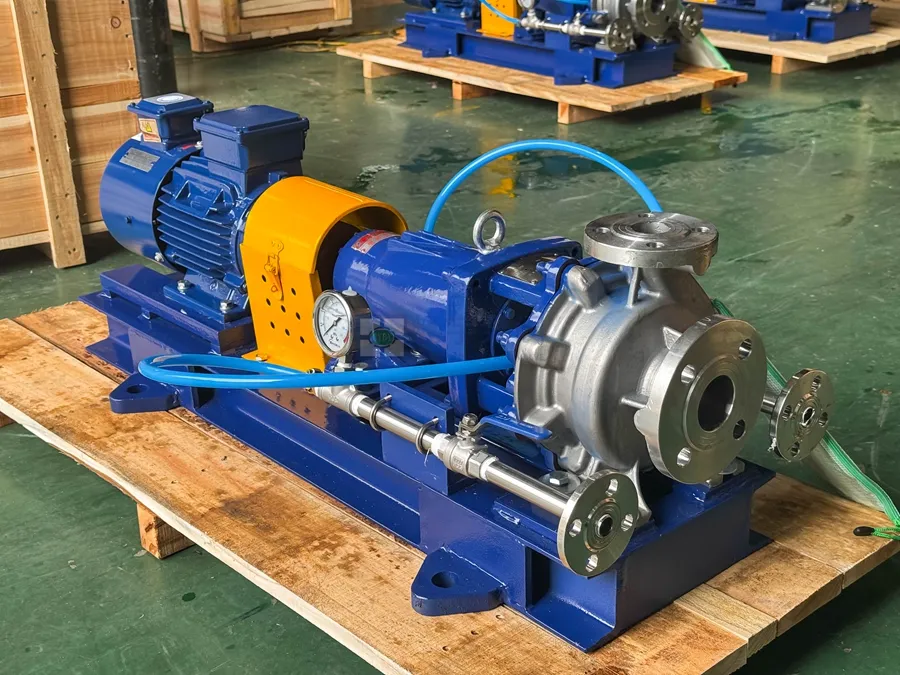
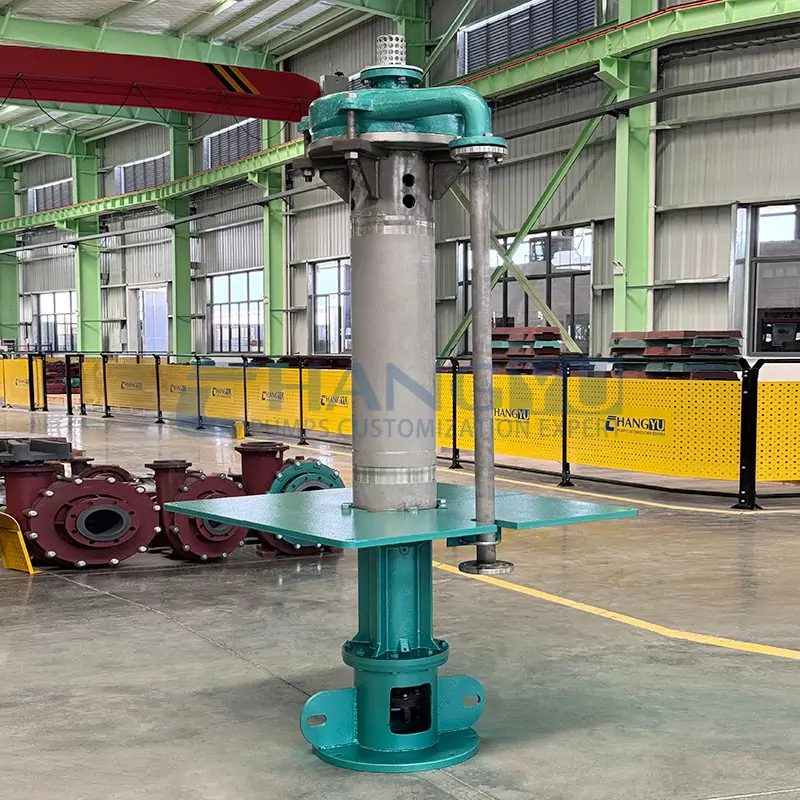

We first confirm whether the project falls within the construction and performance ranges of our existing series. Large intake pumping stations, marine firewater and high-pressure membrane feed require separate checks of pressure ratings, certifications and scope of supply.
Which Changyupump Series Can Be Evaluated for a Seawater Feed Pump Project?
For seawater supply, boosting and transfer, we focus on CYH, then assess CQZ or CYC according to self-priming and leakage-control requirements. The following are our published series ranges for initial screening. Maximum flow and maximum head do not represent the same operating point; the specific model must be confirmed against performance curves, the wetted-materials list and technical confirmation documents. [2][3][4]
| Seri Produk | Series Flow and Head | Duties to Compare | Conditions for Seawater Use |
|---|---|---|---|
| Pompa kimia sentrifugal stainless steel CYH | 0.8–750 m³/h; 3–130 m | In-plant transfer, pretreatment supply and boosting | Confirm wetted configurations such as duplex stainless steel, mechanical seals and inlet conditions |
| CQZ stainless steel self priming magnetic drive pump | 3–800 m³/h; 12.5–130 m | Transfer requiring self-priming and attention to shaft-seal leakage control | Confirm materials, priming conditions, particles and internal lubrication and cooling |
| CYC heavy duty stainless steel magnetic pump | 3.6–100 m³/h; 20–80 m | Process-liquid transfer where liquid conditions are suitable and leakage control matters | Standard stainless steel options do not directly establish suitability for natural seawater |
CYH for Seawater Transfer and Pretreatment Supply
Kami Pompa kimia sentrifugal stainless steel CYH has a single-stage, single-suction cantilever construction. It can be compared for seawater transfer, pretreatment supply and boosting projects within its performance-curve range. Material options include 316L, 2205 and 2507. Seawater projects require further confirmation of the specific model and the complete wetted-parts configuration. [2]
For continuous-supply systems where mechanical seals can be maintained on site, we prioritize flow and head, wetted seal materials, flushing conditions and standby arrangements. A mechanical seal limits liquid leakage around the rotating shaft. Its seal-face pair and elastomers must be selected for the seawater, particles and cleaning liquids involved. Suitable spacer-coupling and back-pull-out configurations also require sufficient maintenance clearance.
The CYH series head range can support initial screening for some seawater booster pump projects; it does not directly establish suitability for high-pressure feed upstream of SWRO membranes. We first verify the required differential pressure and discharge pressure rating, then determine whether a separate high-pressure pump option should be assessed.
CQZ for Self Priming Seawater Transfer
Kami CQZ stainless steel self priming magnetic drive pump combines self-priming construction with magnetic drive. In this arrangement, magnetic drive transmits power through magnetic coupling, eliminating a conventional shaft-through mechanical seal and helping reduce leakage and maintenance issues at that point. Material options include 316L and 2205, but suitability for the specific seawater duty still requires confirmation. [3]
Where the pump sits above the tank liquid level, we check the minimum level, suction-pipe length and diameter, air leakage, seawater temperature and allowable priming time. CQZ must be filled before its first start as instructed. Its internal bearings still depend on the specified liquid for lubrication and cooling, so dry running is not permitted. Sand, crystallization or biological debris may affect internal circulation. If raw-water conditions are unsuitable, the pump construction should be reconsidered rather than simply adding an inlet strainer.
CYC for Compatible Clean Process Liquids
Kami CYC heavy duty stainless steel magnetic pump can be compared for clean process-liquid duties where leakage control matters. For seawater or chloride-containing liquids, we first confirm the suitability of wetted materials, the containment shell, internal circulation and plain bearings, then assess the operating point. [4]
Standard CYC materials include 304, 316 and 316L. These options do not, by themselves, justify a commitment to long-term natural seawater service. If a project requires duplex stainless steel or another specified alloy, we first confirm availability for that model and its wetted parts. We do not apply CYH or CQZ material options directly to CYC.
Already have a flow diagram or pump schedule? Send us your seawater feed pump operating conditions. Our engineers can use them to compare series, wetted materials and inlet conditions, and clarify the information needed for selection and quotation.
Email: [email protected]
TEL/WA: +86-13651913727
PERTANYAAN YANG SERING DIAJUKANS
Can a Seawater Feed Pump Handle Raw Seawater Containing Sand?
This depends on the particles and pump construction. For a seawater intake pump duty, we establish the size, content and variability of sand, shells, biological debris and fibers before discussing intake screens, pretreatment, impeller flow passages, seals and materials. A pump designed for clean process liquids cannot be used directly for sandy raw seawater solely because its materials resist corrosion.
Filtration also has a cost: increasing strainer pressure loss reduces inlet pressure. We include filtration rating, allowable differential pressure from blockage and maintenance intervals in the inlet-condition calculation, paying particular attention to magnetic-drive pump internal circulation passages.
Can a Seawater Booster Pump Use Variable Speed Control?
We can assess variable speed control within the limits of the specific pump, motor and system. In systems with substantial flow variation, speed adjustment can work with pressure or flow control, but allowable speed, minimum flow, minimum inlet pressure and motor-cooling conditions must be established.
We do not promise a fixed energy-saving percentage simply because variable-speed control is used. Savings depend on elevation difference, equipment pressure requirements, piping resistance and operating hours. Where static head or fixed terminal pressure represents a large share of the requirement, low-speed operating capability needs separate calculation.
Can 316L Be Used for Continuous Seawater Service?
We do not use 316L as a universal default for continuous natural seawater service or specify a fixed time to failure without considering water quality and construction. Seawater temperature, chlorination, crevices, deposits and shutdown conditions jointly affect corrosion risk. Specific duties with comparable operating records can be assessed. Projects with higher reliability requirements or existing pitting should compare 2205, 2507 or other materials supported by an appropriate basis for use. [1]
If you are replacing a damaged stainless steel seawater pump, please also provide photographs of the failed areas, operating duration and a water analysis. We first distinguish corrosion, cavitation and particle wear before discussing changes to materials and construction.
How Much Does a Seawater Feed Pump Cost?
The seawater pump price depends on the operating point, wetted materials, seals, pressure-rating requirements, motor, installation arrangement and inspection documents. A price without these conditions can support only a very preliminary budget and cannot directly compare final supply packages.
We recommend comparing each seawater pump quotation on the same scope: whether the motor and baseplate are included, whether all wetted parts meet the agreed material specification, which tests and documents are provided, and the scope of spares, installation and maintenance. Continuous-duty projects should also compare energy consumption and downtime impact, alongside the pump purchase price.
Which Standards Should Be Specified for a Seawater Feed Pump?
Standards should be selected according to the project industry, pump construction and procurement requirements. General industrial centrifugal-pump projects may reference specifications such as ISO 5199; petroleum and related demanding duties may specify API 610. Compliance of a particular model with a standard and its edition must be confirmed item by item in the quotation and technical agreement. Seawater use alone does not establish compliance.
For duplex stainless steel castings, specify the applicable casting standard, grade, heat treatment and inspection conditions, such as checking ASTM A890/A995 where applicable to the project. NORSOK M-650 addresses qualification requirements for certain material manufacturers and manufacturing processes. Its applicability depends on the procurement specification; it is not a universally mandatory certification for all seawater pumps.
NACE MR0175 / ISO 15156 addresses materials in H₂S-containing oil and gas production environments within its defined scope. It should not be applied automatically to ordinary seawater projects. Marine, firewater and other special applications also require separate confirmation of classification-society, regulatory and pump-set requirements. For us, the standards list must translate into requirements for the specific model, scope of supply and delivery documents.
Why Work with Changyupump as Your Seawater Feed Pump Supplier?
We are Changyupump, Anhui Changyu Pump and Valve Manufacturing Co., Ltd. Established in 2006, our factory is located in Jing County, Xuancheng, Anhui. Our site covers approximately 20,000 m² and is equipped with CNC equipment, machining centers and pump-testing systems. Our products include centrifugal, magnetic-drive, self-priming and other industrial pump series, allowing us to discuss different configurations for corrosive-liquid transfer requirements. [5]
As a seawater feed pump supplier or seawater pump manufacturer you are comparing, we aim to match every procurement requirement to a verifiable configuration. Our engineers use the system position, flow, head, water quality and maintenance approach to define the product series, wetted materials, seals, motor and conditions that require further confirmation.
Our published quality-control process includes metal composition checks, impeller dynamic balancing, shaft runout checks and factory testing. For duplex stainless steel and other special-material projects, the technical agreement should also specify part materials, manufacturing condition, inspection methods and acceptance criteria. Clean-water performance testing can verify hydraulic performance; it does not replace the material basis for seawater corrosion resistance. [6]
If you are looking for a seawater booster pump manufacturer or have seawater pump OEM requirements, please also provide project drawings, connections, installation space, electrical conditions and document requirements. We first confirm the available scope of supply, then establish quotation and delivery terms.
Where Can You Find a Seawater Feed Pump PDF or Pump Catalogue?
If you are searching for a seawater feed pump PDF, seawater pump catalogue PDF or seawater pump datasheet, we recommend reviewing the proposed series documents first, then requesting a datasheet for the specific model at your project operating point. General catalogues support initial screening; final selection still requires the model curve, wetted materials and installation conditions.
You can use the following existing document resources:
- CYH Series Specifications PDF: review the CYH series specifications, then confirm the proposed model’s performance curve and configuration with us.
- CQZ Self Priming Stainless Steel Magnetic Pump PDF: support initial discussions of self-priming, magnetic drive and installation requirements.
- CYC Stainless Steel Magnetic Drive Pump PDF: compare the CYC series, with seawater wetted configurations subject to separate confirmation.
- Changyupump PDF Download Center: view published documents for other series.
Our seawater pump material compatibility review considers the actual operating conditions. If the catalogue does not clearly match your flow, head or materials, send us the parameters rather than completing procurement based only on a catalogue cover or a similar model.
How Can You Get a Seawater Feed Pump Selection and Quotation?
Selecting a seawater feed pump requires assessing system position, flow and differential pressure, inlet conditions and wetted materials together. First distinguish seawater intake, pretreatment boosting and high-pressure feed upstream of SWRO membranes. Then check corrosion, cavitation, particles and maintenance conditions to match the pump to the site’s needs.
You do not need to determine every material grade before contacting us. You can start with the following information, which our engineers will use to identify any additional conditions that need clarification:
- Application and process: intake, transfer, pretreatment, boosting or high-pressure membrane feed, together with the connections between relevant equipment.
- Operating requirements: normal, minimum and maximum flow; required head, or minimum inlet pressure and target outlet pressure.
- Seawater conditions: normal and maximum temperatures, salinity or chloride content, water quality and chlorination, and particle size and concentration.
- Site conditions: minimum liquid level or tidal level, installation elevation, suction piping, continuous or intermittent operation, and requirements for power supply, materials, standards and documents.
Please also send any existing pump schedule, P&ID, installation drawing or failure photographs. P&ID stands for piping and instrumentation diagram: a diagram showing the relationships between piping, equipment, valves and instruments. It helps us confirm the pump duty and control requirements.
Email: [email protected]
TEL/WA: +86-13651913727