
Should a seawater pump use 316L or duplex stainless steel? Our approach to seawater pump material selection is to consider 316L for certain validated, lower-temperature chloride duties. When pitting, crevice corrosion, chloride stress corrosion cracking or mechanical loading becomes a major risk, we assess 2205. For warm seawater, chlorinated seawater, concentrated brine and systems requiring greater reliability, we also compare 2507 and other more corrosion-resistant materials.
At Changyu Pump, we assess liquid composition, temperature and operating patterns alongside hydraulic performance, then match the duty to our CYH chemical centrifugal pump, CQZ self-priming magnetic drive pump or CYC heavy-duty magnetic drive pump. Our seawater pump material selection process aims to define a configuration you can purchase, inspect and maintain, rather than simply name an alloy.
Already have project data? Send your seawater or chloride service conditions for material and pump recommendations.
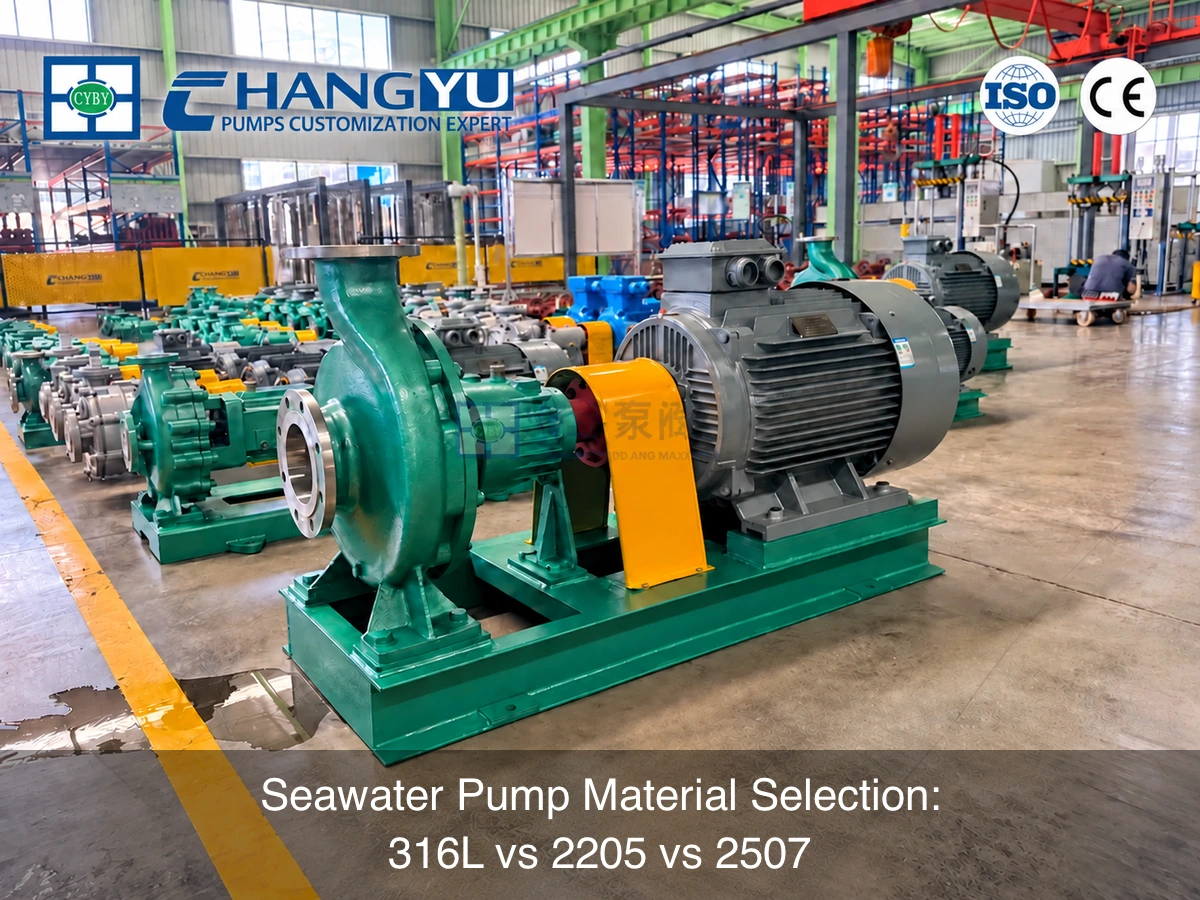
Seawater Pump Material Selection: Comparing 316L, 2205 and 2507
316/316L: established manufacturing, defined chloride limits
The 316 family comprises molybdenum-bearing austenitic stainless steels. Molybdenum helps improve resistance to localized corrosion in certain chloride environments. The main benefit of the low carbon content in 316L is reduced susceptibility to sensitization caused by welding or an unsuitable thermal history.

Low carbon does not mean immunity to chlorides. In seawater pump material selection, 316L still requires assessment for pitting, crevice corrosion and chloride stress corrosion cracking (SCC). Weld sensitization is not a prerequisite for SCC; operating stress, residual tensile stress, temperature and local concentration of the liquid also matter.
For chloride liquids with stable chemistry, lower temperatures and comparable service records, we include 316L in the cost comparison. For long-term natural seawater service, our seawater pump material selection also examines retained liquid during shutdown, deposits, biological fouling and chlorination. We do not treat 316L as a universal default.
2205: assessing a duplex stainless steel seawater pump
2205 has a duplex ferritic-austenitic structure. Suitable alloy chemistry, phase balance and manufacturing condition generally give it better resistance than 316L to chloride pitting, crevice corrosion and SCC. [1]
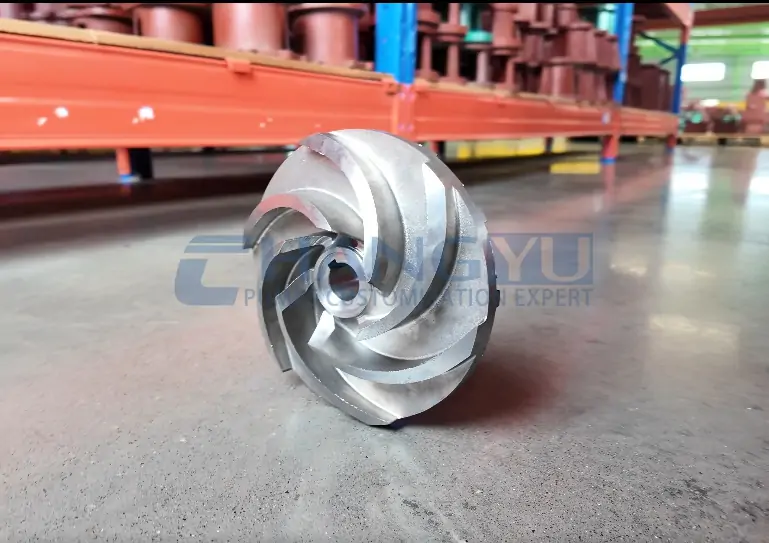
Its yield strength is generally substantially higher than that of annealed 316L, making it worth assessing when both corrosion and mechanical loading matter. However, seawater pump material selection cannot translate roughly twice the strength into half the casing thickness. Pressure design must also account for casting quality, stiffness, corrosion allowance, flange loads and applicable standards.
2205 is an upgrade worth comparing, but it does not eliminate corrosion risk in every seawater environment. Warm, chlorinated, creviced or stagnant seawater systems may still require a higher alloy grade.
2507: assessing a super duplex seawater pump
2507 super duplex stainless steel contains higher levels of chromium, molybdenum and nitrogen, and generally offers greater localized corrosion resistance than 2205. We include it in seawater pump material selection for higher salinity, elevated temperature or projects where failure has serious consequences.

We also review manufacturing, welding and service-temperature restrictions. A higher grade does not establish suitability for every strong acid, and the grade designation alone cannot confirm suitability for hydrogen-sulfide-containing liquids.
Material and pump performance comparison
| Сравнение | 316/316L | 2205 дуплексная нержавеющая сталь | 2507 супер дуплексная нержавеющая сталь |
|---|---|---|---|
| Typical structure | Austenitic | Ferritic + austenitic | Ferritic + austenitic |
| Typical PREN reference | About 24–27 | About 34–36 | Generally about 40 or above |
| Chloride pitting and crevice resistance | Narrower application boundaries | Generally better than 316L | Generally better than 2205 |
| Chloride SCC resistance | Requires particular attention | Generally substantially improved | Generally high resistance |
| Mechanical strength | Conventional austenitic level | Generally substantially higher than 316L | High; confirm against the material standard |
| Manufacturing and welding | Established processes | Greater thermal-history and phase-balance control | More demanding manufacturing consistency |
| Первоначальная стоимость покупки | Often lower for common configurations | Quote according to weight, machining and quantity | Usually higher; compare against downtime consequences |
| Our selection approach | Certain validated lower-temperature chloride duties | Projects balancing chloride resistance and strength | Specific assessment for harsher seawater or brine |
PREN, the pitting resistance equivalent number, is commonly estimated as PREN = Cr% + 3.3 × Mo% + 16 × N%. For seawater pump material selection, these values are screening references only and depend on grade and composition. They do not establish allowable chloride concentration, operating temperature or service life. Producer data for billets and other product forms cannot directly serve as acceptance values for pump castings. [1]
Which Operating Conditions Do We Check?
Seawater and industrial chloride solutions cannot be treated as interchangeable based only on salt concentration. Our seawater pump material selection and brine pump material selection also consider temperature, pH, dissolved oxygen, chlorination, contaminants, solids and operating patterns.
| Actual duty | Initial material approach | Conditions to confirm |
|---|---|---|
| Low-temperature, low-chloride process water with stable chemistry | Assess 316L | Actual chlorides, pH, cleaning liquids and comparable service history |
| Seawater transfer or cooling circulation | Compare 2205 and 2507; do not default to 316L | Maximum water temperature, chlorination, crevices, biological fouling and shutdown state |
| Warm seawater, chlorinated seawater or more concentrated brine | Focus on 2507 and other suitable materials | Oxidizing conditions, salinity changes, deposits and crystallization |
| Chloride liquids containing sand or solids | Assess materials, flow passages and seals together | Particle size, concentration, hardness, velocity and cavitation risk |
| Oil and gas liquids containing hydrogen sulfide | Specific assessment against sour-service requirements | H₂S partial pressure, pH, temperature, hardness and applicable standards |
| Hydrochloric acid, mixed acids or complex chemicals | Recheck material compatibility | Full composition and corrosion data; compare nickel alloys or fluoropolymer-lined designs where needed |
Low flow and intermittent operation do not automatically mean mild conditions. Retained seawater, trapped liquid and deposits can increase localized corrosion risk. For standby pumps, seawater pump material selection includes discussion of draining, flushing and periodic operation.
If you are replacing a pitted 316L pump, send us photographs of the damaged locations, time in service, water analysis and shutdown arrangements. We distinguish material issues from cavitation, seal-flushing issues or operation away from the intended duty before recommending an upgrade.
Changyu Pump Stainless Steel Series for Seawater and Chloride Liquids
After seawater pump material selection, we still need to confirm flow, head, suction conditions and leakage-control requirements. Our stainless steel designs address conventional transfer, self-priming installation and magnetic drive requirements.
| Product series | Requirements we assess | Технические параметры | Material and configuration checks |
|---|---|---|---|
| Химический центробежный насос из нержавеющей стали CYH | Seawater transfer, cooling circulation and chloride process liquids | Flow: 0.8–750 m³/h; head: 3–130 m | Options include 316L, 2205 and 2507; confirm against the wetted-parts list |
| Самовсасывающий магнитный насос из нержавеющей стали CQZ | Transfer with the pump above liquid level, self-priming and reduced shaft-seal maintenance | Flow: 3–800 m³/h; head: 12.5–130 m | Options include 316L and 2205; check suction lift, priming time and internal lubrication |
| Магнитный приводной насос CYC повышенной прочности из нержавеющей стали | Clean chloride process liquids with greater leakage-control requirements | Flow: 3.6–100 m³/h; head: 20–80 m | Common options include 304, 316 and 316L; confirm special materials separately |
These are series screening ranges. Maximum flow and maximum head do not describe one simultaneous duty point. The specific model, materials, temperature and motor configuration are subject to technical confirmation. In seawater pump material selection, CYC‘s standard stainless steel options must not be interpreted as automatic suitability for natural seawater.
CYH: a stainless steel seawater pump option for transfer and circulation
Наш сайт Химический центробежный насос из нержавеющей стали CYH uses a single-stage, single-suction cantilever design. We can discuss 316L, 2205 or 2507 options as part of seawater pump material selection for seawater and chloride duties. [2]
We prioritize assessing CYH for continuous transfer, a wider flow range and sites able to maintain mechanical seals. Configuration review covers the casing, impeller, cover, shaft sleeve, wear rings, wetted seal metals and gaskets. Upgrading only the impeller can leave other corrosion-sensitive locations exposed.
Depending on configuration, we can discuss single or double mechanical seals and face materials such as SiC. A spacer coupling with a corresponding back-pull-out arrangement can facilitate maintenance, provided the site allows sufficient dismantling space.
For desalination, we first identify whether the duty is intake, pretreatment, circulation or high-pressure membrane feed, then check the required pressure. This series’ head range does not establish suitability as a reverse-osmosis high-pressure pump. Seawater firefighting duties also require separate confirmation of regulations, certifications and package requirements.
CQZ: verify suction conditions as well as materials
Where a tank or collection sump places the pump above liquid level, we compare our Самовсасывающий магнитный насос из нержавеющей стали CQZ. It combines a self-priming design with magnetic drive, with wetted material options including 316L and 2205. [3]
Для CQZ, seawater pump material selection goes alongside checks of suction lift, pipe length and diameter, air leakage, minimum liquid level, liquid temperature and allowable priming time. Self-priming does not mean dry-running capability: fill the pump before first startup as instructed. Internal magnetic-pump bearings still need reliable liquid lubrication and cooling.
For seawater or brine transfer, we also assess how sand, crystallization and biological debris affect internal circulation. Filtration or pretreatment must be checked together with suction pressure losses. If the particles are unsuitable for a magnetic drive pump, we compare other designs.
CYC: leakage control for clean chloride process liquids
We assess our Магнитный приводной насос CYC повышенной прочности из нержавеющей стали where compatibility is established, particle conditions are suitable and reduced mechanical shaft-seal maintenance is a priority.
Magnetic drive removes the conventional through-shaft mechanical seal. However, the containment shell, static seals, internal magnet encapsulation and sleeve bearings still require compatibility checks. We also confirm liquid density, magnetic torque, internal circulation, and low-level and overtemperature protection needs.
If seawater pump material selection identifies a need for 2205 or 2507, we first confirm availability for the specific CYC model and all relevant wetted components. Duplex options from another series cannot simply be assumed available for CYC.
Send your duty conditions so we can compare CYH, CQZ and CYC configurations. You can also browse our stainless steel pump series before confirming a model with us.
Compare Purchase Price, Maintenance and Downtime
For seawater pump material selection, we compare the alloy price difference over the intended service period: total cost = purchase and installation + energy + maintenance and spares + downtime impact + replacement and disposal.
Where 316L has adequate evidence of suitability, access is easy and failure consequences are manageable, it may be an economical choice. Where access is difficult, continuous operation matters or localized corrosion has already occurred, the investment in 2205 or 2507 deserves comparison with expected maintenance and downtime costs.
Although duplex steels contain less nickel, complete pump pricing still depends on alloy chemistry, casting, heat treatment, machining, inspection and order quantity. We quote the specific wetted configuration without assuming a fixed premium or saving. Lean duplex grades such as 2304 may be compared for particular duties, but seawater pump material selection cannot treat them as universal seawater replacements for 316L or equivalents to 2205.
Seawater Pump Material Selection FAQ
1. Can a 316L stainless steel pump handle seawater long term?
Это может быть рассмотрено для определённых подтверждённых условий, но мы не гарантируем долгосрочную пригодность, основываясь только на марке. Температура природной морской воды, хлорирование, биологическое обрастание, зазоры и застойная жидкость при остановке изменяют риск. Для непрерывной эксплуатации и высокой надёжности наш выбор материалов для морских насосов дополнительно сравнивает 2205 или 2507.
2. Should a seawater pump use 2205 or 2507?
We define the comparison using maximum water temperature, treatment, salinity, crevice geometry and shutdown conditions. 2205 generally resists chloride corrosion better than 316L. Warm, chlorinated or harsher seawater may require 2507 or other materials. Seawater pump material selection cannot be finalized with a blanket rule that ordinary seawater always means 2205.
3. Below what chloride concentration in ppm is 316L safe?
There is no universal safe value independent of other conditions. We also need temperature, pH, oxidizing conditions, deposits, stress and operating patterns. The same chloride concentration can produce different outcomes in different systems. Send complete water chemistry and duty data for seawater pump material selection.
4. Should seawater or brine transfer use a mechanical seal or magnetic drive pump?
We compare CYH where a wider flow range and practical mechanical-seal maintenance matter. For cleaner liquids and shaft-seal leakage control, suitably configured CYC или CQZ pumps may be compared. Sand, crystallization or possible liquid starvation require additional checks of internal lubrication and cooling. Seal choice accompanies seawater pump material selection.
5. Will replacing a 316L impeller with 2205 solve corrosion?
Not necessarily. We also examine the casing, cover, shaft sleeve, wear rings, seals and static sealing locations, and confirm dimensions, fits, rotor balance and galvanic-corrosion risk. A partial upgrade cannot replace complete seawater pump material selection and assessment, or automatically resolve cavitation or off-duty operation.
6. What information does Changyu Pump need for a seawater pump quotation?
Please provide liquid and water chemistry, normal and maximum temperatures, flow, head, suction conditions, particles, chlorination and operating hours. Include any specified materials, failure photographs, piping drawings or inspection-document requirements. We use these inputs for seawater pump material selection and to confirm the pump series, seal and motor configuration.
Why Develop Your Stainless Steel Pump Configuration with Our Factory?
Coordinate wetted materials, machining, assembly and testing
Founded in 2006, Changyu Pump operates in Jing County, Xuancheng, Anhui, with approximately 20,000 m² of factory space, CNC machines, machining centers and pump testing systems. [4] Our seawater pump material selection discussions connect materials, parts, seals and hydraulic performance so purchasing requirements correspond to a specific configuration.
Connect material requirements to components and inspection documents
Our published quality-control process includes metal composition verification, impeller balancing, shaft runout checks and final testing. [5] For duplex projects, we recommend specifying material standards, a wetted-parts list, heat-treatment records and project-specific phase-balance, metallographic, detrimental-phase or corrosion-testing requirements. Test methods and acceptance limits should be agreed before execution.
Duplex steels require control of thermal history and microstructure. Castings, weldments and different section thicknesses must follow the appropriate standards and qualified procedures. We do not prescribe one phase ratio for every component or post-weld solution treatment for every weld. XRF can help verify major alloying elements, but low-carbon grades, nitrogen content and microstructure require suitable methods and supporting material documents.
Verify performance with agreed tests and corrosion resistance with material evidence
We confirm project requirements for testing and reports covering flow, head, power and other agreed items. Clean-water performance testing verifies hydraulics; it cannot replace corrosion validation in actual seawater or chemical liquids. For special projects, seawater pump material selection should establish material evidence, testing, witnessing and delivery documents at quotation stage, helping you compare proposals and inspect deliveries.
Base quotations on actual site conditions
We offer different stainless steel pump designs and discuss installation, spares and maintenance alongside configuration. You do not have to choose 316L, 2205 or 2507 before contacting us. Send the operating conditions first; we can then establish the material basis, suitable series and quotation boundaries together.
Please send: liquid / chlorides or salinity / normal and maximum temperatures / flow / head / minimum liquid level and installation height / particles / chlorination and shutdown arrangements.
Запрос Цитировать
Электронная почта: [email protected]
ТЕЛ/WA: +86-13651913727
For related checks, see our руководство по подбору химических насосов из нержавеющей стали и руководство по деталям насосов из нержавеющей стали.
Technical and Product References
[1] Alleima SAF 2205 material data supports the localized corrosion, SCC, strength and PREN comparison. Data apply to the stated product form and do not replace pump-casting acceptance standards.
[2] Changyu Pump CYH stainless steel chemical centrifugal pump.
[3] Changyu Pump CQZ stainless steel self-priming magnetic drive pump и Магнитный приводной насос CYC повышенной прочности из нержавеющей стали.
[4] Changyu Pump factory.