
Quick Answer
A lithium slurry pump is a heavy-duty pump engineered to handle the corrosive and abrasive fluids found throughout the lithium production chain — from saline brines and acid-leached mineral slurries to cathode precursor pastes. This application presents a demanding combination: aggressive acids that corrode standard metals, and hard, fine particles that rapidly erode unprotected surfaces. Key selection factors:
- Combined corrosion and abrasion resistance: Fluids in lithium processing are seldom just corrosive or just abrasive — they are usually both. A pump material must resist both chemical attack from acids and mechanical wear from solids — a combination that defeats most standard pump materials.
- Metal-ion contamination control: Cathode materials and battery-grade lithium chemicals are sensitive to trace metal pickup. Pump materials must not leach iron, copper, or other contaminants into high-purity process streams.
- Solids handling capability: From silica sand in brine to cathode precursor particles, slurries can settle, clog, and abrade. The pump must pass solids without blockage and withstand the resulting wear.
The lithium industry moves between extremes. A single production site may pump saturated salt brine in the morning and a thick, acidic slurry of crushed mineral ore in the afternoon. Standard chemical pumps, built for clean corrosive liquids, fail rapidly in these conditions. Standard slurry pumps, built for neutral mine tailings, corrode when exposed to acid.
This guide focuses on the pumps that handle these combined challenges across the lithium production chain — from extracting raw brine to finishing high-purity battery materials. It covers where these pumps are applied, which materials survive lithium’s unique combination of corrosion and abrasion, and how to select a pump that delivers reliable service in this demanding industry.
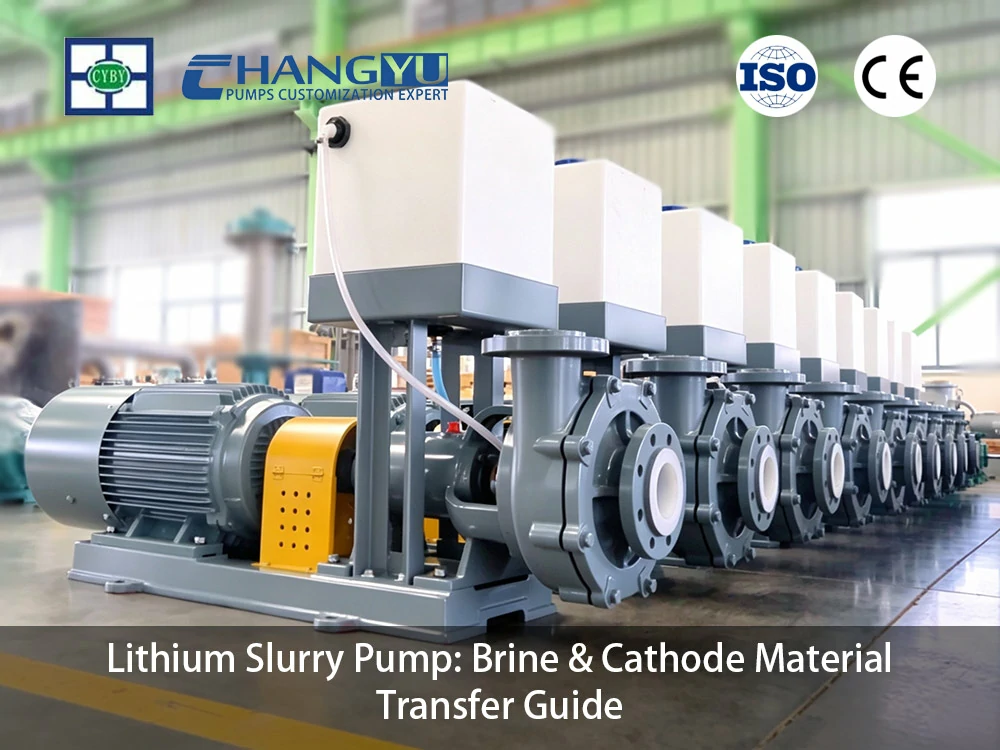
1. What Is a Lithium Slurry Pump?
A lithium slurry pump handles fluids containing both corrosive chemicals and abrasive solid particles at some stage of the lithium production process. It differs from a standard chemical pump in its ability to resist wear from entrained solids, and from a standard slurry pump in its resistance to chemical attack.
The nature of the solids varies by process stage — from coarse silica sand and crushed mineral particles in brine extraction and acid leaching, to fine, high-purity precursor powders in cathode material production. The corrosive component ranges from near-neutral chloride brines to hot sulfuric or hydrochloric acid solutions. This is where UHMWPE-lined pumps — the focus of this guide — provide a unique solution to the combined challenges of corrosion and abrasion that define the lithium industry.
2. Where Are Lithium Slurry Pumps Used?
Lithium production spans three distinct stages, each with its own fluid characteristics and pumping challenges.
Stage 1: Lithium Extraction — Brine and Mineral Slurries
Lithium is extracted from two primary sources: continental brines (salt lakes) and hard-rock minerals (spodumene). In brine operations, the raw fluid is a concentrated salt solution containing sodium, potassium, magnesium, and lithium chlorides. It carries suspended silica, clay particles, and crystallized salts. The chloride content can exceed 200,000 mg/L, creating an environment that initiates pitting and crevice corrosion in standard stainless steel.
In hard-rock operations, crushed spodumene ore is mixed with sulfuric acid and heated. The resulting slurry contains sharp mineral particles suspended in acid at pH levels below 2 and temperatures that accelerate both chemical attack and abrasive wear.
| Extraction Method | Fluid Characteristics | Temperature | Solids |
|---|---|---|---|
| Brine extraction | Concentrated chloride solution | Ambient to 60°C | Fine silica, clay, salt crystals |
| Spodumene acid leach | Sulfuric acid with crushed ore | 60–100°C | Sharp mineral particles, silica |
Stage 2: Intermediate Processing — Purification and Precipitation
After initial extraction, the lithium-bearing solution is purified, concentrated, and precipitated. This stage introduces additional pumping challenges: soda ash (sodium carbonate) addition for precipitation, filtration and thickening of precipitated lithium carbonate, and various solvent extraction and ion exchange steps. The fluids are often at elevated temperatures and contain both corrosive process chemicals and precipitated solids.
Stage 3: Cathode Material Production — Precursor and Finished Materials
The final stage produces the active materials for lithium-ion batteries: cathode precursors such as nickel-manganese-cobalt (NMC) hydroxide and finished cathode powders such as lithium iron phosphate (LFP). These are high-purity processes where metal-ion contamination from pump materials can compromise battery performance. The slurries contain fine, abrasive particles — often in the micron range — that settle and compact easily. Pumps must handle these solids without clogging, resist the mild but persistent corrosive environment, and above all, introduce zero metallic contamination into the product.
| Production Stage | Fluid Characteristics | Key Challenge |
|---|---|---|
| Brine extraction | High-chloride, sandy, scaling | Chloride pitting plus silica erosion |
| Acid leach | Sulfuric acid with mineral solids | Acid corrosion plus sharp-particle abrasion |
| Precipitation / purification | Alkaline or mildly acidic slurries | Combined chemical attack and solids handling |
| Cathode material finishing | High-purity slurry with fine particles | Abrasion resistance plus zero metal-ion contamination |
3. What Materials Are Best for Lithium Slurry Pumps?
The material that handles all three challenges of lithium processing — corrosion, abrasion, and purity — is Ultra-High Molecular Weight Polyethylene, or UHMWPE. Used as a thick lining inside a steel pump casing, UHMWPE delivers a combination of properties that no single metal alloy can match.
Why UHMWPE Excels in Lithium Service
Corrosion resistance: UHMWPE is chemically inert to the full range of lithium processing fluids. It resists hydrochloric and sulfuric acids at the concentrations and temperatures encountered in extraction. It is unaffected by the chloride brines that pit and stress-crack stainless steel. Unlike metals, it does not rely on a passive oxide layer that chlorides can penetrate.
Abrasion resistance: UHMWPE offers superior abrasion resistance compared to rubber and fluoroplastic liners, particularly against the sliding abrasion that dominates slurry pump wear. Its long molecular chains absorb and dissipate the energy of particle impacts without cutting or fracturing. In lithium slurries containing silica, crushed ore, or precipitated crystals, UHMWPE consistently outlasts both rubber and FEP/PFA liners.
Zero metal-ion contamination: UHMWPE contains no metals. It does not leach iron, copper, nickel, or chromium into the pumped fluid — a requirement for the high-purity cathode material processes at the end of the lithium production chain.
Material Comparison for Lithium Slurry Service
| Material | Corrosion Resistance | Abrasion Resistance | Metal-Ion Risk | Best Application |
|---|---|---|---|---|
| 316L Stainless Steel | Poor in chlorides and acids above ambient | Moderate | High — leaches Fe, Ni, Cr | Not recommended for lithium slurries |
| Duplex 2205 / 2507 | Better chloride resistance than 316L; limited in hot acid | Moderate | Moderate — still leaches metals | Brine with low solids; not for acid service |
| FEP / PFA Lined | Excellent — universal chemical resistance | Low — soft lining; particles can embed and wear | None — fully inert | Clean acids without solids |
| UHMWPE Lined | Excellent — inert to acids, alkalis, chlorides | Excellent — superior to rubber and fluoroplastic liners for sliding abrasion | None — fully inert | Lithium slurries: corrosive fluids with solids |
Material Selection by Operating Condition
| Fluid Condition | pH Range | Solids Content | Temperature | Recommended Material |
|---|---|---|---|---|
| Neutral brine with sand | 6–8 | Low to moderate | < 60°C | UHMWPE or duplex 2205 |
| Acid leach slurry | < 2 | High (sharp mineral particles) | 60–90°C | UHMWPE |
| Alkaline precipitation slurry | 8–12 | Moderate (precipitated solids) | 40–80°C | UHMWPE |
| High-purity cathode slurry | 6–9 | Moderate (fine particles) | 40–80°C | UHMWPE (zero contamination) |
Engineers at Changyu Pump recommend: For any lithium slurry application containing both corrosive chemicals and solid particles, specify UHMWPE-lined pumps. The material’s combination of chemical inertness and abrasion resistance cannot be matched by metal alloys. For clean acids without solids, FEP or PFA-lined pumps are appropriate. For very high-viscosity lithium slurries or applications requiring precise flow control, progressive cavity (screw) pumps with compatible stator materials provide an alternative pumping solution. For lithium brine with very low solids, duplex stainless steel may serve — but UHMWPE provides a wider safety margin against chloride corrosion.
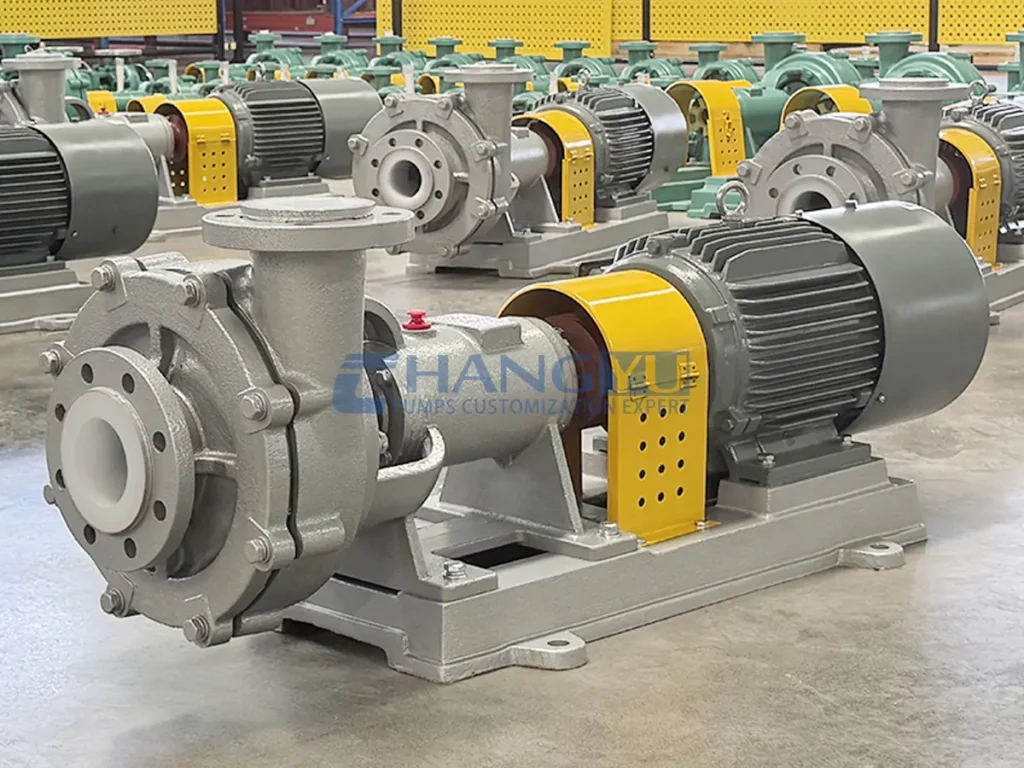
4. How to Select the Right Lithium Slurry Pump?
Selection follows a structured evaluation of the fluid’s corrosive potential, solids characteristics, and operating temperature.
Step 1: Characterize the fluid chemistry.
Determine the primary acid or base present, its concentration, and the pH range. Identify the chloride content if brine is involved. A fluid that is predominantly sulfuric acid at pH 1–2 with suspended mineral solids points toward UHMWPE or FEP-lined construction.
Step 2: Characterize the solids.
Determine the particle type, size range, shape, and concentration. Sharp, freshly crushed mineral particles are far more abrasive than rounded, precipitated crystals. Solids concentrations above 10% by weight demand a pump designed specifically for slurry service.
Step 3: Evaluate the temperature.
UHMWPE-lined pumps serve reliably from -20°C to 90°C, covering all standard lithium extraction, purification, and cathode material processes. For acid leach processes operating above 90°C, FEP-lined pumps (CYB-ZKJ Series) are required.
Step 4: Select the pump type.
| Pump Type | Best For in Lithium Service | Limitations |
|---|---|---|
| UHMWPE-lined centrifugal (UHB) | Brine with sand, acid leach slurries, cathode material slurries | Temperature limit -20°C to 90°C |
| FEP/PFA-lined centrifugal (CYB-ZKJ) | Clean acids above 90°C, high-purity chemicals without solids | Not for abrasive slurries — soft lining wears |
| Progressive cavity (screw) | High-viscosity slurries, metering applications, high-solids pastes | Higher initial cost; stator is a wear component |
| Duplex stainless steel centrifugal | Low-solids brine at moderate temperature | Not for acid service or high-purity applications |
Step 5: Size the pump.
Calculate flow rate based on production throughput. Calculate total dynamic head including static lift and friction losses. For slurries with solids content above 10%, apply a derating factor to pump performance. Size the suction line to maintain a minimum velocity of 1.5–2.0 m/s to prevent solids settling.
5. Changyu Pump Lithium Slurry Pump Solutions
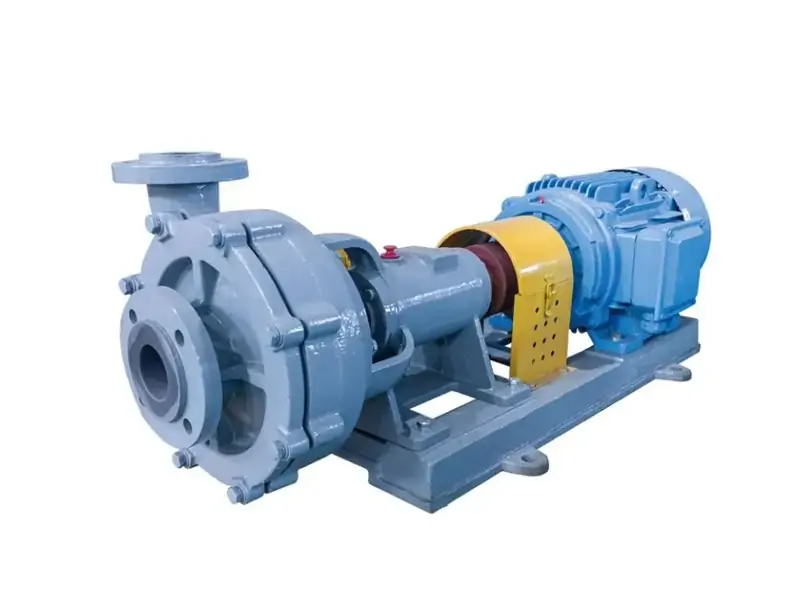
Changyu Pump offers proven pump solutions for the full lithium production chain, built around the UHB Series — a UHMWPE-lined centrifugal pump that handles the industry’s defining challenge: corrosive fluids carrying abrasive solids.
UHB Series — UHMWPE-Lined Slurry Pump for Lithium Processing
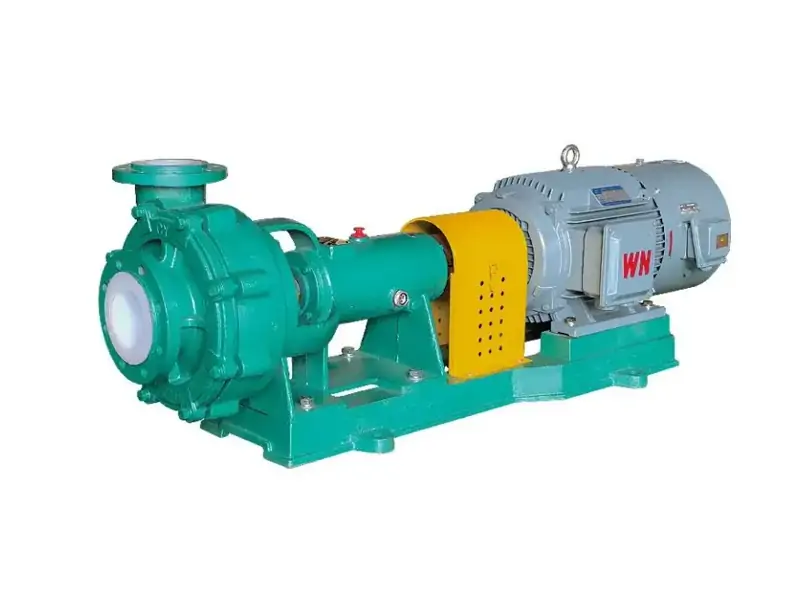
The UHB Series is a horizontal, single-stage, single-suction centrifugal pump with a steel casing internally lined with Ultra-High Molecular Weight Polyethylene. The UHMWPE lining provides the combined corrosion and abrasion resistance that lithium slurry service demands, while the steel outer casing provides structural strength for pressures up to 100 meters head.
A semi-open impeller design passes solids without clogging — an advantage in lithium slurries where settled particles can block closed-impeller pumps. The pump accommodates solids concentrations up to 30% by weight, covering brine with entrained sand, acid-leached mineral slurries, and cathode material precursor pastes.
| Parameter | Specification |
|---|---|
| Flow rate | 3–2,600 m³/h |
| Head | 5–100 m |
| Motor power | 0.75–300 kW |
| Speed | 750–2,900 r/min |
| Temperature | -20°C to 90°C |
| Solids handling | Up to 30% by weight |
| Lining material | UHMWPE |
Optional Supplementary Pumps for Specialized Lithium Applications
G-Type Single Screw Pump — High-Viscosity and Metering Applications
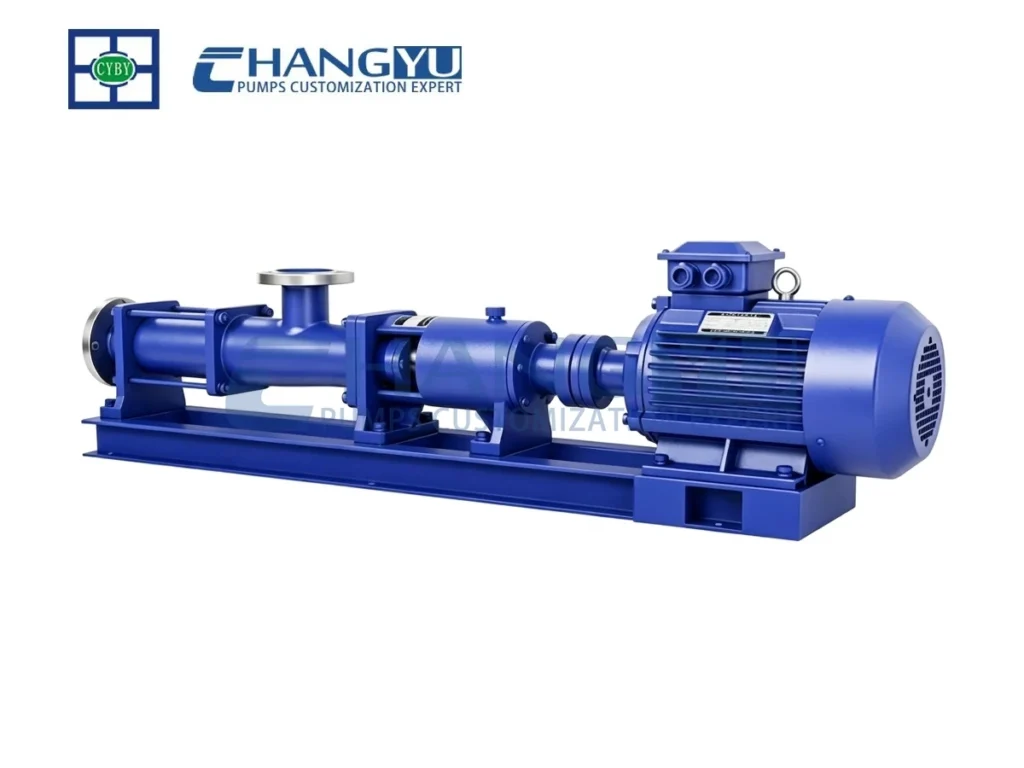
For lithium slurries with very high solids content or viscosity — such as precipitated lithium carbonate paste or thick cathode precursor slurry — a progressive cavity pump delivers pulsation-free, gentle transfer without shearing the solids. It also serves metering applications where precise flow control is required. Stator material selection must match the process temperature — food-grade EPDM for standard lithium processes; high-temperature elastomers for processes above 80°C.
CYB-ZKJ Series — FEP-Lined Pump for High-Temperature Acid Service
For acid leach processes operating above 90°C where UHMWPE reaches its thermal limit, the CYB-ZKJ Series with FEP fluoroplastic lining provides universal chemical resistance at temperatures up to 120°C. This pump is suitable for clean, hot acids — it should not be applied to abrasive slurries, as the softer FEP lining is less wear-resistant than UHMWPE.
Lithium Slurry Pump Selection Matrix
| Lithium Process Stage | Fluid Challenge | Primary Recommendation | Optional Alternative |
|---|---|---|---|
| Brine extraction with sand | Chloride corrosion + silica erosion | UHB Series | Duplex stainless steel (low-solids brine only) |
| Spodumene acid leach | Hot sulfuric acid + sharp mineral particles | UHB Series (≤90°C) | CYB-ZKJ (temperature > 90°C, low solids) |
| Lithium carbonate precipitation | Alkaline slurry with precipitated solids | UHB Series | G-Type Screw Pump (high-viscosity paste) |
| Cathode material precursor | High-purity slurry with fine abrasive particles | UHB Series | G-Type Screw Pump (metering applications) |
| Clean acid transfer | Corrosive liquid without solids | CYB-ZKJ Series | — |
6. Case Study of Lithium Slurry Pump: Solving a Cathode Material Pump Wear Failure
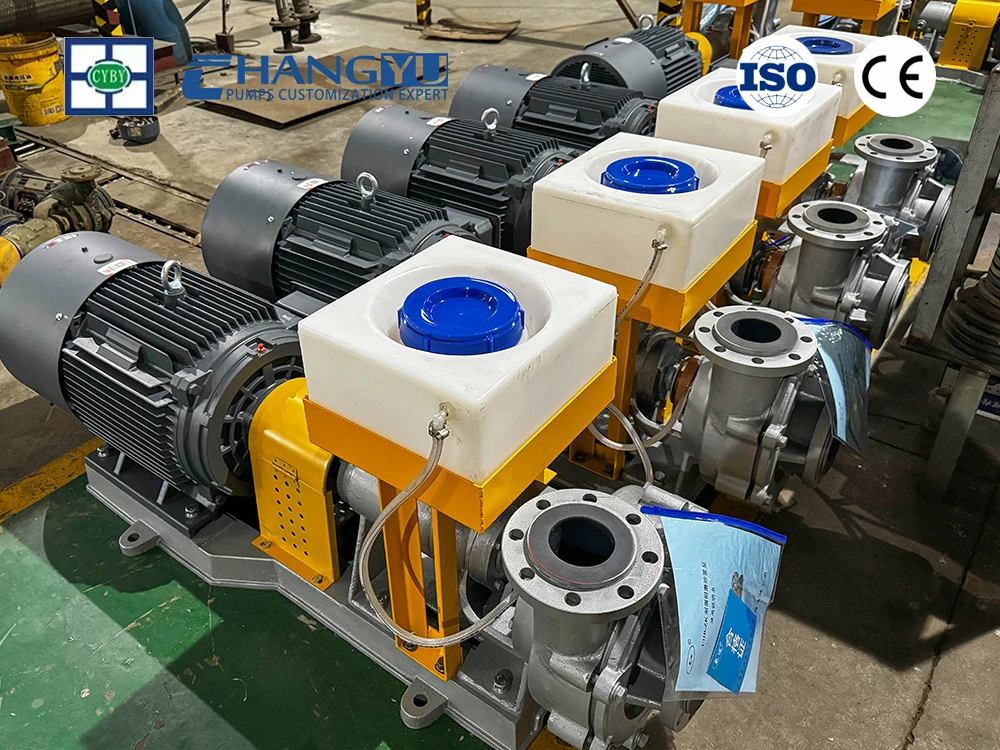
A lithium iron phosphate (LFP) cathode material producer in China used 316L stainless steel centrifugal pumps to transfer precursor slurry — a mixture of iron phosphate and lithium carbonate particles suspended in water at approximately 15% solids by weight, operating at 60°C and neutral pH.
Within four months, the pumps exhibited declining flow and visible leakage from the mechanical seals. Inspection revealed that the 316L impeller vanes had been worn thin by the abrasive slurry — the fine, hard particles had eroded the metal surfaces to the point where the pump could no longer generate the required head. The mechanical seal faces showed similar abrasive wear, compounded by particle accumulation in the seal chamber.
Beyond the performance degradation, the plant faced a more serious problem: the 316L pump components were leaching trace iron and chromium into the precursor slurry. Metal-ion contamination in cathode materials degrades battery performance, and the product quality team had identified the pumps as the source of elevated iron levels in the finished LFP powder.
Changyu Pump replaced the 316L pumps with UHB Series UHMWPE-lined pumps. The UHMWPE lining provided the abrasion resistance to handle the precursor slurry without the progressive wear experienced by the stainless steel. The lining also eliminated metal-ion leaching entirely — UHMWPE contains no metals and is chemically inert to the precursor slurry. A semi-open impeller design prevented solids accumulation and maintained stable flow.
Twelve months after the replacement: pump flow and head remained stable, no mechanical seal failures occurred, and iron contamination in the LFP product dropped below the detection limit. The plant replaced all product-contact pumps with UHB Series units during the next maintenance cycle.
Key takeaway: In cathode material production, pump material selection affects both equipment reliability and product quality. A pump that wears prematurely increases maintenance costs. A pump that leaches metal ions compromises the battery material it is producing. UHMWPE-lined pumps address both failure modes.
FAQs about Lithium Slurry Pumps
Q: What pump material is best for lithium brine with sand?
A: UHMWPE-lined pumps provide the best combination of chloride corrosion resistance and silica abrasion resistance. Duplex stainless steel resists chloride corrosion but offers only moderate abrasion resistance against sand.
Q: Can I use a stainless steel pump for lithium acid leach slurry?
A: Not reliably. The combination of hot sulfuric acid and sharp mineral particles will corrode and erode stainless steel. UHMWPE-lined pumps are the recommended choice for this demanding combination.
Q: Why is metal-ion contamination a concern in lithium pumping?
A: Cathode materials and battery-grade lithium chemicals are sensitive to trace metals such as iron, copper, and chromium. These impurities degrade battery performance. UHMWPE-lined pumps eliminate this risk because the lining contains no metals.
Q: What is the temperature limit for UHMWPE-lined pumps?
A: UHMWPE-lined pumps operate reliably from -20°C to 90°C. This covers all standard lithium extraction, purification, and cathode material processes. For processes above 90°C, FEP or PFA-lined pumps are required.
Q: How do UHMWPE and FEP linings compare for lithium service?
A: UHMWPE provides superior abrasion resistance and is the first choice for lithium slurries containing solids. FEP provides superior temperature resistance and chemical resistance but is less abrasion-resistant. Use UHMWPE for slurries with solids, and FEP for clean, hot, aggressive chemicals without solids.
Changyu Pump Engineer’s Avoidance Checklist
- Do not specify metal pumps for lithium slurries containing both corrosive chemicals and solid particles. The combination of corrosion and abrasion destroys metal components.
- Use UHMWPE-lined pumps for all lithium slurry applications within the 90°C temperature limit. The material handles corrosion, abrasion, and purity requirements simultaneously.
- Consider progressive cavity pumps for very high-viscosity lithium pastes or applications requiring precise flow control.
- Verify that pump materials do not introduce metal-ion contamination in cathode material and battery-grade lithium chemical production.
- Maintain minimum pipe velocity of 1.5–2.0 m/s for lithium slurries to prevent solids settling in suction and discharge lines.
- Size pumps with adequate margin for solids content. Slurry duty derates pump performance compared to clean water.
- Keep spare impellers and wear plates in inventory for lithium slurry pumps. Even UHMWPE wears over time in abrasive service.
- Inspect pump internals at scheduled intervals. UHMWPE wear is gradual and predictable — planned replacement prevents unplanned downtime.
Conclusion
Lithium production moves fluids that are both chemically aggressive and mechanically abrasive. A pump that resists only one of these challenges will fail from the other. UHMWPE-lined centrifugal pumps have become the standard for lithium slurry service because they address all three requirements of the industry: corrosion resistance across the full range of process chemicals, abrasion resistance against the silica, mineral particles, and precipitated solids present at every stage, and zero metal-ion contamination for the high-purity cathode materials that determine battery performance.
From the salt lakes of South America to the spodumene processing plants of Australia to the cathode material factories of Asia, the same pump technology handles the same combination of challenges. A correctly specified pump operates reliably between planned maintenance intervals and protects product quality by eliminating a source of metal contamination.
Changyu Pump’s engineering team provides tailored technical assessments for lithium processing applications — covering fluid characterization, material selection, and pump sizing for the specific conditions of your operation. Two decades of manufacturing experience across chemical, mining, and industrial sectors inform every recommendation.