
Formaldehyde pump selection is not just a matter of moving liquid from point A to point B; it is a critical safety decision. Formaldehyde (CH₂O) is a fundamental chemical intermediate used extensively in the production of resins, plastics, coatings, textiles, and disinfectants. However, transferring it safely requires specialized equipment. Formaldehyde is highly volatile, extremely toxic, and poses significant health and environmental risks even at low concentrations. If a standard industrial pump is used without proper sealing and material compatibility, the result will be vapor leakage, seal failure, environmental contamination, and unacceptable safety hazards for plant personnel.
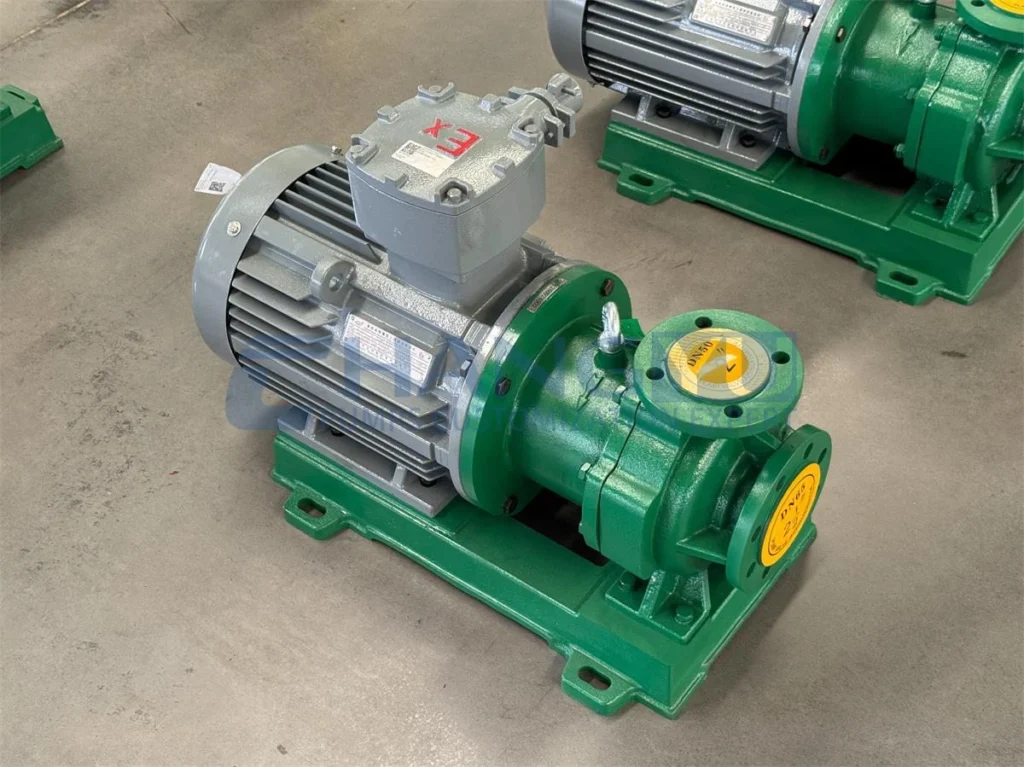
Why You Cannot Use a Standard Centrifugal Pump for Formaldehyde
Formaldehyde is rarely pumped as a pure gas; it is typically handled as an aqueous solution known as formalin (usually 37% to 50% formaldehyde in water), often stabilized with a small percentage of methanol.
While its physical viscosity might seem similar to water, its chemical behavior is entirely different.
- Extreme Volatility and Toxicity: Formaldehyde vaporizes easily at room temperature. A standard centrifugal pump relies on mechanical shaft seals such as single packing or basic mechanical seals. Over time, these dynamic seals inevitably wear out, creating a direct pathway for toxic formaldehyde vapors to escape into the atmosphere.
- Polymerization Risks: If formaldehyde leaks and is exposed to the atmosphere or a drop in temperature, it can precipitate into paraformaldehyde — a solid white polymer. This solid residue will quickly bind dynamic seals, causing them to tear and fail catastrophically.
- Corrosive Nature: Formaldehyde, especially when slightly oxidized into formic acid, requires specific wetted materials. Using cast iron or inappropriate elastomers will lead to rapid corrosion and O-ring degradation.
For these reasons, a reliable formaldehyde transfer pump must feature zero-leakage containment, specific corrosion-resistant materials, and a design suited to the exact installation layout.
Key Engineering Criteria for Formaldehyde Pump Selection
When specifying a pump for formaldehyde service, process engineers must evaluate the following parameters before requesting a quotation.
1. Zero-Leakage Containment (Sealless Technology)
Because of the strict emission regulations surrounding formaldehyde, sealless magnetic drive pumps are the industry standard for continuous transfer.
Instead of a shaft passing through a casing, a magnetic coupling transmits torque through a solid containment shell. This completely eliminates the dynamic shaft seal, thereby eliminating the primary source of toxic vapor leaks.
2. Material Compatibility
The wetted parts of the pump must resist both formaldehyde and its methanol stabilizer.
- Plastics: Polypropylene (PP), PVDF, and PTFE (Teflon) offer excellent resistance to formaldehyde at various temperatures.
- Metals: 304 and 316 Stainless Steel are highly effective and commonly used for formaldehyde handling due to their structural strength and corrosion resistance.
- Elastomers (O-Rings): Standard Buna-N rubber should be avoided. PTFE, Viton, or FEP-encapsulated O-rings are mandatory to prevent the seals from swelling or degrading.
3. Installation Layout (Above-Ground vs. Below-Ground)
The physical location of the formaldehyde storage dictates the pump structure.
If drawing from an above-ground tank with flooded suction, a horizontal magnetic drive pump is ideal. However, if the formaldehyde is stored in an underground pit or below-grade sump, using an external pump will cause suction-lift issues. In this scenario, a vertically immersed submersible pump is required.
Top 3 Formaldehyde Pump Solutions from Changyu Pump
At Changyu Pump, we understand that formaldehyde transfer happens in different scenarios — from continuous high-volume reactor feeding to intermittent drum unloading.
Here are three distinct pump technologies from our industry solutions, carefully matched to specific formaldehyde applications.
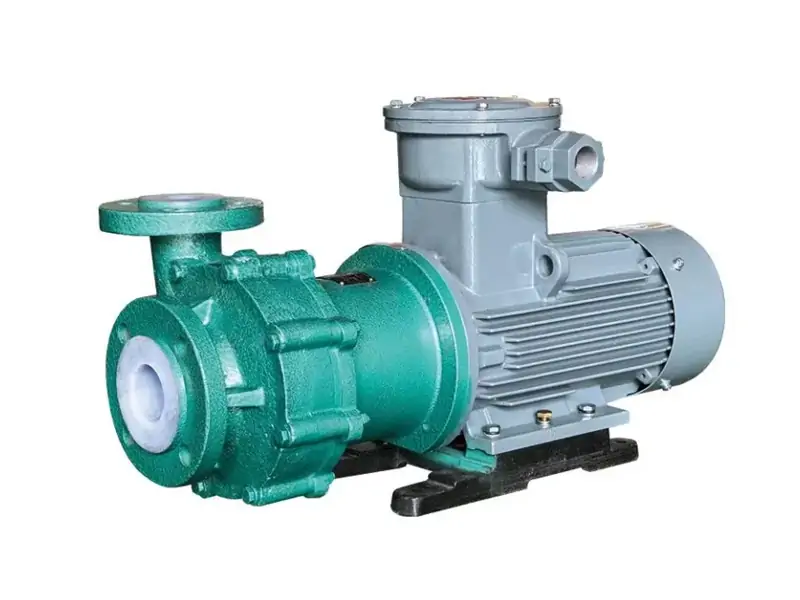
1. CYQ High Temperature Magnetic Drive Pump — For Continuous, Zero-Leakage Process Transfer
When your process requires continuous circulation or transfer of formaldehyde between main storage tanks and chemical reactors, the Changyu Pump CYQ High Temperature Magnetic Drive Pump is the premium choice.
Why it fits formaldehyde service:
- Absolute Sealing: It utilizes a sealless magnetic drive mechanism, meaning there is no mechanical seal to wear out. Formaldehyde liquid and toxic vapors remain 100% contained within the pump casing.
- Temperature and Chemical Resistance: Built to handle aggressive chemicals and elevated temperatures, the CYQ series ensures that even heated formalin solutions are transferred safely without warping the pump components.
- Heat Jacket Compatibility: For cold-climate facilities or high-concentration formalin, a heat-jacketed configuration keeps the fluid above its polymerization temperature during both operation and standby — protecting the pump internals from paraformaldehyde crystallization.
- Best Application: Continuous pipeline transfer, reactor feeding, and closed-loop circulation where zero emissions are mandated by plant safety regulations.
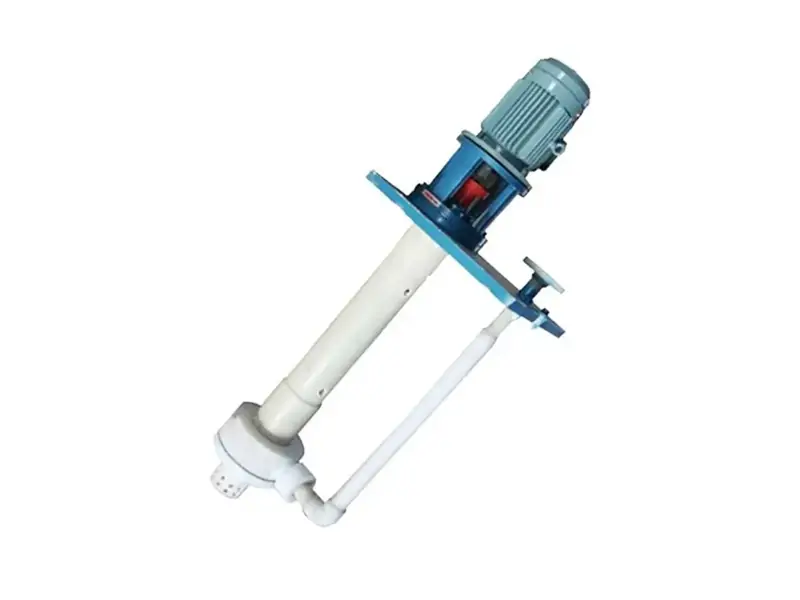
2. FYH Fluoroplastic Submersible Pump — For Below-Grade Tanks and Underground Sumps
Many chemical plants store bulk formaldehyde in underground tanks for safety and space-saving reasons. Drawing volatile formaldehyde upward with a standard self-priming pump can cause the liquid to vaporize in the suction line, leading to cavitation and loss of prime.
The Changyu Pump FYH Series Fluoroplastic Submersible Pump solves this engineering challenge directly.
Why it fits formaldehyde service:
- Submerged Operation: The pump end is installed vertically and directly into the formaldehyde. This eliminates the need for an external suction line, completely bypassing suction-lift and vaporization issues.
- Corrosion-Proof Fluoroplastic Construction: The wetted components are lined with high-performance fluoroplastics, offering total immunity to formaldehyde, formic acid, and methanol mixtures.
- No Suction-Side Vapor Lock: Because the impeller is always fully submerged, the FYH series never loses prime, making it exceptionally reliable for volatile fluids that are prone to flashing.
- Best Application: Pumping formaldehyde out of deep underground storage tanks, chemical sumps, and collection pits safely and efficiently.
| NO | Model | Flow (m³/h) | Head (m) | Rev (r/min) | Power | Caliber (mm) | |
| Axial power | Motor power | ||||||
| 1 | 32FYH-5-20 | 5 | 20 | 2900 | 0.8 | 2.2 | 32×25 |
| 2 | 32FYH-10-15 | 10 | 15 | 2900 | 1.17 | 2.2 | |
| 3 | 40FYH-10-20 | 10 | 20 | 2900 | 1.5 | 3 | 40×32 |
| 4 | 40FYH-15-20 | 15 | 20 | 2900 | 2.34 | 3 | |
| 5 | 50FYH-10-25 | 10 | 25 | 2900 | 3.4 | 4 | 50×40 |
| 6 | 50FYH-10-30 | 10 | 30 | 2900 | 4.1 | 5.5 | |
| 7 | 50FYH-15-30 | 15 | 30 | 2900 | 5.3 | 5.5 | |
| 8 | 50FYH-20-20 | 20 | 20 | 2900 | 4.6 | 5.5 | |
| 9 | 50FYH-20-25 | 20 | 25 | 2900 | 5.45 | 5.5 | |
| 10 | 50FYH-10-40 | 10 | 40 | 2900 | 6.1 | 7.5 | |
| 11 | 50FYH-20-30 | 20 | 30 | 2900 | 6.54 | 7.5 | |
| 12 | 65FYH-25-25 | 25 | 25 | 2900 | 5.68 | 7.5 | 65×50 |
| 13 | 65FYH-25-30 | 25 | 30 | 2900 | 6.8 | 7.5 | |
| 14 | 65FYH-30-20 | 30 | 20 | 2900 | 5.8 | 7.5 | |
| 15 | 65FYH-40-20 | 40 | 20 | 2900 | 6.82 | 7.5 | |
| 16 | 65FYH-30-25 | 30 | 25 | 2900 | 5.84 | 7.5 | 65×50 |
| 17 | 65FYH-30-30 | 30 | 30 | 2900 | 6.5 | 7.5 | |
| 18 | 65FYH-25-40 | 25 | 40 | 2900 | 7.79 | 11 | |
| 19 | 65FYH-30-40 | 30 | 40 | 2900 | 9.35 | 11 | |
| 20 | 65FYH-35-30 | 35 | 30 | 2900 | 8.2 | 11 | |
| 21 | 65FYH-30-50 | 30 | 50 | 2900 | 11.7 | 15 | |
| 22 | 80FYH-60-15 | 60 | 15 | 2900 | 6.2 | 7.5 | 80×65 |
| 23 | 80FYH-60-20 | 60 | 20 | 2900 | 9.3 | 11 | |
| 24 | 80FYH-50-25 | 50 | 25 | 2900 | 9.7 | 11 | |
| 25 | 80FYH-50-30 | 50 | 30 | 2900 | 10.6 | 11 | |
| 26 | 80FYH-40-30 | 40 | 30 | 2900 | 10.4 | 11 | |
| 27 | 80FYH-60-25 | 60 | 25 | 2900 | 11.5 | 15 | |
| 28 | 100FYH-60-30 | 60 | 30 | 2900 | 14 | 15 | 100×80 |
| 29 | 100FYH-80-15 | 80 | 15 | 2900 | 12.8 | 15 | |
| 30 | 100FYH-100-10 | 100 | 10 | 2900 | 13.6 | 18.5 | |
3. BFQ Air Operated Double Diaphragm Pump — For Drum Unloading and Portable Batch Transfer
Not all formaldehyde handling involves massive storage tanks. Maintenance crews and operators frequently need to transfer formaldehyde from 55-gallon drums, IBC totes, or mobile containers. For these intermittent tasks, a fixed centrifugal pump is impractical. The Changyu Pump BFQ Series Air Operated Double Diaphragm Pump is the perfect utility solution.
Why it fits formaldehyde service:
- Intrinsically Safe (Explosion-Proof): Formaldehyde vapors can be flammable. The BFQ pump is driven entirely by compressed air — no electricity, no motor, and no sparking risk.
- Self-Priming and Dry-Running Tolerance: It can pull formaldehyde directly out of a drum without needing to be manually primed, and it will not be damaged if the drum runs dry.
- Sealless Diaphragm Design: Like the magnetic drive pump, AODD pumps have no rotating shaft seals, eliminating the risk of toxic vapor leaks during batch transfers.
- Best Application: Drum unloading, IBC emptying, spill cleanup, and mobile batch transfer across different zones of the chemical plant.

| No. | Name | No. | Name | No. | Name | No. | Name |
|---|---|---|---|---|---|---|---|
| 01 | Pig Head Seal Ring | 02 | Pig Head | 03 | Large Slider | 04 | Small Slider |
| 05 | Assist Rod Sleeve | 06 | Piston Sleeve | 07 | Assist Rod | 08 | Assist Rod O-Ring |
| 09 | Piston V-Ring | 10 | Piston | 11 | Large Slider O-Ring | 12 | Large Slider Seat |
| 13 | Guide Block | 14 | Guide Block Gasket | 15 | Upper Cover (Outlet) | 16 | Ball Valve |
| 17 | Ball Seat | 18 | Ball Seat Seal Ring | 19 | Air Valve Cover | 20 | Air Valve Cover Gasket |
| 21 | Column | 22 | Clamp Plate Screw | 23 | Clamp Plate O-Ring | 24 | Outer Clamp Plate |
| 25 | Teflon Diaphragm | 26 | Triple Diaphragm | 27 | Inner Clamp Plate | 28 | Diaphragm Plate |
| 29 | Silencer | 30 | Lower Cover (Inlet) | 31 | Air Valve Cover | 32 | Connecting Rod Shaft |
| 33 | V-Ring | 34 | Connecting Rod Bushing | 35 | Air Valve Cover Gasket |
Changyu Pump Formaldehyde Pump Quick Selection Guide
| Application | Recommended Changyu Pump Model | Key Reason |
|---|---|---|
| Continuous pipeline transfer and reactor feeding | CYQ High Temperature Magnetic Drive Pump | Sealless zero-leakage design; heat-jacket compatible for polymerization prevention. |
| Below-grade tanks, underground sumps, pits | FYH Fluoroplastic Submersible Pump | Submerged operation eliminates suction-lift and vapor-lock issues. |
| Drum unloading, IBC emptying, portable transfer | BFQ Air Operated Double Diaphragm Pump | Air-driven, explosion-proof, self-priming for flexible batch service. |
Critical Engineering Consideration: Preventing Formaldehyde Polymerization (Crystallization) in Your Pump System
One of the most overlooked challenges in formaldehyde pumping is not the chemical’s toxicity — it is its tendency to polymerize.
Depending on the concentration (typically 37% to 50%), if the temperature of the formalin solution drops below its specific saturation point, the formaldehyde will precipitate and convert into paraformaldehyde — a hard, white, solid polymer.
If this polymerization occurs inside a pump while it is turned off, the solid crystals will cement the impeller and internal bearings together. When the pump is restarted, the locked impeller will cause immediate and catastrophic failure, such as shattered magnetic couplings or burned-out motors.
To prevent this, process engineers must implement two critical system designs when installing a formaldehyde pump:
Thermal Preservation (Heat Jacketing)
For highly concentrated formaldehyde, maintaining a consistent fluid temperature is mandatory.
If your plant operates in a cold environment, you should request a heat-jacketed magnetic drive pump. A heat jacket allows hot water or low-pressure steam to circulate around the pump casing, keeping the formaldehyde above its crystallization temperature even when the pump is idle.
Post-Operation Flushing Systems
If a formaldehyde pump must be shut down for maintenance or batch changeovers, the fluid cannot be left sitting in the pump casing.
The piping system must be designed with a flushing loop. Before the pump is completely powered down, operators must flush the pump internals with warm water or a compatible solvent such as methanol to clear out all residual formaldehyde.
For magnetic drive pumps, ensuring the internal cooling channels are thoroughly flushed is the only way to prevent paraformaldehyde from destroying the internal bearings during the next startup.
FAQs About Formaldehyde Pumps
What is the best pump material for handling formaldehyde (formalin)?
The best wetted materials for formaldehyde and its methanol stabilizer are stainless steel (such as 304 or 316) and high-performance fluoroplastics such as PTFE or PVDF. Just as importantly, the sealing elastomers must be strictly specified. Standard rubber will degrade rapidly; you must use PTFE, FEP-encapsulated, or specialized fluoroelastomers to ensure long-term chemical resistance.
Why are magnetic drive pumps highly recommended for formaldehyde transfer?
Formaldehyde is extremely toxic, volatile, and strictly regulated by environmental and safety agencies. A magnetic drive pump features a sealless design, meaning it has no mechanical shaft seal that can wear out and leak hazardous vapors into the atmosphere. This guarantees zero emissions and ensures maximum operator safety during continuous process transfer.
Can an air-operated double diaphragm pump be used for formaldehyde?
Yes. AODD pumps are excellent for intermittent formaldehyde handling such as drum unloading, IBC emptying, and spill cleanup. Because they are driven entirely by compressed air rather than electricity, they are intrinsically safe and explosion-proof. This is a critical advantage since formaldehyde vapors can be flammable under certain conditions.
How do I safely pump formaldehyde from an underground storage tank?
Using a standard surface-mounted pump to draw formaldehyde from a below-grade tank can cause the volatile fluid to vaporize in the suction line, leading to cavitation and loss of prime. The safest and most reliable method is to use a vertically immersed fluoroplastic submersible pump such as the Changyu Pump FYH series, which operates directly within the fluid and completely eliminates suction-lift issues.
Does formaldehyde require a heat-jacketed pump?
It depends on your specific concentration and ambient conditions. If the temperature of the formaldehyde solution drops, it can precipitate and polymerize into solid paraformaldehyde, which will quickly jam and destroy pump internals. If your process requires maintaining an elevated temperature to prevent crystallization, you must ensure the pump and piping system can accommodate thermal preservation with a heat-jacketed configuration.
What happens if a formaldehyde magnetic drive pump runs dry?
Running a magnetic drive pump dry is catastrophic. The internal bearings and cooling channels rely entirely on the formaldehyde fluid for lubrication and heat dissipation. If the supply tank runs empty, the internal components will rapidly overheat, melt, or shatter. You should always install a dry-run protection monitor or level-control system on the supply tank when operating these pumps.
Common Mistakes in Formaldehyde Pump Selection
- Ignoring O-Ring Materials: Selecting a highly rated stainless steel pump but forgetting to upgrade the standard rubber O-rings. Formaldehyde will degrade standard rubber, leading to immediate leaks. Always specify PTFE or FEP-encapsulated O-rings.
- No Flushing Protocol After Shutdown: Leaving residual formaldehyde inside the pump during maintenance or planned shutdown will result in paraformaldehyde crystallization and a destroyed pump on the next startup.
- Ignoring Cold Ambient Conditions: Installing a formaldehyde pump in an unheated warehouse or outdoor environment without specifying heat-jacket options will almost certainly lead to repeated crystallization failures.
- Allowing Magnetic Pumps to Run Dry: Magnetic drive pumps must never run dry. Install dry-run protection monitors and low-level tank alarms as a mandatory system safeguard.
- Using Dynamic Seals for Toxic Fluids: Relying on single mechanical seals for highly volatile toxic chemicals will expose operators to hazardous fumes as the seal face wears down.
Conclusion: Partner with Changyu Pump for Safe and Reliable Formaldehyde Handling
Transferring formaldehyde is a high-stakes operation where equipment failure can lead to severe safety, health, and environmental consequences.
Whether your plant requires the zero-emission continuous transfer capability of the CYQ Magnetic Drive Pump, the below-grade reliability of the FYH Fluoroplastic Submersible Pump, or the portable explosion-proof flexibility of the BFQ Air-Operated Diaphragm Pump, Changyu Pump provides the right engineered solution for every formaldehyde application.
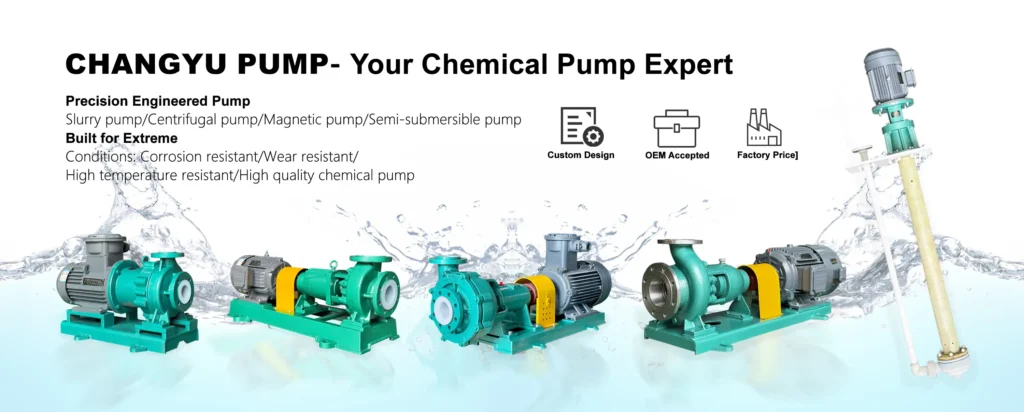
Do not compromise on chemical safety. Contact Changyu Pump today with your specific formaldehyde concentration, temperature, flow rate, and installation requirements. Our engineering team will recommend the safest, most efficient, and most cost-effective formaldehyde pump for your critical process.