
1. Introduction
High solids slurry pump selection is an exercise in managing limits—limits of material hardness, limits of hydraulic efficiency, limits of what a single pump design can survive. When solid concentrations exceed 50% by weight, the abrasive mixture behaves less like a fluid and more like a mobile solid, placing extraordinary demands on every wetted component. A standard slurry pump thrown into this environment may not merely wear faster; it may fail catastrophically within hours.
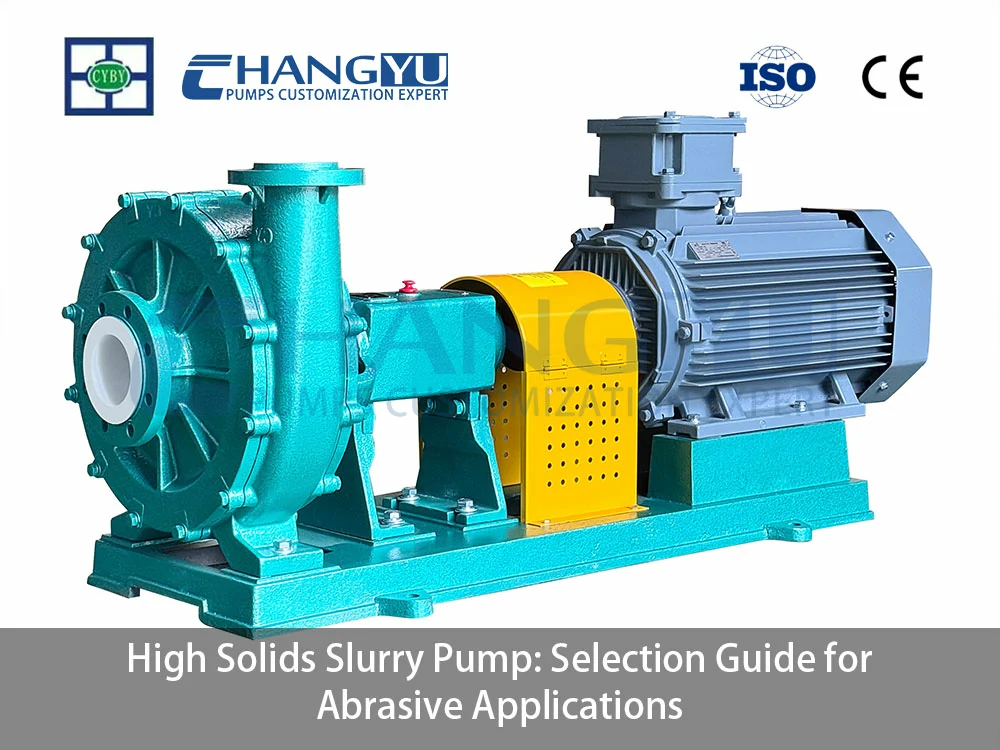
The challenge of high-density slurries is well documented. Slurries in mining often feature silica or ore particles up to 100mm, eroding components at rates 4–8 times faster than water. Each percentage point increase in solids concentration past a certain threshold dramatically accelerates wear. When centrifugal pumps encounter viscosities in the 800–1,000 cP range, head losses of 8 m or more and efficiency reductions of 20% are well established in the literature. Furthermore, high-density, coarse, angular solids drive both wear and power draw in ways that clean fluids never do.
This guide provides a structured framework covering the defining characteristics of high-solids slurries, when to switch from centrifugal to positive displacement technology, a critical material selection matrix, key application considerations, and a practical approach to maintenance and life-cycle cost management. Drawing on over two decades of engineering experience, Changyu Pump brings deep expertise in specifying wear-resistant pump solutions for the world’s most abrasive applications.
2. What Defines a High Solids Slurry Pump?
2.1 The Meaning of “High Solids”
A high solids slurry is a liquid-solid mixture in which the solid concentration by weight exceeds approximately 40%, beyond which particle-to-particle contact and collision become the dominant interaction modes—fundamentally altering the slurry’s rheology and its effect on pump components. A high solids slurry pump is specifically engineered to transport such mixtures, with many applications operating in the 50–70% solids range. This is not simply a more robust version of a standard centrifugal pump. Above roughly 40% solids by weight, the slurry’s rheology shifts markedly. The mixture exhibits non-Newtonian behavior: viscosity changes with shear rate, and particles interact through direct contact and collision rather than merely moving within a carrier fluid.
In practical terms, a pump that handles a 30% solids slurry with acceptable wear may be destroyed within weeks by the same ore ground to 60% solids. The difference is not incremental—it is a step change in the physical mechanism of pump degradation.
2.2 How High Solids Alter Pump Wear and Performance
Standard slurry pumps are designed on the assumption that abrasive particles are largely entrained in the liquid phase. This assumption breaks down completely when solids dominate the mixture. In a high-solids environment, particles repeatedly strike, slide across, and grind against internal pump surfaces. The wear rate is not linearly proportional to solids concentration; it rises sharply once particle-to-particle contact becomes the dominant interaction mode.
Research has established that at high solids concentrations, the performance of centrifugal pumps declines primarily due to elevated disc friction losses in the viscous, non-Newtonian fluid, and that these losses are substantially larger than those from vortex structures and tip‑leakages alone. What this means for the engineer is that simply oversizing a standard pump does not solve the problem. The pump’s hydraulic design, impeller clearance, and material selection must all be recalibrated for the specific solids regime.
2.3 Key Design Features That Distinguish a High Solids Slurry Pump
| Feature | Standard Slurry Pump | High Solids Slurry Pump |
|---|---|---|
| Casing Wall Thickness | Moderate | Substantially reinforced |
| Internal Clearances | Standard (for mixed particle sizes) | Enlarged and adjustable |
| Impeller Vane Count | 5–7, efficiency-focused | 3–5, solids-passage-focused |
| Wear Parts | Replaceable | Replaceable + thicker + harder material grades |
| Sealing System | Expeller, gland packing, or mechanical seal | Expeller with auxiliary seal; seal-less (PD) or flushed double seal |
High-solids pumps typically incorporate one or more of the following: adjustable wear plates that allow the operator to restore internal clearances as material erodes; semi-open or open impeller designs with fewer, thicker vanes to allow passage of larger solids; enhanced bearing assemblies to withstand higher radial loads generated by dense slurry slugs; and casing walls with substantially greater thickness than those found on standard slurry pumps. These features represent the engineering baseline for handling high-solids applications; the selection process must also address pump type, materials, and system design.
3. High Solids Slurry Pump Types: Centrifugal vs. Positive Displacement
The selection between centrifugal and positive displacement (PD) technology is the single most consequential decision in high-solids pump specification. The wrong choice leads not merely to inefficient operation but to rapid mechanical failure.
3.1 How Centrifugal Pumps Degrade at High Solids Concentrations
Centrifugal pumps dominate industrial slurry handling for good reason: they provide high flow rates, continuous (non-pulsating) delivery, simpler maintenance, and lower capital cost per unit of flow. However, their performance degrades measurably as solids concentrations increase and as the slurry takes on non-Newtonian flow characteristics. The impeller adds kinetic energy to the fluid, but denser, more viscous mixtures resist this acceleration. Efficiency declines; head falls off; and wear accelerates because particles spend more time in contact with pump surfaces.
A centrifugal pump handling 10% solids behaves very differently from one pushing 60% solids; higher concentrations increase wear and require more robust designs. The rule that “slower is better for abrasive duty” applies with special force in high-solids service, where reducing pump speed often yields a disproportionate reduction in wear rate. However, reducing speed below the point at which solids remain suspended in the pump casing and pipeline—the limit deposit velocity (LDV)—is counterproductive, leading to settling, pipeline blockage, and high local wear rates. For a deeper understanding of centrifugal slurry pump fundamentals, see our centrifugal slurry pump guide.
3.2 When Positive Displacement Pumps Become the Rational Choice
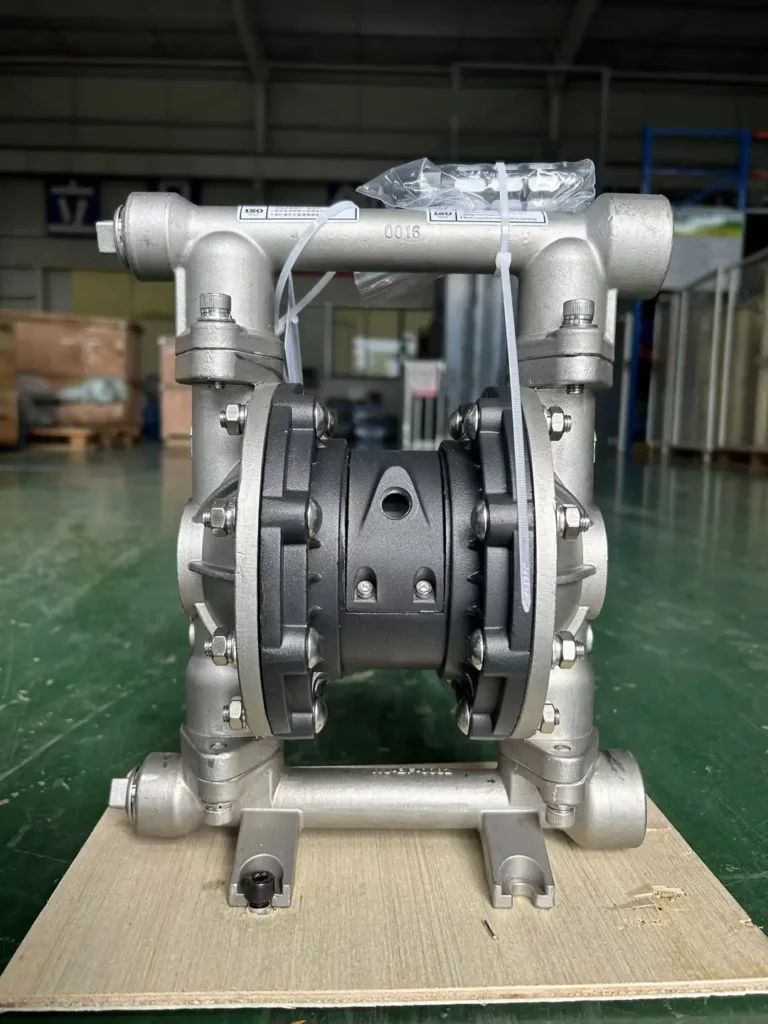
PD pumps—including progressive cavity, diaphragm, peristaltic hose pumps, and plunger designs—operate on a fundamentally different principle. Rather than adding kinetic energy to the fluid, they trap a fixed volume and mechanically displace it toward the discharge. This makes their flow rate largely independent of system pressure and slurry viscosity, a decisive advantage when solids concentrations push beyond what centrifugal pumps can handle efficiently.
In particular, PD pumps can handle much higher solids concentrations (over 50–70% by weight) without experiencing the same decline in efficiency seen in centrifugal designs at similar high loads. They are capable of handling much higher pressures—typically up to 30 MPa (300 bar)—although they deliver reduced flow compared to centrifugal pumps. Furthermore, PD pumps have advantages in applications with low net positive suction head available (NPSHa) and when pumping viscous or high-solids products.
3.3 Six Factors That Determine the Correct Technology Choice
| Factor | Favors Centrifugal | Favors Positive Displacement |
|---|---|---|
| Solids Concentration | < 40% by weight | > 50% by weight (some PD types handle >70%) |
| Particle Size | Coarse, fast-settling | Fine to moderate (but PD hose pumps can pass large particles) |
| Slurry Viscosity | Low to moderate (water-like to ~500 cP) | High (>800–1,000 cP) or non-Newtonian |
| Flow Requirement | High (> 20 m³/h) | Low to moderate |
| Discharge Pressure | Low to moderate | High (> 6,000 kPa / ~870 psi) |
| Service Duty | Continuous high-flow transfer | Metering, dosing, or intermittent high-pressure |
The boundary between centrifugal and PD territory is not rigid. Where the application sits near the middle of several factors, a hybrid approach—centrifugal for the main transfer line, PD for a high-pressure side stream—may deliver the best overall outcome.
3.4 Essential Selection Principles for High Solids Service
Several practical principles should guide the selection process regardless of the pump type ultimately chosen.
Reduce pump speed—but stay above the settling limit. For abrasive duties, slowing the pump and increasing its size if necessary often delivers a better outcome than running a smaller, faster pump. However, reducing speed below the limit deposit velocity (LDV) is counterproductive, as it leads to settling, pipeline blockage, and high local wear rates.
Select the impeller and casing materials together. An excellent impeller inside a substandard casing defeats the purpose of the upgrade. The material pair must be chosen as a system.
Size the pump for the actual solids content. A pump that handles a specific slurry at 40% solids may be undersized for the same slurry at 60%.
Factor the entire life-cycle cost into the decision. Energy consumption (often 60–70% of lifetime cost), wear-part replacement frequency, maintenance labor, and the downtime cost of pump failure—calculated over a three- to five-year horizon—each contributes to the total cost of ownership and should inform the pump specification.
4. High Solids Slurry Pump Materials: The Critical Selection Matrix
Material selection for a high solids slurry pump must start from an understanding of how the solids in the specific application actually destroy pump surfaces. The question is not “which material is hardest?” but “which material system best survives the particular wear mode this slurry produces?”
4.1 Primary Wear Mechanisms and Their Material Requirements
In slurry pump practice, three distinct wear mechanisms operate, often simultaneously:
- Sliding abrasion: Particles are dragged across a surface under pressure, as occurs in bushings, sleeves, wear rings, and close-clearance seal support areas. Here, high hardness and a stable microstructure are critical. Under these conditions, tungsten carbide is often the strongest choice because it combines very high hardness, compressive strength, and dimensional stability.
- Impact abrasion: Particles strike surfaces at higher angles, common in liners, impellers, suction plates, and casing areas. In these locations, toughness and energy absorption are just as important as hardness. Rubber and polyurethane linings excel here—they absorb the kinetic energy of impacting particles and release it elastically, rather than resisting it through hardness alone.
- Erosion plus corrosion: Simultaneous abrasive wear and chemical attack, common in acid mine drainage, flue gas desulfurization (FGD) slurries, and phosphoric acid production. Here, material selection becomes a multi-parameter problem: the surface must resist both the abrasive particles and the corrosive carrier fluid.
4.2 Material Selection Table
| Material | Hardness (BHN) | Best Against | Temp. Limit | Typical Application | Relative Wear Life vs. Mild Steel* | Avoid When |
|---|---|---|---|---|---|---|
| Natural Rubber | N/A (Elastomer) | Fine, sharp particles (impact) | ~70°C | Tailings, flotation feed | 5–15× (fine particles) | Strong solvents, hydrocarbons, oils, >70°C |
| Polyurethane | N/A (Elastomer) | Mixed slurries with varied particle size | ~70°C | Dredging, sand slurries | 3–8× | Strong solvents, >70°C |
| High-Chrome White Iron (27–35% Cr) | 600+ | Coarse, sharp-edged, angular solids | ~110°C | Mill discharge, ore transport | 3–10× (coarse angular solids) | pH < 4 (acid service), strong alkalis |
| Duplex Stainless Steel (CD4MCu, 2205) | 280–350 | Corrosion + moderate abrasion | ~110°C | Acid mine drainage, FGD, phosphoric acid | 2–4× (corrosive-abrasive) | High-chloride environments above 110°C |
| UHMW-PE Lining (8–20 mm) | N/A (Polymer) | Combined moderate abrasion + strong chemical corrosion | ~90°C | Phosphoric acid, titanium dioxide, mixed chemical slurries | 4–10× (combined corrosion-abrasion) | >90°C, strong oxidizing acids |
| Ceramic (Alumina/SiC) | 1200+ (Vickers) | Clean, fine abrasion with limited impact | ~150°C (seal/gasket limited; ceramic element higher) | FGD recycle, chemical slurries, kaolin | 8–20× (fine particle abrasion only) | High-impact loading, thermal shock |
*Wear life ratios are indicative values based on standardized laboratory abrasion tests (e.g., ASTM G65, Miller Number testing). Actual service life depends on operating speed, solids loading, particle size and angularity, pH, temperature, and maintenance practices. These figures serve as a preliminary screening guide; field validation under actual operating conditions is recommended before final material specification.
4.3 Matching Material to Wear Mechanism
Material selection guidance distilled from industry practice:
- Fine, sharp particles with low impact: Natural rubber—best for fine, sharp particles (like sand) where impact is low but abrasion is high.
- Coarse, angular solids at high velocity: High-chrome white iron (27% Cr)—extremely wear-resistant and suited for coarse, angular solids in high-flow applications.
- Mixed particle sizes with sliding abrasion: Polyurethane—offers good resistance to sliding abrasion and can handle tramp objects.
- Combined severe corrosion and moderate abrasion: Fluoroplastic-lined pumps with UHMW-PE, FEP, or PTFE linings at 8–20 mm thickness. These provide a complete chemical barrier between the pumped fluid and the pump’s structural casing.
- Severe sliding abrasion in close-clearance components: Tungsten carbide bushings and sleeves.
For further reading on material selection across broader chemical and slurry applications, see our comprehensive chemical process pump material guide.
5. High Solids Slurry Pump Applications Across Heavy Industries
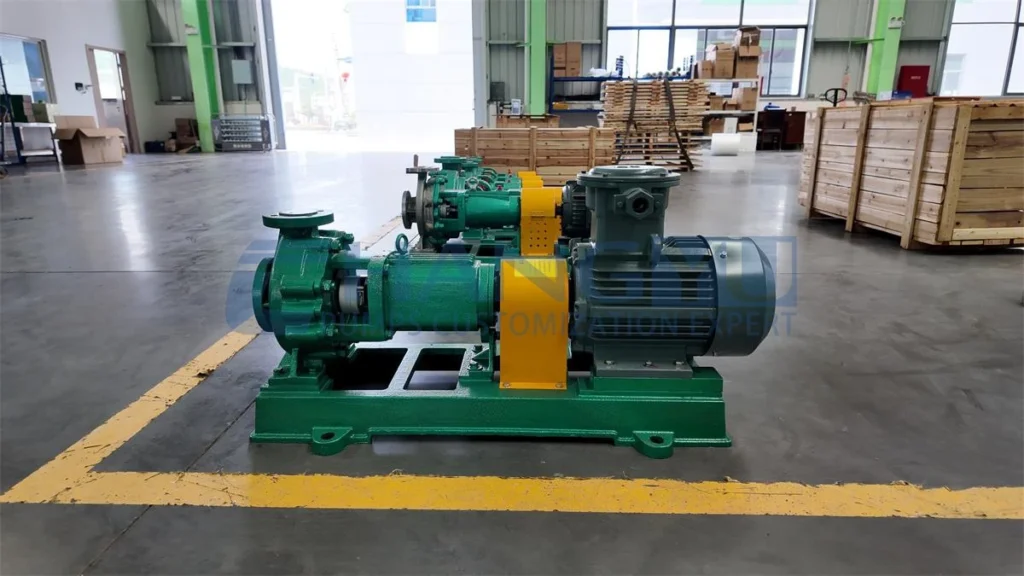
Mining and mineral processing: Mill discharge, cyclone feed, and tailings transport require high solids slurry pumps capable of handling coarse, angular, and highly abrasive solids continuously. High-chrome iron wet ends are the industry standard for these applications.
Oil sands and thickened tailings: De-watered and thickened tailings with solids content exceeding 60% require PD pumps—typically progressive cavity or hose pumps—for controlled, low-shear transfer to disposal sites.
Sludge dewatering and biomass handling: In municipal and industrial wastewater treatment, high-solids centrifugal or PD pumps transfer thickened sludge to digesters, centrifuges, or drying beds. The combination of variable solids loading and demanding continuous operation requires robust, adjustable-clearance designs.
Dredging and river channel maintenance: Dredge pumps handle sand, gravel, and silt with solids concentrations of 40–70%, requiring casings made from high-chrome iron or elastomer-lined (natural rubber) to survive the extreme abrasion. Dredging applications demand large-diameter, open-design impellers with high passage capacity and replaceable wear components.
Steel and power generation: Slag slurry in steel mills and ash slurry in coal-fired power plants combine high solids, elevated temperatures, and variable pH, demanding duplex stainless steel or fluoroplastic-lined pump options depending on the specific chemistry of the slurry.
6. Maintenance and Life-Cycle Cost Management
Wear parts—impellers, liners, throatbushes, and seal faces—are consumable in high-solids slurry service. The question is not whether they will need replacement, but at what interval and at what cost. Many slurry pump wear parts may last for years with proper routine maintenance, but all will eventually require attention.
Maintenance frequency and cost control: Proactive maintenance—scheduled impeller clearance measurement, wear plate inspection, and bearing lubrication—extends mean time between failures (MTBF) dramatically. Routine maintenance planning for slurry pumps should include regular inspection and timely replacement of worn parts.
Predictive maintenance and condition monitoring: Vibration analysis, wear-rate trending, and performance degradation monitoring (gradual decline in flow rate and pressure) enable intervention before catastrophic failure. In mineral processing operations, structured maintenance programs routinely reduce downtime costs by 40–60% compared to run-to-failure approaches.
Life-cycle cost evaluation: A life-cycle cost (LCC) evaluation should factor in capital, power, wear parts, maintenance labor, and downtime costs over a 3–5 year horizon. A pump with a higher initial price but substantially longer wear life consistently delivers lower total cost of ownership than a budget alternative requiring frequent rebuilds.
7. Changyu Pump Solutions for High Solids Slurry Applications
Changyu Pump’s product portfolio includes three pump series engineered for high-solids, abrasive slurry service. Each series employs distinct material and hydraulic strategies matched to specific slurry characteristics.
UHB Series UHMWPE Corrosion Resistant Pump
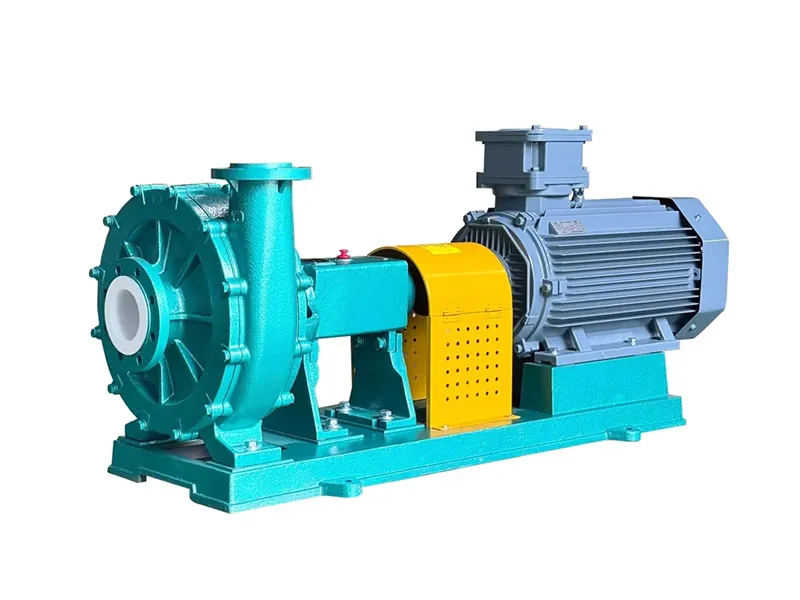
The UHB Series is a cantilever, single-stage centrifugal pump with a steel-lined UHMW-PE casing, designed for chemically aggressive and abrasive-corrosive fluids. Its UHMW-PE lining—at 8–20 mm thickness—provides a dual defense: it absorbs particle impact energy while isolating the steel casing from corrosive attack. This combined protection makes the UHB Series suitable for acid slurries and high-solids streams in phosphate fertilizer production, titanium dioxide processing, and non-ferrous metal smelting.
Key Specifications: Flow 3–2,600 m³/h | Head 5–100 m | Power 0.75–300 kW | Temperature -20°C to 90°C
HB Series Stainless Steel Slurry Pump
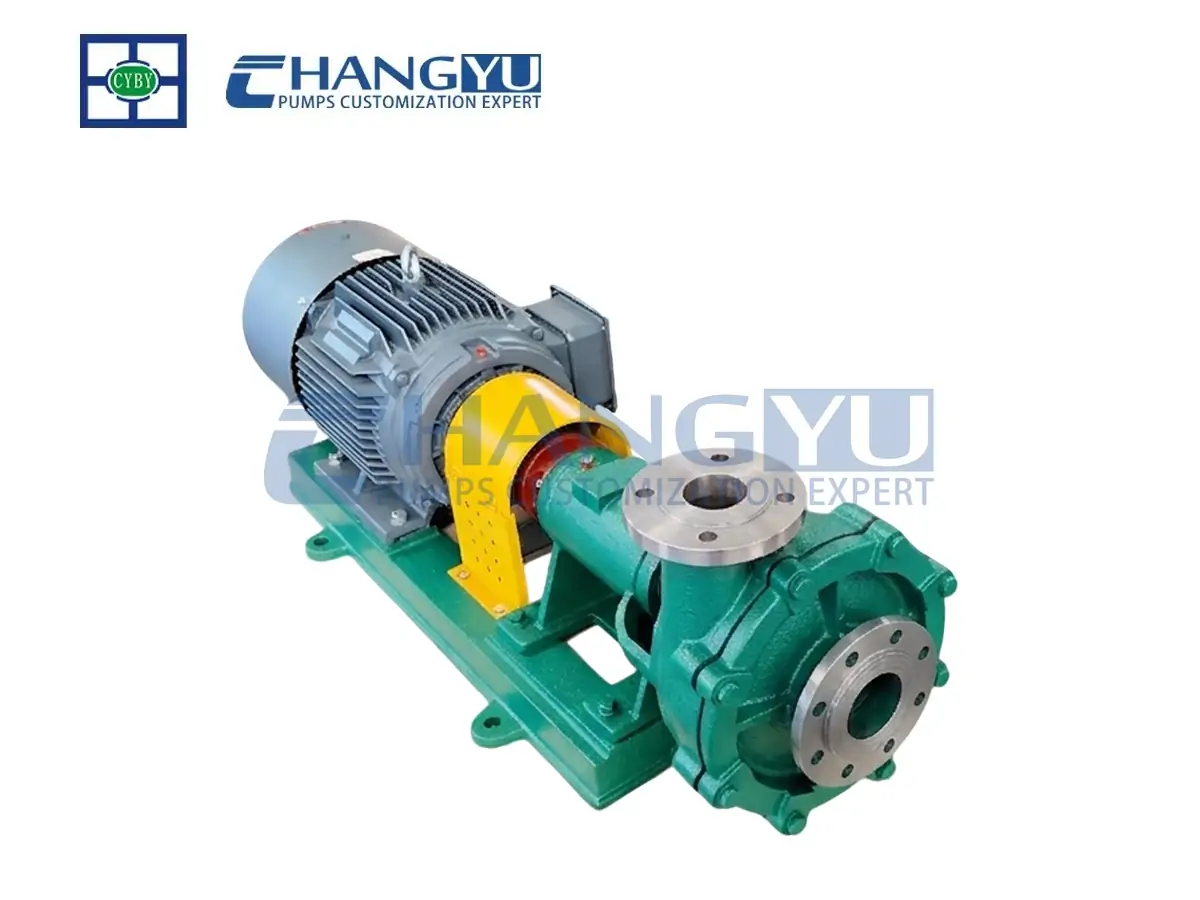
The HB Series is a high-efficiency, single-stage horizontal centrifugal pump designed in accordance with ISO 2858 and compliant with CE standards. Its all stainless steel wetted structure—customizable in 304, 316, 316L, 2205, and 2507—handles abrasive slurry and medium-corrosive fluids in demanding industrial environments. The rigid metallic structure resists erosive wear and high-velocity fluid impact, while the smooth internal flow passages reduce turbulence and associated erosion.
Key Specifications: Flow 10–60 m³/h | Head 20–120 m | Power 3–45 kW | Temperature -20°C to 120°C
CYB-ZKJ Series Corrosive Chemical Transfer Pump
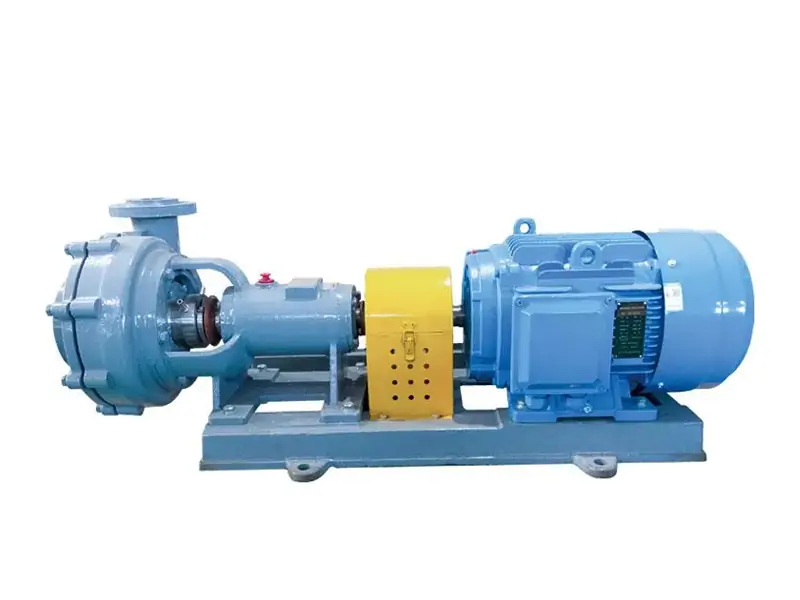
The CYB-ZKJ Series is a high-performance centrifugal pump with FEP lining (PFA available for high-temperature service), designed for conveying corrosive liquids, mineral slurries, and dilute acids containing up to 20% flexible solid particles. Its fluoroplastic-lined wetted components provide broad chemical resistance for applications across the chemical, metallurgical, and environmental protection industries.
Key Specifications: Flow 3–2,600 m³/h | Head 5–100 m | Power 0.75–300 kW | Temperature -80°C to 120°C
8. Quality Control: How Changyu Pump Ensures High Solids Slurry Pump Reliability


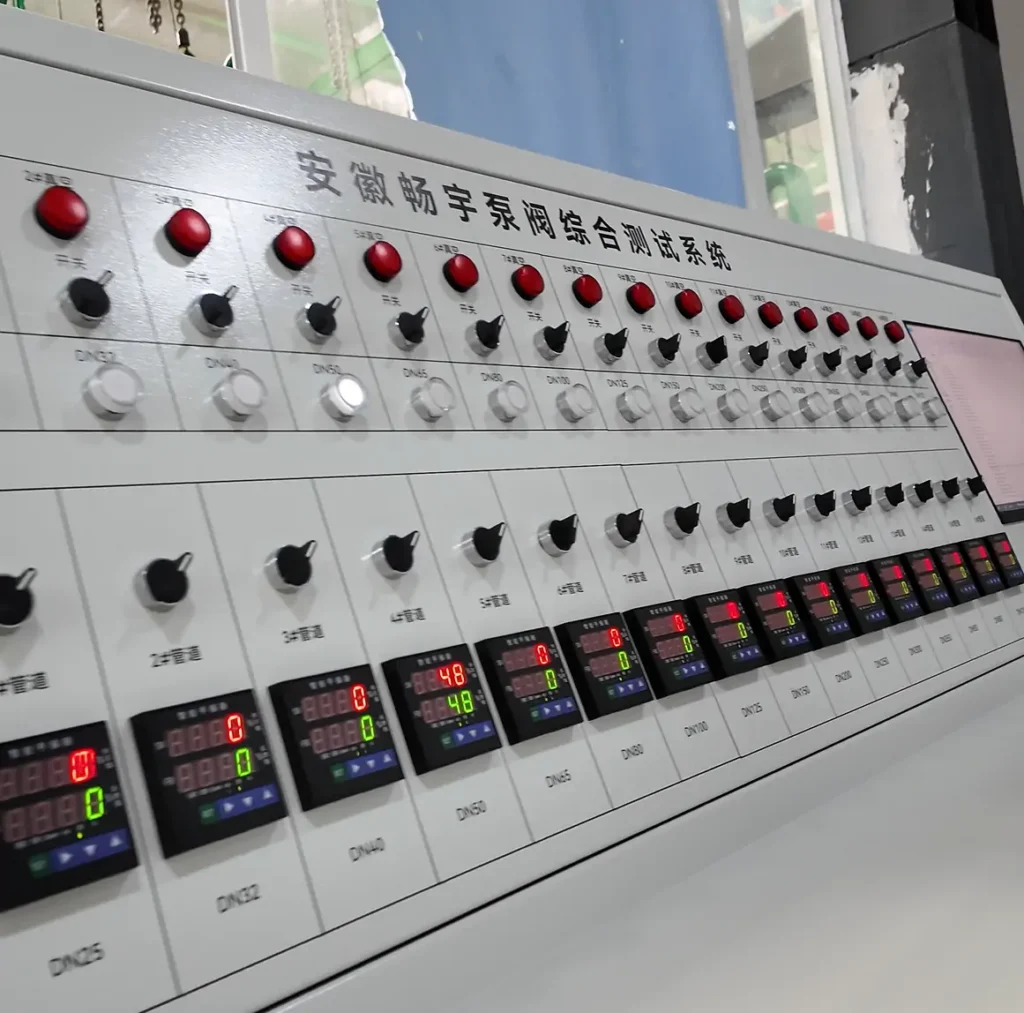
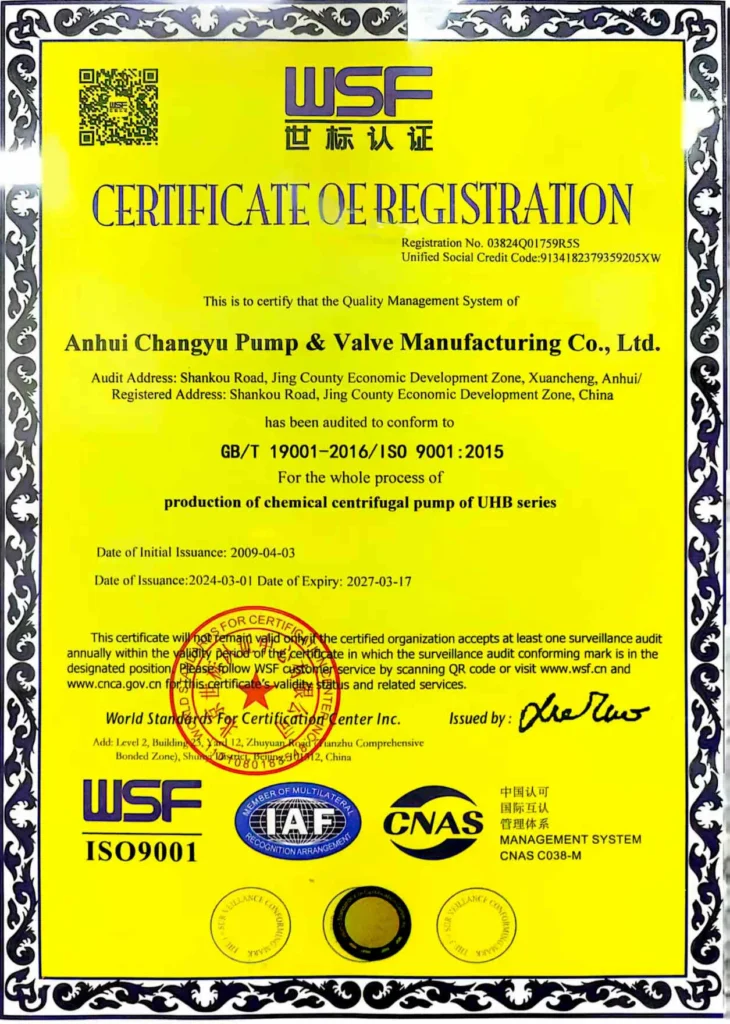
Every high solids slurry pump from Changyu Pump undergoes a structured quality assurance program designed to prevent defects before the pump reaches the field. The program reflects the understanding that in slurry service—where a single casting void can become a failure initiation point under abrasive attack—quality control is a performance differentiator, not an administrative formality.
Material Verification: All incoming raw materials—UHMW-PE compounds, stainless steel grades (304, 316L, 2205, 2507), and fluoroplastic resins (FEP, PFA)—undergo spectral analysis to verify chemical composition against specification. Each material batch carries documented certification before release to production.
In-Process Inspection: Impeller dimensions, casing tolerances, lining thickness and bond integrity, shaft straightness, and dynamic balance grade are measured at every critical production stage. For fluoroplastic-lined pumps, ultrasonic testing confirms uniform lining coverage, as a single void can become a failure initiation point under chemical-mechanical attack.
Hydraulic Performance Testing: Every assembled pump is tested across multiple duty points. Flow rate, head, power consumption, and efficiency are measured and verified against published performance curves. Pumps must meet specifications before clearance for shipment.
Final Assembly Audit: Bolt torque, seal integrity, bearing preload, and free rotation are confirmed before packaging. Mechanical seals undergo static hydrostatic testing, and magnetic drive pumps are verified for coupling integrity.
For a deeper discussion of pump quality assurance, refer to our detailed Quality Inspection Process.
9. Case Study of High Solids Slurry Pump: Extending Service Life in a Phosphate Fertilizer Plant
Customer Challenge: A phosphate fertilizer manufacturer was experiencing chronic wet-end failures on the high-chrome iron slurry pumps handling phosphoric acid slurry (pH 1–2, 35–45% gypsum solids, 70–80°C). The combined corrosion-abrasion mechanism was destroying impellers within 4–5 months and casings within 12 months. Annual per-pump maintenance costs exceeded USD 55,000, and unplanned downtime events were occurring quarterly.
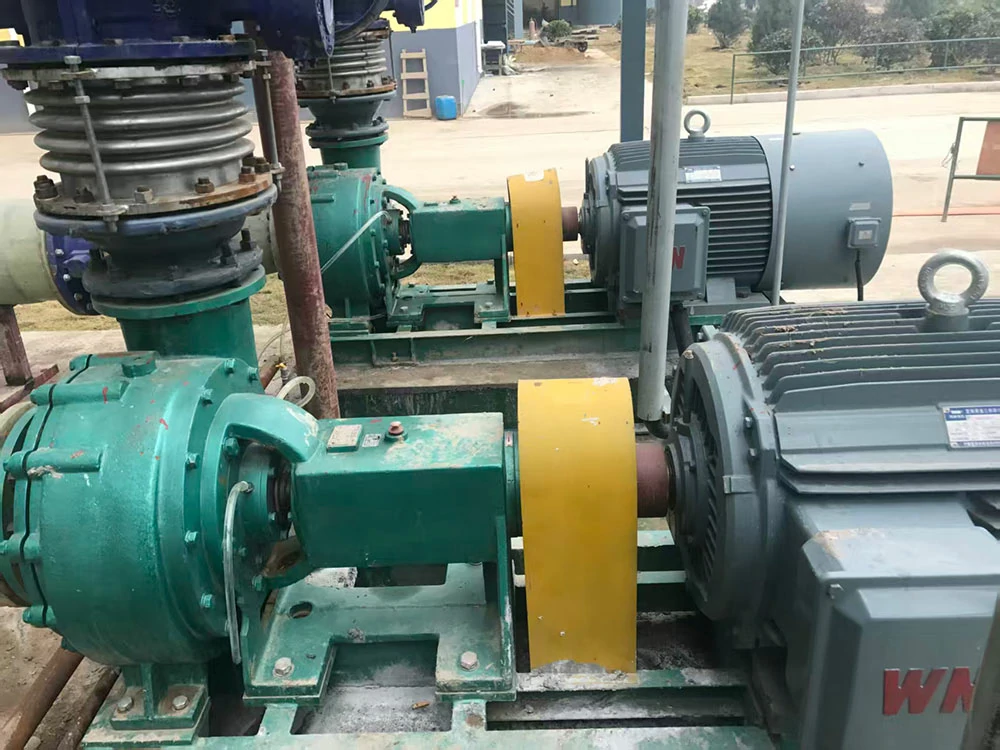
Engineering Analysis: The dual failure mechanism was identified: sulfuric and phosphoric acid corrosion was attacking the grain boundaries of the high-chrome iron, weakening the metal matrix. Gypsum crystals then mechanically eroded this pre-weakened surface, producing material loss rates far exceeding what either corrosion or abrasion would generate independently.
Solution Deployed: Changyu Pump replaced the high-chrome iron pumps with UHB Series UHMW-PE lined pumps. The solution addressed the dual failure mechanism through three coordinated changes:
- Eliminating the corrosion path: The UHMW-PE lining prevented acid contact with the pump casing entirely, removing the corrosion component from the wear equation.
- Absorbing particle impact: The 8–20 mm UHMW-PE lining absorbed gypsum crystal impact energy, reducing the mechanical erosion rate on the wetted surfaces.
- Eliminating seal water consumption: A cartridge mechanical seal design replaced the gland seal, removing the seal water requirement and eliminating dilution of the process stream.
Quantified Results (24-month evaluation):
- Impeller replacement interval extended from 4–5 months to over 18 months—a 300%+ improvement
- Annual per-pump maintenance cost reduced by approximately 58%
- Unplanned downtime related to pump failures reduced by over 70%
- Seal water consumption eliminated through cartridge mechanical seal design
10. FAQs about High Solids Slurry Pump
Q1: At what solids concentration should I switch from a centrifugal to a positive displacement pump?
A: Generally, centrifugal pumps lose efficiency and experience accelerated wear when solids exceed 40–50% by weight. Above 50%, particularly if the slurry also exhibits non-Newtonian (shear-thinning) behavior, PD pumps—progressive cavity, peristaltic hose, or diaphragm—become the rational choice. The decisive factors are viscosity and the degree of particle-particle interaction rather than solids concentration alone.
Q2: Why does running a slurry pump at lower speed reduce wear?
A: Erosive wear is proportional to roughly the cube of the particle impact velocity. Reducing pump speed from, say, 1,450 RPM to 1,200 RPM reduces the tip speed by about 17%, but the wear rate reduction can be 30% or more. Slower speed also reduces cavitation risk and allows particles to pass through the pump with fewer wall contacts per unit length traveled. However, reducing speed below the limit deposit velocity (LDV)—the minimum velocity at which solids remain suspended—is counterproductive and leads to settling and pipeline blockage.
Q3: What is the best material for a high-solids slurry pump handling coarse, angular solids?
A: High-chrome white iron (27–35% Cr, 600+ BHN) is the standard material for coarse, angular, sharp-edged solids in neutral-pH slurries. It provides maximum abrasion resistance for mining tailings and ore transport. For combined corrosion and abrasion—common in acid mine drainage or phosphoric acid production—duplex stainless steel or fluoroplastic (UHMW-PE) linings provide superior service life.
Q4: How often should I replace wear parts in a high-solids slurry pump?
A: Replacement intervals depend on solids characteristics, operating speed, and materials selected. In severe mining applications, impellers may require replacement every 3–6 months. In less aggressive service, wear parts can last years with routine maintenance. Establish a baseline by trending impeller clearance, flow rate, and power consumption over time; adjust the impeller clearance when flow drops 5–10% below baseline.
Q5: Can I use a standard centrifugal pump for high-solids slurries?
A: Only if the pump has been specifically designed or modified for the solids regime. Standard centrifugal pumps lack the reinforced casing, enlarged internal clearances, and wear-resistant materials that high-solids service demands. A pump that handles water efficiently at its best efficiency point (BEP) may fail rapidly when asked to move a 60% solids slurry.
Q6: What causes slurry pump seals to fail in high-solids service?
A: The primary failure mechanism is solids ingress between the seal faces. Abrasive particles become trapped in the fluid film and score the seal faces, causing leakage. For high-solids service, expeller seals, gland packing with external flush water, or sealless designs (magnetic drive or peristaltic) are preferred over single mechanical seals.
Q7: How does slurry pH affect material selection?
A: Below pH 4, high-chrome iron corrodes at grain boundaries, and the corrosion-accelerated wear rate can exceed the pure abrasion wear rate by a factor of 2–5. In these conditions, duplex stainless steel or fluoroplastic (UHMW-PE, FEP, PFA) linings provide the combined corrosion-abrasion resistance required.
Q8: How should I specify a slurry pump for a combined corrosion-abrasion duty?
A: Start with a full fluid analysis: pH, chemical composition, solids concentration, particle size distribution, and temperature. Match the material system to the dominant wear mechanism—elastomers (rubber, polyurethane) for impact-dominated wear, high-chrome iron for pure abrasion, and fluoroplastic linings (UHMW-PE, PTFE, PFA) for combined corrosion-abrasion.
11. Expert Recommendations from Changyu Pump Engineers
Drawing on over two decades of experience, Changyu Pump engineers recommend four core criteria for high-solids slurry pump selection:
- Match the pump type to the solids concentration, not just the flow and head. At solids concentrations exceeding 50% by weight, evaluate PD pumps as the primary candidate, regardless of whether a centrifugal pump could theoretically deliver the flow rate.
- Select the material system based on the dominant wear mechanism, not merely on hardness. Impact-dominated wear requires toughness and energy absorption (rubber, polyurethane); sliding abrasion requires hardness (high-chrome iron, tungsten carbide); combined corrosion-abrasion requires fluoroplastic linings or duplex stainless.
- Design for adjustable clearances. A pump with fixed internal clearances is a pump with a predictable end-of-life date. Adjustable wear plates and bearing housing adjustment mechanisms allow clearance restoration and extend service intervals.
- Evaluate total cost of ownership over a three- to five-year horizon, not the purchase price alone. Factor in energy, wear parts, maintenance labor, and the production cost of unplanned downtime. A pump with higher initial cost but substantially longer service life routinely delivers lower TCO.
12. Conclusion: Selecting the Right High Solids Slurry Pump
A high solids slurry pump is an engineered asset, not a commodity. Selecting the right pump requires an integrated assessment of the specific slurry’s solids concentration, particle characteristics, chemical environment, and the operational demands of the application. Centrifugal pumps remain the industry workhorse for the majority of slurry duties, but at high solids concentrations—particularly above 50% by weight—positive displacement technology offers decisive advantages in efficiency, wear life, and operational predictability.
Across all applications, the principles remain consistent: characterize the slurry completely; match the pump type to the solids regime; select materials for the dominant wear mechanism; reduce speed where practical—but always maintain velocity above the limit deposit velocity (LDV); design the system for maintenance access; and evaluate total cost of ownership over a multi-year horizon.
Contact Changyu Pump with your slurry parameters and process requirements. Our engineering team will provide a detailed pump recommendation and quotation tailored to your high-solids application.