
Quick answer: A metallurgy slurry pump handles hot, abrasive, mildly acidic smelter streams. Four variables decide the specification. Slurry temperature: elastomer linings stop at roughly 80 °C. Particle shape: granulated slag fractures into glassy shards that cut rather than round off. Solids specific gravity: metal oxide slurries run 4.2–5.2 and settle within seconds. And pH, which swings between campaigns. High-chrome white iron covers most slag duty, UHMWPE and PFA cover the acid side, duplex stainless sits between them.
Most catalogues treat “metallurgy” as one application. A smelter asks four different things of a metallurgy slurry pump, sometimes within fifty metres of pipe. We have supplied into copper, lead, zinc, nickel and ferroalloy plants, and the failures we get called in to fix are rarely hydraulic. They are material choices made on the wrong assumption — a rubber-lined unit specified from a mill-duty datasheet, a cast iron volute asked to survive a launder flush.
Typical smelter duty ranges
| Parámetro | Typical range | Por qué es importante |
|---|---|---|
| Temperatura de la pulpa | 40–95 °C; granulation 75–95 °C | Sets the lining ceiling — above 80 °C elastomers are out |
| Solids by weight | 5–50 %; slag granulation 10–30 % | Drives wear rate and settling velocity |
| Tamaño de partícula | d50 0.05–8 mm; cleanout lumps to 100 mm | Decides impeller passage and impact tolerance |
| Solids SG | 2.6–3.2 slag; 4.2–5.2 iron and metal oxide | Head and power must be corrected for SG |
| pH | 2–10, frequently swinging | Rules high chrome in or out of acid duty |
What Makes Smelting Duty Different From Leaching Duty
A hydrometallurgy circuit has one enemy: acid. A smelter has three, arriving together.
The particles cut. Granulated slag quenches into glass and fractures with conchoidal breakage — thin, sharp, hard shards. Silica-rich ferrous slag sits around 6–7 on the Mohs scale; fayalite copper slag is similar. Rounded tailings deform a surface; these shards slice it. Rubber resists indentation and rebound far better than a sharp edge dragged across it at 3 m/s, which is why a lining that gives three years in a tailings line can be cut through in a slag launder. Composition shifts with furnace and campaign, so Euroslag publishes chemistry ranges rather than a single slag specification — worth checking before you treat one plant’s experience as another’s.
The slurry is hot. Granulation water recirculates through cooling towers and returns to the granulation box, so the pump normally sees 60–95 °C, not ambient. Rubber’s ceiling is about 80 °C; above that it takes compression set and the lining-to-casing bond becomes the weak point.
The chemistry drifts. Granulation water runs near neutral, but acid plant weak acid, scrubber blowdown and converter hood wash can drop to pH 2–4 during an upset. Any material relying on a passive oxide film will pit in a weekend of that.
Then add density. Slag slurry runs 1.3–1.6 SG; metal oxide slurry runs higher, because the solids themselves are heavy. This is where sizing most often goes wrong — pump chosen from a water curve, motor chosen from the water power, and the first hot weekend tells the story.
Four Streams, Four Different Pumps
1. Furnace slag and granulation slurry
Slag tapped at 1,450–1,700 °C is quenched, screened, and the fines report to a settling sump. The metallurgy slurry pump on this stream moves 10–30 % solids at 75–95 °C with d50 in the millimetre range. Wear is cutting erosion at the volute throat and impeller discharge, plus impact at the suction eye from a lump that got past the screen.
This is high-chrome territory — hypereutectic white iron in the Cr26–Cr28 range at 58–63 HRC, with 25–40 mm of section at the throat so wear allowance is designed in rather than discovered. We set the impeller passage wide relative to the duty point; a slight efficiency sacrifice buys far fewer blockages.
2. Skull, scale and launder cleanout
Every smelter has a stream nobody puts on the P&ID: the washdown. Launders get flushed, ladles cleaned, scale pits dug out, and the slurry carries lumps to 100 mm plus tramp steel. Impact wear, not abrasion, is the failure mode — and a blockage costs more than a liner. Here we argue for a vertical sump pump with an oversized suction, or a horizontal unit with a large-passage semi-open impeller and clean water flush at the gland.
3. Converter and hood dust slurry
Converter off-gas washing produces a fine slurry (d90 usually under 150 µm) that is acidic from SO₂ and SO₃ absorption — pH 2–5 is common. The failure mode flips: this is corrosion-erosion, not abrasion. Fine acidic solids polish away corrosion product and expose fresh metal, so a static coupon test is optimistic by a factor of two or three.
Duplex stainless (2205/2507) or a PFA-lined casing is the usual answer, provided the PFA is anchored properly. Our CYG series uses a moulded 8–20 mm PFA lining sintered into a steel body, which avoids the cracking that plagues loosely bonded liners.
4. Metal oxide slurry
Iron oxide dust, TiO₂ calciner slurry, zinc fume wash, mill scale: fine, dense, fast-settling. Iron oxide runs about 5.2 SG, TiO₂ about 4.2. A 30 % by weight iron oxide slurry has an approximate SG of 1.32, assuming iron oxide SG 5.2 and water SG 1.0, and settles several times faster than silica at the same concentration.
Two consequences. Size on real SG, not 1.0 — a 45 m duty at SG 1.9 draws almost twice the water power. And keep line velocity above carrying velocity, typically 1.8–2.5 m/s, or you build a plug in the horizontal run and then cook the pump clearing it.
Material Selection for Metallurgy Slurry Pumps
| Material | Dureza | Temp ceiling | Ideal para | Weak against |
|---|---|---|---|---|
| High-chrome white iron (Cr26–28) | 58–63 HRC | 200 °C+ | Slag, scale, coarse angular solids | pH below 4 without alloy upgrade |
| Revestimiento de caucho natural | 40–55 Shore A | ~80 °C | Fine rounded solids, acid slurry | Sharp shards, large lumps, hot duty |
| UHMWPE, steel-backed | ~50 Shore D | ~90 °C | Acid slurry, fine low-impact solids | Coarse angular particles, tramp metal |
| PFA / PTFE lining | — | 160–180 °C | Hot acid, chloride, HF | Coarse abrasion; needs rigid backing |
| Duplex 2205/2507 | 25–30 HRC | 250 °C+ | Acid and abrasion together | Severe cutting wear alone |
| Alumina ceramic inserts | 1,200+ HV | 400 °C | Low-angle erosion, fine hard solids | Impact above 1–2 mm particles |
Hardness is one input, not the answer. The same silica that scores 7 on Mohs is a respiratory hazard, and OSHA’s crystalline silica rule shapes how slag and dust handling areas are ventilated and maintained — occasionally the reason a wet transfer route is chosen over a dry one.
The matrix is not a menu. Every row has a condition where it wins and one where it fails early, and specifying a metallurgy slurry pump means finding which condition the stream is in. We covered the mechanics, including the hardness–toughness trade-off and the five wear mechanisms, in our wear-resistant slurry pump material and selection guide.
For smelter slag the ranking is blunt: high chrome first, ceramic inserts second (only if the screen is reliable), duplex third (only if pH forces it), elastomer last. For converter dust the order reverses.
Temperature Is the Constraint Most Specifications Miss
We are sent more bad datasheets over temperature than any other line.
The 80 °C figure for rubber is not a marketing number. Above roughly 80 °C, natural rubber in a slurry lining takes permanent compression set, hardness climbs, resilience falls, and the adhesive bond to the casing becomes the limiting component. A lining bonded at 20 °C will disbond at 90 °C within a few thousand hours, and the failure looks like a manufacturing defect when it is a metallurgy slurry pump specification error.
Three rules. Ask for the temperature at the pump flange, not at the tap — a granulation circuit can run 95 °C at the launder and 62 °C at the pump after the cooling tower. Derate the seal with the lining: above 80 °C default to a double mechanical seal or a K-type dynamic seal with clean water. And respect thermal growth, because the coupling alignment set cold is not the alignment in service.
Check NPSH at temperature too. Water at 90 °C has a vapour pressure near 70 kPa, which removes most of the margin on a short suction line.
Sizing: Three Corrections That Change the Answer
Correct for specific gravity. Shaft power follows slurry density:
P (kW) = Q (m³/h) × H (m) × SG ÷ (367 × η)
A 200 m³/h duty at 45 m, SG 1.55, efficiency 0.72, gives 200 × 45 × 1.55 ÷ (367 × 0.72) = 52.8 kW. Fit a 75 kW motor, not a 55 kW one — the next frame up is cheap next to a rewind and a lost production day.
Do not read the water curve as the slurry curve. Slurries produce less head than water at the same impeller speed and flow, and the gap widens with concentration and particle size. The Hydraulic Institute standard for rotodynamic centrifugal slurry pumps sets out the correction method.
Keep line velocity above carrying velocity. For dense oxide solids, 1.8–2.5 m/s horizontally; for slag granulation slurry, 2.5–3.5 m/s. Below that the line plugs and the metallurgy slurry pump runs out on its curve until something overheats.
Configuration Choices That Decide Maintenance Cost
Double casing. An outer pressure casing with replaceable inner liners lets the wet end be changed without breaking pipe — measured in shutdown days per year across a battery of units.
Impeller type. Semi-open handles coarse solids and resists a lodged particle jamming the eye. Closed is more efficient on fine duty, but never put one on a stream carrying lumps.
Disposición de las juntas. Packing is cheap but leaks, which is unacceptable near a hot launder. An expeller seal needs no flush water and tolerates grit, but stops working if the pump runs back. A mechanical seal is the default for hot or toxic duty, and its reliability depends on whether the flush is clean.
Motor margin. 15–20 % above calculated shaft power, because oxide density varies between campaigns and slag circuits surge when a furnace is tapped.
Which Changyu Metallurgy Slurry Pump to Start From
Nuestro metallurgy and smelting pump solutions page maps the full range to process streams. For the four duties above, these are the starting points.
Slag, scale and coarse tailings — high chrome.
El PGY series horizontal slurry pump uses a double casing with wetted parts in BTMCr27, BTMCr28 or BTMCr33, discharge 40–400 mm, head to about 100 m, rated for slag slurry and mill scale. For long-distance high-head duty, the PHH series centrifugal slurry pump covers 16.2–1,008 m³/h and 20–97 m.
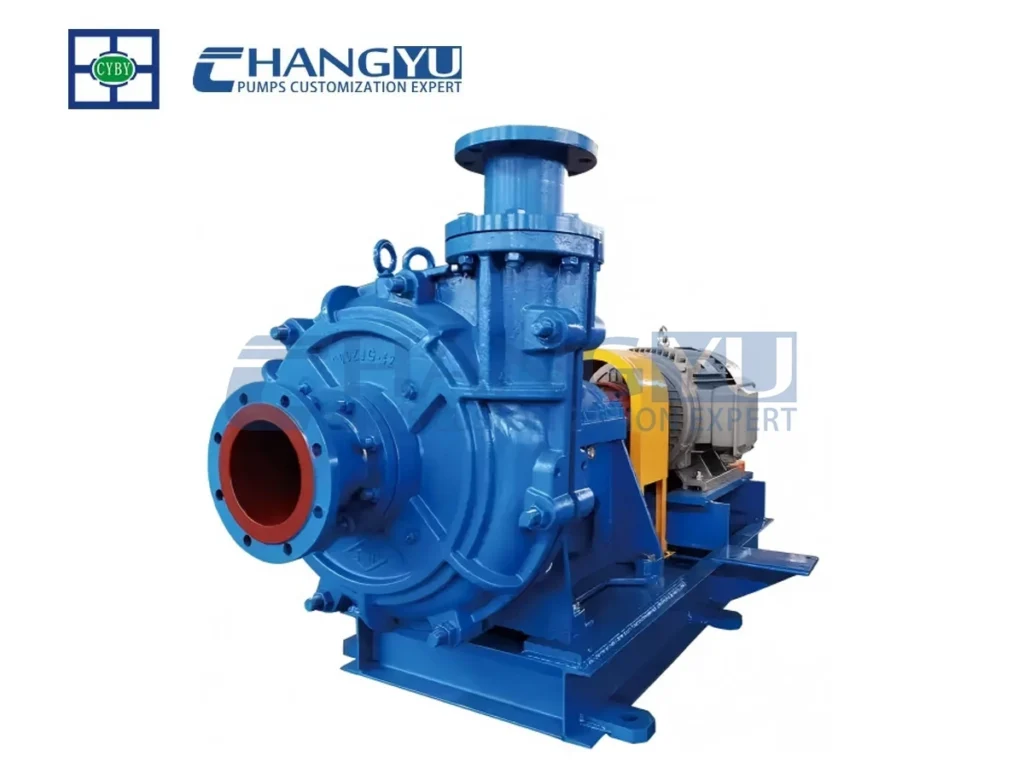
Bombas horizontales para lodos de la serie PGY | Bomba de alta presión para servicio pesado
Hot acid slurry with fine solids — PFA lined.
El CYG series high-temperature chemical mortar pump carries an 8–20 mm moulded PFA lining on a steel body, rated to 180 °C and 40 % solids, with a semi-open impeller. This is what we specify for converter hood wash where high chrome would pit.
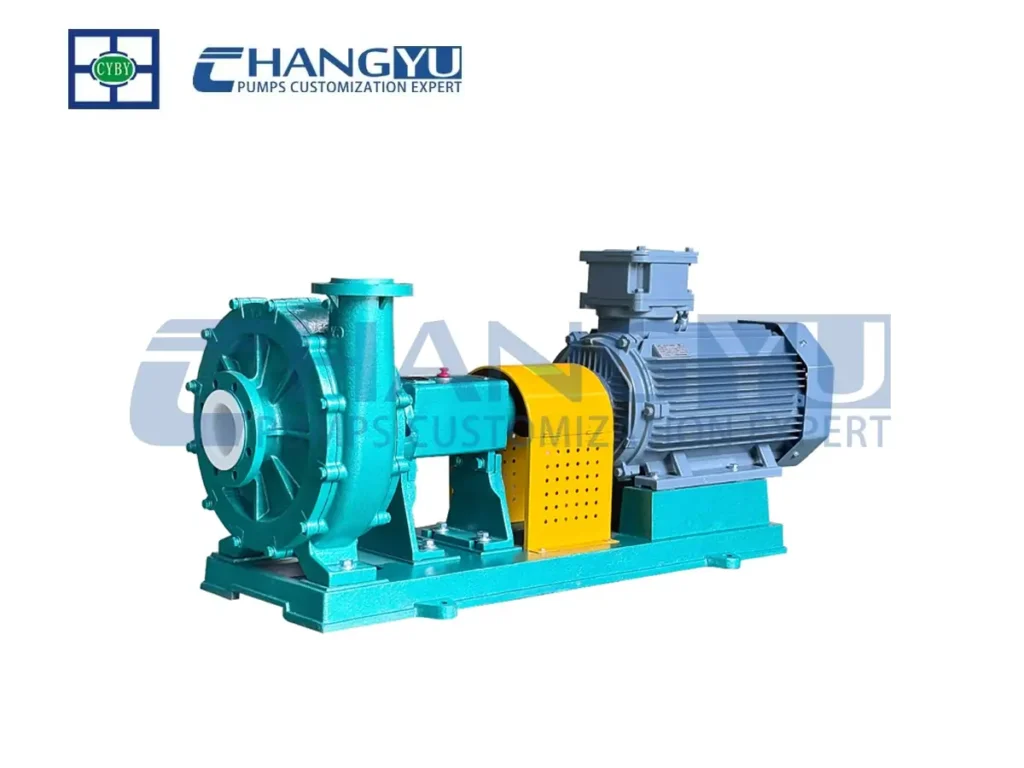
Bomba química para altas temperaturas de la serie CYG
Acid slurry, fine abrasives, moderate temperature — UHMWPE.
El UHB series abrasive slurry pump uses a steel-backed UHMWPE lining of 8–20 mm, 3–2,600 m³/h, to 100 m head, −20 to 90 °C; the Bomba resistente a la corrosión de UHMWPE is the same steel-lined construction in its chemical-duty build. Nine times the wear resistance of carbon steel in fine-particle acid slurry is the claim we make, and it holds where impact load is low.
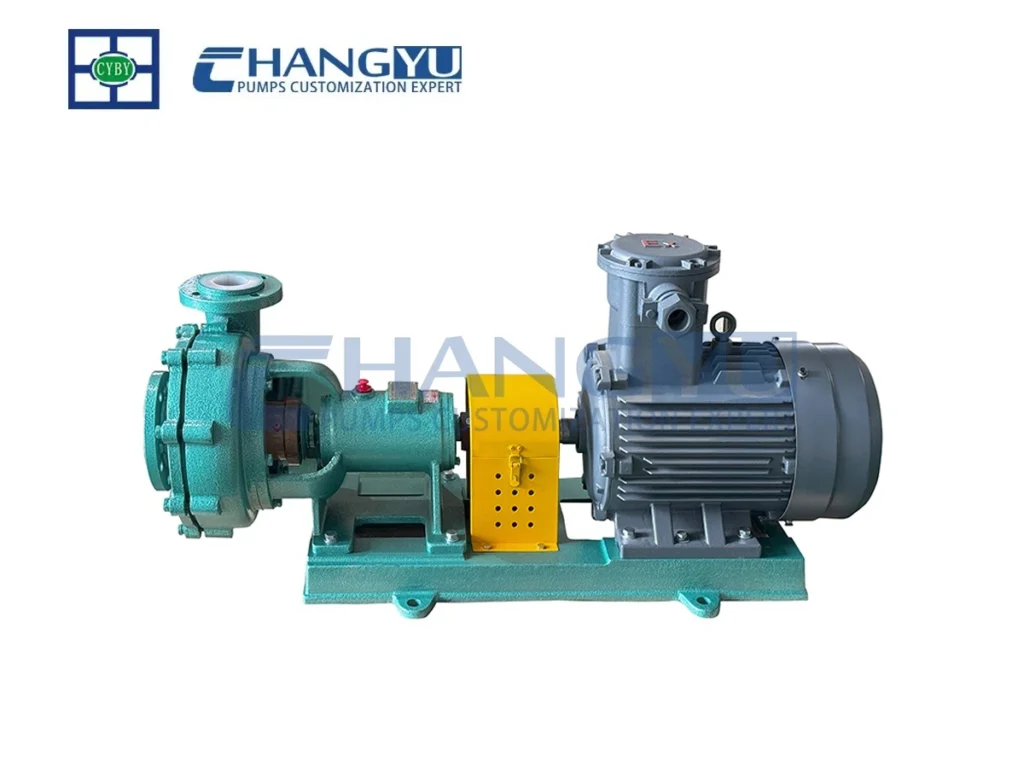
Bomba para lodos abrasivos de la serie UHB
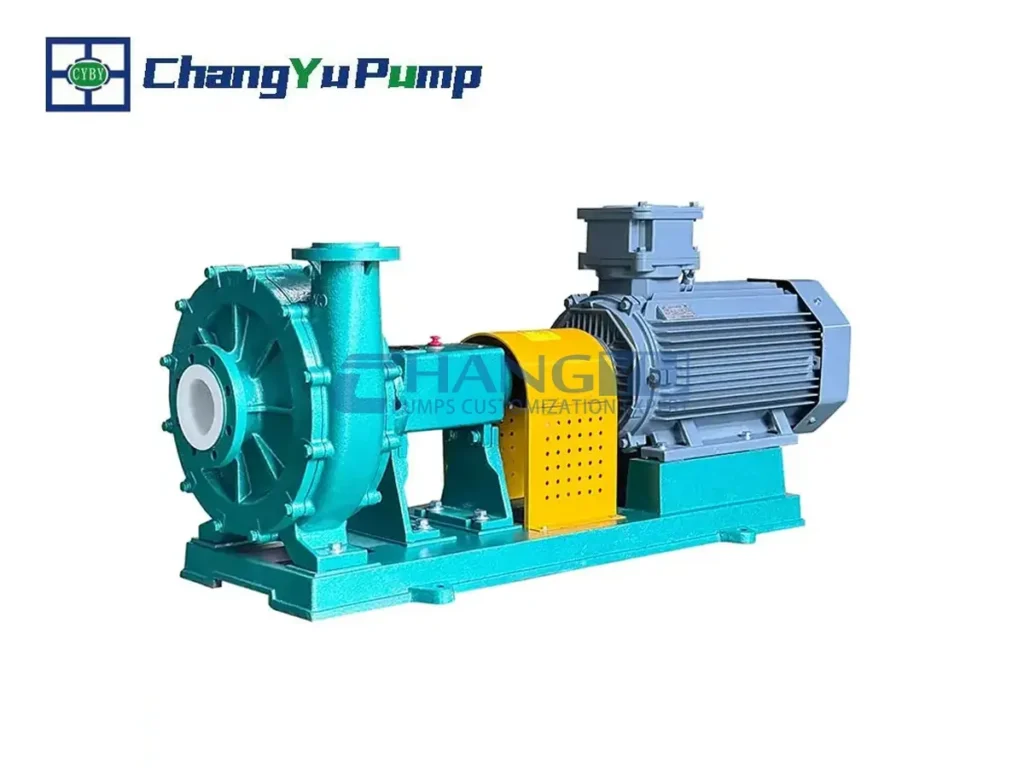
Bomba resistente a la corrosión de polietileno de peso molecular ultra alto (UHMWPE) serie UHB
Hot abrasive slurry where a polymer lining has already failed.
El HB series stainless steel slurry pump is a single-piece stainless casting with no lining to disbond, rated to 120 °C in 304/316L/2205/2507. When a lined pump has blistered twice in the same service, that is the signal.
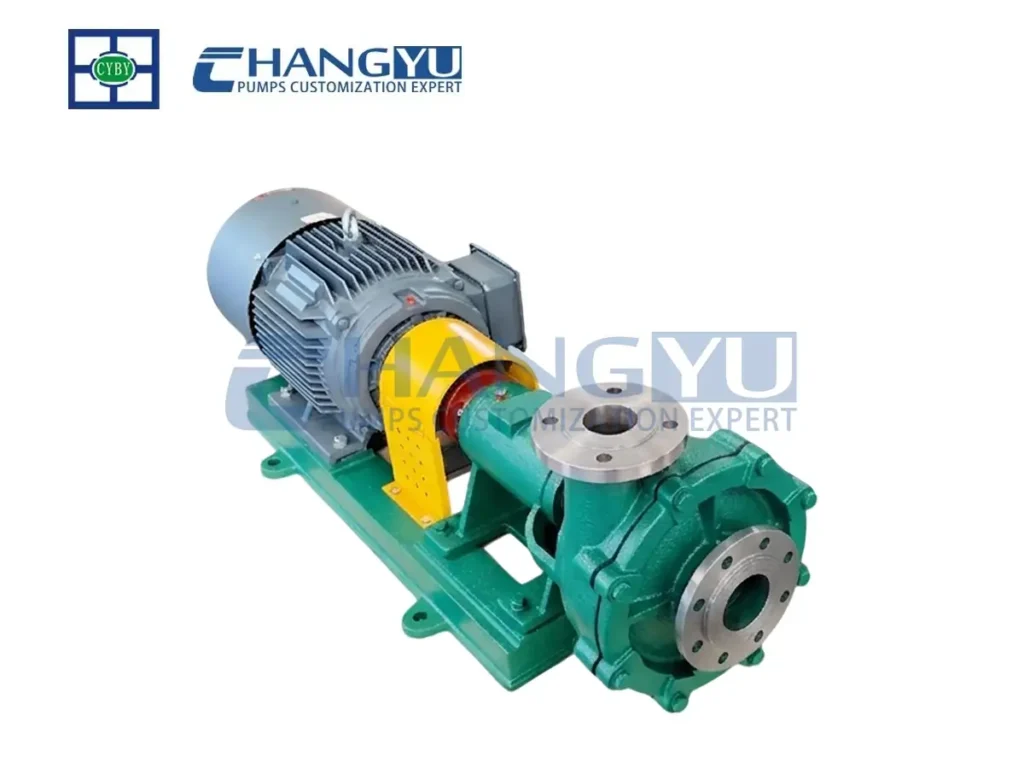
Bomba para lodos abrasivos | Fabricante de bombas para lodos de acero inoxidable de la serie HB
Corrosive and abrasive at once. El corrosion-resistant horizontal slurry pump y el bomba horizontal de lodos químicos sit between the slurry and chemical ranges.
Send us the duty point and we will tell you which of these we would put on it — and which we would not.
Correo electrónico: [email protected]
TEL/WA: +86-13651913727
Inside Our Factory
Anhui Changyu Pump & Valve Manufacturing Co., Ltd. has built industrial pumps since 2006, in a 20,000 m² plant at the Jingxian Development Zone, Xuancheng, Anhui. Around 100 people produce more than 20,000 units a year across 14 series, roughly a fifth of them for the United States, Europe, South Africa and Southeast Asia. Slurry pump wet ends are cast to our own patterns and machined on CNC and gantry centres. Every batch is checked by XRF on incoming metal, hardness testing on wear parts, spark testing on lining coverage, and G2.5–G6.3 dynamic balancing on each impeller, then run through a 24-hour hydro test before shipment. Certification is ISO 9001, CE and ATEX.
Preguntas frecuentes
P: Can I run a rubber-lined metallurgy slurry pump on smelter slag?
R: Only if the flange temperature stays below about 60 °C and the particles are fine and rounded. Granulated slag fails both tests: it arrives at 75–95 °C and fractures into sharp glass.
P: What solids concentration can these pumps handle?
R: Most of our horizontal slurry pumps pass 60 % solids by weight with the right impeller and motor margin. Practically, slag granulation runs 10–30 % and oxide slurries 20–50 %. Above 40 %, carrying velocity becomes the constraint, not wear life.
P: Why does my slag pump impeller fail in six to eight weeks?
R: Three causes, in order of frequency: the material is not hard enough for the shard shape, the pump runs off its best efficiency point raising local velocity at the throat, or the upstream screen has failed. The wear pattern identifies which — send us the impeller.
P: How do I size a pump for metal oxide slurry that keeps settling in the line?
R: Size on real specific gravity — iron oxide slurry at 30 % solids by weight is approximately 1.32 SG, assuming solids SG 5.2 — and hold horizontal velocity at 1.8–2.5 m/s. If turndown is large, a recirculation line back to the sump is cheaper than a bigger pump.
P: Is high chrome better than ceramic for slag service?
R: Usually yes. Alumina ceramic resists low-angle erosion extremely well but is brittle, and one 10 mm lump at the wrong angle cracks a tile. High-chrome white iron at 58–63 HRC tolerates that impact.
P: What seal should I use on hot slag slurry?
R: Above 80 °C, a double mechanical seal with SiC/SiC faces and a clean cool flush, or a K-type dynamic seal where flush quality cannot be guaranteed. Packing is not appropriate near a hot launder.
P: Can a UHMWPE pump handle slag?
R: Not granulated slag. UHMWPE is excellent against fine-particle sliding abrasion in acid, poor against coarse angular impact.
P: How much spare motor capacity should I allow?
R: 15–20 % above calculated shaft power at design SG. If density varies by more than 15 %, size for the top of the range or fit a VFD.
Talk to Us About Your Duty
If you are replacing a pump that failed early, the most useful thing to send is a photo of the failed part plus the duty point — flow, head, temperature, solids concentration, particle size and pH. We can usually name the wear mechanism from the pattern and tell you what to change, whether or not you buy the replacement from us.
Call +86-13651913727, message us on WhatsApp at the same number, or email our engineering team. We answer within 24 hours, and we will say plainly if your existing metallurgy slurry pump specification is already the right one.
Correo electrónico: [email protected]
TEL/WA: +86-13651913727
The Short Version
A metallurgy slurry pump is not a mill pump with a different nameplate. Smelter streams combine heat, glassy angular solids and drifting pH, so the specification has to be built around the stream rather than the catalogue page. Match the lining to temperature first, material to particle shape second, correct the hydraulics for real specific gravity third, and size the motor for the worst campaign. Do that and the pump becomes uninteresting — which is what a smelter wants from it.