
Réponse rapide
Un Pompe à boues d'électroplacage est une pompe de transfert chimique conçue pour traiter les eaux usées contenant des acides mixtes, des métaux lourds et des solides générées par l'électroplacage et les processus de finition de surface. Trois facteurs de sélection clés :
- Compatibilité des matériaux: Les composants en contact avec le fluide doivent résister aux acides mixtes (chlorhydrique, sulfurique, chromique, nitrique et fluorhydrique) sur une large plage de pH tout en supportant l'usure abrasive des solides d'hydroxyde métallique. UHMW-PE offre un équilibre efficace entre résistance chimique et tolérance à l'abrasion pour de nombreuses applications de boues d'électroplacage. Le PFA/PTFE est requis pour les mélanges d'acides à haute température ou fortement oxydants.
- Sélection du type de pompe: Les pompes centrifuges avec roues ouvertes ou semi-ouvertes gèrent la majorité des tâches de transfert de boues d'électroplacage. Les pompes à membrane pneumatiques servent pour les applications d'alimentation de filtres-presses à haute teneur en solides. Les pompes à entraînement magnétique éliminent les fuites au niveau de la garniture d'étanchéité pour les flux d'eaux usées hautement toxiques, comme les eaux de rinçage contenant du cyanure.
- Étanchéité et sécurité: Les garnitures mécaniques doubles avec fluide barrière ou les accouplements à entraînement magnétique traitent les voies de fuite que les garnitures simples peuvent ne pas protéger de manière fiable lors de la manipulation de fluides acides chargés de métaux lourds. Les systèmes de rinçage des garnitures aident à prévenir la cristallisation au niveau des faces d'étanchéité pendant un fonctionnement intermittent.
Les eaux usées d'électroplacage combinent plusieurs défis agressifs que les pompes industrielles standard ne peuvent pas supporter. Les acides mixtes — incluant souvent chlorhydrique, sulfurique, chromique et fluorhydrique — attaquent les métaux et dégradent les polymères conventionnels. Les métaux lourds dissous (nickel, chrome, cuivre, zinc) précipitent sous forme d'hydroxydes solides lors du traitement des eaux usées, créant une boue abrasive qui accélère l'usure des composants internes de la pompe. Une pompe spécifiée sans tenir compte de cette attaque chimique et mécanique combinée peut tomber en panne en quelques semaines à quelques mois — non pas en raison d'un défaut de fabrication, mais d'une inadéquation fondamentale entre les matériaux de la pompe et les propriétés corrosives et érosives du fluide.
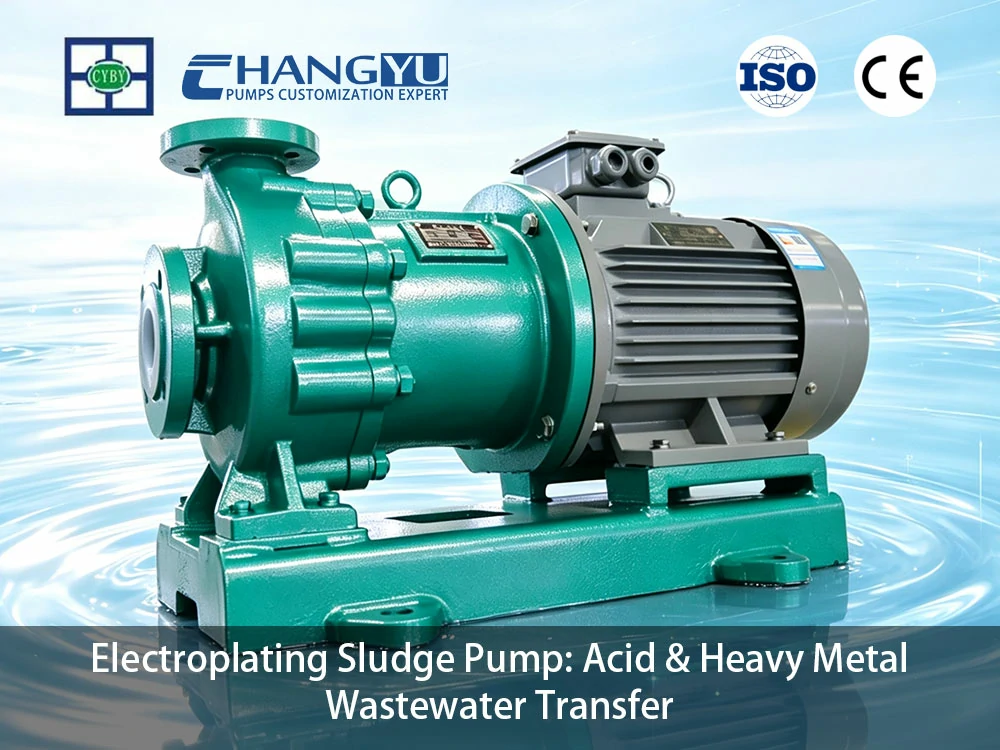
Pompe Changyu fabrique des pompes résistantes à la corrosion pour le traitement chimique, l'électroplacage et le traitement des eaux usées dangereuses depuis plus de deux décennies. Ce guide fournit le cadre structuré pour la sélection des pompes à boues d'électroplacage — du type de pompe et de la compatibilité des matériaux à la technologie d'étanchéité et aux pratiques de maintenance.
Pourquoi les Boues d'Électroplacage Détruisent les Pompes Standard
Comprendre la composition unique des eaux usées d'électroplacage est le fondement d'une spécification correcte de la pompe. Le fluide entrant dans une pompe de transfert de boues n'est pas un seul produit chimique — c'est un mélange complexe avec plusieurs mécanismes de dégradation simultanés.
La Triple Menace : Corrosion, Abrasion et Cristallisation
Corrosion chimique due aux acides mixtes :
Les processus d'électroplacage utilisent une gamme d'acides pour le dégraissage, le décapage et le placage. Les solutions de bains usés et les eaux de rinçage les combinent en un flux d'acides mixtes. Contrairement à une application à acide unique où la sélection des matériaux est simple, les acides mixtes peuvent présenter des effets synergiques — un matériau résistant à l'acide sulfurique seul peut se dégrader rapidement lorsque l'acide nitrique est également présent. Le pH des eaux usées d'électroplacage varie considérablement, d'un acide fort (pH 10) dans les eaux de rinçage de dégraissage. Les matériaux de la pompe doivent résister à tout ce spectre de pH.
Usure abrasive due aux solides d'hydroxyde métallique :
Lors de la neutralisation des eaux usées, les métaux lourds dissous précipitent sous forme d'hydroxydes métalliques — généralement l'hydroxyde de chrome, l'hydroxyde de nickel, l'hydroxyde de cuivre et l'hydroxyde de zinc. Ceux-ci forment une boue gélatineuse et floculente avec une concentration en solides de 2 à 10 % en poids. Bien que les particules individuelles soient fines et relativement molles, l'effet abrasif cumulatif sur les composants internes de la pompe — en particulier aux extrémités des aubes de la roue et à la langue de la volute — accélère l'usure au-delà de ce que l'environnement chimique seul produirait. Des débris solides occasionnels — supports de placage tombés, sacs d'anodes cassés ou formations de sels cristallins — introduisent des charges d'impact qui peuvent fracturer les matériaux fragiles.
Cristallisation pendant les périodes d'inactivité :
Lorsqu'une pompe à boues d'électroplacage est inactive, le liquide acide s'évapore des faces d'étanchéité et des surfaces mouillées, concentrant les sels dissous. Ces sels cristallisent, formant des dépôts durs qui peuvent bloquer la roue, abraser les faces des garnitures mécaniques au redémarrage et obstruer les petites conduites de rinçage des garnitures. Les pompes en service intermittent — courant dans le traitement des eaux usées où le transfert se fait par lots — sont particulièrement vulnérables à ce mode de défaillance.
Les pompes standard avec des corps en acier inoxydable 316, des volutes en fonte ou des garnitures mécaniques standard sont fondamentalement incompatibles avec l'un de ces trois défis — et les boues d'électroplacage les présentent tous les trois simultanément. L'effet combiné d'un faible pH et d'ions chlorure peut perforer l'acier inoxydable 316 en quelques semaines à quelques mois selon la concentration en acide et la température.
Comment Choisir le Bon Type de Pompe pour les Boues d'Électroplacage
Trois types de pompes servent l'industrie de l'électroplacage, chacun optimisé pour une combinaison spécifique de teneur en solides, d'exigences de débit et de demandes de sécurité. La sélection du type correct est la première décision de spécification — avant les matériaux, avant les garnitures, avant le dimensionnement.
Comparaison des Types de Pompes pour les Boues d'Électroplacage
| Type de pompe | Meilleur pour | Manipulation des solides | Risque de fuite | Applications typiques |
|---|---|---|---|---|
| Pompe centrifuge (roue ouverte/semi-ouverte) | Transfert de boues en vrac, alimentation de filtre-presse, drainage de puisard | Bonne — les roues ouvertes laissent passer les solides jusqu'à 25 mm | Modérée — nécessite une garniture mécanique fiable | Transfert du réservoir de neutralisation au clarificateur ; retour d'eau clarifiée |
| Pompe à membrane pneumatique (AODD) | Alimentation de filtre-presse à haute teneur en solides, transfert par lots intermittent | Excellente — gère les boues pâteuses jusqu'à 50 % de solides | Faible — conception sans garniture ; la membrane isole le fluide | Alimentation de filtre-presse ; déshydratation de puisard ; transfert portable |
| Pompe centrifuge à entraînement magnétique | Transfert sans fuite des eaux usées hautement toxiques | Limitée — nécessite une protection par crépine ; pas pour les boues abrasives. Les particules cristallines dures sont particulièrement dommageables pour les paliers d'entraînement magnétique. | Presque nulle — pas de garniture dynamique | Transfert sans fuite d'eaux usées hautement toxiques |
Limité — nécessite une protection par crépine ; pas pour les boues abrasives. Les particules cristallines dures sont particulièrement dommageables pour les paliers d'entraînement magnétique.
Quasi nul — pas de joint dynamique. Eau de rinçage au cyanure ; solution de chromage ; solution de nickelage.
Arbre de décision pour le choix du type de pompe. Contient des solides élevés (> 10%) ou une boue pâteuse ? → Pompe à membrane pneumatique.
Les pompes AODD gèrent des concentrations de solides qui obstrueraient une pompe centrifuge. La membrane isole le fluide pompé du mécanisme d'entraînement, éliminant les fuites au niveau du joint d'arbre. Cependant, les pompes AODD produisent un débit pulsatoire et ont une efficacité énergétique inférieure à celle des pompes centrifuges — elles sont mieux adaptées aux applications de transfert par lots intermittents. Le fluide est hautement toxique (cyanure, chrome hexavalent) et nécessite une protection renforcée contre les fuites ? → Pompe centrifuge à entraînement magnétique.
Les pompes à entraînement magnétique éliminent complètement le joint d'arbre dynamique, confinant le fluide pompé à l'intérieur d'une enveloppe de confinement statique. Cela offre un niveau de protection supplémentaire pour les solutions d'électroplacage cancérigènes ou hautement toxiques. Cependant, les pompes à entraînement magnétique nécessitent une protection par crépine en amont — les solides dans le fluide pompé endommageront les paliers internes qui sont lubrifiés par le fluide lui-même.
Transfert de boues standard, solides modérés (< 10%), fonctionnement continu ou par lots fréquents ? → Pompe centrifuge avec roue ouverte ou semi-ouverte.
C'est la configuration de travail pour la majorité des applications de boues d'électroplacage. Les roues ouvertes résistent au colmatage par les solides d'hydroxyde mous et laissent passer les petits débris sans dommage. Les composants mouillés doivent être revêtus ou entièrement construits à partir de matériaux non métalliques compatibles — discutés dans le chapitre suivant.
Les ingénieurs de Changyu Pump ont observé à travers des centaines d'installations d'électroplacage : les pompes centrifuges avec roues ouvertes et composants mouillés non métalliques offrent un équilibre efficace de fiabilité, de manutention des solides et de rentabilité pour les tâches de transfert de boues standard. Les pompes à entraînement magnétique sont le choix recommandé pour les applications à haute toxicité et peuvent être spécifiées pour tout service d'électroplacage où l'absence de fuite est une priorité. Les pompes à membrane pneumatiques sont les mieux adaptées lorsque la concentration de boues dépasse la capacité de la pompe centrifuge ou lorsqu'un fonctionnement portable et intermittent est requis.
Quels sont les meilleurs matériaux pour les pompes à boues d'électroplacage ?.
La sélection des matériaux pour les pompes à boues d'électroplacage doit tenir compte des effets combinés de la corrosion par acides mixtes, de l'usure abrasive par les solides d'hydroxyde et — pour les solutions de procédé chauffées — de la température élevée. Le matériau optimal dépend du mélange acide spécifique, de la température de fonctionnement et de la charge en solides.
Pourquoi les métaux échouent dans le service d'électroplacage
| Matériau | Les acides mixtes présents dans les eaux usées d'électroplacage attaquent les métaux par différents mécanismes. L'acide chlorhydrique provoque une corrosion par piqûres et une corrosion générale dans les aciers inoxydables. L'acide sulfurique attaque la fonte et l'acier au carbone. L'acide nitrique, un oxydant fort, accélère le taux de corrosion de la plupart des métaux. L'acide chromique passive initialement l'acier inoxydable mais provoque une corrosion intergranulaire au niveau des soudures et des zones affectées par la chaleur. L'effet combiné est une perte de métal rapide et imprévisible. | L'acier inoxydable 316 — souvent spécifié à tort pour un "service chimique" — peut se perforer en quelques semaines à quelques mois dans un service d'eaux usées d'électroplacage. Sa teneur en molybdène offre une certaine résistance aux piqûres, mais la combinaison d'un faible pH, d'acides oxydants et d'ions chlorure submerge sa couche passive. Le Hastelloy C-276 offre une résistance améliorée à certains acides mais à un coût qui dépasse la plupart des alternatives non métalliques sans offrir d'avantage compensatoire dans un service d'acides mixtes d'électroplacage. | Matrice de compatibilité des matériaux pour les boues d'électroplacage | HCl (37%) | H₂SO₄ (98%) | Temp. max. | Résistance à l'abrasion | Recommandation |
|---|---|---|---|---|---|---|---|---|
| 316 SS | ❌ | ❌ | ❌ | ❌ | ❌ | N/A | N/A | HNO₃ (68%) |
| PP | HF (49%) | CrO₃ (50%) | ❌ | Ne pas utiliser | ❌ | 150°C+ | Pauvre | ✅ (TA seulement) |
| PVDF | ✅ (dilué, TA) | ✅ (TA) | Non recommandé — limites de température et d'oxydation | ✅ (dilué, TA) | ❌ | 90°C | Modéré | ✅ (jusqu'à 40°C) |
| ✅ (jusqu'à 90%) | ✅ | ✅ | ✅ | ✅ | ✅ | 120–180 °C | ⚠️ (limité, dépendant de la température) | Bon pour un service acide général sans oxydants forts |
| UHMW-PE | ✅ | PFA/PTFE | Faible (mou) | ✅ (dilué, TA) | Résistance chimique la plus large ; nécessite une protection contre les solides | 90°C | Excellent | ✅ (jusqu'à 80%) |
| Hastelloy C-276 | ✅ (dilué, TA) | ✅ | ✅ (jusqu'à 20%) | ❌ | ✅ | ✅ (dilué) | Bon | Équilibre efficace — résistance chimique + protection contre l'usure |
❌ (résistance limitée au-dessus d'une concentration de 20%)
| 40°C | Acceptable pour certains acides mais le coût dépasse les options non métalliques ; pas pour HNO₃ ou HF | Teneur en solides | Température | Matériau recommandé |
|---|---|---|---|---|
| Sélection des matériaux par application d'électroplacage | Procédé d'électroplacage | Faible à modéré | Ambiant | UHMW-PE |
| Acides présents | Eaux usées mixtes générales | Faible | Ambiant à chaud | HCl, H₂SO₄ (dilué) |
| Chromage | CrO₃, H₂SO₄ | Faible | PFA/PTFE (l'acide chromique attaque le PE) | Nickelage |
| H₂SO₄, HCl (trace) | Chaud (40–60°C) | Faible à modéré | Ambiant à chaud | PVDF ou PFA |
| Décapage acide | HCl, H₂SO₄, HF | Modéré à élevé | Ambiant | UHMW-PE |
| Eaux usées contenant du cyanure | UHMW-PE ou PFA (si HF présent) | Faible | Ambiant | Neutralisation des boues |
Mixte (pH 2–12).
Alcalin (pH 9–11)
PVDF ou PFA (marge de sécurité renforcée).
Les ingénieurs de Changyu Pump ont observé à travers des centaines d'installations de pompes d'électroplacage : l'UHMW-PE offre systématiquement un équilibre efficace de résistance chimique, de tolérance à l'abrasion et de rentabilité pour la majorité des applications de boues d'électroplacage mixtes. Sa combinaison d'une large résistance aux acides, d'une protection contre l'usure due aux solides d'hydroxyde et d'une capacité de température ambiante à chaude couvre l'enveloppe opérationnelle standard de la plupart des systèmes de traitement des eaux usées d'électroplacage. Pour les solutions de placage à haute température au-dessus de 60°C, les mélanges d'acides fortement oxydants (chromique, nitrique fumant), ou les applications de pompe à entraînement magnétique sans fuite, le revêtement PFA/PTFE est le choix approprié. Les pompes métalliques — y compris en acier inoxydable ou Hastelloy — ne sont pas recommandées pour le service de boues d'électroplacage. L'environnement chimique est trop agressif et trop variable pour que les matériaux métalliques offrent une durée de vie fiable.
Comment prévenir le colmatage dans les pompes à boues d'électroplacage
Une roue ouverte possède des aubes fixées directement au moyeu sans blindage avant. Cette conception offre le plus grand passage libre pour les solides et permet aux matériaux fibreux ou cohésifs de passer sans points d'ancrage où une accumulation peut commencer. Les roues ouvertes gèrent les solides d'hydroxyde mous et gélatineux typiques des boues d'électroplacage sans colmatage. Le compromis est une efficacité hydraulique inférieure (50–60 %) par rapport aux conceptions fermées. Pour le transfert de boues d'électroplacage, cette pénalité d'efficacité est négligeable par rapport à la fiabilité opérationnelle gagnée.
Roues Semi-Ouvertes :
Un blindage partiel sur un côté des aubes offre un compromis entre la capacité de manutention des solides d'une roue ouverte et l'efficacité d'une conception fermée. Les roues semi-ouvertes conviennent aux boues d'électroplacage avec une faible teneur en solides (< 5 %) ou lorsque une certaine efficacité de pompe est souhaitée.
Roues Vortex (Encaissées) :
La roue est encaissée dans la paroi arrière de la volute, créant un vortex qui aspire le fluide et les solides à travers la pompe. Seule une partie du fluide entre en contact direct avec la roue. Les roues vortex offrent la meilleure résistance au colmatage mais la plus faible efficacité (35–50 %). Elles sont spécifiées pour les applications où le fluide pompé contient de gros débris — sacs d'anodes cassés, fixations de placage tombées — qui pourraient coincer une roue ouverte.
Configuration de Pompe pour la Résistance au Colmatage
- Pompes verticales cantilever éliminent le palier immergé et la garniture mécanique présents dans les conceptions de pompes horizontales. La roue s'étend dans le puisard depuis le dessus, avec le moteur et les paliers situés au-dessus du niveau du liquide. Cette configuration est intrinsèquement auto-vidangeable et résiste à l'accumulation de boues pendant les périodes d'inactivité.
- Pompes horizontales avec de grandes passages d'aspiration (diamètre minimum de 50 mm) réduisent le risque de pontage des boues à l'entrée de la pompe. La tuyauterie d'aspiration doit être conçue avec des coudes à grand rayon et lisses, et éviter toute zone morte où les boues peuvent s'accumuler.
- Raccords de rinçage à l'aspiration et au refoulement de la pompe permettent aux opérateurs de dégager les boues déposées avec de l'eau ou un fluide de procédé propre avant de redémarrer une pompe qui a été inactive.
Comment Concevoir une Pompe à Boues d'Électroplacage pour un Fonctionnement Sûr et sans Fuite
La sécurité dans la conception d'une pompe à boues d'électroplacage englobe trois éléments interdépendants : l'intégrité des matériaux pour éviter la perforation du corps, la technologie d'étanchéité pour prévenir les fuites d'arbre, et les systèmes de surveillance pour fournir un avertissement précoce des problèmes en développement. Chaque élément aborde une voie de défaillance différente.
Comparaison des Technologies d'Étanchéité
| Technologie d'étanchéité | Risque de fuite | Maintenance | Coût | Meilleur pour |
|---|---|---|---|---|
| Garniture mécanique simple | Modéré | 6–12 mois | $ | Applications non critiques ; fluides à faible toxicité |
| Joint mécanique double avec fluide barrière | Faible | 12–24 mois | $$$ | Transfert en service continu d'eaux usées dangereuses d'électroplacage |
| Pompe à entraînement magnétique | Quasi nul | 12–36 mois (dépend des paliers) | $$$$ | Solutions de cyanure, chrome ou nickel où toute fuite est inacceptable |
Prévention de la Cristallisation aux Faces d'Étanchéité
Les solutions d'électroplacage sont sujettes à la cristallisation pendant les périodes d'inactivité. Lorsque la pompe s'arrête, le liquide résiduel aux faces d'étanchéité s'évapore, laissant derrière lui des sels acides concentrés qui cristallisent. Au redémarrage, ces cristaux abrasent les faces d'étanchéité, initiant une fuite qui s'aggrave avec le temps.
Trois stratégies préviennent les dommages par cristallisation :
- Fluide barrière dans les garnitures mécaniques doubles maintient un film liquide sur les deux faces d'étanchéité, empêchant le fluide pompé d'atteindre la garniture extérieure où l'évaporation et la cristallisation se produiraient.
- Plans de rinçage des garnitures mécaniques (Plan API 32 ou Plan 54) délivrent de l'eau propre ou un liquide compatible aux faces d'étanchéité avant, pendant et après le fonctionnement de la pompe, déplaçant le fluide de procédé et empêchant le dépôt de sel.
- Procédures de rinçage avant arrêt — faire circuler de l'eau propre à travers la pompe pendant 2 à 3 minutes avant de l'arrêter — rince l'acide résiduel de la chambre d'étanchéité et empêche la cristallisation pendant les périodes d'inactivité.
Intégrité des Matériaux : Prévention de la Perforation du Corps
Au-delà de l'étanchéité, l'intégrité du corps de pompe est une préoccupation de sécurité dans le service d'électroplacage. Une fuite par piqûre due à la corrosion ou à l'érosion dans un corps de pompe métallique peut passer inaperçue pendant des jours, libérant un fluide acide chargé de métaux lourds dans la salle des pompes ou la zone de confinement. Les pompes à revêtement non métallique — où le corps structurel est protégé par un revêtement chimiquement inerte (UHMW-PE, PFA, PTFE) — éliminent ce mode de défaillance. Le revêtement isole la limite de pression du fluide corrosif, tandis que le corps métallique fournit la résistance structurelle.
Surveillance et Alerte Précoce
- Surveillance de la pression ou du niveau de la chambre d'étanchéité détecte la perte de fluide barrière qui signale une défaillance de la garniture mécanique avant que le fluide pompé n'atteigne l'atmosphère.
- Capteurs de détection de fuite dans la base de la pompe ou le puisard de confinement fournissent une alarme immédiate en cas de libération de fluide.
- Surveillance des vibrations détecte le déséquilibre de la roue dû à l'accumulation de solides ou à l'usure avant que des dommages mécaniques ne se produisent.
Comment Entretenir une Pompe à Boues d'Électroplacage
La maintenance des pompes à boues d'électroplacage diffère de la maintenance standard des pompes chimiques sur un point critique : les effets combinés de la corrosion, de l'abrasion et de la cristallisation exigent une inspection plus fréquente des composants mouillés et un remplacement proactif des pièces d'usure.
Maintenance Programmée pour les Pompes à Boues d'Électroplacage
| Intervalle | Action | Objectif |
|---|---|---|
| Hebdomadaire | Vérifier les fuites visibles, les bruits inhabituels ou les vibrations ; vérifier le débit de rinçage de la garniture mécanique | Détection précoce des problèmes de joint ou de roulement |
| Mensuel | Inspecter le système de rinçage de la garniture mécanique ; vérifier le niveau et l'état du fluide barrière ; contrôler le panier d'aspiration | Empêche la cristallisation de la garniture mécanique et les dommages à la roue dus aux débris |
| Trimestrielle | Inspecter la roue pour l'usure, l'attaque chimique ou l'accumulation de solides ; inspecter le revêtement du corps pour des signes de dégradation | Détecte la dégradation des matériaux avant la perforation du corps |
| Annuellement | Remplacer la garniture mécanique ; remplacer la roue si l'usure dépasse les limites du fabricant | Le remplacement planifié évite les temps d’arrêt imprévus |
| En fonction de l'état | Remplacer les garnitures mécaniques au premier signe de fuite ; remplacer le revêtement si une attaque chimique ou une usure est visible | Traite les problèmes au stade le plus précoce détectable |
Pratiques de Maintenance Critiques
- Rincer après chaque arrêt : Faire circuler de l'eau propre à travers la pompe pendant 2 à 3 minutes avant de l'arrêter déplace l'acide résiduel et les boues du corps, de la roue et de la chambre d'étanchéité. Cette seule pratique prévient la majorité des défaillances de garniture mécanique liées à la cristallisation et de la solidification des boues dans les parties internes de la pompe.
- Inspecter les paniers d'aspiration : Les boues d'électroplacage peuvent contenir des débris — sacs d'anodes déchirés, pièces tombées, fragments de plastique — qui peuvent endommager les roues ou obstruer les petits passages. Les filtres doivent être inspectés et nettoyés mensuellement.
- Surveiller l'état du revêtement : Les revêtements de pompe non métalliques (UHMW-PE, PTFE, PFA) sont chimiquement inertes mais sujets à l'usure mécanique due aux solides abrasifs. Une inspection annuelle de l'épaisseur du revêtement aux points d'usure élevée — extrémités des aubes de roue, langue de volute et col d'aspiration — fournit des données pour prévoir les intervalles de remplacement du revêtement.
- Remplacer les élastomères de manière proactive : Les joints toriques, les joints d'étanchéité et les matériaux de membrane dans le service d'électroplacage se dégradent par attaque oxydative et exposition aux acides. Un remplacement à intervalle de 12 mois est plus rentable qu'un remplacement réactif après défaillance.
Étude de cas sur une pompe à boues d'électroplacage : Résolution d'une défaillance par corrosion acide
Une installation d'électroplacage nickel-chrome dans le sud de la Chine exploitait trois pompes centrifuges horizontales pour transférer les boues neutralisées du système de traitement des eaux usées vers un filtre-presse. Les pompes d'origine étaient spécifiées avec des corps en acier inoxydable 316 et des garnitures mécaniques simples. Les boues étaient composées d'hydroxydes métalliques mixtes (nickel, chrome, cuivre) à une concentration en solides d'environ 5 %, avec une solution acide résiduelle à pH 3–4. La température de fonctionnement était ambiante jusqu'à 40 °C.
Dans les quatre semaines suivant la mise en service, les opérateurs de l'usine ont découvert une fuite du corps de pompe de la pompe de transfert principale. L'inspection a révélé de multiples perforations par piqûres dans la volute en acier inoxydable 316, concentrées dans les zones à faible vitesse où la couche d'oxyde passive avait été attaquée par la solution acide contenant des chlorures. La garniture mécanique simple avait également cédé — le joint torique en EPDM avait gonflé jusqu'à deux fois son diamètre d'origine en raison de l'attaque acide, et des cristaux de sel de chrome avaient rayé les faces d'étanchéité.
L'analyse des causes profondes a identifié une incompatibilité fondamentale des matériaux : l'acier inoxydable 316, bien que résistant à de nombreux environnements chimiques, ne peut pas résister à la combinaison de faible pH, d'ions chlorure et d'ions métalliques oxydants présents dans les eaux usées d'électroplacage. La corrosion par piqûres était le résultat d'une corrosion générale combinée due au faible pH et à la corrosion par piqûres induite par les chlorures, accélérée par la présence d'ions chrome et nickel oxydants. Si la fuite n'avait pas été détectée plus longtemps, les eaux usées chargées de nickel et de chrome auraient contaminé le système de drainage au sol de l'installation.
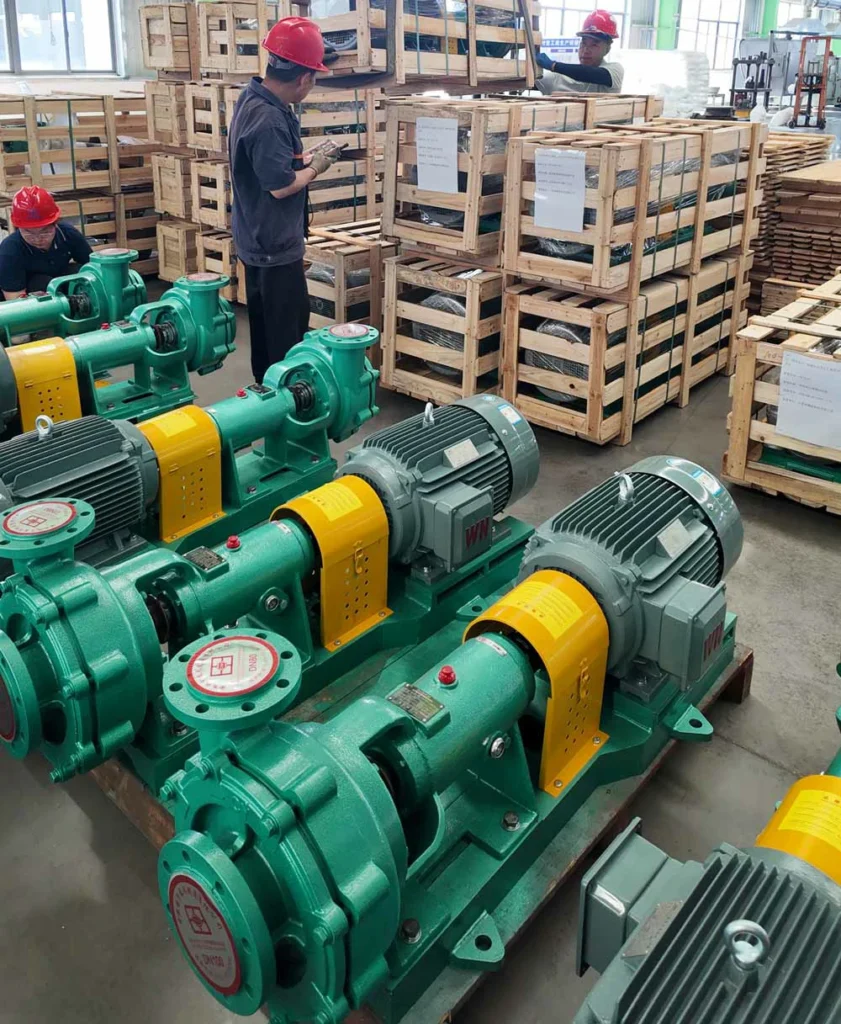
L'installation a remplacé les trois pompes par des pompes de la série Changyu UHB avec des corps revêtus d'UHMW-PE et des roues ouvertes. L'UHMW-PE a été choisi plutôt que le PVDF ou le PFA pour cette application en raison de la charge modérée en solides — la résistance à l'abrasion supérieure de l'UHMW-PE par rapport aux fluoropolymères prolongerait la durée de vie de la roue dans la boue abrasive d'hydroxyde. Des garnitures mécaniques doubles avec joints toriques encapsulés en PTFE ont remplacé les garnitures simples d'origine. Une procédure de rinçage avant arrêt a été mise en œuvre : chaque pompe reçoit un rinçage à l'eau propre de 3 minutes à la fin de chaque transfert par lot.
Sur trois ans de fonctionnement depuis la mise à niveau : aucune fuite de corps, aucun remplacement non planifié de garniture et aucun temps d'arrêt attribué aux pompes de transfert de boues. Le responsable de la maintenance de l'installation a indiqué que le coût de remplacement de la pompe a été récupéré en 8 mois grâce à l'élimination des réparations d'urgence, des coûts de confinement des déversements chimiques et des temps d'arrêt de production.
Key takeaway: L'acier inoxydable 316 n'a pas sa place dans le service des boues d'électroplacage. La combinaison de pH acide, d'ions chlorure et d'ions métalliques oxydants crée un environnement de corrosion qui submerge la couche passive de l'acier inoxydable. Le revêtement en UHMW-PE offre à la fois la résistance chimique à l'environnement acide mixte et la résistance à l'abrasion aux solides d'hydroxyde — une combinaison que les matériaux métalliques ne peuvent égaler.
Solutions de pompes à boues d'électroplacage de Changyu Pump
Changyu Pump propose trois séries de pompes adaptées aux applications de boues et d'eaux usées d'électroplacage, chacune optimisée pour une combinaison spécifique de résistance chimique, de manipulation des solides et d'exigences de sécurité.
Guide de sélection des produits de pompes à boues d'électroplacage
| Application | Solides | Défi primaire | Série recommandée | Caractéristique principale |
|---|---|---|---|---|
| Transfert de boues (en vrac) | Modérée (< 10 %) | Corrosion + abrasion | Série UHB | Revêtement UHMW-PE pour résistance chimique et protection contre l'usure |
| Mélange d'acides fortement oxydants | Faible | Corrosion (acides chromique, nitrique) | Série CYB-ZKJ | Revêtement FEP/PFA ; résiste aux acides oxydants qui attaquent le PE |
| Eaux usées à haute toxicité (cyanure, chrome) | Faible | Sécurité zéro fuite | Série CYQ | Pompe à entraînement magnétique à revêtement PFA ; pas de joint dynamique |
| Solution de placage à haute température | Faible | Chaleur + corrosion | Série CYG | Revêtement moulé en PFA (8–20 mm) ; température jusqu'à 160 °C |
| Alimentation de filtre-presse (solides élevés) | Élevée (> 10 %) | Colmatage + abrasion | Pompe pneumatique à membrane | Conception sans joint ; manipule les boues pâteuses |
Série UHB — Pompe à revêtement UHMW-PE pour le transfert de boues d'électroplacage
Pompe centrifuge en acier revêtu d'UHMW-PE conçue pour les boues corrosives avec des solides fins à modérés. La roue semi-ouverte offre un bon passage des solides, et le revêtement UHMW-PE offre la résistance chimique et la protection contre l'abrasion combinées nécessaires pour les boues d'électroplacage mixtes. Disponible avec garniture mécanique double et système de fluide barrière.
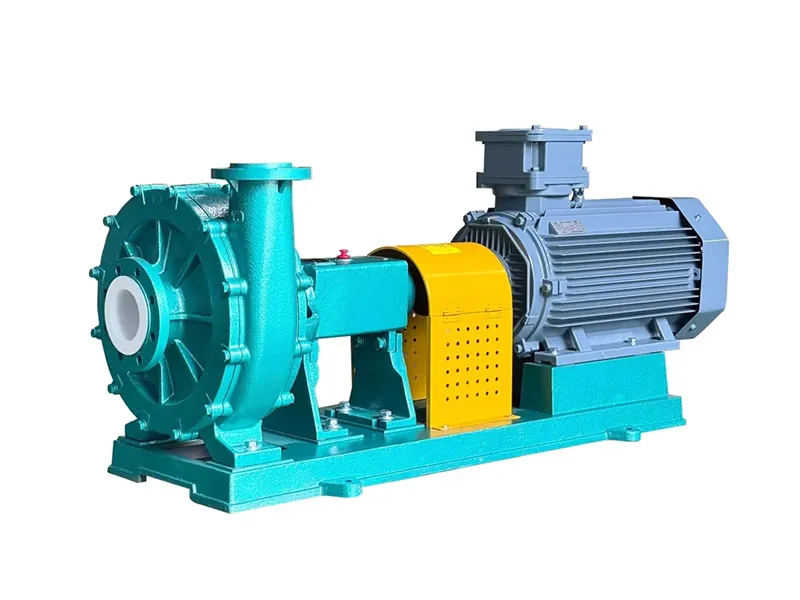
| Paramètres | Spécifications |
|---|---|
| Débit | 3-2 600 m³/h |
| Tête | 5-100 m |
| Puissance du moteur | 0,75-300 kW |
| Vitesse | 750-2 900 r/min |
| Température | De -20°C à 90°C |
| Matière de la doublure | UHMW-PE |
Série CYB-ZKJ — Pompe à revêtement fluoropolymère pour les acides d'électroplacage fortement oxydants
Pompe centrifuge à revêtement FEP/PFA pour les solutions d'électroplacage contenant des oxydants puissants — acide chromique, acide nitrique ou acide sulfurique fumant — qui peuvent dégrader l'UHMW-PE avec le temps. Le revêtement fluoropolymère est chimiquement inerte à tous les acides utilisés en électroplacage. La garniture mécanique double avec fluide barrière assure un fonctionnement fiable et à faible fuite.
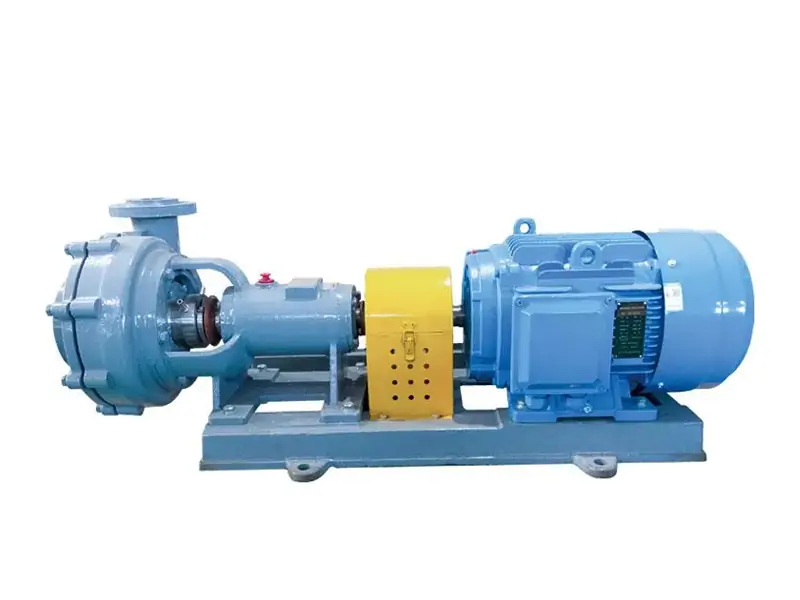
| Paramètres | Spécifications |
|---|---|
| Débit | 3-2 600 m³/h |
| Tête | 5-100 m |
| Puissance du moteur | 0,75-300 kW |
| Température | De -80°C à 120°C |
| Matériaux de revêtement | FEP (standard), PFA (option haute température) |
Série CYQ — Pompe à entraînement magnétique pour le transfert chimique d'électroplacage zéro fuite
Pompe à entraînement magnétique à revêtement PFA conçue pour le transfert sans fuite de solutions d'électroplacage hautement toxiques — eau de rinçage contenant du cyanure, solutions de chrome hexavalent et bains de nickel concentrés. Le couplage magnétique en terres rares élimine complètement le joint d'arbre dynamique. Le revêtement PFA à paroi épaisse offre une inertie chimique sur tout le spectre chimique de l'électroplacage.
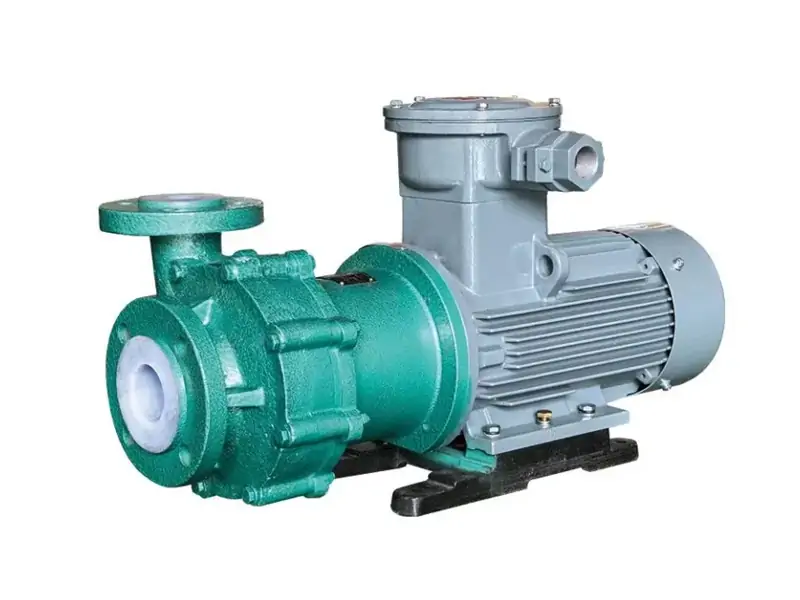
| Paramètres | Spécifications |
|---|---|
| Débit | 3-800 m³/h |
| Tête | 15–125 m |
| Puissance du moteur | 2,2–110 kW |
| Vitesse | 2 950 tr/min |
| Température | De -20°C à 180°C |
| Matériaux de revêtement | FEP / PFA / PTFE |
FAQ sur les pompes à boues d'électroplacage
Q : Puis-je utiliser une pompe en acier inoxydable pour les boues d'électroplaquage ?
R : Non. L'acier inoxydable 316 subit une corrosion par piqûres rapide dans l'environnement acide et chloré des eaux usées d'électroplaquage. Une perforation par piqûres peut survenir en quelques semaines à quelques mois. Utilisez uniquement des pompes à revêtement non métallique — UHMW-PE pour le transfert standard de boues, PFA/PTFE pour les mélanges d'acides fortement oxydants.
.
Q : Quel type de roue est le meilleur pour les boues d'électroplaquage ?
R : Les roues ouvertes ou semi-ouvertes offrent la meilleure résistance au colmatage pour les solides d'hydroxyde métallique gélatineux dans les boues d'électroplaquage. L'absence de voile avant élimine les surfaces où les boues peuvent s'accumuler et offre le plus grand passage libre pour les solides.
.
Q : Comment puis-je prévenir les dommages de cristallisation aux joints de la pompe ?
R : Rincez la pompe à l'eau claire pendant 2 à 3 minutes avant chaque arrêt. Utilisez des joints mécaniques doubles avec fluide barrière. Spécifiez des joints toriques encapsulés PTFE qui résistent à l'attaque acide qui fait gonfler et fuir les élastomères standard.
.
Q : Quand dois-je choisir une pompe à entraînement magnétique plutôt qu'une pompe à joint mécanique ?
R : Choisissez une pompe à entraînement magnétique pour les solutions d'électroplaquage hautement toxiques — eau de rinçage au cyanure, bains de chrome hexavalent, solutions concentrées de nickel — où une protection renforcée contre les fuites est requise pour des raisons de sécurité et d'environnement. Les pompes à entraînement magnétique peuvent également être spécifiées pour tout service d'électroplaquage où une fuite zéro est une priorité.
.
Q : Quel matériau est le meilleur pour les pompes de solution de chromage ?
R : Un revêtement PFA/PTFE est requis. L'acide chromique est un oxydant fort qui peut dégrader l'UHMW-PE et le PVDF avec le temps, en particulier à des températures élevées. Le PFA/PTFE est chimiquement inerte vis-à-vis de l'acide chromique à toutes les concentrations et températures utilisées en électroplaquage.
.
Q : À quelle fréquence dois-je inspecter une pompe à boues d'électroplaquage ?
R : Contrôles visuels hebdomadaires pour les fuites et les vibrations. Inspection mensuelle du système de rinçage des joints et du panier d'aspiration. Inspection trimestrielle de la roue et du revêtement. Remplacement annuel du joint mécanique. Les pompes en service abrasif peuvent nécessiter un remplacement plus fréquent de la roue.
.
Liste de contrôle des mesures de prévention pour les ingénieurs en pompes chez Changyu
- Ne spécifiez jamais de pompe métallique — y compris l'acier inoxydable 316, le Hastelloy ou le titane — pour les composants mouillés des boues d'électroplaquage. L'environnement d'acide mixte et d'ions métalliques oxydants est incompatible avec les matériaux métalliques.
. - Faites correspondre le matériau de revêtement au mélange acide spécifique. UHMW-PE pour les boues d'acide mixte standard. PFA/PTFE pour les acides fortement oxydants (chromique, nitrique) ou les solutions de plaquage à haute température.
. - Sélectionnez des roues ouvertes ou semi-ouvertes pour toutes les applications de boues d'électroplaquage. Les roues fermées se boucheront en raison de l'accumulation de solides d'hydroxyde.
. - Rincez la pompe à l'eau claire pendant 2 à 3 minutes avant chaque arrêt. Cette seule pratique prévient la majorité des défaillances de joints liées à la cristallisation.
. - Installez des paniers d'aspiration et inspectez-les mensuellement. Les boues d'électroplaquage peuvent contenir des débris — sacs d'anodes cassés, fixations tombées — qui peuvent endommager les roues.
. - Spécifiez des joints mécaniques doubles avec fluide barrière et des joints toriques encapsulés PTFE pour toutes les pompes à boues d'électroplaquage en service continu.
. - Pour les solutions de plaquage au cyanure, au chrome ou au nickel, utilisez des pompes à entraînement magnétique pour éliminer complètement la voie de fuite du joint d'arbre.
. - Gardez des roues de rechange, des joints mécaniques, des joints toriques et des joints d'étanchéité en stock. Le service d'électroplaquage dégrade les élastomères plus rapidement que les autres services chimiques.
.
Conclusion
Une pompe à boues d'électroplaquage fonctionne à l'intersection de la corrosion chimique agressive, de l'usure par solides abrasifs et des dommages de joints induits par la cristallisation — une combinaison que les pompes industrielles standard ne sont pas conçues pour supporter. Trois décisions de spécification déterminent la fiabilité et la durée de vie de la pompe : la sélection de matériau non métallique adapté au mélange acide spécifique, la conception de roue ouverte pour le passage des boues, et la technologie de joint mécanique double ou d'entraînement magnétique pour un fonctionnement sûr et sans fuite. Le revêtement UHMW-PE offre une solution matérielle efficace pour la majorité des applications de transfert de boues d'électroplaquage, combinant une large résistance chimique sur le spectre des acides d'électroplaquage avec une bonne résistance à l'abrasion contre les solides d'hydroxyde métallique. Pour les solutions fortement oxydantes ou hautement toxiques, le revêtement PFA/PTFE et l'étanchéité par entraînement magnétique offrent la marge de sécurité renforcée que ces fluides dangereux exigent.
.
Lorsque vous êtes prêt à spécifier une pompe à boues d'électroplaquage, l'équipe d'ingénierie de Changyu Pump peut fournir une évaluation technique couvrant la sélection des matériaux, la conception de la roue et la technologie d'étanchéité adaptées à votre chimie d'électroplaquage et à vos conditions de fonctionnement spécifiques. Deux décennies de fabrication de pompes résistantes à la corrosion dans les domaines du traitement chimique, de l'électroplaquage et du traitement des eaux usées dangereuses éclairent chaque recommandation.
.
Contactez Changyu Pump pour une évaluation technique gratuite →