
1. Introduction
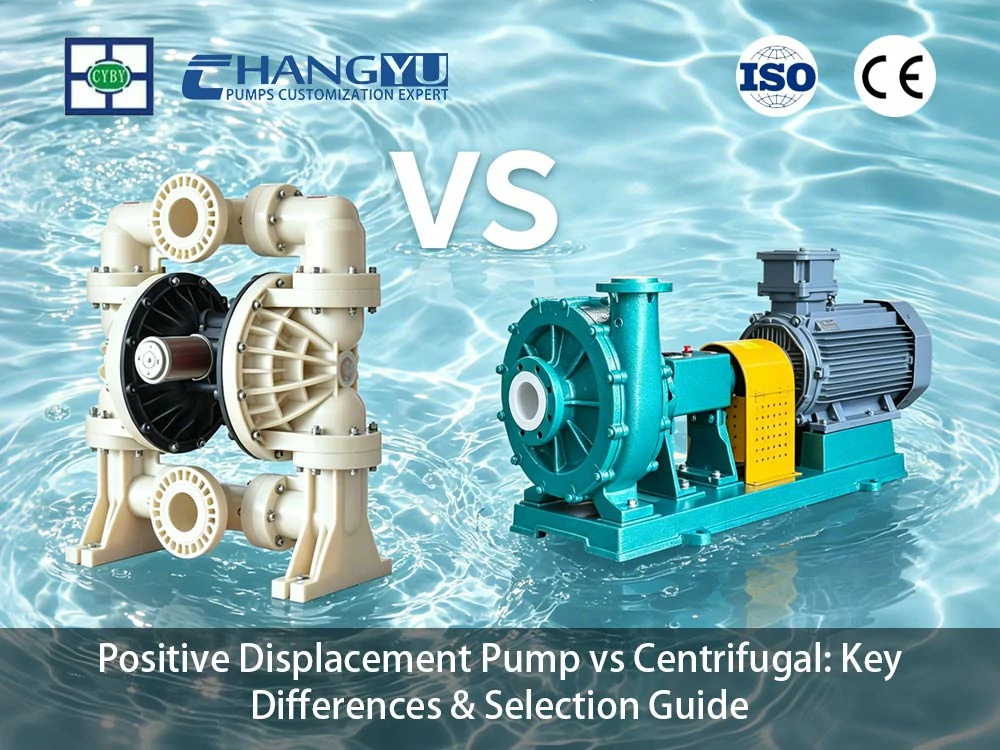
Positive displacement pump vs centrifugal — this is an important choice that shapes the industrial pump selection decision. The core of the decision rests on a single operational difference: a centrifugal pump’s flow varies with system pressure, while a positive displacement pump delivers a nearly constant flow regardless of pressure changes. This distinction cascades through every aspect of pump performance — viscosity tolerance, efficiency, pressure capability, shear sensitivity, and maintenance requirements. Understanding which pump type your application needs before consulting performance curves is the starting point for a successful specification.
This guide provides a structured comparison across eight dimensions, a four-step selection framework, and application-specific recommendations for engineers and procurement specialists. Drawing on over two decades of experience engineering both centrifugal and positive displacement pump technologies for demanding industrial applications, Changyu Pump brings verified expertise across both pump families. Contact us with your fluid parameters for a specific recommendation.
2. How Do Centrifugal Pumps Work?
A centrifugal pump is a rotodynamic machine that uses a rotating impeller to convert mechanical energy from a driver into kinetic energy in the fluid, which is then converted to pressure energy in the volute casing. Fluid enters the impeller eye, accelerates radially outward under centrifugal force, and enters the volute, where the expanding flow area converts velocity into pressure.
The defining characteristic of a centrifugal pump is the inverse relationship between flow and pressure: as system pressure increases, flow decreases. As the Hydraulic Institute notes, the performance of a centrifugal pump is such that the flow rate is variable as a function of system differential pressure or total head — it can achieve variable flow while operating at a constant rotational speed.
Centrifugal pumps are best suited to high-flow, low-to-moderate viscosity applications. They deliver continuous, pulse-free flow and serve the majority of water, solvent, and light chemical transfer duties. They are specifically designed for a single best efficiency point (BEP) flow rate — as the pump operates away from BEP, efficiency decreases and the allowable operating region is limited.
3. How Do Positive Displacement Pumps Work?
A positive displacement (PD) pump operates on a fundamentally different principle. Rather than adding kinetic energy to the fluid, it traps a fixed volume of fluid in a cavity and mechanically forces that trapped fluid into the discharge pipe. Flow rate is directly proportional to pump speed and is largely independent of system pressure — in practice, the flow rate is directly proportional to the pump’s rotational speed; if you increase the rotational speed, the flow rate increases proportionally.
This working principle makes PD pumps particularly effective when consistent, precise flow is required, regardless of fluctuations in discharge pressure. As the pump’s internal components — lobes, gears, diaphragms, screws, or vanes — rotate or reciprocate, they create expanding cavities on the suction side that draw fluid in, then seal and transport the fluid to the discharge side, where the cavity collapses and forces the fluid out.
Key characteristics include:
- Nearly constant flow regardless of system pressure — PD pumps have more or less constant flow regardless of pressure
- Ability to handle high-viscosity fluids where centrifugal pumps lose efficiency
- Most PD designs are dry self-priming, capable of emptying a suction line without the pump needing to be filled first — a significant advantage over centrifugal pumps
- Lower shear forces on the pumped fluid, making them suitable for shear-sensitive products
The main PD pump subtypes — gear pumps, diaphragm pumps (AODD), progressive cavity pumps, and peristaltic pumps — each have distinct viscosity ranges, solids tolerances, and pressure capabilities. For a detailed exploration of PD pump types, see Wikipedia’s positive displacement pump overview.
4. 8 Key Differences Between Centrifugal and Positive Displacement Pumps
8 Key Differences at a Glance
| Comparison Dimension | Centrifugal Pump | Positive Displacement Pump |
|---|---|---|
| Flow vs. Pressure | Flow decreases as pressure increases | Flow nearly constant regardless of pressure |
| Viscosity Handling | Efficiency declines above ~200 cP | Efficiency increases at higher viscosity |
| Efficiency | Peaks at BEP (50–90%+); declines away from design point | Stable across wide range (typically 90%+) |
| Pressure Capability | Limited per stage (~130 m single-stage) | Up to 275 bar (gear); 350 bar (specialized) |
| Shear Sensitivity | Higher shear (1,750–3,500 RPM) | Lower shear (100–600 RPM) |
| Self-Priming | Requires priming or flooded suction | Dry self-priming (most designs) |
| NPSH/Cavitation | Sensitive; cavitation risk at off-design flows | Lower NPSHR at lower speeds; better suction |
| Maintenance | Simpler for clean fluids | More complex; lower TCO for difficult fluids |
4.1 Flow Rate vs. Pressure: Variable vs. Constant
The most fundamental difference between the two pump types lies in how flow responds to system pressure.
Centrifugal pumps: Flow decreases as system pressure increases. At a given rotational speed, the pump delivers its maximum flow at low pressure and progressively less flow as discharge pressure rises — ultimately reaching a shut-off head where flow drops to zero. This variable flow characteristic makes centrifugal pumps suitable for applications where some flow variation is acceptable.
Positive displacement pumps: Flow remains nearly constant regardless of pressure changes. A PD pump delivers approximately the same volume per revolution whether the discharge pressure is 1 bar or 100 bar. The flow rate is directly proportional to the pump’s rotational speed, and as pressure increases, the pump simply requires more power to maintain that constant flow. This makes PD pumps the standard specification for metering, dosing, and any application requiring consistent flow against variable back-pressure.
4.2 Viscosity Handling: Efficiency Declines vs. Efficiency Increases
Viscosity is the single most influential fluid property in the centrifugal-vs-PD decision. The two pump types respond to viscosity in opposite ways, which creates a clear selection boundary.
Centrifugal pumps: Efficiency is minimally affected below 50 cP, declines by 10–30% between 200–500 cP, and experiences significant performance loss above 500 cP. At around 1,000 cP, centrifugal pumps experience head losses of 8 m or more and efficiency reductions of approximately 20% compared to water-like fluids. Centrifugal pumps are generally not recommended above 1,000 cP.
Positive displacement pumps: Efficiency actually increases at higher viscosities. As Viking Pump notes, the PD pump’s flow actually increases with viscosity because higher viscosity liquids fill the internal clearances of the pump, producing higher volumetric efficiency. The viscosity effectively reduces internal slip (recirculation), so the pump delivers a larger percentage of its theoretical displacement per revolution. For this reason, PD pumps are preferred for handling high-viscosity fluids — thick oils, polymers, pastes, and slurries — where centrifugal pumps would operate far from their BEP or fail entirely.
Selection boundary: Below approximately 200 cP with moderate-to-high flow requirements, centrifugal pumps are generally the most economical choice. Above 500 cP, PD pumps should be evaluated as the primary candidate. Between 200 and 500 cP, the decision depends on other factors — flow rate, pressure, and shear sensitivity.
4.3 Efficiency: Peaks at BEP vs. Stable Across Range
Centrifugal pumps: Efficiency peaks at the BEP and declines as the operating point moves away from this design point in either direction. While positive displacement pumps can deliver efficiencies greater than 90 percent, centrifugal pump efficiencies can range from 50% to over 90% depending on the type and size. The steep efficiency curve of a centrifugal pump means that it must be carefully matched to the system’s normal operating point to achieve acceptable energy consumption.
Positive displacement pumps: Efficiency remains relatively stable across the operating range. Changes in pressure have little effect on PD pump efficiency, whereas they produce a dramatic effect on centrifugal pump efficiency. PD pumps maintain high efficiency across a much wider operating envelope, making them the preferred choice for applications where the system curve varies significantly or where the pump must operate at multiple duty points.
4.4 Pressure Capability: Limited per Stage vs. High Pressure
Centrifugal pumps: Pressure capability is limited per stage. A single-stage centrifugal pump can typically develop up to approximately 130 meters of head. For higher pressures, multiple stages must be used in series. Centrifugal pumps are best suited for a maximum of 7 MPa (70 bar) pressure and 7,000 m³/h flows, and can be arranged in series up to a maximum of 8 pumps.
Positive displacement pumps: Pressure capability is limited primarily by the structural strength of the pump casing and the driver power. PD pumps can generate much higher pressures than centrifugal designs — standard gear pumps can achieve up to 275 bar (up to 350 bar in specialized designs), AODD pumps up to 30 bar, and progressive cavity pumps up to 48 bar. For applications requiring high differential pressure at low-to-moderate flow, PD pumps are the standard specification.
4.5 Shear Sensitivity: High Speed vs. Low Speed
Centrifugal pumps: The high-speed impeller generates significant shear forces on the pumped fluid. Centrifugal pumps typically operate at higher speeds (often 1,750–3,500 RPM) and may create product-damaging shear because of high speeds and impact forces. For this reason, centrifugal pumps are not recommended for shear-sensitive fluids such as biological slurries, polymer solutions, and food products where product integrity is a quality requirement.
Positive displacement pumps: PD pumps operate at lower speeds (typically 100–600 RPM) and produce substantially lower shear. Peristaltic and progressive cavity designs are particularly gentle, making them suitable for transferring whole fruits, yogurt, cream, sauces, and other shear-sensitive products without degradation.
4.6 Self-Priming: Requires Priming vs. Dry Self-Priming
Centrifugal pumps: Standard centrifugal pumps cannot pump air and must be primed — the pump casing and suction line must be filled with liquid before start-up. If the suction line drains between operating cycles, the pump must be re-primed. Self-priming centrifugal designs are available but add complexity and cost.
Positive displacement pumps: Virtually all PD pumps are dry self-priming. They can empty a suction line without the pump needing to be filled first — a significant advantage over centrifugal pumps, which in most cases need to be vented before they can function. AODD pumps and peristaltic pumps are particularly effective at self-priming from a dry suction, making them the preferred choice for tanker unloading, sump drainage, and any installation where the pump is mounted above the liquid source.
4.7 NPSH and Cavitation Risk: Sensitive vs. Tolerant
Centrifugal pumps: NPSHr (required) varies as a function of flow, which is determined by pressure and viscosity. A centrifugal pump is sensitive to cavitation — if NPSHa falls below NPSHr, vapor bubbles form at the impeller inlet and collapse violently, causing noise, vibration, and impeller damage. Centrifugal pumps must be carefully matched to system suction conditions to avoid cavitation.
Positive displacement pumps: NPSHr varies as a function of flow, which is determined by speed — the lower the speed of a PD pump, the lower the NPSHr. PD pumps generally have better suction characteristics and are less vulnerable to cavitation because their displacement mechanism does not rely on fluid velocity to generate pressure.
4.8 Maintenance and Lifecycle Cost: Simpler vs. More Complex but Lower TCO
Centrifugal pumps: Simpler construction with fewer moving parts results in lower initial cost and easier maintenance for clean fluid applications. The purchase price of a centrifugal pump is typically lower than an equivalent PD pump. However, when handling viscous, abrasive, or variable-condition fluids, maintenance costs can rise significantly due to seal wear, impeller erosion, and bearing loading from off-BEP operation.
Positive displacement pumps: Higher initial cost due to more complex construction with tighter internal clearances and more wear components. However, for the demanding applications they are designed for — high-viscosity, high-pressure, abrasive, or shear-sensitive fluids — PD pumps often deliver lower total cost of ownership because they operate efficiently across a wider range of conditions and require less frequent maintenance when correctly specified. A PD pump selected for a high-viscosity duty that a centrifugal pump could not efficiently handle will recover its higher initial cost through energy savings and reduced downtime.
4.9 Key Differences Summary
| Selection Factor | Centrifugal Pump | Positive Displacement Pump |
|---|---|---|
| Operating Principle | Rotating impeller adds kinetic energy to fluid | Traps fixed volume and mechanically displaces it |
| Flow vs. Pressure | Flow decreases as system pressure increases | Flow nearly constant regardless of pressure |
| Viscosity Limit | Efficiency declines above ~200 cP; optimal <20 cP; generally not recommended >1,000 cP | Efficiency increases or remains stable at high viscosity |
| Efficiency | Peaks at BEP; 50–90%+ depending on type and size | Stable across wide operating range; typically 90%+ |
| Pressure Capability | Limited per stage (single-stage ~130 m; 70 bar max) | Up to 275 bar (gear, standard); up to 350 bar (specialized); 30 bar (AODD); 48 bar (PC) |
| Shear Sensitivity | Higher shear (1,750–3,500 RPM typical) | Lower shear (100–600 RPM typical) |
| Self-Priming | Standard designs require flooded suction or manual prime | Most PD designs self-prime from dry suction |
| NPSH/Cavitation | Sensitive to NPSH; cavitation risk at off-design flows | Lower NPSHR at lower speeds; better suction performance |
| Maintenance | Simpler for clean fluids; seal is primary wear item | More complex; diaphragms, tubes, gears, or stators are primary wear items |
| Initial Cost | Lower | Higher |
| TCO for Difficult Fluids | Higher (energy, maintenance, downtime) | Lower (operates efficiently at design conditions) |
5. How to Choose Between a Centrifugal and a Positive Displacement Pump: A 4-Step Framework
Step 1: Characterize the Fluid Properties
Document the fluid’s chemical composition, concentration, pH, temperature, specific gravity, viscosity, vapor pressure, and solids content. The fluid’s viscosity — not a generic label — is the most important parameter for the centrifugal-vs-PD decision. For fluids below approximately 200 cP with moderate-to-high flow requirements, a centrifugal pump is the appropriate starting point. For fluids above 500 cP, positive displacement pumps should be evaluated as the primary candidate. The region between 200 and 500 cP is a transitional zone where other factors — pressure, flow rate, and shear sensitivity — become decisive.
For a deeper discussion of material selection for corrosive fluids, see our Chemical Process Pump: Types, Selection & Applications Guide.
Step 2: Define Flow Rate, Total Dynamic Head, and Process Requirements
Calculate the required flow rate and total dynamic head (TDH), accounting for static lift, friction losses through the piping system, and any destination pressure. Determine whether the application requires constant flow against variable pressure — a characteristic that strongly favors PD pumps — or whether flow variation with pressure is acceptable. For metering and dosing applications, specify the required accuracy and repeatability.
Step 3: Match Pump Type to the Fluid and Operating Conditions
Based on the eight comparison dimensions in Section 4, match the pump type to the fluid characteristics, flow and pressure requirements, and installation constraints:
- Select a centrifugal pump when: The fluid viscosity is below approximately 200 cP, the flow rate is high (above 20 m³/h), the discharge pressure is moderate, some flow variation with pressure is acceptable, the fluid is not shear-sensitive, and the pump can be installed with flooded suction or a self-priming design is specified.
- Select a positive displacement pump when: The fluid viscosity exceeds approximately 500 cP, constant flow against variable pressure is required, the discharge pressure is high, the fluid is shear-sensitive, the pump must self-prime from a dry suction, or precise metering or dosing is required.
For detailed centrifugal pump selection guidance, see our industrial centrifugal pumps guide.
Step 4: Evaluate Total Cost of Ownership
The purchase price of a pump typically represents only 15–25% of its lifetime cost. Energy consumption (often 60–70% of lifetime cost), wear part replacement frequency, maintenance labor, and the production cost of unplanned downtime each contribute to the total cost of ownership. A PD pump with a higher initial cost but substantially longer service life and higher efficiency in a high-viscosity application routinely delivers lower TCO than a centrifugal pump operating far from its BEP in the same service. Evaluate TCO over a three- to five-year horizon for accurate comparison.
6. Application Recommendations: Centrifugal vs Positive Displacement Pump Selection
6.1 By Viscosity
| Viscosity Range | Recommended Pump Type | Example Applications |
|---|---|---|
| < 200 cP | Centrifugal pump (optimal) | Water, light solvents, thin chemicals, cooling water |
| 200–500 cP | Centrifugal or PD (evaluate both) | Light oils, some chemical solutions, thin slurries |
| 500–10,000 cP | Positive displacement pump | Heavy oils, polymers, adhesives, thick slurries |
| > 10,000 cP | Positive displacement pump (gear, PC, or diaphragm) | Pastes, greases, heavy crude, sludge |
6.2 By Industry
- Chemical Processing: Centrifugal pumps serve the majority of bulk acid, solvent, and intermediate transfer at low-to-moderate viscosity. Magnetic drive centrifugal pumps handle hazardous chemicals with zero-leakage containment. PD diaphragm and gear pumps meter additives and catalysts precisely.
- Oil and Gas: Centrifugal pumps handle produced water and light hydrocarbon transfer. PD progressive cavity and gear pumps handle crude oil, drilling mud, and high-viscosity products at high pressure.
- Food and Beverage: Centrifugal pumps transfer low-viscosity products (milk, beer, juices). PD lobe and peristaltic pumps handle viscous products (chocolate, yogurt, sauces) and shear-sensitive fluids.
- Pharmaceutical: PD peristaltic and diaphragm pumps serve metering and high-purity transfer. Centrifugal pumps handle utility water and CIP chemical circulation.
- Mining: Centrifugal slurry pumps handle high-volume, abrasive slurry transfer. PD diaphragm and hose pumps handle high-density tailings and reagent dosing.
6.3 By Operating Condition
| Condition | Best Pump Type | Reason |
|---|---|---|
| High flow, low pressure, low viscosity | Centrifugal | Most economical, simple maintenance |
| Low flow, high pressure, any viscosity | Positive Displacement | Constant flow, high efficiency across pressure range |
| Viscous, shear-sensitive fluids | PD (peristaltic, progressive cavity) | Low shear, gentle handling |
| Self-priming required, pump above liquid | PD (AODD, peristaltic) | Dry self-priming capability |
| Constant flow against variable pressure | Positive Displacement | Flow independent of pressure |
| Clean, non-hazardous, continuous duty | Centrifugal | Lowest capital and maintenance cost |
7. Changyu Pump Solutions for Centrifugal and Positive Displacement Applications
Changyu Pump designs and manufactures both centrifugal and positive displacement pump technologies for corrosive, abrasive, and high-temperature applications across chemical processing, mining, water treatment, and general industry.
CYQ Series Magnetic Drive Centrifugal Pump
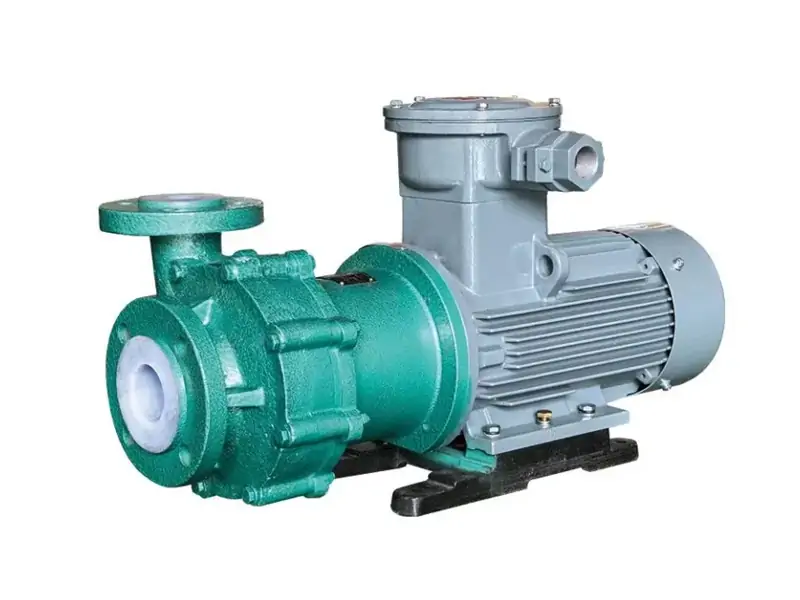
The CYQ Series is a sealless magnetic drive centrifugal pump with wetted components lined in FEP, PFA, or PTFE. Torque is transmitted across a stationary isolation sleeve, eliminating the mechanical seal and achieving zero leakage by design. For hazardous chemical transfer — toxic intermediates, high-value solvents, corrosive acids — the CYQ Series provides the absolute containment required for safe, compliant operation. This centrifugal pump design delivers the high-flow, low-viscosity performance and simple maintenance that Section 4 identifies as centrifugal advantages.
Key Specifications: Flow 3–800 m³/h | Head 15–125 m | Power 2.2–110 kW | Temperature -20°C to 180°C
UHB Series UHMWPE Corrosion Resistant Centrifugal Pump
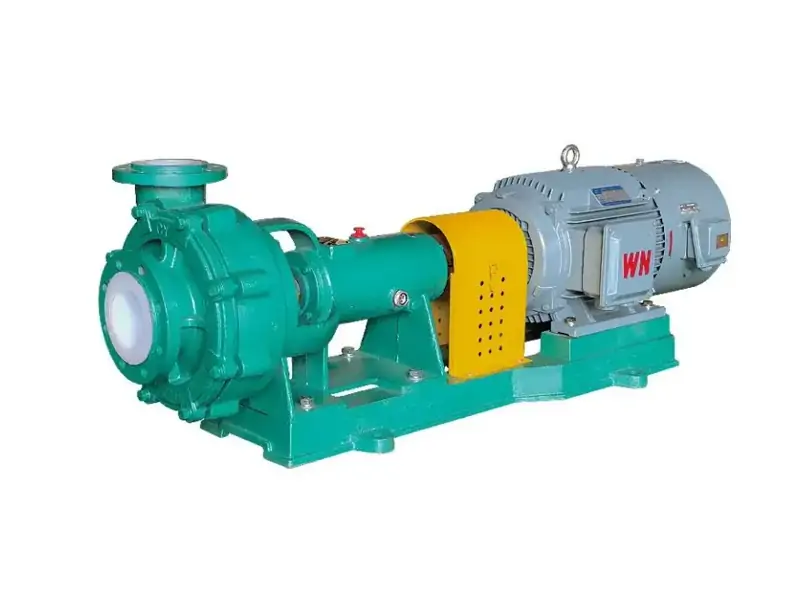
The UHB Series is a cantilever, single-stage centrifugal pump with a steel-lined UHMW-PE casing at 8–20 mm thickness, specifically engineered for chemically aggressive and abrasive-corrosive fluids. The UHMW-PE lining delivers wear resistance 7–10 times that of carbon steel while providing broad chemical compatibility with acids, alkalis, and salt solutions.
Key Specifications: Flow 3–2,600 m³/h | Head 5–100 m | Power 0.75–300 kW | Temperature -20°C to 90°C
FZB Series Fluoroplastic Self-Priming Centrifugal Pump
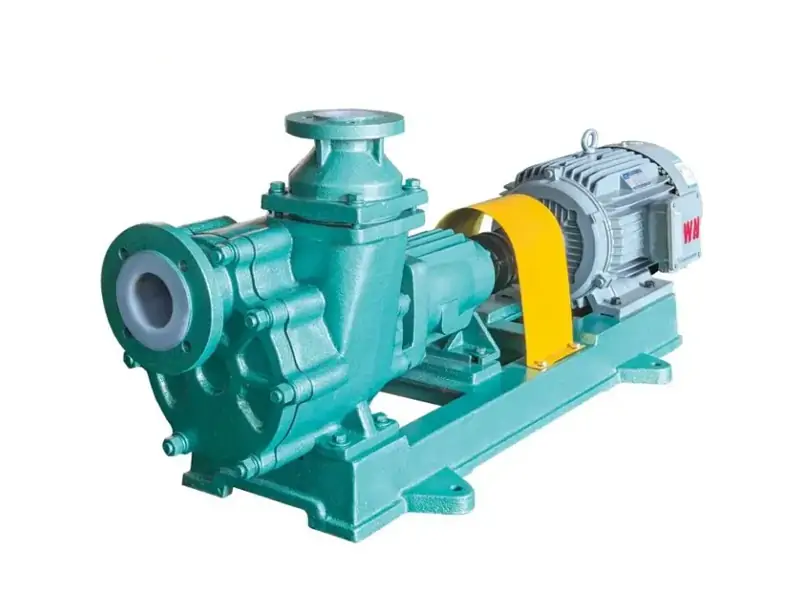
The FZB Series is a self-priming centrifugal pump with all flow-through components lined in FEP (F46) or PFA. Once initially filled, the pump automatically evacuates air from the suction line and achieves a self-priming height of up to 5 meters. The self-priming capability combined with full fluoroplastic corrosion resistance makes it suitable for tanker unloading, sump drainage, and below-grade chemical transfer.
Key Specifications: Flow 2.5–100 m³/h | Head 15–50 m | Power 0.75–55 kW | Temperature -20°C to 150°C
BFQ Series Air Operated Double Diaphragm Pump (AODD — Positive Displacement)

The BFQ Series is a positive displacement AODD pump with body materials spanning cast steel, ductile iron, aluminum alloy, PP, stainless steel, and PVDF. Powered entirely by compressed air, it is inherently sealless, self-priming from a dry suction to 7.6 meters, and can run dry without damage. For corrosive, abrasive, high-viscosity, and volatile fluids, the BFQ Series delivers the constant flow, gentle low-shear handling, and operational flexibility that centrifugal pumps cannot match in difficult fluid conditions. This AODD positive displacement pump delivers the constant flow against variable pressure, dry self-priming, and high-viscosity handling that Section 4 identifies as PD advantages.
Key Specifications: Max working flow up to 1,041 L/min | Working pressure 0.84 MPa | Suction lift 7.6 m | Solids passage 9.4 mm
8. Frequently Asked Questions About Centrifugal vs Positive Displacement Pumps
Q1: What is the main difference between a centrifugal pump and a positive displacement pump?
A: The main difference is how flow responds to pressure. A centrifugal pump’s flow decreases as system pressure increases; a positive displacement pump delivers a nearly constant flow regardless of pressure changes. Centrifugal pumps use a rotating impeller to add kinetic energy to the fluid; PD pumps trap a fixed volume and mechanically displace it into the discharge pipe.
Q2: At what viscosity should I switch from a centrifugal pump to a positive displacement pump?
A: Centrifugal pumps are most efficient below approximately 200 cP, with efficiency minimally affected below 50 cP and declining by 10–30% between 200–500 cP. Above 500 cP, the efficiency penalty of a centrifugal pump becomes economically significant, and PD pumps should be evaluated as the primary candidate. Centrifugal pumps are generally not recommended above 1,000 cP.
Q3: Can a centrifugal pump handle high-viscosity fluids?
A: Centrifugal pumps can be cataloged to handle viscosities up to 1,000 cSt and higher, but their efficiency drops dramatically as viscosity increases. At elevated viscosities, PD pumps are clearly the better choice when considering the high energy costs resulting from lost centrifugal pump efficiency.
Q4: Are positive displacement pumps self-priming?
A: Yes, most PD pumps are dry self-priming — they can empty a suction line without the pump needing to be filled first. This is a significant advantage over centrifugal pumps, which generally require priming or flooded suction. AODD pumps and peristaltic pumps are particularly effective at self-priming from a dry suction.
Q5: Which pump type is more efficient?
A: PD pumps can deliver efficiencies greater than 90%, while centrifugal pump efficiencies range from 50% to over 90% depending on type, size, and operating point. However, a centrifugal pump operating near its BEP with a low-viscosity fluid can match or exceed PD pump efficiency, so the comparison depends on the specific application conditions.
Q6: Do positive displacement pumps require a pressure relief valve?
A: Yes. Because PD pumps deliver nearly constant flow regardless of pressure, they can generate dangerously high pressures if operated against a closed discharge valve. A pressure relief valve or bypass arrangement is required to protect the pump and system from overpressure. Centrifugal pumps, by contrast, can operate against a closed valve at shut-off head without immediate damage (though sustained operation at shut-off will overheat the fluid).
Q7: Which pump type handles solids better?
A: This depends on the specific pump design rather than the pump category. Centrifugal pumps with semi-open or recessed impellers can handle slurries with 30–40% solids content. PD pumps — particularly AODD diaphragm pumps — can handle up to 60–80% solids content depending on the specific design. Progressive cavity and peristaltic PD pumps are also effective with solids-laden fluids.
Q8: How do I calculate which pump type will have lower total cost of ownership?
A: TCO = initial capital cost + energy cost (60–70% of lifetime cost) + wear part replacement frequency and cost + maintenance labor + production downtime cost. Evaluate over a 3–5 year horizon. For high-viscosity or variable-condition applications where a centrifugal pump would operate far from its BEP, a PD pump often delivers lower TCO despite a higher initial purchase price, because energy savings and reduced maintenance outweigh the capital difference.
9. Expert Recommendations from Changyu Pump Engineers
- Let viscosity guide the initial pump type decision, not just flow and head. A centrifugal pump selected for a 500 cP fluid may meet the flow and head requirements on paper but consume substantially more energy than a PD pump serving the same duty. Above 500 cP, evaluate PD pumps as the primary candidate. Centrifugal pumps are generally not recommended above 1,000 cP.
- Consider the entire operating range, not just the design point. Centrifugal pumps are designed for a single BEP; efficiency drops off as the operating point moves away from this flow rate. If your application requires the pump to operate across a wide flow range, a PD pump’s stable efficiency curve may deliver better overall performance.
- Factor self-priming requirements into the pump type decision. If the pump must be mounted above the liquid source and cannot rely on flooded suction, the dry self-priming capability of most PD pumps — or a self-priming centrifugal design — should be included in the specification from the start.
- For hazardous or high-value fluids, select sealless magnetic drive centrifugal or diaphragm PD pumps. Eliminating the mechanical seal removes both a leak path and a routine maintenance item. The higher initial cost is typically recovered through eliminated seal replacements, reduced flush water consumption, and avoided emissions reporting.
10. Conclusion
The choice between positive displacement pump vs centrifugal is a decision that begins with fluid properties — particularly viscosity — and extends through every aspect of pump performance. Centrifugal pumps dominate high-flow, low-viscosity, continuous-duty applications for good reason: they are simple, cost-effective, and reliable when matched to their design conditions. Positive displacement pumps serve the applications that centrifugal pumps cannot handle efficiently — high-viscosity fluids, high-pressure duties, shear-sensitive products, and processes requiring constant flow against variable pressure.
The selection process begins with a complete characterization of the fluid, proceeds through pump type matching based on the eight comparison dimensions outlined in this guide, and concludes with a total cost of ownership evaluation over a three- to five-year horizon. A pump that operates at its BEP with materials verified for the specific fluid will deliver the lowest total cost of ownership and the longest mean time between repairs.
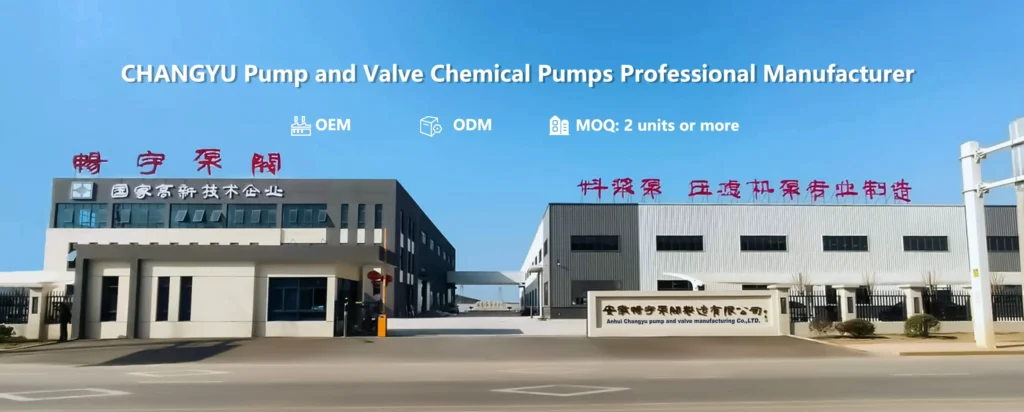
Changyu Pump’s centrifugal (CYQ, UHB, FZB) and positive displacement (BFQ) pump platforms provide corrosion-resistant, wear-resistant, and sealless solutions for demanding industrial fluid handling applications. Contact our engineering team with your fluid parameters and process requirements. We will provide a detailed pump recommendation and quotation tailored to your application.