
Quick Answer
A hose pump vs peristaltic pump comparison is fundamentally a question of engineering scale rather than operating principle. Both use rotating rollers to compress a flexible conduit — but a hose pump is an industrial-grade peristaltic pump built with multi-layer reinforced rubber hose for high-pressure, high-flow, abrasive fluid handling. A peristaltic pump in its common usage refers to a laboratory or light-duty device using thin-walled tubing for low-flow, precision metering applications. The two terms describe the same working principle applied at opposite ends of the pressure and flow spectrum.
Key distinctions include:
- Pressure capability: Hose pumps operate up to 1.6 MPa; laboratory peristaltic pumps typically handle pressures at or below 0.3 MPa.
- Flow range: Industrial hose pumps deliver up to 50 m³/h; laboratory peristaltic pumps are measured in mL/min to L/min.
- Hose/tube construction: Hose pumps use multi-layer reinforced rubber hose; laboratory peristaltic pumps use unreinforced silicone, Tygon, or other thin-walled tubing.
A procurement officer receives a requisition for a “peristaltic pump” to transfer abrasive mining slurry. They source a laboratory-grade unit with silicone tubing rated for clean fluids at low pressure. The pump is installed, and the tubing fails within hours — not because the pump was defective, but because the term “peristaltic pump” meant one thing to the engineer who wrote the requisition and another thing entirely to the supplier who fulfilled it. This scenario illustrates why understanding the distinction between hose pumps and peristaltic pumps matters — not as an academic exercise, but as a procurement and engineering decision with operational consequences.
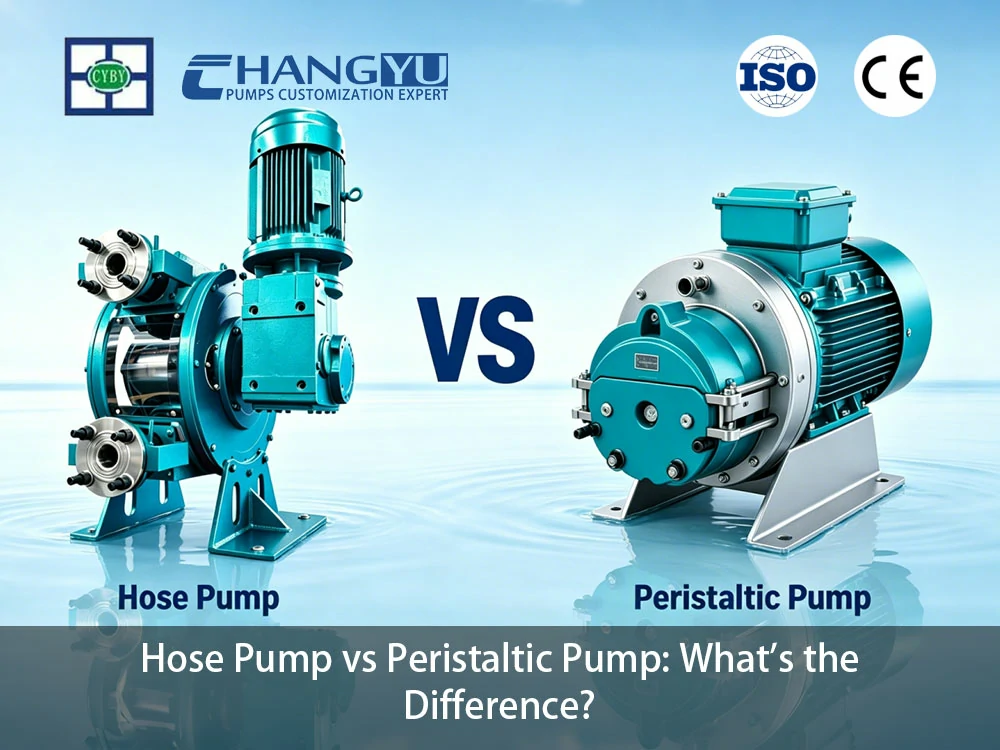
Changyu Pump manufactures industrial-grade peristaltic hose pumps for demanding applications across mining, chemical, and industrial sectors. This guide clarifies the terminology, the engineering differences, and how to specify the correct pump type for your application.
1. What Is a Hose Pump?
A hose pump is a rotary positive displacement pump that operates on the peristaltic principle. Rotating rollers or shoes compress a reinforced elastomer hose against a curved housing. As each roller passes, the hose recovers to its original shape behind the roller, creating suction that draws fluid into the pump. Ahead of the roller, the trapped fluid is pushed forward under positive pressure.
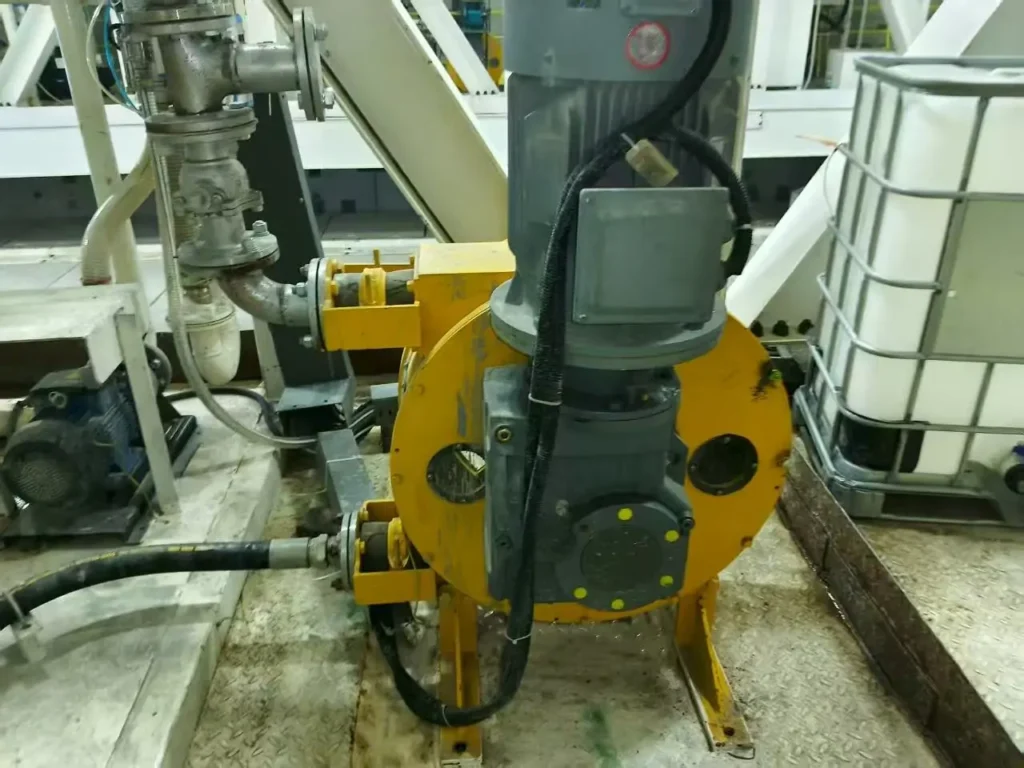
What distinguishes a hose pump from other peristaltic designs is its industrial engineering. The hose is a multi-layer reinforced rubber component — typically natural rubber (NR), EPDM, NBR, CSM (Hypalon), or food-grade variants — capable of withstanding discharge pressures up to 1.6 MPa and flow rates up to 50 m³/h. The pump casing is heavy-duty cast iron or ductile iron. The rollers are oversized and mounted on robust bearings. The lubrication system may use forced circulation for cooling in heavy-duty models, or a dry-running design in advanced configurations.
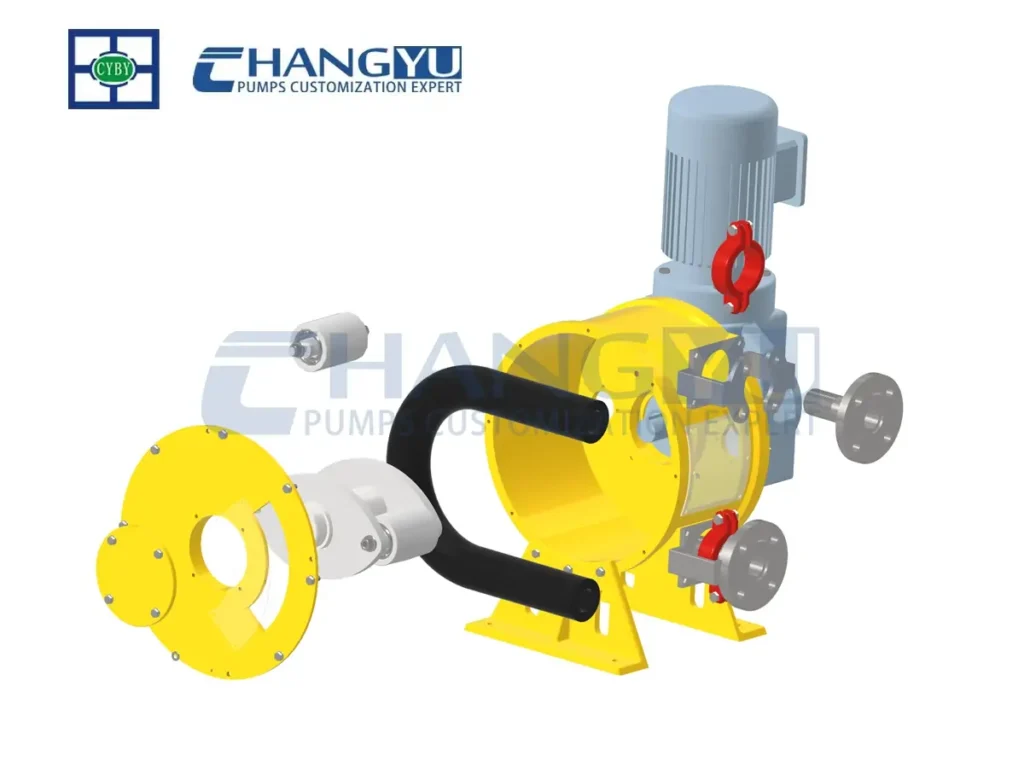
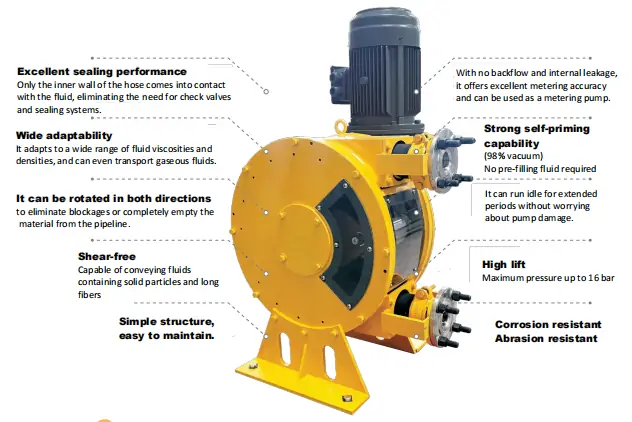
The defining feature of any hose pump is that the pumped fluid contacts only the inner wall of the hose. There are no mechanical seals, gland packing, or valves exposed to the fluid — the hose itself is both the pumping chamber and the only wetted component.
2. What Is a Peristaltic Pump?
A peristaltic pump operates on exactly the same mechanical principle as a hose pump — rollers compress a flexible conduit to create suction and positive displacement. However, in common engineering and procurement usage, the term “peristaltic pump” without qualification refers to laboratory or light industrial devices designed for low-flow, precision metering applications.
These pumps use thin-walled, unreinforced tubing — typically silicone, Tygon, Viton, or PharMed — with tube diameters measured in millimeters. Operating pressures rarely exceed 0.1–0.3 MPa, and flow rates are measured in milliliters or liters per minute rather than cubic meters per hour. The pump housing is typically plastic or lightweight metal, designed for benchtop or portable use rather than continuous industrial duty.
The historical origin of the term explains this association. Peristaltic pumps were first developed for medical applications — blood transfusion and dialysis — where the gentle, contamination-free pumping action was essential. This medical and laboratory heritage shaped the default meaning of “peristaltic pump” as a precision, low-flow device, even after the same principle was scaled up for industrial applications.
3. Are Hose Pumps and Peristaltic Pumps the Same Thing?
The short answer is that every hose pump is a peristaltic pump, but not every peristaltic pump is a hose pump. The relationship is one of category and subclass: a hose pump is the industrial, heavy-duty subclass of the broader peristaltic pump category.
Why the Confusion Exists: The History of Hose Pumps and Peristaltic Pumps
The terminology confusion has practical roots in how the technology evolved across different industries. The peristaltic principle was first commercialized for medical applications in the 1930s–1950s, where the term “peristaltic pump” became established in clinical and laboratory vocabulary. When engineers later adapted the same principle for industrial slurry handling in the 1960s–1970s, they needed a term that distinguished their high-pressure, abrasive-duty machines from the laboratory devices. “Hose pump” emerged naturally — it emphasized the industrial-grade reinforced rubber hose that was the core of the new design, in contrast to the thin-walled tubing used in laboratory peristaltic pumps.
Today, the practical distinction is understood within the pump industry, but procurement documents, specifications, and supplier catalogs often use the terms interchangeably, creating the confusion this guide addresses.
4. What Are the Key Differences Between Industrial Hose Pumps and Laboratory Peristaltic Pumps?
The following comparison table covers the engineering dimensions that separate industrial hose pumps from laboratory peristaltic pumps. Each dimension represents a decision point in pump specification.
Industrial Hose Pump vs Laboratory Peristaltic Pump: Engineering Comparison
| Feature | Industrial Hose Pump | Laboratory Peristaltic Pump |
|---|---|---|
| Maximum discharge pressure | Up to 1.6 MPa | 0.05–0.3 MPa (some reinforced tube models to 0.6 MPa) |
| Flow rate range | 0.06–50 m³/h | mL/min to L/min (typically < 1 m³/h) |
| Hose/tube material | Multi-layer reinforced NR, EPDM, NBR, CSM, F-NR, F-NBR | Unreinforced silicone, Tygon, Viton, PharMed |
| Hose/tube wall thickness | 10–25 mm (with textile/steel reinforcement layers) | 1–3 mm (single-layer extrusion) |
| Lubrication/cooling | Forced circulation lubricant cooling or dry-running design | Dry-running (no lubrication system) |
| Casing material | Heavy-duty cast iron or ductile iron | Plastic, aluminum, or lightweight metal |
| Bearing configuration | Oversized, heavy-duty roller bearings | Standard or miniature bearings |
| Typical applications | Mining slurry, chemical transfer, wastewater sludge, construction grout | Laboratory reagent dosing, medical infusion, pharmaceutical metering, aquarium feeding |
| Solids handling | Up to 60%+ solids concentration (depending on particle size and shape) | Clean fluids only; solids cause rapid tube failure |
| Operating speed | 20–60 r/min | 1–600 r/min (varies widely by tube size) |
| Pulsation level | Moderate (peristaltic pulses) | Low to moderate (pulses smaller in amplitude due to smaller tube volume) |
What Happens When the Wrong Pump Is Specified
A university pilot plant was testing a mineral processing circuit and specified a peristaltic pump with silicone tubing to transfer abrasive slurry containing 15% silica particles at 0.4 MPa, near the upper pressure limit of the unreinforced tubing. The tubing failed every 3–4 days — the silica particles rapidly eroded the thin silicone wall, and the operating pressure exceeded the practical working limit of unreinforced tube construction. The project was delayed by six weeks while the pump was replaced with an industrial hose pump equipped with multi-layer reinforced NR hose rated for the pressure and solids content. The replacement pump operated without failure for the remaining duration of the pilot program.
5. Which Pump Do You Need — Industrial Hose Pump or Peristaltic Pump?
The decision between an industrial hose pump and a laboratory peristaltic pump follows a logical sequence based on the operating parameters of the application. Use the following selection criteria to determine which pump type matches your requirements.
Selection Decision Tree
- Is the discharge pressure above 0.6 MPa? → Industrial hose pump.
Laboratory peristaltic pumps are not designed for pressures exceeding 0.3–0.6 MPa. Operating above these limits risks tube rupture. - Is the flow rate above 1 m³/h? → Industrial hose pump.
Laboratory peristaltic pumps are designed for flows measured in mL/min or L/min. Continuous operation at flow rates above 1 m³/h requires an industrial hose pump. - Does the fluid contain abrasive solids? → Industrial hose pump.
Unreinforced laboratory tubing fails rapidly from abrasive wear. Multi-layer reinforced hose is required for any fluid containing sand, grit, metal particles, or mineral solids. - Is the fluid corrosive? → Either, depending on concentration and temperature.
Both pump types offer chemical-resistant elastomer options. Laboratory pumps with Viton or Tygon tubing handle many corrosive chemicals. For concentrated acids at high temperatures, an industrial hose pump with CSM (Hypalon) or EPDM hose provides greater reliability. - Is precision metering the primary requirement with clean fluids? → Laboratory peristaltic pump.
For dosing reagents, catalysts, or additives at flow rates below 1 m³/h with clean fluids, a laboratory peristaltic pump offers a cost-effective and precise solution. - Is the application food or pharmaceutical processing? → Both are viable.
Industrial hose pumps with F-NR or F-NBR hoses serve food and pharmaceutical applications at production scale. Laboratory peristaltic pumps with FDA-compliant tubing serve smaller-scale or research applications.
6. Changyu Pump ZJP-Z Series Industrial Hose Pump Solutions
Changyu Pump manufactures the ZJP-Z Series industrial peristaltic hose pump, engineered for continuous operation in demanding industrial environments. The pump operates on the peristaltic principle — rotating rollers compress a reinforced rubber hose, creating suction and positive displacement — while incorporating design features that distinguish it from laboratory peristaltic devices.
The ZJP-Z Series features a dry-running pump chamber requiring no oil or grease lubrication, eliminating lubricant contamination risk and reducing routine maintenance. The pump casing and end covers are precision-machined with a fit tolerance controlled to 0.1 mm, ensuring smooth internal surfaces that reduce hose wear. Rotor bearings are configured in a dual-support cantilever arrangement for stable rotation under high radial loads. The discharge connections are reinforced for pressures up to 2.5 MPa.
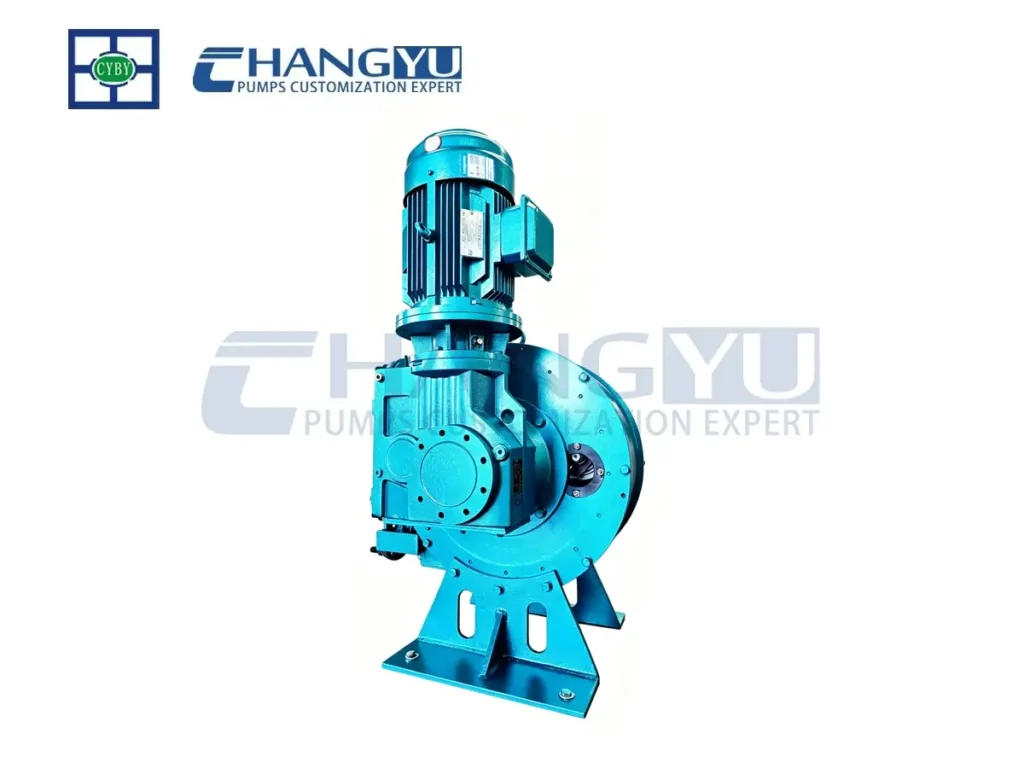
Changyu ZJP-Z Series Industrial Hose Pump Specifications
| Flow Rate Range : | 0.06 m³/h~50 m³/h |
|---|---|
| Head Range: | Up to 160 m |
| Motor Power : | 0.55–22 kW |
| Speed: | 34–50 r/min |
| Medium Temperature Range: | -20°C to 100°C |
| Customizable Materials: | NR/CSM/EPDM/NBR/F-NR/F-NBR |
View Changyu ZJP-Z Series Industrial Hose Pump specifications →
FAQs about Hose Pump vs Peristaltic Pump
Q: Is a hose pump the same as a peristaltic pump?
A: Every hose pump is a type of peristaltic pump, but not every peristaltic pump is a hose pump. Hose pumps are the industrial, heavy-duty subclass designed for high pressure, high flow, and abrasive fluids. Peristaltic pumps in common usage refer to laboratory or light industrial devices for low-flow, precision metering.
Q: Can I use a laboratory peristaltic pump for industrial applications?
A: Not for applications involving discharge pressures above 0.6 MPa, flow rates above 1 m³/h, or fluids containing abrasive solids. Laboratory peristaltic pumps use unreinforced thin-walled tubing that fails rapidly under these conditions. An industrial hose pump with multi-layer reinforced hose is required.
Q: What pressure can a hose pump handle compared to a peristaltic pump?
A: Industrial hose pumps handle discharge pressures up to 1.6 MPa. Laboratory peristaltic pumps typically operate at 0.05–0.3 MPa. The reinforced hose construction of industrial hose pumps enables this pressure capability.
Q: Why do some people call it a hose pump and others call it a peristaltic pump?
A: The term “peristaltic pump” originated in medical and laboratory applications, where it refers to precision, low-flow devices. “Hose pump” emerged as an industrial term to distinguish heavy-duty machines with reinforced rubber hoses from their laboratory counterparts. Both terms describe the same operating principle.
Q: What are the main applications for industrial hose pumps vs peristaltic pumps?
A: Industrial hose pumps serve mining slurry transfer, chemical processing, wastewater treatment, and construction grouting. Laboratory peristaltic pumps serve reagent dosing, medical infusion, pharmaceutical metering, and research applications with clean fluids at low flow rates.
Changyu Pump Engineer’s Avoidance Checklist
- Verify the term “peristaltic pump” in any specification or requisition. If the document does not specify “industrial” or “hose” pump, confirm the required pressure, flow rate, and solids content before procurement.
- Do not use laboratory peristaltic pumps for fluids containing abrasive solids. Unreinforced tubing will fail within hours to days. Multi-layer reinforced hose is required for any fluid containing sand, grit, or mineral particles.
- Check the hose or tube material against the complete fluid chemistry. Silicone, Tygon, and other laboratory tubing materials have different chemical resistance profiles than industrial hose elastomers (NR, EPDM, NBR, CSM).
- Match the pump casing and bearing construction to the operating environment. Laboratory pumps with plastic or lightweight metal casings are not designed for continuous industrial duty or outdoor installation.
- Consider pulsation dampening for metering applications. Both industrial hose pumps and laboratory peristaltic pumps generate flow pulsations. For precision dosing, external dampening may be required.
- Specify the correct hose material for the full fluid composition, not just the primary component. Trace solvents or cleaning agents can destroy an otherwise compatible hose material.
- Keep spare hoses or tubes in inventory for critical applications. Industrial hose replacement takes 1–2 hours with parts on hand. Laboratory tube replacement is faster but more frequent.
Conclusion
Hose pumps and peristaltic pumps share the same operating principle — rotating rollers compressing a flexible conduit to generate suction and positive displacement. The difference is one of engineering scale. A hose pump is an industrial peristaltic pump designed for high-pressure, high-flow, and abrasive fluid handling with multi-layer reinforced rubber hose, heavy-duty casing, and robust bearing assemblies. A peristaltic pump in common usage refers to a laboratory device for precision, low-flow metering with thin-walled unreinforced tubing.
When specifying a pump for industrial applications involving discharge pressures above 0.6 MPa, flow rates above 1 m³/h, or abrasive solids, an industrial hose pump is the correct specification. For clean fluid metering at laboratory scale, a peristaltic pump with appropriate tubing provides a cost-effective and precise solution.
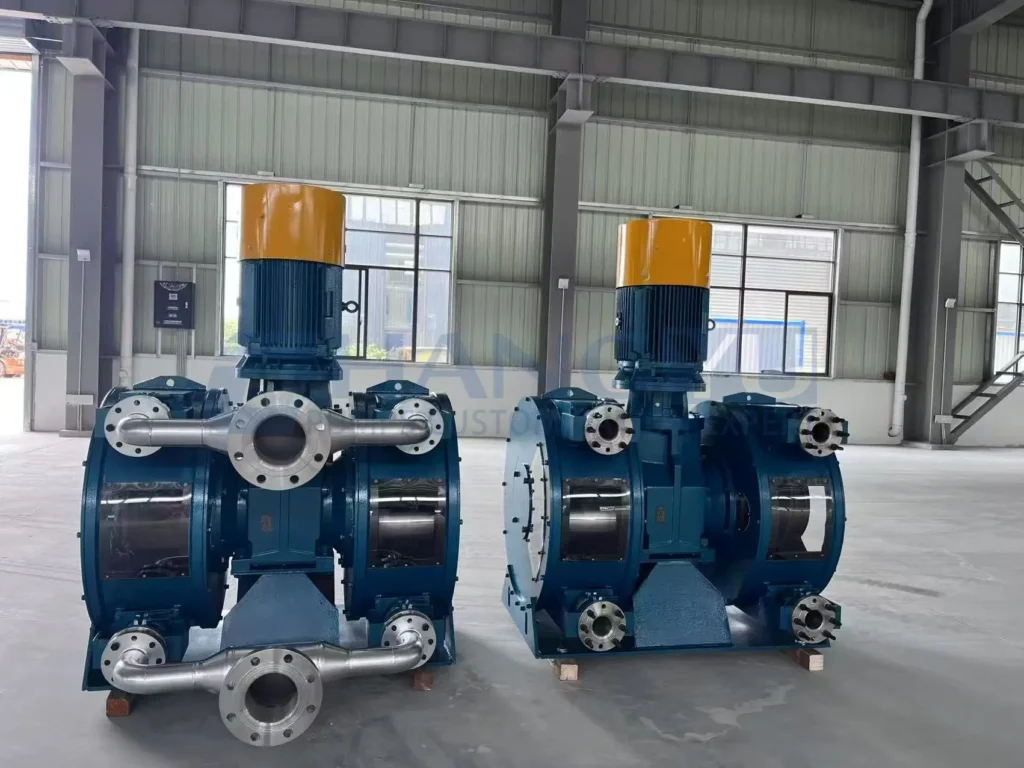
Changyu Pump’s engineering team provides technical assessments for industrial hose pump applications, backed by two decades of pump manufacturing experience across mining, chemical, and industrial sectors.