
Introduction
Electric acid transfer pump selection requires navigating a matrix of acid-specific corrosion mechanisms. Sulfuric acid’s attack on metals is concentration-dependent, with dilute acid corroding iron and steel while concentrated acid above 80% forms a protective sulfate layer on carbon steel at low temperatures — a layer that erodes under flow conditions, making carbon steel unsuitable for pump components. Hydrochloric acid attacks metals through chloride-induced pitting, eliminating stainless steels from consideration and making non-metallic pumps the standard selection. Nitric acid is a strong oxidizer that degrades polypropylene yet is compatible with certain stainless steels. Hydrofluoric acid permeates fluoropolymer linings and attacks the underlying metal substrate — a failure mode invisible to external inspection.
These acid-specific behaviors mean that pump material, pump type, and sealing technology form a single integrated selection decision. Changyu Pump has spent over two decades engineering corrosion-resistant fluid-handling equipment for acid transfer and chemical processing. This guide provides a structured reference covering pump types, material compatibility for specific acids, sealing and safety technologies, and a selection framework for engineers specifying or upgrading electric acid pump installations.
What Is an Electric Acid Transfer Pump?
An electric acid transfer pump is a pump powered by an electric motor, engineered to transfer acidic media — sulfuric, hydrochloric, nitric, phosphoric, hydrofluoric, and mixtures thereof — within industrial facilities. Every wetted component (casing, impeller, shaft, seals, O‑rings, and gaskets) must be verified as chemically compatible with the specific acid at its operating concentration and temperature.
The electric drive distinguishes it from air-operated diaphragm (AODD) pumps and manual pumps. Electric acid pumps are specified where continuous, stable flow is required, where the facility has reliable electrical power, and where the higher energy efficiency of electric motors compared to compressed-air systems reduces operating cost over the equipment’s service life. In electroplating, electric pumps recirculate acid-based plating solutions through treatment tanks — a duty where continuous, uninterrupted flow is critical, as even a few hours of pump downtime can result in the loss of an entire production batch. In chemical processing, electric acid pumps transfer acids between storage tanks and reactors. In water treatment, they meter sulfuric acid or hydrochloric acid for pH adjustment.
| Application | Typical Acids | Pump Requirement |
|---|---|---|
| Electroplating & metal finishing | Sulfuric, hydrochloric, chromic, nitric | Continuous recirculation; corrosion-resistant wetted path |
| Chemical processing | Sulfuric, hydrochloric, nitric, phosphoric | Bulk transfer between storage and process vessels |
| Water & wastewater treatment | Sulfuric acid, hydrochloric acid | Dosing and pH adjustment; precise metering |
| Steel pickling | Hydrochloric acid, sulfuric acid (heated) | High-flow continuous circulation; temperature-resistant materials |
| Semiconductor manufacturing | Hydrofluoric acid, high-purity acids | Ultra-pure wetted path; zero metallic contamination |
| Pharmaceutical & fine chemicals | Various acids, mixed acid streams | Sealless or double-sealed containment |
What Types of Electric Pumps Are Used for Acid Transfer?
Three electric pump types cover the majority of acid transfer applications, each with a distinct sealing architecture that determines its suitability for hazardous, high-purity, or solids-laden acid streams.
Electric Centrifugal Pumps (Lined and All-Plastic)
Electric centrifugal acid transfer pumps use a rotating impeller to accelerate fluid outward, converting velocity into pressure. They are the most widely deployed configuration for high-flow, continuous acid transfer — circulating pickling bath solutions, transferring acids between storage tanks, and feeding process reactors. For acid service, centrifugal pumps are constructed in two configurations: fluoroplastic-lined (a metallic casing with an internal PTFE, PFA, or FEP lining) and all-plastic (PP or PVDF casing and impeller). The fluoroplastic lining isolates the metal casing from the acid, combining the chemical inertness of PTFE or PFA with the structural strength of the metal shell — eliminating the trade-off between corrosion protection and mechanical durability. These pumps are suited to flow rates from approximately 1 to 2,600 m³/h and discharge heads up to 130 m.
Centrifugal pumps are best suited to low-to-moderate-viscosity acids (below approximately 200 cP). They rely on a mechanical seal where the shaft exits the casing. For acids that contain crystallizing solutes — such as phosphate salts in phosphoric acid — the seal faces must be protected against crystal formation during shutdown, which can damage the seal on restart. Above 200 cP, efficiency declines and positive-displacement designs become the preferred alternative.
Electric Magnetic Drive Pumps
Electric magnetic drive acid transfer pumps eliminate the mechanical shaft seal entirely. Torque is transmitted from the motor to the impeller across a stationary containment shell using a magnetic coupling. The process fluid is fully enclosed within the sealed casing — no rotating shaft penetrates the pressure boundary. This sealless design achieves zero leakage by design, making magnetic drive pumps the standard specification for hazardous, toxic, flammable, or high-value acids where even minor seal leakage is unacceptable.
Magnetic drive pumps are used across the full acid spectrum — hydrochloric, sulfuric, nitric, phosphoric, and hydrofluoric — when constructed with the appropriate wetted materials. For most acid services, fluoroplastic-lined (PTFE, PFA, or FEP) magnetic drive pumps provide verified chemical compatibility. For applications where a metallic wetted path is structurally required, stainless steel or Hastelloy magnetic drive pumps are specified after thorough verification. These pumps are governed by API 685 for heavy-duty service in petrochemical and chemical plants.
A specific operational consideration for magnetic drive pumps in strong acid service is hydrogen embrittlement of magnets. Acid-corrosion reactions generate atomic hydrogen, which can permeate the containment shell and be absorbed by neodymium-iron-boron (NdFeB) magnets, causing lattice expansion, embrittlement, and eventual decoupling. Samarium-cobalt (SmCo) magnets are resistant to this failure mode and are the standard specification for magnetic drive pumps in aggressive acid service.
Electric Diaphragm Pumps
Electric diaphragm acid transfer pumps use a motor-driven reciprocating mechanism to flex a diaphragm, creating a pumping chamber that alternately fills and discharges. The diaphragm forms a sealless barrier between the process fluid and the drive mechanism — no rotating shaft seal is required. This makes electric diaphragm pumps suitable for acids containing abrasive particles, slurries, or crystallizing solids that would destroy a mechanical seal or clog a centrifugal impeller. By pairing the motor with a variable-frequency drive (VFD), the pump can deliver precise, adjustable flow rates — an advantage for dosing and metering applications where flow accuracy is critical.
Diaphragm pumps provide stable, continuous flow without the compressed-air infrastructure required by pneumatic (AODD) models. They handle high-viscosity acids, volatile fluids, and small solids, with body materials spanning PP, PVDF, and stainless steel. Flow rates reach approximately 480 L/min with discharge heads up to 84 m. For facilities where compressed-air generation would add significant energy cost, electric diaphragm pumps provide the solids-handling capability of a diaphragm pump without the energy penalty of pneumatic drive.
Acid Pump Type Comparison
| Pump Type | Sealing Method | Zero-Leakage | Best Application | Viscosity Range | Flow Range |
|---|---|---|---|---|---|
| Centrifugal (lined/all-plastic) | Single mechanical seal | No (seal-dependent) | High-flow continuous transfer, recirculation | < 200 cP | 1–2,600 m³/h |
| Magnetic drive | Sealless (static containment shell) | Yes (by design) | Hazardous, toxic, flammable, high-value acids | < 200 cP | 3–800 m³/h |
| Electric diaphragm | Sealless (diaphragm barrier) | Yes (by design) | Particle-laden, high-viscosity, crystallizing acids | > 200 cP | Up to 480 L/min |
How Do Different Acids Dictate Material and Pump Selection?
Each acid attacks materials through a distinct corrosion mechanism. The pump material must be matched to the specific acid, its concentration, and its temperature — not to a generic “acid-resistant” label.
Sulfuric Acid (H₂SO₄)
Sulfuric acid exhibits a concentration-dependent corrosion curve that makes material selection particularly unforgiving. Dilute sulfuric acid (below approximately 40%) is compatible with PP at temperatures up to approximately 25°C and with PVDF across the full concentration range up to approximately 100°C. Concentrated sulfuric acid (80–98%) presents a different challenge: it is strongly dehydrating and attacks many polymers at elevated temperatures. Carbon steel resists concentrated sulfuric acid above 80% at low temperatures (below approximately 80°C) because a protective iron sulfate layer forms on the surface, but it fails rapidly in dilute acid and at high flow velocities where the protective layer is eroded. For this reason, carbon steel is not used for pump components in sulfuric acid service at any concentration where the fluid is in motion.
316 stainless steel fails in sulfuric acid above approximately 15% concentration. Hastelloy® C-276 provides broad resistance to sulfuric acid across concentrations, but at a significantly higher material cost. Fluoroplastic-lined centrifugal pumps with PFA or PTFE linings are the standard specification for concentrated sulfuric acid transfer across all concentrations and temperatures within the liner’s rated range (up to approximately 160°C for PFA).
Hydrochloric Acid (HCl)
Hydrochloric acid aggressively attacks most metals, including all stainless steels, through chloride-induced pitting and stress corrosion cracking. Hastelloy® C-276 is generally not recommended for hydrochloric acid service — while it may provide limited service life in very dilute concentrations (below approximately 5%) at ambient temperature, thorough compatibility verification and frequent inspection are required, and non-metallic materials are strongly preferred. This makes non-metallic pumps the default selection for hydrochloric acid transfer.
PP is compatible with hydrochloric acid up to approximately 37% concentration at temperatures below 25°C. Above 37% or at elevated temperatures, PP softens and must be replaced with PVDF, which resists hydrochloric acid across all concentrations up to approximately 100°C. For the broadest chemical compatibility, PTFE- and PFA-lined pumps are specified — they are inert to hydrochloric acid at all concentrations and temperatures within their rated limits (PTFE to approximately 120°C, PFA to approximately 160°C). For concentrated hydrochloric acid transfer, fluoroplastic-lined magnetic drive pumps provide the combined benefit of material compatibility and zero-leakage containment.
Nitric Acid (HNO₃)
Nitric acid is a strong oxidizing agent. This makes it incompatible with PP at any concentration — PP is attacked through oxidative degradation. PVDF resists nitric acid at moderate concentrations and temperatures. 316 stainless steel is one of the few common metals compatible with nitric acid at moderate concentrations and temperatures, making it an option for nitric acid transfer where a metallic pump is structurally required. For concentrated nitric acid above approximately 50% or at elevated temperatures, PTFE- and PFA-lined pumps provide the verified chemical compatibility required.
A note on silicon carbide (SiC) in acid service. Silicon carbide seal faces and bearing components must be verified for compatibility in specific acid environments. In hydrochloric acid, SiC can, under certain conditions involving the presence of reactive metals, generate silane (SiH₄) — a pyrophoric gas — though this reaction pathway is uncommon in standard pump operation. In hydrofluoric acid, SiC reacts directly with HF to form silicon tetrafluoride (SiF₄) gas, which destroys the material. For hydrofluoric acid service, all silicon-containing materials must be excluded from the wetted path.
Hydrofluoric Acid (HF)
Hydrofluoric acid presents a unique engineering challenge. It is chemically compatible with PTFE and PFA at the bulk level, but as a small-molecule acid, HF permeates through fluoropolymer linings at elevated temperatures and attacks the underlying metal casing — a failure mode that cannot be detected by external visual inspection. For HF service, PFA linings at a minimum thickness of 15–20 mm are specified, and the lining integrity must be verified periodically through ultrasonic thickness testing. Silicon carbide and other silicon-containing materials must be strictly excluded — HF reacts with silicon to form silicon tetrafluoride gas, which destroys the material.
Phosphoric Acid (H₃PO₄)
Pure phosphoric acid is compatible with PP, PVDF, and 316 stainless steel at moderate temperatures. Wet-process phosphoric acid — the more common industrial grade — contains fluoride impurities and abrasive gypsum particles that create a combined corrosion-abrasion environment. For wet-process phosphoric acid, UHMW-PE lined pumps provide the impact toughness and chemical resistance required, making them the standard specification for this duty.
Acid-Material Compatibility Quick Reference
| Acid | Concentration/Temperature | PP | PVDF | PTFE/PFA | 316 SS | Hastelloy® C-276 |
|---|---|---|---|---|---|---|
| Sulfuric acid | ≤40%, ≤25°C | ✅ | ✅ | ✅ | ❌ | ✅ |
| Sulfuric acid | 40–80% | ❌ | ✅ | ✅ | ❌ | ✅ |
| Sulfuric acid | 80–98%, ≤80°C | ❌ | ✅ | ✅ | ❌ | ✅ |
| Hydrochloric acid | ≤37%, ≤25°C | ✅ | ✅ | ✅ | ❌ | ❌* |
| Hydrochloric acid | >37% or hot | ❌ | ✅ | ✅ | ❌ | ❌* |
| Nitric acid | ≤50%, ≤50°C | ❌ | ✅ | ✅ | ✅ | ✅ |
| Nitric acid | >50% or hot | ❌ | ❌ | ✅ | ❌ | ✅ |
| Hydrofluoric acid | Any | ❌ | ❌ | ✅** | ❌ | ❌ |
| Phosphoric acid (pure) | ≤85%, ≤80°C | ✅ | ✅ | ✅ | ✅ | ✅ |
| Phosphoric acid (wet-process) | Contains F⁻ + solids | ❌ | ⚠️ | ✅ | ❌ | ✅ |
*Hastelloy C-276 may provide limited service life in very dilute HCl (<5%) at ambient temperature; non-metallic materials are strongly preferred.
**PFA at 15–20 mm minimum thickness; periodic ultrasonic inspection required. Silicon-containing materials strictly excluded.
What Sealing and Safety Technologies Prevent Acid Leaks?
The sealing technology is the primary safety decision in electric acid pump specification. For hazardous acids, the choice is between containing a leak (mechanical seal) or eliminating the leak path entirely (sealless pump).
Magnetic Drive: The Static Containment Shell Solution
Magnetic drive pumps enclose the process fluid within a sealed casing. Torque is transmitted across a stationary containment shell with no rotating shaft penetration, achieving zero leakage by design. For hazardous acids — hydrochloric, hydrofluoric, concentrated sulfuric, nitric — where a mechanical seal leak would create a personnel exposure risk or environmental release, magnetic drive pumps are the standard specification. They also eliminate the ongoing maintenance cost of seal replacements and seal flush water consumption.
Double Mechanical Seals with Barrier Fluid (API Plan 53/54)
When a mechanically sealed centrifugal pump is the preferred hydraulic choice — for high-flow acid transfer where magnetic drive pumps may be cost-prohibitive or unavailable in the required size — a double mechanical seal with a pressurized barrier fluid (API Plan 53) or a gas barrier (API Plan 74) provides the required containment. The barrier fluid pressure must exceed the process fluid pressure at the seal faces so that any leakage is barrier fluid into the process, not acid into the atmosphere. The seal support system must operate continuously without interruption; a failure of the barrier fluid supply is functionally equivalent to a seal failure.
ATEX/IECEx Requirements for Flammable Acid Environments
When the acid itself is non-flammable but its vapors or the process environment may be flammable — for example, hydrochloric acid in facilities that also handle solvents — the pump motor must carry ATEX (EU) or IECEx (international) certification appropriate to the hazardous area classification. Even for non-flammable acids, the motor must be specified with the correct ingress protection (IP) rating for the installation environment. For the Chinese domestic market, GB 3836 explosion-proof standards apply.
Static Grounding and Leak Detection
Static electricity generated by fluid flow through non-conductive pump components is an ignition risk independent of the acid’s flammability. Conductive pump materials and a verified grounding path are mandatory where the pump handles or is located near flammable materials. For magnetic drive pumps in acid service, containment shell temperature monitoring detects dry running and solids accumulation before containment failure occurs.
How to Select the Right Electric Acid Transfer Pump: A 5-Step Framework
Step 1: Characterize the Acid
Document the acid type, concentration, specific gravity, viscosity, temperature (including any process excursions above the nominal setpoint), and the presence of any solids, impurities, or abrasive particles. The acid’s identity — not a generic “acid” label — determines the material compatibility window.
Step 2: Define Flow Rate and Total Dynamic Head
Calculate the required flow rate and total dynamic head, accounting for static lift, friction losses through the pipeline, and any pressure requirement at the destination. For concentrated sulfuric acid at specific gravity 1.84, verify that the motor is sized for the elevated power demand — an undersized motor will trip on overload.
Step 3: Match Materials to the Specific Acid
Select pump materials based on the acid-material compatibility data for the specific acid at its maximum operating temperature. Confirm every wetted component — casing, impeller, shaft sleeve, O‑rings, gaskets, and seal faces — against the compatibility data. For magnetic drive pumps, verify that the containment shell material and magnet encapsulation are rated for the acid.
Step 4: Select the Pump Type and Sealing Technology
Match the pump type to the flow and pressure requirements. For high-flow, continuous acid transfer, a centrifugal pump (lined or all-plastic) serves well. For hazardous, toxic, or high-value acids, a magnetic drive pump provides zero-leakage containment. For acids containing solids, particles, or high viscosity, an electric diaphragm pump handles the abrasive load. Verify that the sealing technology — mechanical seal, double seal with barrier fluid, or sealless magnetic drive — is appropriate for the acid’s hazard classification.
Step 5: Verify NPSH Margin and Motor Certification
For centrifugal pumps, ensure the available Net Positive Suction Head (NPSHA) exceeds the pump’s required NPSH (NPSHR) by a minimum margin of 1 meter, or NPSHA > 1.3 × NPSHR. This verification is particularly important for acid pumps handling fluids at elevated temperatures or with high vapor pressure: a temperature rise of 10°C can reduce NPSHA substantially, and the resulting cavitation can destroy an impeller within weeks. For fluids within 20°C of their boiling point, recalculate NPSHA at the maximum operating temperature. Confirm that the motor carries the required hazardous-area certification if the installation environment requires it.
Changyu Pump Solutions for Electric Acid Transfer
Changyu Pump offers four pump platforms engineered for electric acid transfer, each matched to specific acid compatibility and operational requirements.
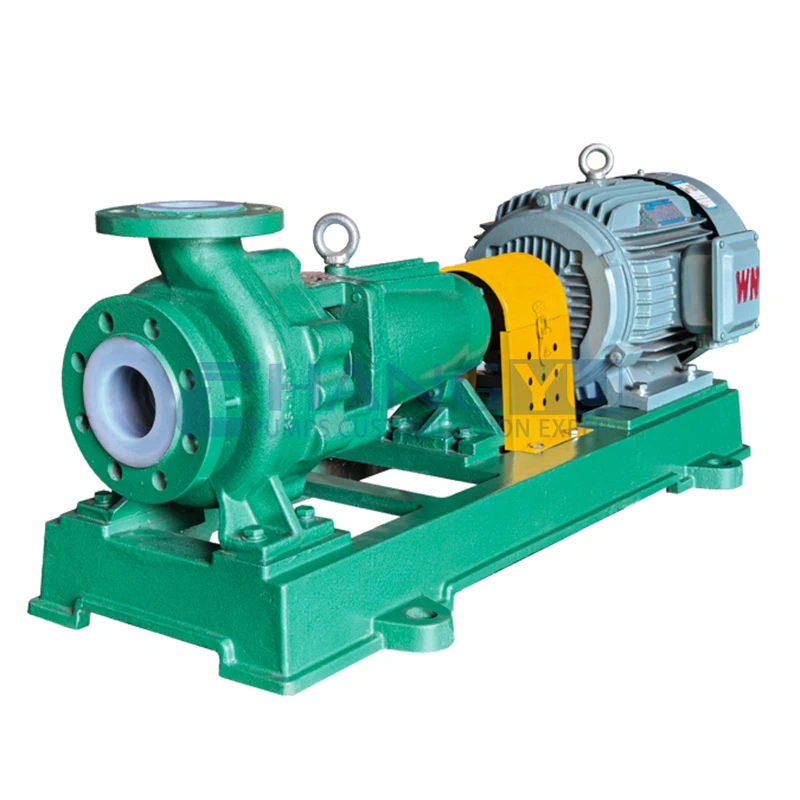
IHF Series Fluoroplastic Lined Centrifugal Pump
The IHF Series is a centrifugal pump with the casing and flow-through components lined in FEP, PFA, or PTFE. The fluoroplastic lining isolates the metal casing from the acid, providing verified chemical compatibility for sulfuric, hydrochloric, nitric, phosphoric, and hydrofluoric acids within the liner’s temperature rating (PFA to approximately 180°C). Designed for high-flow acid transfer, reactor feed, and recirculation duties, the IHF Series is widely deployed in chemical processing, electroplating, and environmental protection industries. The fluoroplastic lining eliminates the trade-off between corrosion protection and mechanical durability — the PFA or PTFE layer provides near-universal chemical resistance, while the steel casing absorbs pipe loads and pressure stresses.
Key Specifications: Flow 1.6–2,600 m³/h | Head 5–130 m | Power 1.5–110 kW | Speed 1,450–2,900 r/min | Temperature -20°C to 180°C

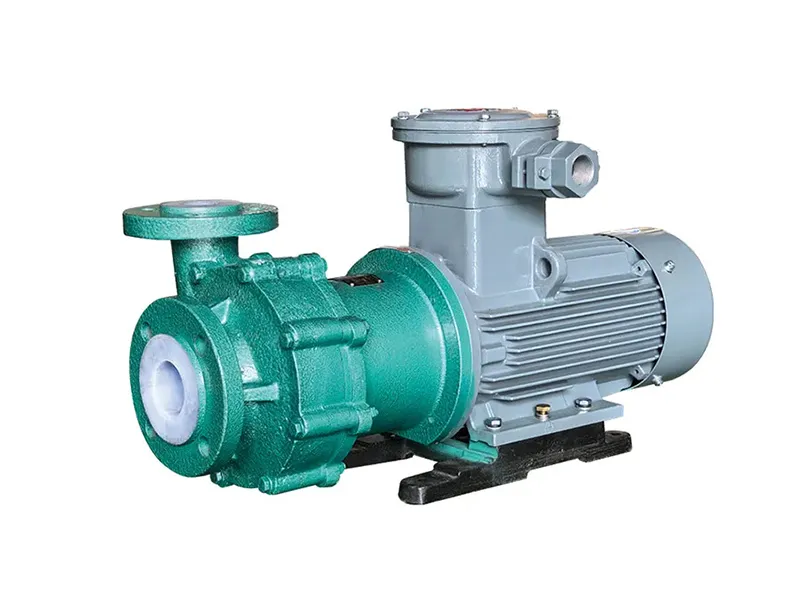
CYQ Series Chemical Resistant Magnetic Drive Pump
The CYQ Series is a sealless magnetic drive pump with wetted components lined in FEP, PFA, or PTFE. Torque is transmitted from a standard motor across a stationary containment sleeve, enclosing the process fluid in a fully sealed chamber and achieving zero leakage by design. For hazardous acids — hydrochloric, hydrofluoric, concentrated sulfuric — the magnetic drive design eliminates the mechanical seal and its associated leak path. The NdFeB magnet rotor is rated at 35–45 MGOe, delivering the torque density required for acids with elevated specific gravity.
Key Specifications: Flow 3–800 m³/h | Head 15–125 m | Power 2.2–110 kW | Speed 2,950 r/min | Temperature -20°C to 180°C
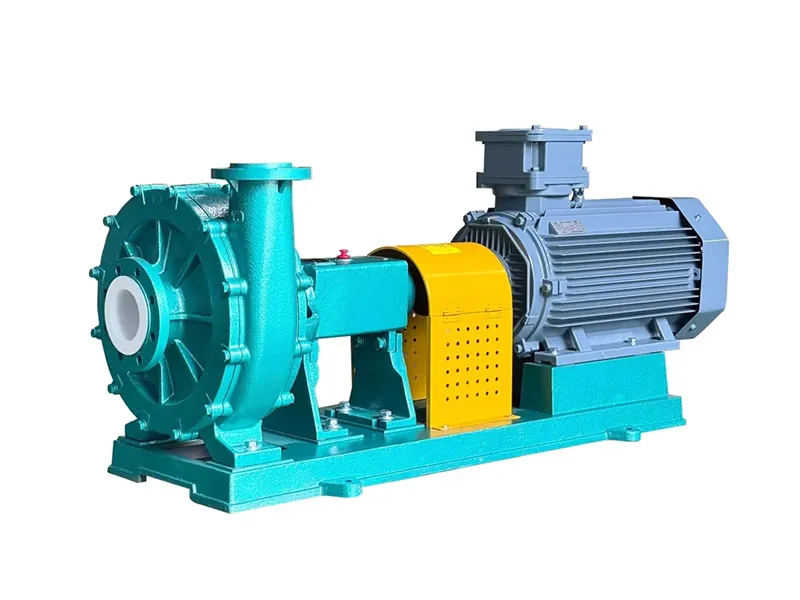
UHB Series UHMWPE Corrosion Resistant Pump
The UHB Series is a cantilever, single-stage, single-suction centrifugal pump with a casing lined in UHMW-PE (ultra-high molecular weight polyethylene). Designed for chemically aggressive and abrasive-corrosive fluids, the UHB Series provides combined corrosion and wear protection for wet-process phosphoric acid, acid slurries, and acidic wastewater containing suspended solids. Thickened imported wetted parts and widened flow passages ensure stable long-term operation in harsh chemical environments. For acid services where abrasive particles or crystallizing solids are present alongside the acid — conditions that would destroy a standard mechanical seal — the UHB Series provides the wear resistance required for reliable continuous operation.
Key Specifications: Flow 3–2,600 m³/h | Head 5–100 m | Power 0.75–300 kW | Speed 750–2,900 r/min | Temperature -20°C to 90°C
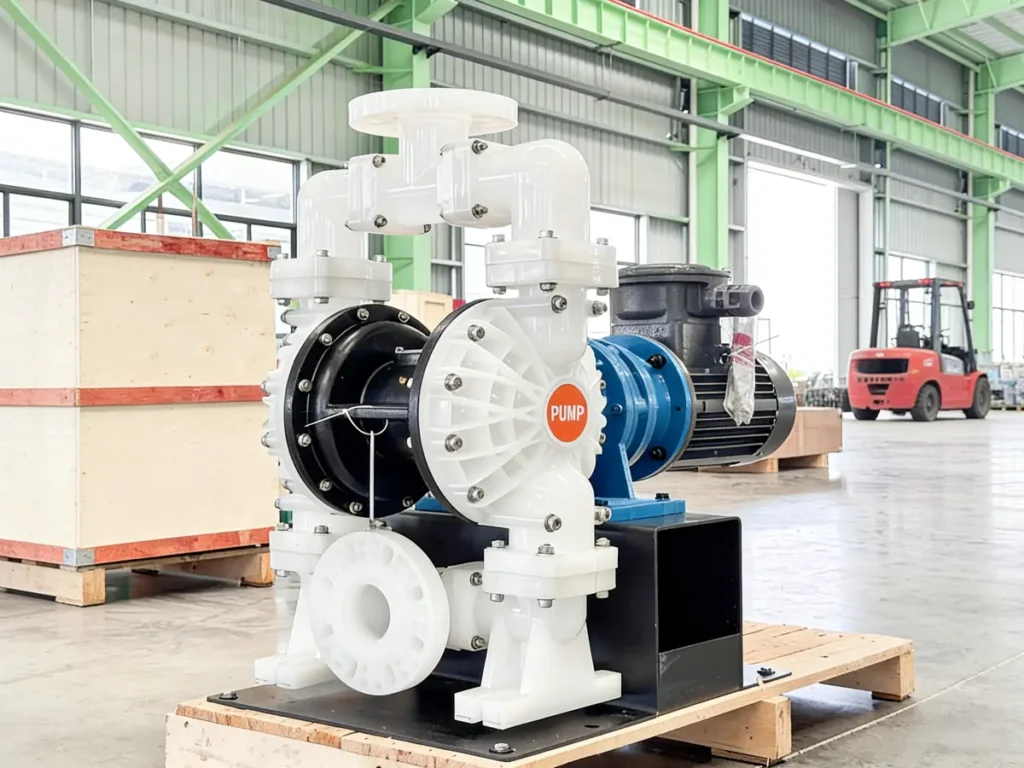
BFD Series Electric Diaphragm Pump
The BFD Series is a motor-driven electric diaphragm pump that provides stable, continuous flow without compressed-air infrastructure. The diaphragm forms a sealless barrier between the process fluid and the drive mechanism, making it suitable for corrosive, abrasive, high-viscosity, and volatile acids. Body materials span cast steel, ductile iron, aluminum alloy, PP, stainless steel, and PVDF, enabling material matching to the specific acid chemistry. When paired with a variable-frequency drive, the BFD Series delivers precise, adjustable flow rates — an advantage for dosing and metering applications. For acid transfer applications containing particles, solids, or high viscosity — conditions where centrifugal and magnetic drive pumps are not recommended — the BFD Series provides the required solids tolerance and chemical compatibility.
Key Specifications: Flow up to 480 L/min | Head up to 84 m | Power 0.75–45 kW | Temperature -20°C to 120°C
Frequently Asked Questions
Q1: How do materials differ for sulfuric, hydrochloric, and nitric acid transfer?
A: Each acid attacks materials through a distinct mechanism. Sulfuric acid is concentration-dependent: PP serves dilute acid (≤40%) at moderate temperatures, while concentrated acid above 80% requires PVDF or PTFE/PFA. Hydrochloric acid attacks metals through chloride pitting — stainless steels fail rapidly, making non-metallic materials (PP for ≤37% at ≤25°C, PVDF for higher concentrations, PTFE/PFA for maximum resistance) the standard specification. Nitric acid is a strong oxidizer that attacks PP at any concentration; PVDF and 316 stainless steel serve at moderate concentrations and temperatures, while PTFE/PFA provides the broadest compatibility.
Q2: Can a centrifugal pump handle concentrated sulfuric acid?
A: Yes, when constructed from the correct materials. A PFA- or PTFE-lined centrifugal pump provides verified chemical compatibility for concentrated sulfuric acid (80–98%) at temperatures up to approximately 160°C (PFA-lined). 316 stainless steel fails in sulfuric acid above approximately 15% concentration and must not be specified. Carbon steel resists concentrated sulfuric acid at low temperatures in static storage but is not suitable for pump components where the fluid is in motion and the protective iron sulfate layer erodes.
Q3: When should a magnetic drive pump be selected over a mechanically sealed centrifugal pump for acid transfer?
A: Select a magnetic drive pump when the acid is hazardous, toxic, flammable, or high in value — conditions where even minor mechanical seal leakage is unacceptable. Magnetic drive pumps achieve zero leakage by design because there is no rotating shaft penetrating the pressure boundary. For acids containing particles or solids, a mechanically sealed pump with appropriate flush plan or an electric diaphragm pump may be the more practical choice, as magnetic drive pumps require clean fluids to protect the product-lubricated internal bearings.
Q4: Is PP or PVDF better for acid transfer?
A: PP is the more economical choice for dilute sulfuric acid (≤40%) and hydrochloric acid (≤37%) at ambient temperatures below 25°C. PVDF provides superior chemical resistance — it handles concentrated sulfuric acid (up to 98%), hydrochloric acid at all concentrations, nitric acid, and most organic solvents — and offers higher mechanical strength and temperature capability (up to approximately 100°C). For general acid transfer where the specific acid is verified compatible, PP serves well. For concentrated acids, higher temperatures, or oxidizing acids, PVDF is the standard specification.
Q5: How do I select a pump for hydrofluoric acid?
A: Hydrofluoric acid requires PFA-lined pumps with a minimum lining thickness of 15–20 mm. PFA is compatible with HF at the bulk level, but HF permeates fluoropolymers as a small molecule and attacks the underlying metal casing — a failure mode that cannot be detected by external visual inspection. Periodic ultrasonic thickness testing must be performed to verify lining integrity. All silicon-containing materials — including silicon carbide seal faces — must be strictly excluded, as HF reacts with silicon to form destructive silicon tetrafluoride gas.
Q6: What is the best pump for nitric acid transfer?
A: For nitric acid at moderate concentrations and temperatures (≤50%, ≤50°C), PVDF centrifugal pumps or 316 stainless steel pumps serve well — 316 SS is one of the few metals compatible with nitric acid. For concentrated nitric acid (>50%) or elevated temperatures, specify PTFE- or PFA-lined pumps. PP is attacked by nitric acid at any concentration and must not be specified. For high-purity nitric acid in semiconductor applications, PFA-lined magnetic drive pumps are the standard specification.
Q7: What is NPSH and why does it matter for electric acid pumps?
A: Net Positive Suction Head (NPSH) is the pressure available at the pump suction to prevent cavitation — the formation and violent collapse of vapor bubbles at the impeller inlet. For acids at elevated temperatures or with high vapor pressure, NPSHA must be calculated at the maximum operating temperature and must exceed NPSHR by a minimum margin of 1 meter (or NPSHA > 1.3 × NPSHR). Cavitation causes noise, vibration, and pitting damage to the impeller, significantly shortening pump service life.
Q8: What maintenance does an electric acid pump require?
A: Daily: monitor motor current, discharge pressure, and check for visible leakage or unusual vibration. Weekly: verify seal flush flow (if applicable) and bearing temperature. Monthly: measure impeller clearance, inspect O‑rings and gaskets for chemical attack. Quarterly: full wet-end inspection and bearing lubricant replacement. Annually: complete disassembly and replacement of all wear components. Every inspection must be preceded by thorough flushing of the pump to remove residual acid — personnel must wear acid-resistant gloves, face shields, and protective aprons.
Expert Selection Recommendations from Changyu Pump Engineers
- Match materials to the specific acid, not to a generic “acid-resistant” label. Each acid attacks materials through a distinct corrosion mechanism. Hydrochloric acid attacks metals; nitric acid attacks PP; hydrofluoric acid permeates fluoropolymers. The material must be verified against the specific acid at its operating concentration and maximum temperature. For concentrated hydrochloric acid, non-metallic materials are the default selection, with Hastelloy C-276 providing limited service life only in very dilute concentrations at ambient temperature.
- Specify zero-leakage containment for hazardous acids. Magnetic drive pumps eliminate the mechanical seal — the most common leak path. For hydrochloric, hydrofluoric, concentrated sulfuric, and nitric acids, the sealless magnetic drive design is the standard specification for safe, compliant operation.
- Verify motor sizing for the acid’s specific gravity. Concentrated sulfuric acid at specific gravity 1.84 requires substantially more motor power than water at the same flow and head. An undersized motor that trips on overload during acid transfer creates a safety hazard when the pump stops with acid in the casing.
- Select the pump type matched to the acid’s physical properties. Centrifugal pumps (lined or all-plastic) serve high-flow, low-viscosity acid transfer. Magnetic drive pumps provide zero-leakage containment for hazardous acids. Electric diaphragm pumps handle acids containing particles, solids, or high viscosity — conditions where centrifugal and magnetic drive pumps are not recommended.
Conclusion
An electric acid transfer pump must be specified as an integrated system: the pump material, pump type, and sealing technology are selected together based on the specific acid’s chemistry, concentration, and temperature. The acid determines the material. The material and operating conditions determine whether a centrifugal pump, magnetic drive pump, or electric diaphragm pump is the appropriate choice. And the acid’s hazard classification determines whether a mechanical seal, double seal with barrier fluid, or sealless magnetic drive design provides the required containment.
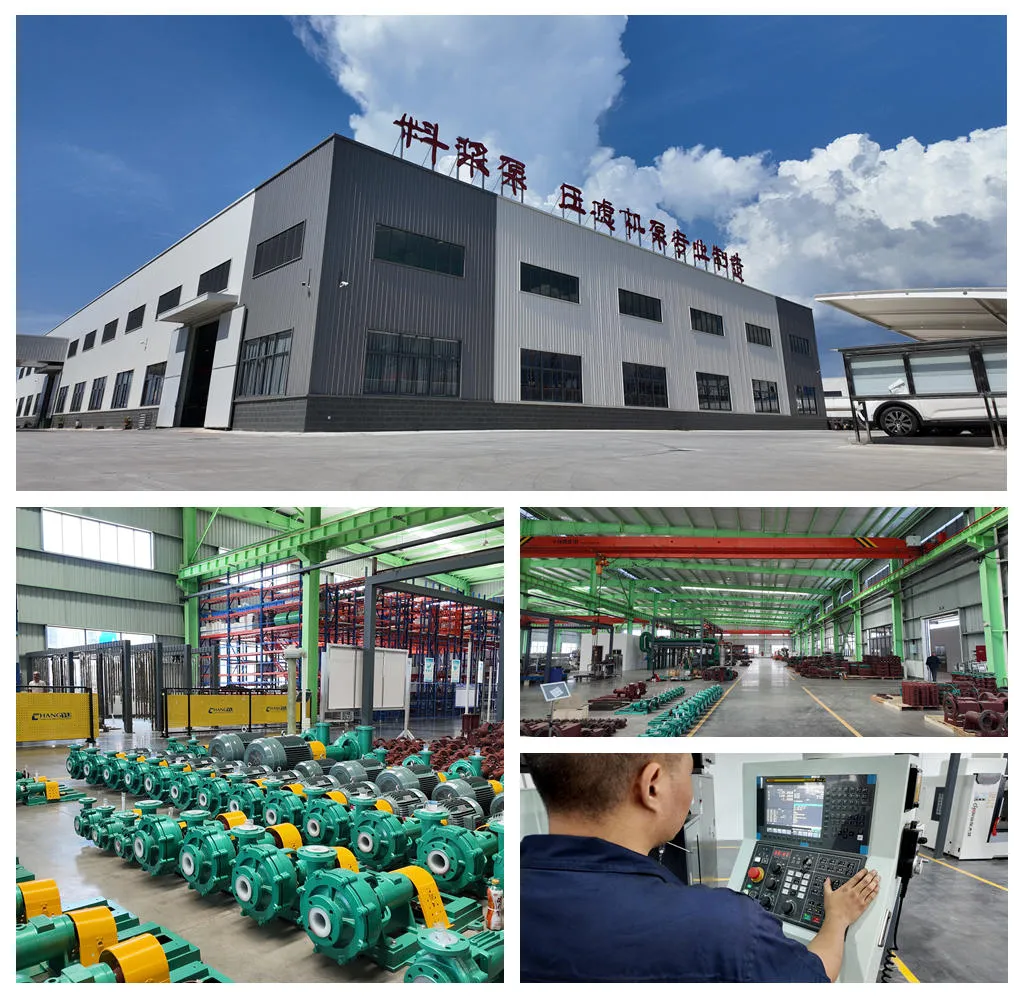
Contact Changyu Pump with your acid parameters and process requirements. Our engineering team will provide a detailed pump recommendation and quotation tailored to your application.