
Introduction
Acid drum pump selection is a safety decision disguised as an equipment purchase. When an operator inserts a pump tube into a 55-gallon drum of hydrochloric acid, sulfuric acid, or aggressive solvent, the pump becomes the only barrier between a contained chemical and a workplace exposure incident. Standard utility pumps fail rapidly in this role—their materials corrode, their seals leak, and standard motors lack the explosion-proof construction required for hazardous atmospheres. A properly specified acid drum pump, verified against the specific chemical at its operating temperature, turns that risk into a routine, controlled transfer.
Changyu Pump has spent over 20 years engineering corrosion-resistant fluid-handling equipment for chemically aggressive industries. This guide covers the materials science, safety standards, and selection framework that determine whether a drum pump performs reliably or creates a hazard. Contact us with your chemical parameters for a specific recommendation.
What Is an Acid Drum Pump?
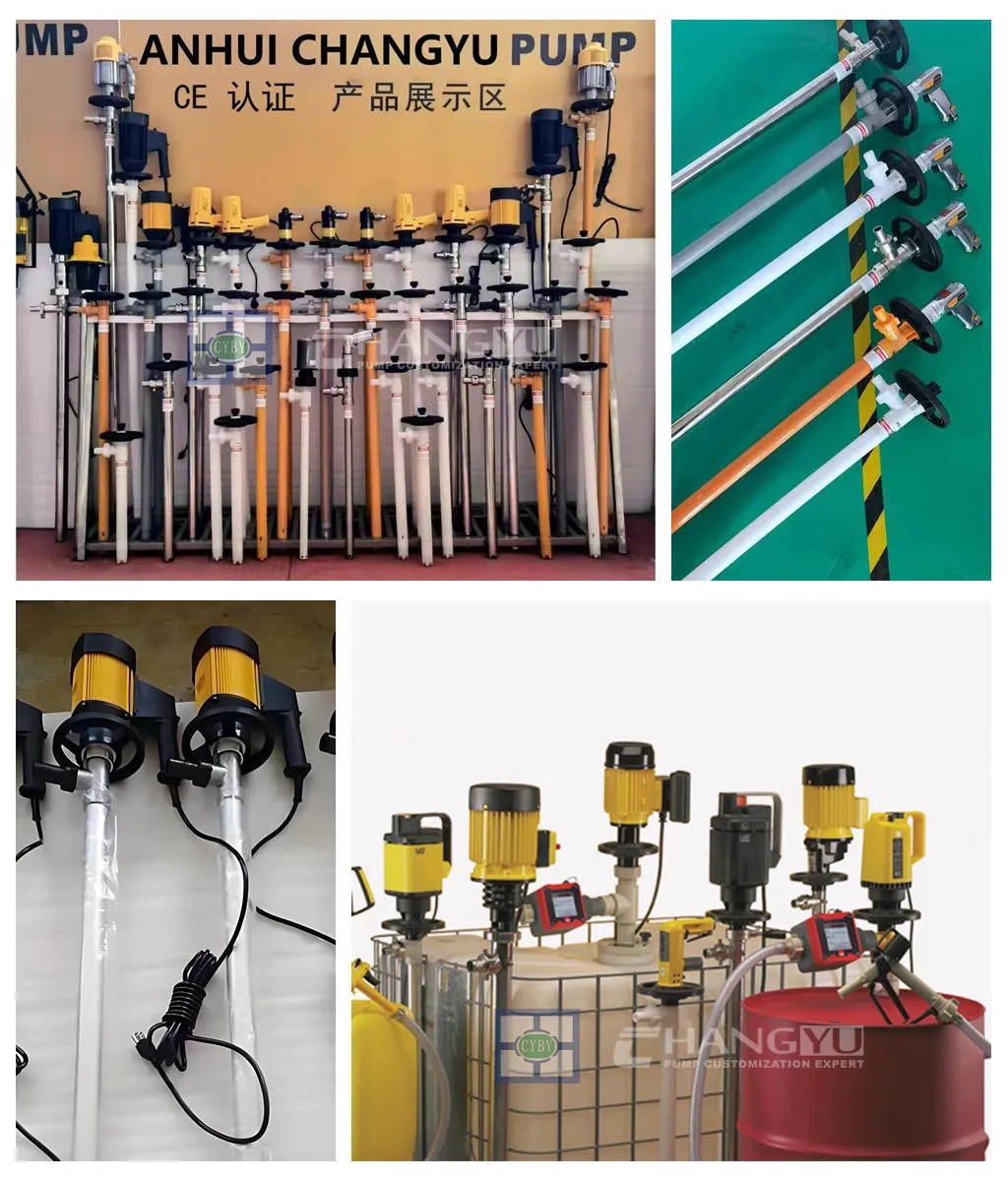
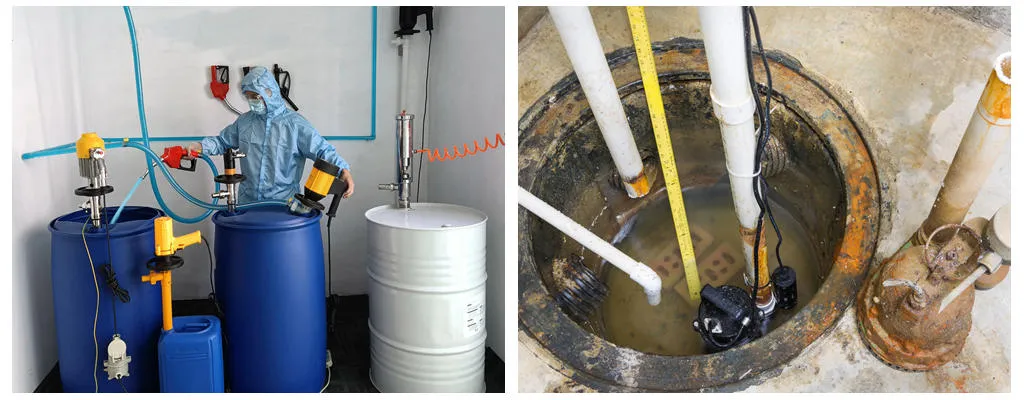
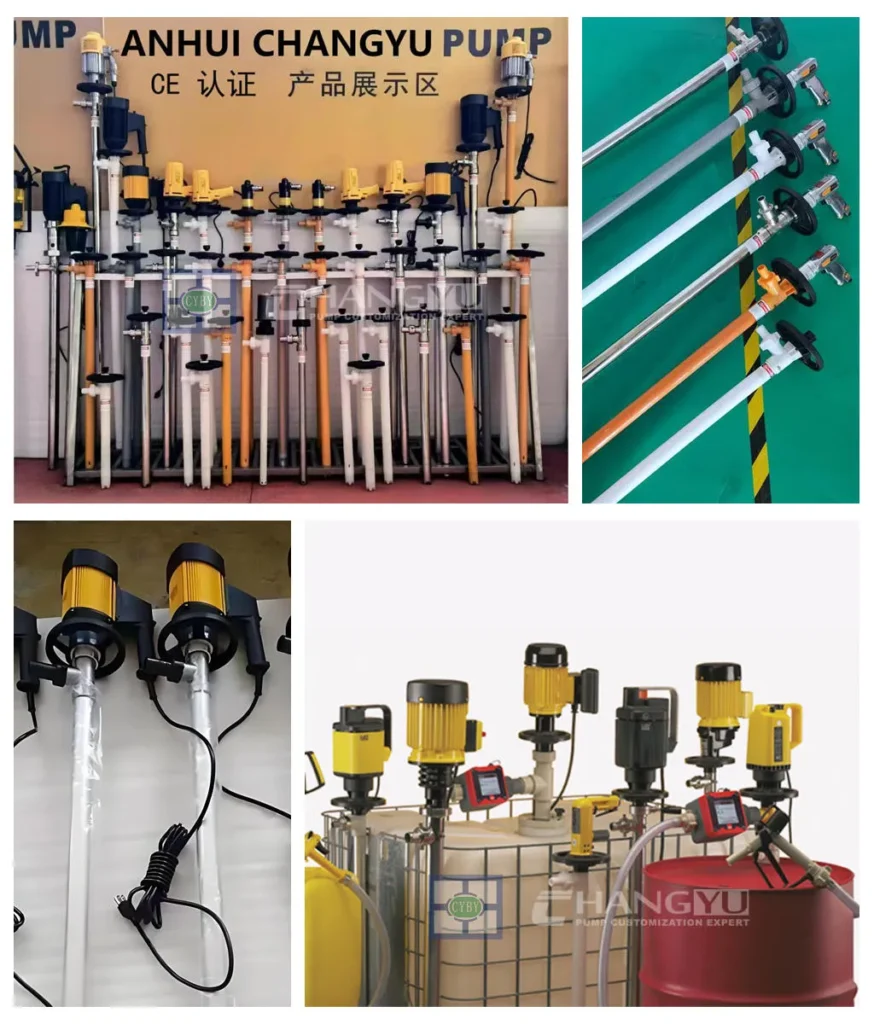
An acid drum pump—also known as a barrel pump or chemical transfer pump—is a portable, vertically oriented pump specifically designed to extract corrosive chemicals directly from drums, barrels, and intermediate bulk containers (IBCs). The pump tube inserts through the drum’s 2-inch bung opening, with the motor mounted above the drum and the impeller submerged near the bottom. This configuration eliminates the need to tilt heavy drums, pour chemicals manually, or install fixed piping for intermittent transfers.
Most chemical drum pumps operate on the centrifugal pump principle: a long drive shaft, running through the center of the pump tube, connects the motor to a small impeller at the bottom. When the motor spins the shaft, the impeller rotates at high speed, using centrifugal force—the same force that keeps water in a spinning bucket—to fling the liquid outward and upward through the pump tube to the discharge port. This continuous, smooth transfer mechanism is well-suited to the moderate flow rates and heads typical of drum emptying operations. For a broader understanding of how centrifugal pumps handle corrosive chemicals, please contact us.
The engineering distinction between an acid drum pump and a general-purpose utility pump is material compatibility. Every wetted component—the pump tube, impeller, shaft, seals, and O‑rings—must withstand the specific chemical at its operating concentration and temperature. A PP (polypropylene) pump tube that performs reliably with 30% sulfuric acid at room temperature can soften and fail within hours when exposed to hot concentrated nitric acid. The pump tube material, seals, and motor type must all be matched to the chemical’s identity, concentration, and temperature.
| Application | Typical Chemicals | Recommended Pump Material |
|---|---|---|
| Acid transfer from drums | Sulfuric acid (≤98%), HCl, nitric acid | PVDF, PTFE |
| Alkali transfer | Sodium hydroxide, ammonia solution | PP, 316L SS |
| Solvent transfer | Acetone, toluene, alcohols | 316L SS, conductive PVDF |
| High-purity chemicals | Electronic-grade acids, DI water | PTFE, PFA |
| Flammable solvents | MEK, ethanol, ethyl acetate | Conductive PP/PVDF + ATEX/IECEx motor (or air-operated) |
What Materials Are Best for Acid Drum Pump Tubes?
Material selection determines whether an acid drum pump lasts years or fails catastrophically within days. The four most commonly specified materials each have distinct chemical compatibility windows and failure modes that engineers must understand before making a selection.
PP (Polypropylene) is the most economical material for acid drum pumps and provides good resistance to many corrosive chemicals at moderate temperatures. It is important to understand PP’s compatibility in terms of concentration and temperature, not as a simple yes/no property. PP is compatible with hydrochloric acid up to approximately 37% concentration at ambient temperature, and with sulfuric acid up to approximately 40% at ambient temperature. It is attacked by hydrochloric acid above approximately 37% or at elevated temperatures, and by nitric acid above approximately 25% concentration. Specifying a PP pump for concentrated HCl or hot oxidizing acids will result in tube softening and structural failure—a hazardous scenario where the pump tube can collapse during operation.
PVDF (Polyvinylidene Fluoride) provides excellent resistance to concentrated sulfuric acid (up to 98%), hydrochloric acid at all concentrations, and most organic solvents at temperatures up to 100°C. PVDF also offers superior mechanical strength compared to PP and PTFE, making it the standard specification for heavy-duty acid drum pump applications where the pump tube may experience mechanical stress during insertion and removal from drums. For 98% sulfuric acid at specific gravity 1.84, PVDF is the preferred material choice. PVDF also resists nitric acid—a capability that PP cannot match beyond moderate concentrations.
PTFE (Polytetrafluoroethylene) offers near-universal chemical resistance across virtually all industrial chemicals to approximately 120°C. PTFE is the material of choice for aggressive solvent mixtures, hydrofluoric acid, and high-purity applications where any chemical interaction between the pump material and the process fluid is unacceptable. The trade-off is lower mechanical strength than PVDF and higher material cost. For ultra-pure chemical handling in semiconductor and pharmaceutical applications, PTFE or PFA is the standard material.
316L Stainless Steel provides good resistance to mild chemicals, organic solvents, and process water, but has well-documented limits with mineral acids: it fails rapidly in hydrochloric acid at any concentration and in sulfuric acid above approximately 15% concentration. It is not recommended for general acid drum pump service without thorough chemical compatibility verification. In pure dilute phosphoric acid at moderate temperatures, 316L can perform adequately—an important exception—but in the more common “wet process” phosphoric acid containing fluoride impurities and abrasive particles, 316L suffers significant corrosion.
Chemical Compatibility Quick Reference
| Chemical | Concentration | PP | PVDF | PTFE | 316L SS |
|---|---|---|---|---|---|
| Sulfuric Acid | ≤40%, ≤25°C | ✅ | ✅ | ✅ | ❌ (>15% fails) |
| Sulfuric Acid | 40–98% | ❌ | ✅ | ✅ | ❌ |
| Hydrochloric Acid | ≤37%, ≤25°C | ✅ | ✅ | ✅ | ❌ |
| Hydrochloric Acid | >37% or hot | ❌ | ✅ | ✅ | ❌ |
| Nitric Acid | ≤25%, ≤25°C | ⚠️ (limited life) | ✅ | ✅ | ❌ |
| Nitric Acid | >25% | ❌ | ✅ | ✅ | ❌ |
| Phosphoric Acid | ≤85%, ≤80°C | ✅ | ✅ | ✅ | ⚠️ (pure dilute: OK; wet-process: ❌) |
| Sodium Hydroxide | ≤50% | ✅ | ✅ | ✅ | ✅ |
| Acetone / MEK | 100% | ⚠️ | ✅ | ✅ | ✅ |
| Hydrofluoric Acid | Any | ❌ | ❌ | ✅ | ❌ |
The most common material selection mistake: assuming that because a material “resists” an acid at room temperature, it will perform identically at elevated temperatures. Chemical attack rates can double with every 10°C temperature rise. A material that shows no visible degradation after 24 hours at 25°C can fail within hours at 65°C. Always verify material compatibility at the maximum expected operating temperature—not the nominal process temperature.
How Do Acid Drum Pump Motors and Drive Systems Work?
The drive system of an acid drum pump delivers the mechanical power to spin the impeller at the bottom of the pump tube. The choice of motor type is not merely a matter of convenience or cost—it carries direct safety consequences that determine whether the pump is safe for its intended chemical environment.
Electric motor pumps are available in two categories that must be carefully distinguished. Standard (non-explosion-proof) electric motors are the most common drive type for routine transfer of non-flammable acids and alkalis from drums. Available in both corded (115V/230V single-phase) and cordless (battery-powered) configurations, electric drum pumps deliver consistent flow rates up to approximately 200 L/min. However, standard electric motors must never be used for transferring flammable solvents (flashpoint below 60°C) or in areas where flammable vapor atmospheres may be present, because they contain potential ignition sources (commutator sparks, thermal surfaces).
ATEX-certified explosion-proof electric motors are designed, tested, and certified for use in potentially explosive atmospheres. These motors incorporate flameproof enclosures, increased safety terminal boxes, and temperature classification (typically T4 or T5) to prevent ignition of surrounding flammable gases. They are a proven and widely available solution for drum pumps used with flammable solvents in Zone 1 (Category 2G) and Zone 2 (Category 3G) classified areas. When paired with a conductive pump tube and a verified grounding path, an ATEX-certified electric drum pump provides safe, powered transfer of flammable solvents.
Air-operated (pneumatic) pumps contain no electrical components and therefore present no electrical ignition source at the pump. Powered entirely by compressed air, they are a preferred solution for facilities that already have compressed air infrastructure. The trade-off is the requirement for a compressed air supply at the point of use.
Manual (hand-operated) pumps serve low-volume, intermittent transfer applications where power is unavailable or where the transfer volume does not justify a powered pump. They are practical for small-scale sampling, dosing, and laboratory applications, but become physically impractical for transfers exceeding approximately 20–30 liters per cycle.
| Drive Type | Best Application | Flow Rate | Explosion-Proof | Limitations |
|---|---|---|---|---|
| Electric (standard motor) | Non-flammable acids, alkalis, routine transfer | Up to 198 L/min | ❌ Must only be used in non-hazardous areas | Cannot be used with flammable solvents |
| Electric (ATEX/IECEx motor) | Flammable solvents, Zone 1/Zone 2 areas | Up to 198 L/min | ✅ Certified for hazardous areas | Requires grounding cable and conductive tube |
| Battery-powered | Portable use, remote locations | Up to 80 L/min | ❌ (unless specifically ATEX-certified) | Battery life limits continuous use |
| Air-operated | Flammable solvents, hazardous areas | Up to 150 L/min | ✅ No electrical ignition source | Requires compressed air supply |
| Manual | Low-volume sampling, dosing | Variable (hand speed) | ✅ No electrical ignition source | Impractical above ~30 L/cycle |

What Are the Critical Safety Standards and Certifications?
Safety certifications for an acid drum pump are not administrative formalities—they are the documented evidence that the pump has been designed, tested, and certified for use in potentially explosive atmospheres. Understanding which certification applies to your facility is essential before procurement.
For the international market, the ATEX directive (Directive 2014/34/EU) governs equipment intended for use in explosive atmospheres within the European Union and is widely recognized globally. An ATEX drum pump carries a marking indicating the specific zone (Zone 1 or Zone 2 for gas atmospheres) and protection concept under which it is certified. A critical additional parameter on the ATEX marking is the temperature classification (T1 through T6), which indicates the maximum surface temperature the motor can reach during operation. For solvent transfer, the motor’s T-class must be verified against the solvent’s auto-ignition temperature—a motor with a T4 rating (maximum 135°C) is safe for most common solvents, while highly volatile compounds with low auto-ignition temperatures may require T5 (100°C) or T6 (85°C) motors.
IECEx is the international equivalent, providing a globally recognized certification framework that aligns closely with ATEX technical requirements. For facilities exporting products to multiple regulatory jurisdictions, IECEx certification simplifies compliance by providing a single certification recognized across participating countries.
For the domestic Chinese market, ATEX and IECEx certifications are not legally binding. China has its own national explosion-proof standards—the GB 3836 series—which align with IEC standards but require separate certification through Chinese testing bodies. For projects within China, GB explosion-proof certification is the mandatory requirement. ATEX or IECEx certification is required only for export-oriented projects shipping to EU or global markets.
Beyond motor certification, the entire pump assembly must be designed to prevent electrostatic discharge. When pumping non-conductive solvents (such as toluene, hexane, or xylene) through a plastic pump tube at high velocity, the fluid flow can generate static electricity that accumulates on the pump tube surface. Without a proper grounding path, this accumulated charge can discharge as a spark—creating an ignition source regardless of motor certification. Conductive pump tube materials (such as conductive PP or PVDF with carbon-fiber additives) and grounding cables connecting the pump to the drum and a verified earth ground are mandatory for flammable solvent transfer, irrespective of whether the pump uses an ATEX-certified motor or compressed air.
For flammable solvent transfer, three conditions must be met: (1) a pump tube material verified as chemically compatible with the solvent, (2) a drive system appropriate to the hazardous area classification (ATEX/IECEx-certified explosion-proof electric motor, air-operated pump, or manual pump), and (3) a verified static grounding path from the pump through the drum to earth. Any one of these conditions missing creates a potential fire or explosion hazard.


How to Select the Right Acid Drum Pump: A 4-Step Framework
Step 1: Confirm the chemical identity and temperature. Document the exact chemical name, concentration, and maximum temperature including any process-related temperature rise. For mixed chemical streams—common in chemical processing and pharmaceutical manufacturing—verify compatibility for every component of the mixture, not just the primary corrosive agent. A material that resists each chemical individually may fail when the mixture alters the solvent’s polarity or penetrates grain boundaries in the material. Temperature is the most frequently overlooked variable: a material compatible with an acid at 25°C may fail at 65°C, and this temperature dependence must be cross-checked at the maximum possible operating temperature—not just the nominal condition.
Step 2: Evaluate the physical load—viscosity and specific gravity. Fluids with viscosity above approximately 200 cP (centipoise) place additional torque demands on the pump motor. Standard electric drum pump motors may stall or overheat when attempting to pump viscous fluids such as concentrated phosphoric acid or cold glycerol. For sulfuric acid at 98% concentration, the specific gravity of 1.84 means the motor must deliver approximately 84% more torque than it would pumping water at the same flow rate. Confirm that the selected pump motor is rated for the maximum specific gravity and viscosity of the intended fluid.
Step 3: Assess the explosion-proof safety requirement. Classify the transfer area and the chemical’s flashpoint. If the chemical is flammable (flashpoint below 60°C) or the transfer area is classified as Zone 1 or Zone 2, the pump system must meet the corresponding explosion-proof requirements. For the EU and international markets, select an ATEX-certified or IECEx-certified explosion-proof electric motor, or specify an air-operated pump that eliminates the electrical ignition source. For the Chinese domestic market, specify GB 3836-certified explosion-proof motors. Verify the static grounding path in all cases involving flammable solvents, regardless of pump type.
Step 4: Match the drum size and tube length. Standard 55-gallon drums require pump tubes approximately 1,000 mm (39 inches) in length. IBC totes require longer tubes (typically 1,200–1,500 mm). Confirm the tube diameter is compatible with the drum’s bung opening (standard 2-inch NPT). For applications requiring transfer from multiple drum sizes, modular pump tube designs allow tube length adjustment without replacing the entire pump assembly.
Which Acid Drum Pump Is Right for Your Application?
Changyu Pump’s HD Series Chemical Drum Pump is a semi-submersible, vertically oriented chemical transfer pump purpose-built for safe and reliable acid, solvent, and corrosive liquid extraction from drums and barrels. The pump tube and all wetted components are available in 304 stainless steel, 316L stainless steel, PVDF, PP, aluminum alloy, Hastelloy, and engineered plastics, enabling precise material matching to any specific chemical stream.

The HD Series incorporates critical components sourced from internationally recognized manufacturers in Switzerland, Japan, and Taiwan—including deep groove ball bearings, VT fluororubber seals, and TFEP fluoropolymer oil seals—to guarantee material authenticity and long-term structural durability under continuous chemical exposure. The motor is available in multiple power ratings (0.12 kW to 7.5 kW) with variable speed control from 0 to 12,000 r/min, accommodating fluids ranging from thin solvents to high-viscosity and high-specific-gravity liquids. For concentrated sulfuric acid (98% at SG 1.84), the HD Series motor is specifically rated for the additional torque demand, preventing the overheating and stalling issues common with undersized drum pump motors.
Key Specifications: Flow up to 198 L/min | Head up to 30 m | Power 0.12–7.5 kW | Speed 0–12,000 r/min | Temperature ≤110°C | Materials: 304, 316L, PVDF, PP, Aluminum alloy, Hastelloy, engineered plastics
How Was an Acid Drum Pump Seal Failure Resolved? (Case Study)
The problem. A chemical blending facility in Jiangsu Province, China, was experiencing repeated seal failures on the drum pumps used to transfer 37% hydrochloric acid from 55-gallon drums to smaller process containers. The facility had been using PP-bodied drum pumps with standard rubber seals. Operators reported that the pump tube seals began leaking after approximately one month of intermittent use, with visible degradation and cracking of the seal material. Each seal failure released HCl vapors into the workplace, requiring evacuation of the drum storage area. The facility was replacing seals quarterly at an annual per-pump cost of approximately USD 2,800 in parts and labor, plus unquantified productivity losses from repeated work stoppages.
The analysis. Changyu Pump engineers examined the failed components and identified two interacting failure mechanisms. The PP pump tube was chemically compatible with 37% HCl at ambient temperature—a service condition verified against published chemical resistance data for polypropylene. However, the standard rubber seals (a general-purpose material not specified for acid service) were absorbing HCl and degrading through acid-catalyzed hydrolysis. Simultaneously, the pump motor was not equipped with a vapor barrier, allowing trace HCl fumes rising from the drum to attack the motor bearings and electrical connections.
The solution. Changyu Pump replaced the existing PP pumps with HD Series drum pumps featuring PVDF pump tubes and VT fluororubber seals specifically rated for hydrochloric acid service. The PVDF material provided verified chemical compatibility with 37% HCl across the full ambient temperature range of the facility, and the fluororubber seals—being made of a fluoropolymer that resists acid absorption—eliminated the degradation mechanism that had caused the previous seal failures. The integrated vapor barrier on the HD Series motor prevented HCl fumes from reaching the motor compartment.
Measured outcome after 18 months.
- Zero seal replacements required over the 18-month evaluation period
- Annual per-pump maintenance cost reduced from approximately USD 2,800 to under USD 400 (routine inspection only)
- Zero workplace HCl vapor incidents reported—eliminating the evacuation events that had disrupted production
- Pump-related downtime reduced to effectively zero hours
The facility subsequently standardized all acid drum transfer pumps on HD Series units with chemical-specific material matching.
FAQs about Acid Drum Pump
Q1: What is an acid drum pump?
A: An acid drum pump is a portable, vertically oriented pump inserted into a drum or barrel to extract corrosive chemicals without tilting or manual pouring. The pump tube, impeller, and all wetted components are constructed from chemically resistant materials (PP, PVDF, PTFE, or specialty alloys) verified against the specific medium.
Q2: What material is best for a sulfuric acid drum pump?
A: For sulfuric acid up to 40% at ambient temperature, PP is economical and effective. For 40–98% sulfuric acid, PVDF is the standard selection. For 98% sulfuric acid at SG 1.84, PVDF pump tubes paired with a motor specifically rated for high-specific-gravity duty provide reliable long-term performance.
Q3: Can I use the same drum pump for hydrochloric acid and solvents?
A: Only if the pump’s wetted materials are verified against both media. PTFE and PVDF are among the few materials that resist both concentrated HCl and common organic solvents. PP resists HCl only up to approximately 37% at ambient temperature and is attacked by higher concentrations or elevated temperatures. Always confirm compatibility with each specific chemical.
Q4: Why is PVDF preferred over PP for concentrated acids?
A: PVDF resists concentrated sulfuric acid (up to 98%), hydrochloric acid at all concentrations, nitric acid, and most organic solvents—chemicals that attack PP at higher concentrations or temperatures. PVDF also offers superior mechanical strength, reducing the risk of tube breakage during drum insertion and removal.
Q5: Do I need an ATEX-certified pump for acid transfer?
A: It depends on the chemical’s flashpoint and the area classification. For flammable solvents (flashpoint below 60°C) in international markets, select an ATEX/IECEx-certified explosion-proof motor or an air-operated pump. For non-flammable acids (sulfuric, HCl, phosphoric), a standard electric motor is acceptable. For the Chinese domestic market, GB 3836 explosion-proof standards apply. When in doubt, consult your facility’s hazardous area classification drawing.
Q6: Why are fluororubber seals important for acid drum pumps?
A: Standard rubber seals absorb acid and degrade through acid-catalyzed hydrolysis, causing leakage within weeks. VT fluororubber seals resist acid absorption and maintain sealing integrity over extended service life, eliminating the most common failure mode in chemical drum pump service.
Q7: How do I transfer high-viscosity acids from a drum?
A: Fluids above approximately 200 cP place additional torque demands on the pump motor. Select a motor with sufficient power margin for the specific gravity and viscosity of the fluid. For cold or viscous acids, variable-speed control allows the operator to reduce pump speed to match the fluid’s flow characteristics.
Q8: What drum sizes can an acid drum pump accommodate?
A: Standard pumps fit 55-gallon drums (approximately 1,000 mm tube length). For IBC totes, specify longer tubes (1,200–1,500 mm). Confirm the tube diameter is compatible with the standard 2-inch bung opening. Modular designs allow tube length changes without replacing the motor.
Expert Selection Tips from Changyu Pump Engineers
- Verify material compatibility at the maximum operating temperature, not just the nominal condition. Chemical attack rates can double with every 10°C rise. A material performing well at 25°C may fail at 65°C within hours.
- Select PVDF or PTFE for any acid with concentration uncertainty. If the acid concentration in your process fluctuates—common in chemical blending and waste treatment—specify the material that provides a safety margin across the full possible concentration range. PP may be adequate for the nominal condition but fail during a concentration excursion.
- Match motor power to the fluid’s specific gravity, not just the flow rate. 98% sulfuric acid at SG 1.84 requires approximately 84% more motor torque than water at the same flow. An undersized motor that overheats and stalls during operation creates a safety hazard.
- Verify the grounding path for all solvent transfers, regardless of pump type. A non-conductive plastic pump tube pumping a non-conductive solvent generates static electricity. Conductive tube materials and a verified grounding cable from the pump to the drum and to earth ground are mandatory for flammable solvent safety.
- Do not overlook seal material compatibility. The pump tube material may be correctly specified for the acid while the seals are not. VT fluororubber seals provide the chemical resistance required for acid and solvent service and eliminate the most common failure point in chemical drum pump operation.
Conclusion
An acid drum pump is defined by the chemical it handles and the safety it provides. Specifying the right pump requires systematic verification of material compatibility at the maximum operating temperature, selection of a drive system appropriate to the chemical’s flashpoint and the area’s hazardous zone classification, and confirmation that the motor is rated for the fluid’s specific gravity and viscosity. Whether the application calls for routine sulfuric acid transfer from drums, safe extraction of flammable solvents, or high-purity chemical handling, the same methodology applies: verify the chemistry, match the materials, select the drive system for safety, and confirm the physical load.
Contact Changyu Pump with your chemical parameters and transfer requirements. Our engineering team will provide a detailed pump recommendation and quotation.