
Quick Answer
Seawater pumps are industrial pumps engineered to withstand a corrosive environment that attacks through localized, often concealed mechanisms. With chloride concentrations of 19,000–23,000 mg/L, seawater breaks down the passive oxide layer on stainless steels through pitting, crevice corrosion, and stress corrosion cracking — damage that can perforate components while leaving surrounding surfaces intact. Key selection factors include:
- (1) Material selection — the single most critical decision. The Pitting Resistance Equivalent Number (PREN) quantifies this: 316L (PREN 23–28) falls short of the minimum PREN 32–35 required for continuous seawater immersion. Duplex 2205 (PREN 33–36) provides the baseline; super duplex 2507 (PREN 40–44) handles warm or sandy seawater; 6Mo super austenitic (PREN 43–48) and titanium serve the most aggressive stagnant or high-temperature conditions.
- (2) Pump configuration — vertical long-shaft pumps dominate seawater intake; horizontal centrifugal pumps serve in-plant transfer; submersible pumps address deepwell installations.
- (3) Protection strategy — cathodic protection (essential), anti-fouling measures, and freshwater flushing during standby collectively determine whether a correctly specified pump achieves its design life or fails prematurely.
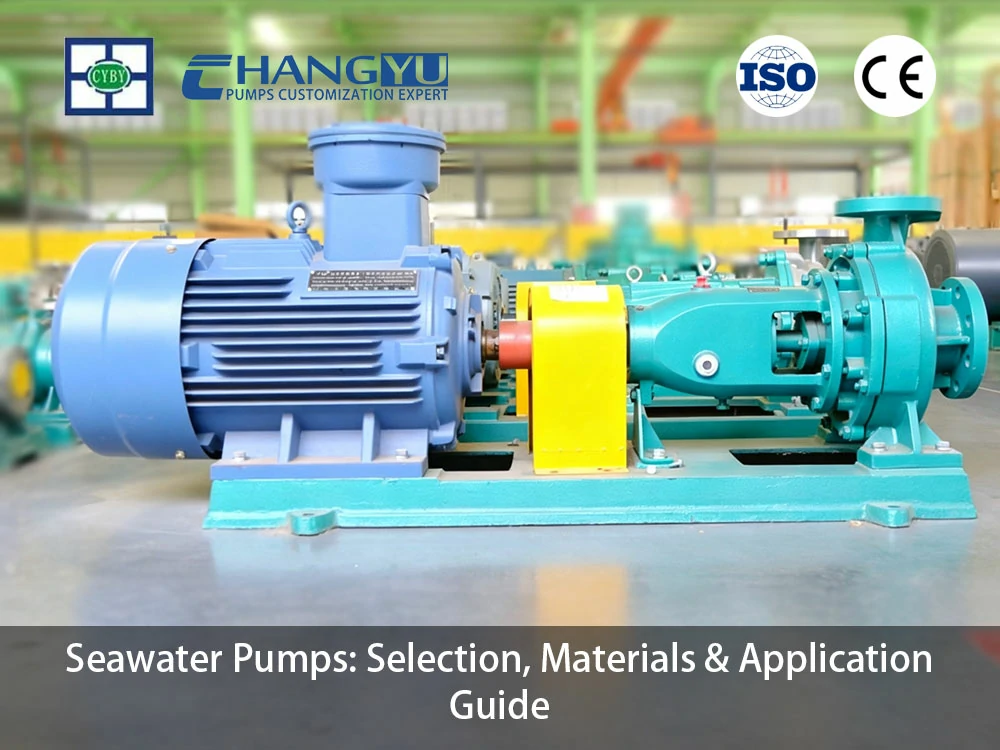
Seawater corrodes differently from strong acids. Where acids visibly dissolve metal surfaces, seawater attacks through localized mechanisms that are often invisible until a component fails. Chloride ions penetrate the passive oxide layer on stainless steels at discrete points, creating deep pits while surrounding material remains untouched. The difference between a pump that fails in two years and one that operates reliably for twenty often comes down to a single specification decision: material selection.
Changyu Pump has manufactured corrosion-resistant pumps for desalination, coastal power generation, offshore platforms, and marine applications over two decades of continuous seawater service. This guide walks through the material options, pump configurations, protection methods, and standards that determine whether a seawater pump delivers reliable long-term performance or becomes a recurring maintenance problem.
1. What Are the Main Types of Seawater Pumps?
Seawater Pump Configurations: Vertical, Horizontal, and Submersible Designs
Seawater pumps fall into three structural categories, each suited to different intake arrangements and plant layouts.
Vertical Turbine Pumps:
The workhorse of seawater intake. A motor mounted above the waterline on a discharge head drives a shaft extending down to submerged impellers. This elevation keeps electrical components away from the corrosive environment — a fundamental advantage in seawater service. Vertical pumps handle flow rates from hundreds to over 20,000 m³/h at moderate heads, naturally accommodate tidal variation without priming systems, and dominate cooling water, firewater, and desalination feed applications.
Horizontal Centrifugal Pumps:
Where vertical pumps handle intake, horizontal pumps manage in-plant duties. Installed at grade with flooded suction, they offer easier maintenance access than vertical designs — the complete pump is accessible without extracting elements from a sump. Common applications include RO membrane feed boosting, secondary cooling loops, and firewater pressure maintenance. Every wetted component — casing, impeller, shaft, mechanical seal — requires seawater-grade material specification.
Submersible Pumps:
Motor and pump integrated into a single submersible unit. These serve deepwell seawater supply and caisson installations where the shaft length required for a vertical turbine pump becomes impractical. Hermetic motor sealing, corrosion-resistant construction, and double mechanical seals with moisture detection are standard requirements.
Seawater Pump Applications: From Desalination to Offshore Platforms
| Pump Type | Configuration | Flow Range | Typical Service |
|---|---|---|---|
| Seawater lift / intake | Vertical turbine | 500–20,000+ m³/h | Cooling water, desalination feed, firewater |
| Cooling water circulating | Vertical or horizontal | 1,000–50,000+ m³/h | Once-through condenser cooling |
| RO high-pressure feed | Horizontal multistage | 50–500 m³/h | SWRO desalination membranes |
| Firewater | Vertical or horizontal | 200–5,000 m³/h | Offshore platform and coastal fire protection |
| Seawater booster | Horizontal | 50–2,000 m³/h | In-plant transfer, pressure boosting |
| Bilge / ballast | Horizontal or submersible | 20–500 m³/h | Shipboard seawater systems |
2. What Are the Key Materials for Seawater Pumps?
Seawater corrosion mechanics differ fundamentally from freshwater corrosion. In freshwater, general corrosion dominates — metal dissolves uniformly. In seawater, chloride ions attack the passive oxide layer on stainless steels at discrete points, creating deep pits that penetrate through the material while surrounding surfaces remain untouched. This localized attack makes material selection far more consequential than in standard industrial pump applications.
Quantifying Pitting Resistance: The PREN Method
The Pitting Resistance Equivalent Number (PREN) predicts stainless steel resistance to chloride-induced pitting:
PREN = %Cr + 3.3(%Mo) + 16(%N)
For duplex grades containing tungsten: PREN = %Cr + 3.3(%Mo + 0.5%W) + 16(%N)
A PREN of 32–35 is the minimum recommended threshold for continuous seawater immersion. Values above 40 are specified for warm water (above 25°C), stagnant conditions, or high-chloride environments.
As a practical example, super duplex 2507 (typical composition: 25% Cr, 4% Mo, 0.27% N) yields:
PREN = 25 + 3.3(4) + 16(0.27) = 25 + 13.2 + 4.32 = 42.52
This PREN above 40 explains why 2507 withstands warm seawater conditions that would rapidly pit 316L (PREN typically 23–28).
Material Options for Seawater Pump Construction
| Material | Typical Grades | PREN Range | Suitable For | Watch Points |
|---|---|---|---|---|
| 316L Stainless | UNS S31603 | 23–28 | Brackish water; intermittent contact with thorough freshwater flushing | Pitting initiates above 15–20°C in continuous seawater — not recommended |
| Duplex 2205 | UNS S31803/S32205 | 33–36 | Continuous seawater below 30°C; good chloride stress corrosion cracking resistance | Upper temperature limit; avoid stagnant warm seawater |
| Super Duplex 2507 | UNS S32750 | 40–44 | Warm seawater; high-flow; sandy/erosive conditions | Higher cost; verify PREN on material certificates |
| 6Mo Super Austenitic | UNS N08367/N08904 | 43–48 | Warm, stagnant seawater; where crevice corrosion is the primary concern | Higher cost; lower mechanical strength than duplex |
| Nickel-Aluminum Bronze | C95800 | Non-stainless | Traditional impeller and casing material | Requires cathodic protection; dealloying risk |
| Titanium Grade 2 | UNS R50400 | Immune to Cl pitting | Ultimate resistance; withstands seawater up to ~80°C | High cost; crevice corrosion risk above 80°C; not suitable for fluoride-containing seawater at any temperature |
Matching Pump Materials to Seawater Conditions
| Seawater Condition | Temperature | Flow | Material | Minimum PREN |
|---|---|---|---|---|
| Cold, clean | < 20°C | < 2 m/s | Duplex 2205 | ≥ 33 |
| Warm, clean, flowing | 20–35°C | > 1 m/s | Super Duplex 2507 | ≥ 40 |
| Cold, sandy | < 20°C | > 3 m/s | Super Duplex 2507 | ≥ 40 |
| Warm, stagnant | > 25°C | < 0.5 m/s | 6Mo or Titanium | ≥ 43 |
| Deaerated (offshore injection) | Variable | Variable | Super Duplex 2507 (verify NACE MR0175) | ≥ 40 |
Across two decades of seawater pump manufacturing, we have seen the same pattern repeat: 316L specified to save initial cost, pitting corrosion appearing within 12–18 months in warm seawater, and the resulting repair costs and downtime far exceeding the material cost difference. The minimum acceptable grade for continuous seawater immersion is duplex 2205. For water above 25°C, high-chloride environments, or any condition where the pump experiences stagnant seawater during shutdowns, super duplex 2507 or 6Mo is the appropriate specification.
3. Vertical vs Horizontal: Which Seawater Pump Configuration?
The choice between vertical and horizontal configurations is driven by the intake arrangement and maintenance philosophy more than by the seawater chemistry.
Vertical vs Horizontal Seawater Pumps: A Side-by-Side Comparison
| Factor | Vertical Turbine / Long-Shaft Pump | Horizontal Centrifugal Pump |
|---|---|---|
| Footprint | Small at grade; motor elevated above water | Larger footprint; requires pump house or shelter |
| NPSH | Impellers submerged — inherent NPSH advantage; minimal suction concerns | Requires flooded suction or careful NPSH calculation; suction piping losses |
| Maintenance | Motor accessible at grade; pump extraction from sump for major work — requires crane, pipe disconnection | Complete pump at grade; impeller and seal replacement without removing pump casing |
| Seal arrangement | Shaft seal above waterline — reduced leak risk; simpler seal design | Shaft seal in direct seawater contact — requires high-grade mechanical seal with flush |
| Motor environment | Motor above waterline — protected from seawater spray, wave action, and flooding | Motor at grade — requires weather protection and flood risk assessment |
| Tidal response | Self-adjusting with water level | Suction design must cover lowest tide level |
| Reliability factors | Longer shaft line with multiple bearings — more wear points; critical alignment | Shorter shaft, fewer bearings — simpler rotor dynamics; fewer potential failure points |
| Relative cost | Higher — lineshaft, discharge head, sump construction | Lower for standard installations |
| Primary use | Direct seawater intake, cooling water, firewater lift | In-plant transfer, RO feed boosting, firewater boosting |
Choosing Between Vertical and Horizontal Configurations
Vertical pumps are the standard for pulling seawater directly from the sea, a wet well, or a deep sump — anywhere the water level varies, or suction lift would be impractical. Horizontal pumps serve best where flooded suction is available, grade-level access simplifies maintenance, and the pump operates within a controlled plant environment rather than at the intake structure.
4. Where Are Seawater Pumps Used?
Seawater pumps operate across industries that depend on seawater for cooling, processing, or production.
Desalination:
SWRO plants depend on seawater pumps at three critical points: vertical turbine intake pumps drawing raw seawater through traveling screens, horizontal multistage high-pressure pumps driving membrane separation at 60–80 bar, and concentrate discharge pumps returning brine to the sea. Material requirements differ at each stage — intake pumps face raw, unfiltered seawater with all its biological activity and suspended solids, while high-pressure pumps handle screened, filtered seawater but at pressures that amplify any corrosion weakness.
Coastal Power Generation:
Once-through condenser cooling moves enormous volumes — 10,000–50,000+ m³/h per generating unit. Vertical turbine pumps lift seawater from intake channels to the condensers. The combination of high velocity, continuous operation, and the erosive effect of suspended sand demands materials that resist both corrosion and erosion. Firewater pumps, mandated separately by safety codes, must start reliably on demand after extended standby — a condition that makes freshwater flushing during idle periods operationally critical.
Offshore Oil & Gas:
Platform seawater lift pumps supply multiple systems from a common intake: cooling water, firewater, reservoir injection water, and desalinated potable water. The offshore environment compounds the material challenge — limited maintenance access, platform motion, hydrocarbon contamination risk, and mandatory NORSOK M-650 material qualification. A seawater pump failure on an unmanned platform can halt production for days while a replacement is mobilized.
Marine:
Shipboard pumps handle engine cooling, ballast water, firefighting, and bilge pumping. Classification societies impose specific material, testing, and redundancy requirements that vary by vessel type and flag state.
LNG Receiving Terminals:
Open-rack vaporizer seawater pumps operate at 20,000+ m³/h to regasify liquefied natural gas. Seawater temperature drops as it passes through the vaporizer heat exchangers — the cold seawater exiting the exchanger is more aggressive than the ambient-temperature water entering it, a detail that must inform material specification.
5. How to Maintain and Protect Seawater Pumps?
Material selection provides the foundation. Protection practices determine whether the pump achieves its design life.
Cathodic Protection: Sacrificial Anodes and Impressed Current Systems
Cathodic protection (CP) prevents corrosion by making the pump structure the cathode of an electrochemical cell. Two methods are used in seawater pump applications:
- Sacrificial anodes: Zinc or aluminum anodes attached to the casing, impeller, and shaft corrode preferentially, protecting pump components. Anode consumption must be tracked — a completely consumed anode provides zero protection.
- Impressed current cathodic protection (ICCP): An external DC power supply drives a controlled current through inert anodes to the pump structure. ICCP serves large pumps where sacrificial anode replacement logistics become impractical.
Marine Growth Prevention: Coatings, Chlorination, and Freshwater Flushing
Marine organisms — barnacles, mussels, algae — colonize internal pump surfaces, disrupting flow patterns, unbalancing impellers, and creating localized corrosion cells beneath the organism attachment points. Three complementary strategies apply:
- Anti-fouling coatings: Specialized epoxy or silicone-based coatings on pump internals discourage organism attachment.
- Chlorination: Low-dose sodium hypochlorite injection at the intake controls biofouling. Materials exposed to chlorinated seawater must withstand the combined effects of chloride corrosion and oxidizer attack.
- Freshwater flushing: During standby, flushing with freshwater displaces seawater, deprives organisms of their environment, and removes chloride-laden deposits. A 15–20 minute flush every 72 hours — until discharge chloride drops below 500 mg/L, representing a 97%+ reduction from seawater chloride levels — frequently doubles standby pump service life.
6. What Industry Standards Apply to Seawater Pumps?
| Standard | What It Governs | When It’s Required |
|---|---|---|
| NORSOK M-650 | Material manufacturer qualification | Mandatory for Norwegian offshore; widely adopted globally |
| API 610 | Pump design, materials, testing, documentation | Petroleum industry seawater applications |
| ISO 5199 | General industrial centrifugal pump specifications | Standard industrial seawater service |
| NACE MR0175 / ISO 15156 | Materials in H2S-containing environments | Sour seawater (offshore produced water, some coastal locations) |
| ASTM A890 | Duplex stainless steel casting quality | All duplex and super duplex pump castings |
7. Case Study of Seawater Pumps: Solving a Seawater Corrosion Failure in a Coastal Power Plant
A coastal power plant in Southeast Asia operated four vertical turbine pumps supplying condenser cooling water at 28–32°C with moderate suspended sand. The pumps ran continuously with periodic short shutdowns for maintenance, during which seawater remained stagnant in the casings. Original specification: 316L stainless steel impellers and wear rings, cast iron casings with epoxy coating.
Within 18 months, two pumps exhibited declining flow and rising vibration. Disassembly revealed pitting corrosion across the 316L impeller surfaces, concentrated in low-flow zones and the impeller-to-shaft crevice. The casing epoxy had blistered and detached in high-velocity areas, exposing cast iron to direct seawater attack.
The failure mechanism was textbook 316L chloride pitting. At 28–32°C, the PREN of 316L (23–28) is inadequate for seawater — the passive oxide layer cannot regenerate fast enough to prevent pit initiation, particularly in crevices where chloride ions concentrate. The suspended sand accelerated the process by mechanically removing the weakened passive film. The epoxy failure traced to inadequate surface preparation before coating and high-velocity erosion at the volute cutwater.
Resolution — Material Upgrades:
- Impellers and wear rings upgraded to super duplex 2507 (PREN 40–44)
- Casings upgraded to solid duplex 2205 — coating eliminated entirely
Resolution — Protection Measures:
- Zinc sacrificial anodes installed on casing interiors and discharge heads
- Standby pump freshwater flushing implemented: 20-minute flush every 72 hours
- Low-dose sodium hypochlorite injection added at the seawater intake
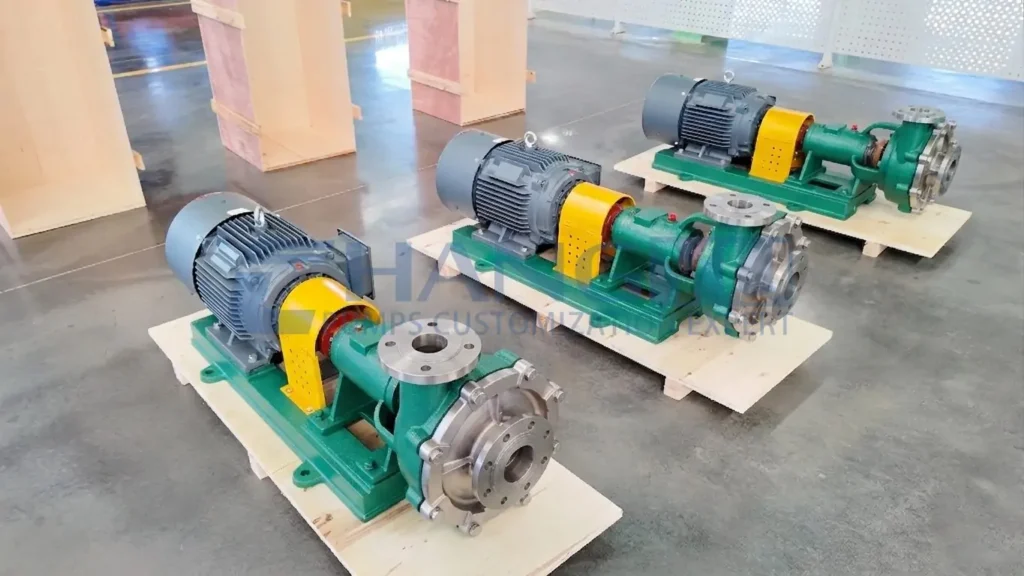
Five years of continuous operation since the upgrade: zero pitting corrosion on the super duplex impellers. Inspection intervals extended from 18 to 36 months. Standby pumps start reliably on demand — freshwater flushing eliminated the stagnant seawater corrosion that previously degraded idle equipment. The plant upgraded all remaining cooling water pumps to super duplex materials during the next scheduled overhaul cycle.
The core lesson extends beyond this single plant: 316L stainless steel cannot withstand continuous immersion in warm seawater. The chloride concentration overwhelms its passive layer at temperatures above 15–20°C. Super duplex 2507, with a PREN above 40, provides the corrosion resistance margin that makes decades-long pump service life achievable. The incremental material cost is recovered through eliminated unplanned downtime and extended maintenance intervals — typically within the first two years of operation.
8. Corrosion-Resistant Seawater Pump Solutions for Industrial Applications
Three pump series serve seawater applications, each addressing a different combination of corrosion severity, flow requirements, and operating temperature.
Matching Changyu Pump Series to Seawater Service Conditions
| Application | Challenge | Series | Material Configuration |
|---|---|---|---|
| Seawater intake, cooling water | Corrosion + high flow | HB Series | Super duplex 2507 or duplex 2205 |
| Cooling water circulation | Corrosion + continuous duty | CYB-ZKJ Series | FEP/PFA-lined casing + duplex impeller |
| Firewater | Corrosion + start reliability | HB Series | Duplex 2205 |
| Chemical dosing, chlorinated seawater | Corrosion + oxidizer attack | CYB-ZKJ Series | FEP/PFA-lined |
| High-temperature seawater (> 80°C) | Corrosion + heat | CYG Series | PFA-lined casing + super duplex or titanium impeller |
HB Series — Stainless Steel Horizontal Pump for Seawater Intake and Transfer
Horizontal centrifugal pump to ISO 2858, all stainless steel wetted construction. Configurable in 316L, duplex 2205, super duplex 2507, or 6Mo for seawater corrosion resistance across the temperature and salinity spectrum.
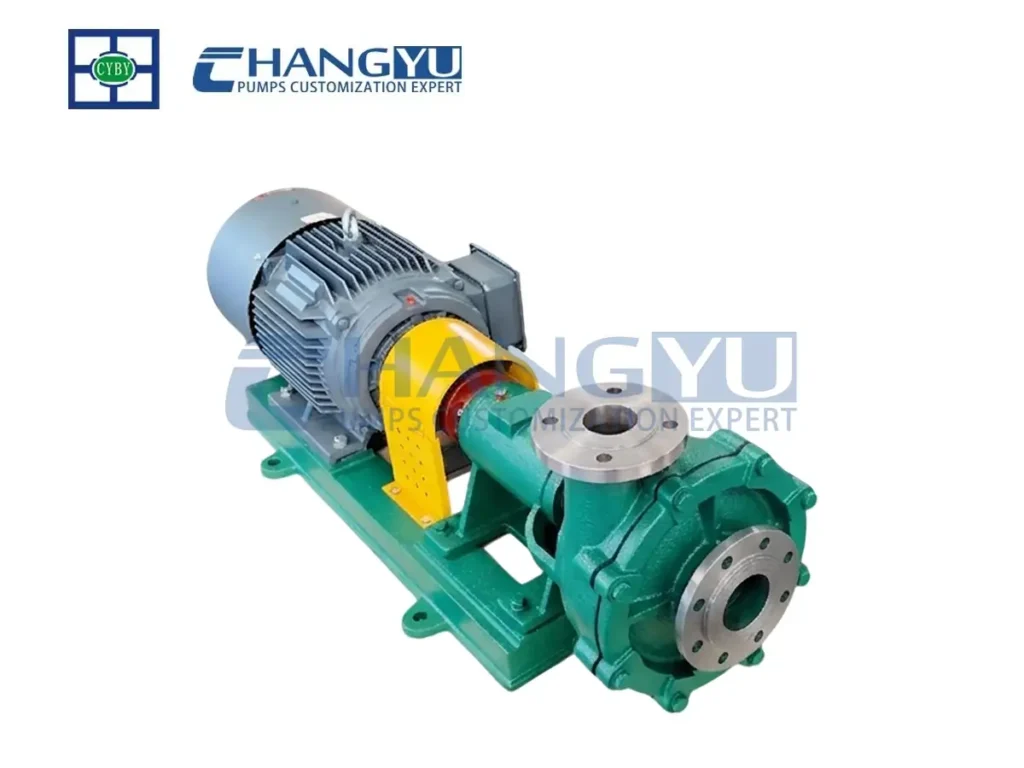
| Parameter | Specification |
|---|---|
| Flow rate | 10–60 m³/h |
| Head | 20–120 m |
| Motor power | 3–45 kW |
| Speed | 2,900 r/min |
| Temperature | -20°C to 120°C |
CYB-ZKJ Series — Fluoropolymer-Lined Pump for Chlorinated and Chemical Seawater Service
FEP/PFA-lined centrifugal pump for seawater applications involving chemical dosing — hypochlorite injection, antiscalant, coagulant — where the pumped fluid is both corrosive and chemically aggressive. The fluoropolymer lining isolates the pump casing from the fluid entirely.
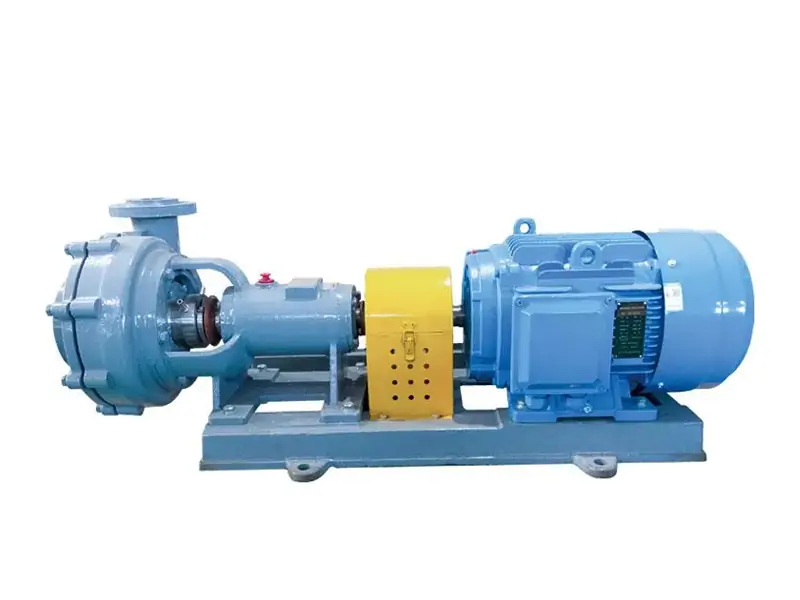
| Parameter | Specification |
|---|---|
| Flow rate | 3–2,600 m³/h |
| Head | 5–100 m |
| Motor power | 0.75–300 kW |
| Temperature | -80°C to 120°C |
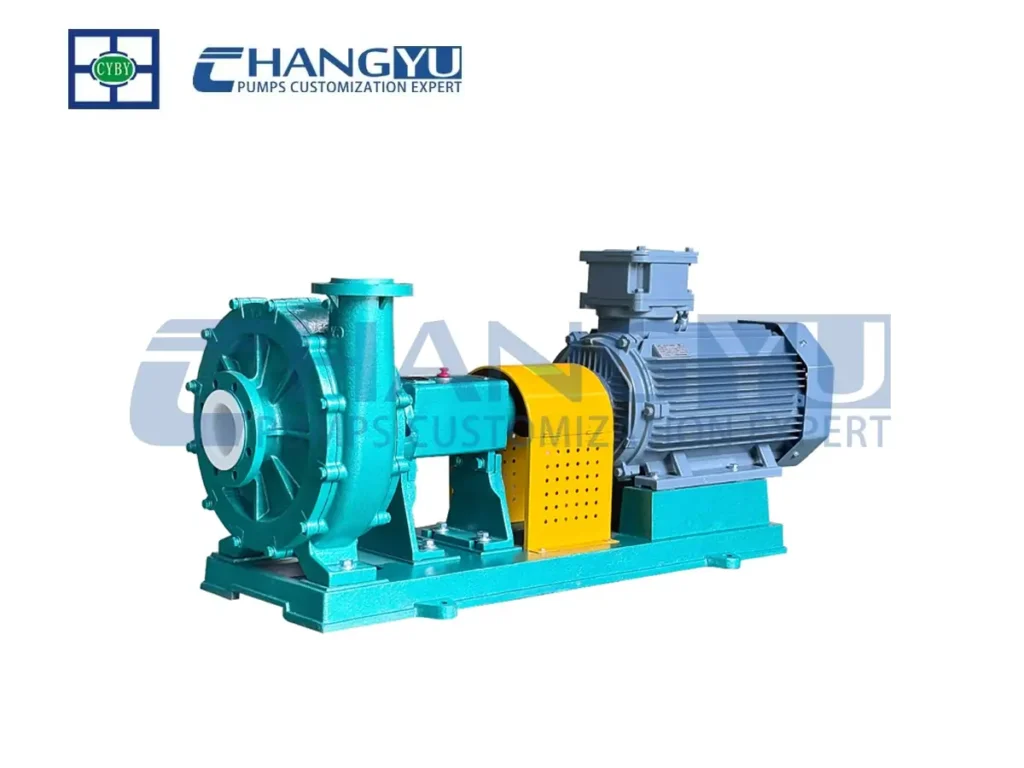
CYG Series — High-Temperature Seawater Pump with Molded PFA Lining
PFA-lined pump with 8–20 mm molded fluoropolymer lining for high-temperature seawater and thermal desalination processes. The sintered lining eliminates the cracking risk associated with mechanically bonded liners under thermal cycling.
| Parameter | Specification |
|---|---|
| Flow rate | 3–2,600 m³/h |
| Head | 5–100 m |
| Motor power | 0.75–300 kW |
| Temperature | -80°C to 160°C |
FAQs about Seawater Pumps
Q: What material should I specify for seawater pump impellers?
A: Super duplex 2507 (PREN 40–44) covers most continuous seawater applications. 6Mo super austenitic (PREN 43–48) handles warm, stagnant conditions where crevice corrosion is the primary risk. Titanium Grade 2 serves the most aggressive environments but is not suitable for fluoride-containing seawater at any temperature.
Q: Can 316L stainless steel work for seawater pumps?
A: Only with significant limitations. Its PREN of 23–28 is insufficient above 15–20°C in continuous immersion. 316L may serve in intermittent seawater contact if the pump receives thorough freshwater flushing after each use, but duplex 2205 is the minimum recommended grade for any continuous duty seawater pump.
Q: What separates 2205 from 2507 duplex stainless steel in practice?
A: 2205 (PREN 33–36) handles cold to moderate seawater adequately below 30°C. 2507 (PREN 40–44) provides the margin needed for warm seawater, high-flow erosion conditions, sandy water, and stagnant shutdown periods. 2507 also offers approximately 25% higher yield strength — relevant for high-pressure pump designs.
Q: How should seawater pumps be protected during standby?
A: Freshwater flush every 72 hours, continuing until discharge chloride drops below 500 mg/L (a 97%+ reduction from seawater levels). Inspect sacrificial anodes at scheduled intervals and replace before they are fully consumed. For extended standby, filling the pump casing with inhibited freshwater provides the most complete protection.
Q: What standards govern seawater pump materials?
A: NORSOK M-650 for offshore material qualification. API 610 for petroleum industry pump design and materials. ASTM A890 for duplex and super duplex casting quality. NACE MR0175/ISO 15156 when seawater contains hydrogen sulfide.
Q: How does suspended sand change material requirements?
A: Sand removes the passive oxide layer mechanically, accelerating erosion-corrosion. The material must provide both high PREN for pitting resistance and high hardness for erosion resistance. Super duplex 2507, combining PREN 40–44 with higher mechanical strength than standard duplex or austenitic grades, is the preferred specification.
Changyu Pump Engineer’s Avoidance Checklist
- Never specify 316L for continuous seawater immersion. Duplex 2205 is the minimum. Above 25°C seawater temperature, super duplex 2507 or 6Mo is required.
- Match PREN to temperature. Minimum PREN 40 for seawater above 25°C. Verify PREN on material certificates — calculated values based on nominal composition are not a substitute for measured values on the actual heat.
- Cathodic protection is mandatory, not optional. Inspect sacrificial anodes at every maintenance interval. Replace before they reach 50% consumption — a partially consumed anode provides diminishing protection.
- Freshwater flush standby pumps every 72 hours. This one procedure frequently doubles standby pump life. Automate it where possible — manual flushing is easily forgotten during extended outage periods. Target discharge chloride below 500 mg/L.
- Verify chlorination material compatibility. Titanium and super duplex stainless resist chlorinated seawater. Standard 316L and many copper alloys do not — chlorination accelerates their corrosion.
- Sand in seawater changes the material equation. Erosion-corrosion removes protective films faster than they can regenerate. Super duplex 2507 handles this combined mechanism; standard duplex 2205 may not provide adequate margin.
- Request full material certification for offshore applications. NORSOK M-650 qualification, heat treatment records, and measured PREN values — not just nominal composition certificates.
- Stock critical spares. Seawater pump components — impellers, wear rings, mechanical seals, shaft sleeves — fail more frequently than their freshwater counterparts. Inventory readiness converts a potential unplanned outage into a planned maintenance event.
Conclusion
Seawater pumps live or die by their material specification. The choice between 316L, duplex 2205, super duplex 2507, 6Mo, and titanium is the single decision that most determines whether a pump operates reliably for decades or becomes a recurring maintenance liability. For continuous seawater immersion, duplex 2205 is the floor — anything below it will fail prematurely. Super duplex 2507 provides the optimal balance of corrosion resistance, mechanical strength, and cost for the majority of warm seawater applications.
Beyond materials, cathodic protection, anti-fouling measures, and freshwater flushing during standby complete the protection strategy. None of these practices are optional in seawater service — each addresses a distinct corrosion mechanism that materials alone cannot defeat.
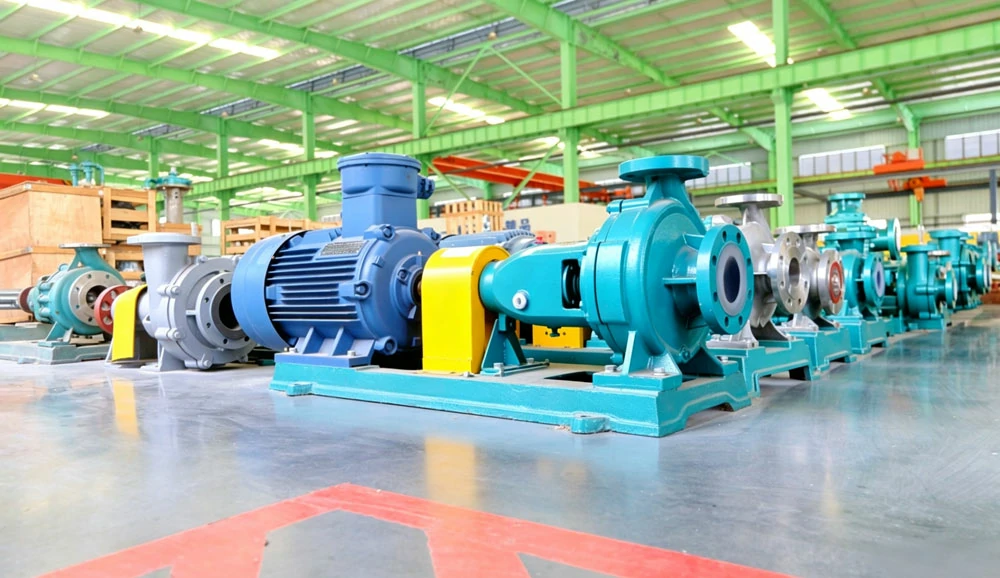
When you are ready to specify a seawater pump, Changyu Pump’s engineering team can provide a technical assessment covering seawater chemistry analysis, material recommendation matched to your operating conditions, and a protection strategy tailored to your installation. Two decades of corrosion-resistant pump manufacturing across desalination, power generation, and offshore applications support every recommendation.
Contact Changyu Pump engineers for a free technical assessment →