
Quick Answer
Large slurry pumps are heavy-duty centrifugal pumps engineered to handle high-volume, high-concentration slurries in mining, dredging, and mineral processing. Unlike standard pumps, they incorporate reinforced casings, oversized bearings, and specialized impeller designs to withstand flows measured in thousands of cubic meters per hour and particles exceeding 100 mm. Key selection factors:
- Structural design: Double-casing construction with replaceable wear liners, heavy-duty oil-bath lubricated bearings, and adjustable impeller clearance — not optional upgrades but design requirements for large-scale slurry service.
- Material selection: High-chrome white iron (CrMo, 600–700 HB) for angular, coarse particles; natural rubber for fine, rounded particles in neutral pH; ceramics for localized high-wear zones.
- Scale amplifies consequences: A 6-month versus 18-month wear life on a large tailings pump represents hundreds of thousands of dollars in replacement parts, days of downtime per event, and climbing energy costs as efficiency degrades.
A large slurry pump is not merely a scaled-up standard pump. Power scales approximately with the fifth power of impeller diameter (Affinity Laws). A single impeller or volute liner can exceed several tons, demanding foundry and machining capabilities fundamentally different from those for smaller pumps. When a large mill discharge or tailings pump fails, the entire concentrator may be forced into reduced production.
Changyu Pump has manufactured heavy-duty slurry pumps for large-scale mining for over two decades. This guide provides a structured framework — from large pump design features, to wear material selection for specific ore characteristics, to evaluating pump specifications for high-volume, high-head slurry service.
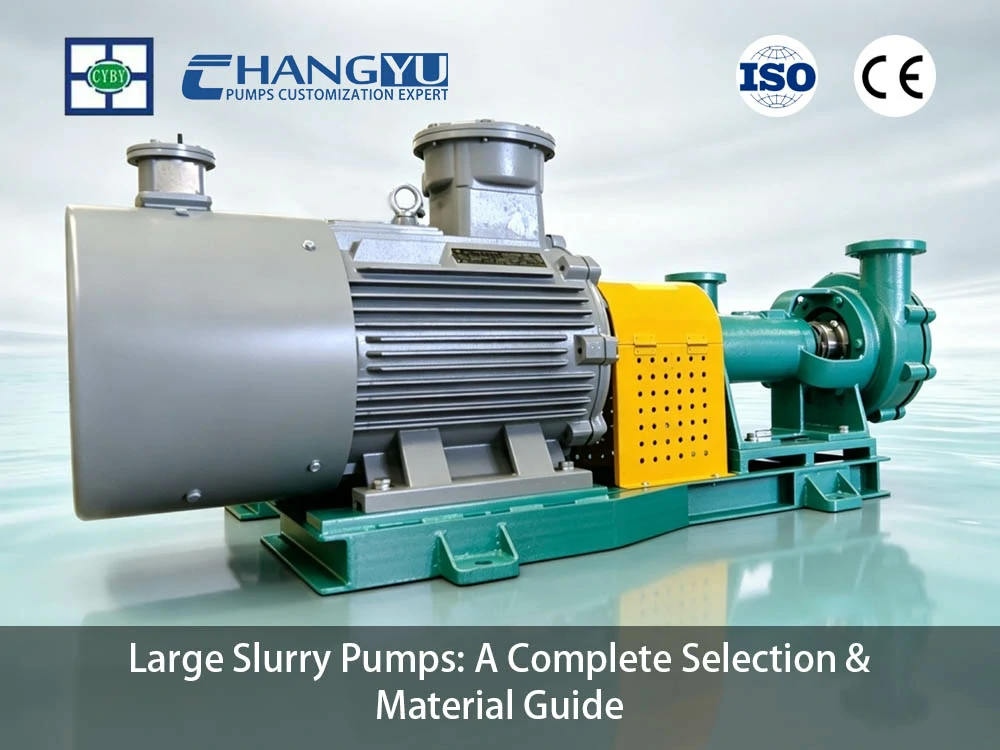
1. What Makes Large Slurry Pump Design Different?
A large centrifugal slurry pump differs from a standard industrial slurry pump in the robustness of its construction and the engineering of its wear management systems. These differences are driven by the fundamental physics of scale: as pump size increases, hydraulic loads, component weights, and the consequences of wear all increase non-linearly.
Double-Casing Construction with Replaceable Liners
Large slurry pumps universally employ a double-casing design. The outer casing — typically ductile iron or cast steel — provides structural integrity and pressure containment. The inner casing consists of replaceable wear liners — volute liners, throatbush, and frame plate liners — that absorb the abrasive action of the slurry. When wear occurs, only the liners are replaced, not the entire pump casing. On a large pump, a single casing replacement would require removing the pump from its foundation, disconnecting large-bore piping, and potentially weeks of downtime. Replaceable liners reduce this to a planned maintenance event completed within a scheduled shutdown window.
Heavy-Duty Bearing Assembly
Large slurry pumps handle slurries with specific gravities routinely exceeding 1.5, imposing radial and axial loads far beyond those encountered in water or clean liquid service. The bearing assembly must absorb these loads continuously while maintaining precise shaft alignment. Large pumps use oversized, oil-bath or forced-oil lubricated heavy-duty roller bearings with L10 rated lives calculated for the specific slurry density and operating conditions. Split bearing housings allow bearing inspection and replacement without removing the pump from its foundation — a maintenance consideration that becomes critical when the pump weighs several tons.
Split Stuffing Box and Seal Access
The stuffing box on a large slurry pump is designed for seal replacement without complete pump disassembly. A split gland design allows the packing or mechanical seal to be serviced while the pump remains in place. On the largest pumps, the stuffing box itself may be a replaceable wear component — the high-velocity slurry at the impeller eye creates localized wear at the shaft entry point that would eventually compromise a fixed stuffing box design.
Adjustable Impeller Clearance
As the impeller and casing wear, the clearance between the impeller front shroud and the suction-side liner increases. This clearance allows internal recirculation — fluid leaking from the high-pressure side of the impeller back to the suction side — which reduces pump efficiency and accelerates localized wear. Large slurry pumps incorporate external impeller adjustment mechanisms that allow this clearance to be reset to the manufacturer’s specification without opening the pump casing. On a large tailings pump, restoring impeller clearance from a worn condition can recover several percentage points of lost efficiency — representing tens of thousands of dollars in annual energy savings.
High-Pressure Sealing Systems
Large pumps in high-head service — long-distance tailings pipelines, series pump installations — operate at discharge pressures that demand robust shaft sealing. Expeller-seal combinations, where a centrifugal expeller reduces pressure at the stuffing box during operation and the packing or mechanical seal provides static sealing during shutdown, are standard on large slurry pumps. For the highest-pressure applications, double mechanical seals with API Plan 54 pressurized barrier fluid systems provide positive containment regardless of discharge pressure.
Long-Distance Pipeline Considerations
A long distance slurry pipeline pump serving tailings transport — often 50 to over 100 kilometers in length — faces additional design requirements. These pumps operate at the upper end of their pressure capability, often in series configurations where multiple pumps discharge into a common pipeline. The pump casing and discharge piping must withstand water hammer pressures from pump starts and stops. Series pump installations require matched performance curves and coordinated control systems to prevent individual pumps from operating outside their allowable operating range.
Engineers at Changyu Pump note: When evaluating suppliers of large slurry pumps, assess the manufacturer’s foundry and machining capabilities directly. The ability to pour high-chrome alloy castings weighing several tons, to machine them to precise tolerances, and to conduct full-speed, full-pressure performance testing on the assembled pump before shipment distinguishes manufacturers with genuine large-pump capability from those supplying scaled-up standard designs. Request photographs of the manufacturer’s foundry, machine shop, and test bay — not just product brochures.
2. What Are the Best Wear Materials for Large Slurry Pumps?
Wear material selection for large slurry pumps must account for particle characteristics, slurry chemistry, and the mechanical loads unique to large-scale operation. The three primary material categories — high-chrome white iron, natural rubber, and ceramics — each occupy a distinct application window.
The Three Primary Wear Materials
High-Chrome White Iron (CrMo):
The standard wear material for large slurry pumps in hard-rock mining. With hardness of 600–700 HB (approximately HV 600–700) and fracture toughness of KIC 25–35 MPa√m, high-chrome white iron combines the hardness to resist cutting by angular particles with the toughness to survive occasional impact from tramp oversize. The microstructure consists of hard chromium carbides (M7C3 type, HV 1200–1600) in a martensitic matrix — the carbides provide cutting resistance, while the matrix provides toughness.
For large pumps, high-chrome alloy selection typically involves choosing between 26% Cr and 28% Cr grades. The higher chromium content produces a greater volume fraction of hard carbides, improving wear resistance at a moderate cost premium (approximately 10–15%). The 28% Cr grade is specified for the most abrasive circuits — iron ore tailings, gold ore with high quartz content, and coarse mill discharge.
Natural Rubber:
Rubber liners protect against wear through resilience — elastic deformation absorbs particle impact energy, and the rubber recovers without material loss. This mechanism works only with rounded particles in neutral pH at temperatures below 70°C. In large pumps, rubber liners are substantially thicker than the equivalent metal liner to provide the resilience required for the larger particles and higher velocities characteristic of large-scale slurry service. However, thicker liners reduce internal flow passage area — hydraulic efficiency must be verified when specifying rubber for large pumps.
Rubber-lined large pumps serve specific applications: copper flotation tailings with fine, rounded particles; coal preparation plant slurries; and mineral sands processing. Rubber is not suitable for angular particles — freshly crushed ore, sharp-edged quartz or magnetite particles cut rubber on contact, reducing service life from months to weeks.
Ceramic (SiC / Al₂O₃):
Ceramic materials offer hardness (HV 1500–2800) far exceeding any naturally occurring mineral particle, providing maximum cutting wear resistance. However, their low fracture toughness (KIC 3–5 MPa√m) makes them vulnerable to impact from particles exceeding 1–2 mm. An additional consideration is chemical stability: SiC degrades in strong alkaline environments (pH > 10) at temperatures above approximately 80°C, while Al₂O₃ maintains stability across a broader pH range. In large pump applications, a further limitation applies: the manufacturing complexity of producing large-format ceramic components. As a result, ceramics in large pumps are typically applied as localized wear protection — ceramic tiles or inserts bonded to a metallic or rubber backing at high-wear zones such as volute cutwaters and impeller vane leading edges — rather than as full monolithic liners.
Wear Material Comparison for Large Slurry Pumps
| Material | Hardness | Best Particle Type | Impact Tolerance | Large Pump Applicability | Relative Cost |
|---|---|---|---|---|---|
| High-chrome CrMo (26–28% Cr) | 600–700 HB | Angular, hard (Mohs > 5) | Good — KIC 25–35 | Universal — standard for mill discharge, tailings | 1× (baseline) |
| Natural rubber | < 50 HB (resilient) | Rounded, soft (Mohs < 4) | Excellent | Limited — fine, rounded particles only; thicker liners reduce flow area | 0.8–1.2× |
| Ceramic (SiC) | HV 2200–2800 | Very fine, non-impact | Poor — KIC 3–5 | Restricted — localized wear protection; not for alkaline pH > 10 above 80°C | 5–8× |
| Ceramic (Al₂O₃) | HV 1500–2000 | Very fine, non-impact | Poor — KIC 3–4 | Restricted — localized wear protection; broad pH stability | 2–4× |
Engineers at Changyu Pump recommend: For large slurry pumps in hard-rock mining applications — iron ore, gold ore, copper tailings with quartz — high-chrome white iron (CrMo, 26–28% Cr) is the appropriate material specification for the majority of wet-end components. The combination of hardness, toughness, and established foundry practice for large castings makes it the most reliable choice for the high-flow, high-head, large-particle conditions characteristic of mill discharge and tailings service.
Natural rubber should be specified only when three conditions are simultaneously met: the particles are rounded (not freshly crushed), the particle size is below approximately 6 mm, and the slurry pH is neutral. For large pumps, the additional liner thickness required for rubber — and the corresponding reduction in internal flow passage area — must be accounted for in the hydraulic design.
Ceramic materials in large pumps are best applied as targeted wear protection — ceramic inserts at the volute cutwater and impeller vane leading edges, where localized velocities and wear rates are highest. Full ceramic liners for large pumps, while technically achievable for smaller sizes, become impractical at the diameters required for flow rates above approximately 500 m³/h.
For a broader comparison of wear materials across the full range of slurry pump applications, see our guide on Wear Resistant Slurry Pump: A Complete Material & Selection Guide.
3. How to Select a Large Slurry Pump for Your Application?
Large slurry pump selection follows a structured process that begins with slurry characterization and proceeds through hydraulic sizing, material specification, and mechanical configuration. Each step is interconnected — a decision made at one stage constrains the options available at subsequent stages.
Step 1: Characterize the Slurry
Define the solids concentration (by weight and by volume), particle size distribution (d50 and d100), particle shape (angular vs rounded), ore hardness (Mohs scale), and slurry pH and temperature. For large pumps, the d100 — the largest particle the pump must pass — is particularly critical. A large mill discharge pump may need to pass tramp oversize up to 150 mm, while a tailings pump handling classified slurry may see a d100 below 1 mm. The d100 directly determines the minimum impeller passage size and influences material selection for impact resistance.
Step 2: Calculate Hydraulic Requirements
Determine the required flow rate and total dynamic head. For large pumps, flow rates are typically measured in thousands of cubic meters per hour, and heads can range from 20 meters for a low-head cyclone feed pump to over 100 meters for a long-distance tailings pump. Apply slurry derating factors to account for the effects of solids on pump performance — a pump selected on its water performance curve will be undersized for slurry duty.
Step 3: Select Wear Materials
Match the wear material to the ore characteristics using the framework in Section 2. The decision matrix is straightforward: angular, hard particles require high-chrome CrMo; fine, rounded, neutral pH particles allow rubber; ceramics serve localized high-wear zones. For large pumps, the foundry capability to produce high-chrome castings of the required size and quality should be verified as part of the material selection process.
Step 4: Choose Mechanical Configuration
Determine whether a horizontal or vertical pump configuration is appropriate. Horizontal pumps are the most common configuration for mill discharge, tailings, and most process applications — they provide easier maintenance access and simpler piping arrangements. Vertical pumps are specified for sump and deepwell applications where the fluid level is below the pump inlet. For large pumps, the weight and size of the pump assembly may dictate crane capacity requirements and foundation design — factors that must be addressed during the configuration selection stage.
Step 5: Size the Motor and Drive System
Large slurry pump motors range from hundreds to several thousand kilowatts. Motor sizing must account for the maximum slurry specific gravity — not the design condition — to prevent overload during process upsets. A variable frequency drive may be justified for large pumps to optimize speed for varying process conditions, reduce wear during low-flow periods, and provide soft-start capability that reduces mechanical stress on the pump and piping.
For ore-specific pump recommendations across the full spectrum of mineral processing circuits, see our guide on Best Slurry Pumps for Gold, Iron, Copper & Mineral Processing.
4. Case Study of Large Slurry Pumps: Extending Wear Life in a Large Iron Ore Tailings Pump
An iron ore concentrator in Western Australia operated a large tailings pump — rated at 800 m³/h at 65 m head, driven by a 560 kW motor — with standard 26% Cr high-chrome white iron wet-end components. The tailings slurry contained angular magnetite and quartz particles (Mohs 5.5–7.0) at 35% solids concentration by weight. Wet-end replacement was required approximately every 6 months, with each replacement causing 48 hours of planned downtime.
Inspection of the worn components revealed that the 26% Cr alloy was being cut by the harder quartz particles (Mohs 7, HV 800–1000) that constituted approximately 20% of the tailings solids. The chromium carbides in the alloy, while harder than the magnetite, were not hard enough to resist cutting by quartz. Material loss was concentrated at the volute cutwater and impeller vane leading edges — the zones of highest flow velocity.
Changyu Pump upgraded the wet-end components to a 28% Cr alloy with hard chrome plating (HV 850–1050) on the impeller vane leading edges and volute cutwater. The increased chromium content produced a higher volume fraction of hard carbides throughout the component, while the chrome plating provided additional hardness at the surfaces experiencing the most severe particle impingement. Impeller clearance was adjusted to the manufacturer’s minimum specification to reduce internal recirculation and the associated localized wear at the impeller eye.
Wet-end replacement interval extended from 6 months to 18 months — a threefold improvement. The material upgrade cost (approximately 15% above the standard 26% Cr specification) was recovered within the first avoided replacement event. The mine applied the same material specification to three additional large tailings pumps over the following year.
Key takeaway: On large slurry pumps, small differences in material grade produce large differences in operating cost. Upgrading from 26% Cr to 28% Cr alloy — a 15% material cost premium — extended service life by 300%. The economics of premium materials become more favorable as pump size increases, because the cost of each replacement event — parts, labor, and production downtime — grows with the pump’s size and criticality.

5. Large Slurry Pump Solutions from Changyu Pump
As a specialist large slurry pump manufacturer, Changyu Pump produces pump series configured for the full spectrum of large-scale slurry applications, from mill discharge to long-distance tailings disposal. Each series addresses a specific combination of flow, head, and wear resistance requirements.
| Application | Primary Challenge | Recommended Series | Key Feature | Typical Wet-End Life |
|---|---|---|---|---|
| Mill discharge, coarse tailings | Extreme abrasion + high head | PGY Series | High-chrome alloy (BTMCr27/Cr28/Cr33); double-casing; heavy-duty oil-bath lubricated bearings | 12–18 months |
| High-flow tailings, process slurry | Abrasion + corrosion | UHB Series | UHMW-PE lined; flow rates to 2,600 m³/h | 2–3 years |
| Copper flotation, moderate abrasion | Combined wear + chemical resistance (medium-flow, corrosion-critical circuits) | HB Series | All stainless steel (304/316L/2205/2507) | 12–24 months |
PGY Series — Heavy Duty High-Head Large Slurry Pumps
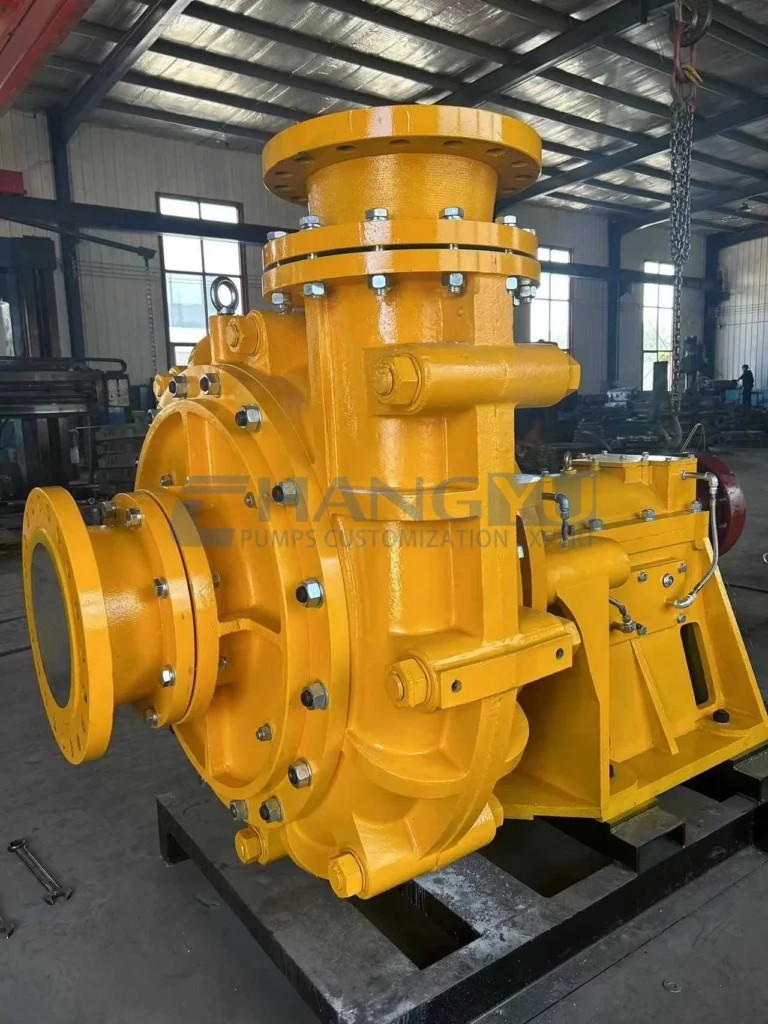
Engineered for high-head and severe-wear conditions in large-scale mining applications. High-chrome alloy wetted parts (BTMCr27, Cr28, Cr33) provide the hardness required for angular, abrasive particles. Double-casing design allows wetted part replacement without dismantling piping — a significant advantage when the pump weighs several tons. Heavy-duty oil-bath lubricated bearing assembly ensures long-term reliability under continuous operation.
| Parameter | Specification |
|---|---|
| Flow rate | 117–976 m³/h |
| Head | 21.1–101.6 m |
| Motor power | 22–560 kW |
| Speed | 730 / 980 / 1,480 r/min |
| Materials | BTMCr27 / BTMCr28 / BTMCr33 / duplex stainless steel |
UHB Series — UHMW-PE Lined Large Slurry Pumps
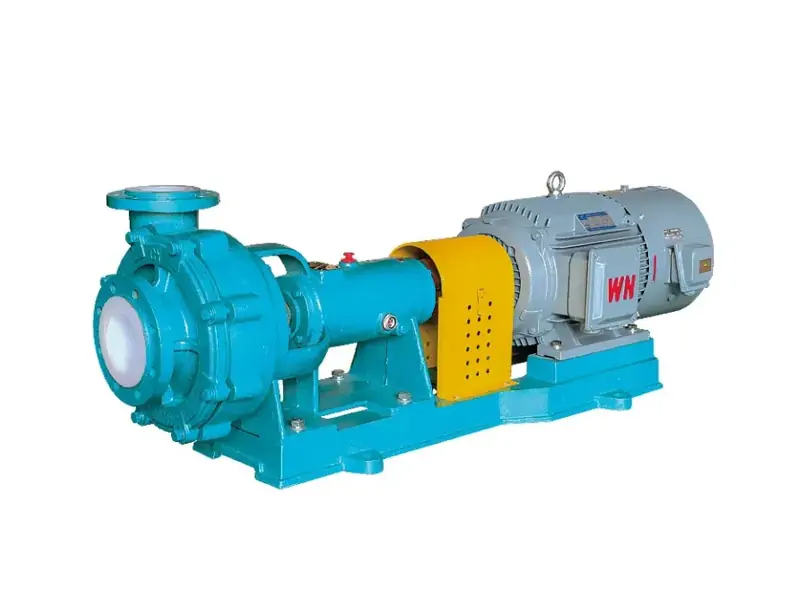
Steel-lined UHMW-PE centrifugal pump for high-flow slurry applications where combined wear and corrosion resistance is required. The non-metallic lining eliminates the corrosion concerns associated with acidic tailings and chemical process slurries. Flow rates to 2,600 m³/h serve the largest-volume slurry transfer duties.
| Parameter | Specification |
|---|---|
| Flow rate | 3–2,600 m³/h |
| Head | 5–100 m |
| Motor power | 0.75–300 kW |
| Speed | 750–2,900 r/min |
| Temperature | -20°C to 90°C |
| Lining material | UHMW-PE |
HB Series — Stainless Steel Large Slurry Pumps
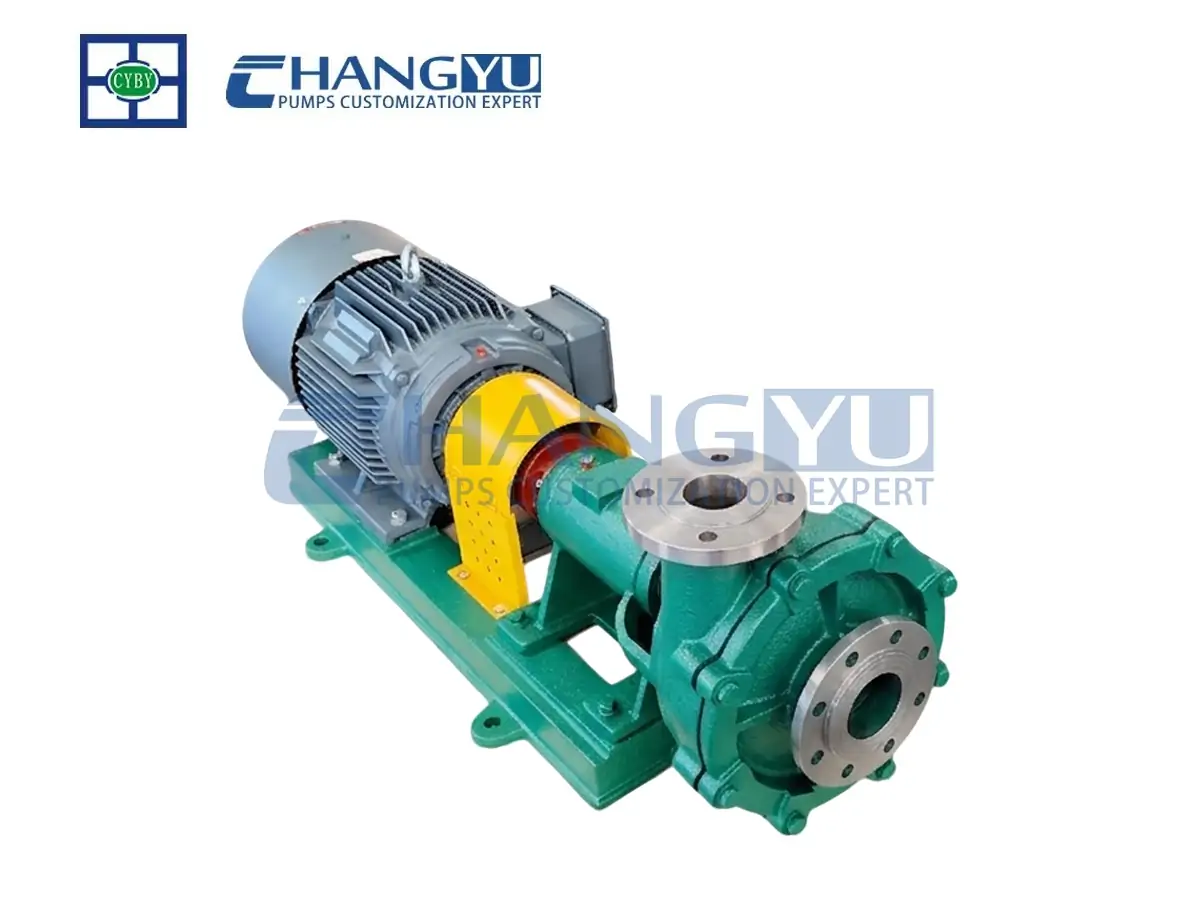
ISO 2858 compliant horizontal centrifugal pump with all-stainless steel wetted construction. Suitable for medium-flow, corrosion-critical circuits within large-scale operations — such as copper flotation systems and chemical process slurries — where corrosion resistance is the primary requirement and flow rates fall within the 10–60 m³/h range. Available in 304, 316L, 2205, and 2507 grades.
| Parameter | Specification |
|---|---|
| Flow rate | 10–60 m³/h |
| Head | 20–120 m |
| Motor power | 3–45 kW |
| Speed | 2,900 r/min |
| Temperature | -20°C to 120°C |
| Materials | 304 / 316L / 2205 / 2507 |
For a comprehensive guide to slurry pump selection across all mining circuits and pump sizes, see our guide on Slurry Pumps in Mining: How to Choose the Right Mine-Duty Pump.
FAQs about Large Slurry Pumps
Step 3: Select Wear Materials
Match the wear material to the ore characteristics using the framework in Section 2. The decision matrix is straightforward: angular, hard particles require high-chrome CrMo; fine, rounded, neutral pH particles allow rubber; ceramics serve localized high-wear zones. For large pumps, the foundry capability to produce high-chrome castings of the required size and quality should be verified as part of the material selection process.
Step 4: Choose Mechanical Configuration
Determine whether a horizontal or vertical pump configuration is appropriate. Horizontal pumps are the most common configuration for mill discharge, tailings, and most process applications — they provide easier maintenance access and simpler piping arrangements. Vertical pumps are specified for sump and deepwell applications where the fluid level is below the pump inlet. For large pumps, the weight and size of the pump assembly may dictate crane capacity requirements and foundation design — factors that must be addressed during the configuration selection stage.
Step 5: Size the Motor and Drive System
Large slurry pump motors range from hundreds to several thousand kilowatts. Motor sizing must account for the maximum slurry specific gravity — not the design condition — to prevent overload during process upsets. A variable frequency drive may be justified for large pumps to optimize speed for varying process conditions, reduce wear during low-flow periods, and provide soft-start capability that reduces mechanical stress on the pump and piping.
For ore-specific pump recommendations across the full spectrum of mineral processing circuits, see our guide on Best Slurry Pumps for Gold, Iron, Copper & Mineral Processing.
Case Study of Large Slurry Pumps: Extending Wear Life in a Large Iron Ore Tailings Pump
An iron ore concentrator in Western Australia operated a large tailings pump — rated at 800 m³/h at 65 m head, driven by a 560 kW motor — with standard 26% Cr high-chrome white iron wet-end components. The tailings slurry contained angular magnetite and quartz particles (Mohs 5.5–7.0) at 35% solids concentration by weight. Wet-end replacement was required approximately every 6 months, with each replacement causing 48 hours of planned downtime.
Inspection of the worn components revealed that the 26% Cr alloy was being cut by the harder quartz particles (Mohs 7, HV 800–1000) that constituted approximately 20% of the tailings solids. The chromium carbides in the alloy, while harder than the magnetite, were not hard enough to resist cutting by quartz. Material loss was concentrated at the volute cutwater and impeller vane leading edges — the zones of highest flow velocity.
Changyu Pump upgraded the wet-end components to a 28% Cr alloy with hard chrome plating (HV 850–1050) on the impeller vane leading edges and volute cutwater. The increased chromium content produced a higher volume fraction of hard carbides throughout the component, while the chrome plating provided additional hardness at the surfaces experiencing the most severe particle impingement. Impeller clearance was adjusted to the manufacturer’s minimum specification to reduce internal recirculation and the associated localized wear at the impeller eye.
Wet-end replacement interval extended from 6 months to 18 months — a threefold improvement in service life. The material upgrade cost (approximately 15% above the standard 26% Cr specification) was recovered within the first avoided replacement event. The mine applied the same material specification to three additional large tailings pumps over the following year.
Key takeaway: On large slurry pumps, small differences in material grade produce large differences in operating cost. Upgrading from 26% Cr to 28% Cr alloy — a 15% material cost premium — extended service life by 200% (3× the original life). The economics of premium materials become more favorable as pump size increases, because the cost of each replacement event — parts, labor, and production downtime — grows with the pump’s size and criticality.
Large Slurry Pump Solutions from Changyu Pump
As a specialist heavy-duty slurry pump manufacturer, Changyu Pump produces pump series configured for the full spectrum of large-scale slurry applications, from mill discharge to long-distance tailings disposal. Each series addresses a specific combination of flow, head, and wear resistance requirements.
| Application | Primary Challenge | Recommended Series | Key Feature | Typical Wet-End Life |
|---|---|---|---|---|
| Mill discharge, coarse tailings | Extreme abrasion + high head | PGY Series | High-chrome alloy (BTMCr27/Cr28/Cr33); double-casing; heavy-duty oil-bath lubricated bearings | 12–18 months |
| High-flow tailings, process slurry | Abrasion + corrosion | UHB Series | UHMW-PE lined; semi-open impeller; K-type dynamic seal | 6–12 months |
| High-viscosity tailings, sludge | High viscosity | G-Type Screw Pump | Progressive cavity; NBR/EPDM/FKM stator | 12–24 months |
| Corrosive process slurry | Strong corrosion | CYB-ZKJ Series | FEP/PTFE lined; double mechanical seal | 12–24 months |
| General slurry, moderate duty | Moderate abrasion | HB Series | 316L / 2205 duplex stainless steel | 6–12 months |
All pump series are available with customized seal configurations, material upgrades, and VFD-ready drive systems. View PGY Series Specifications →
Frequently Asked Questions About Large Slurry Pumps
Q: What is the difference between a large slurry pump and a standard slurry pump?
A large slurry pump differs from a standard slurry pump primarily in its structural design. Large pumps use double-casing construction with replaceable wear liners, oversized oil-bath lubricated bearings, and adjustable impeller clearance mechanisms. These features are necessary because the hydraulic forces and power requirements increase non-linearly with impeller diameter — power scales approximately with the fifth power of diameter.
Q: What wear material is best for large slurry pumps handling hard rock tailings?
For hard rock mining tailings (iron ore, gold ore, copper tailings with quartz), high-chrome white iron (CrMo, 26–28% Cr, 600–700 HB) is the recommended material. It provides the best balance of cutting wear resistance, impact tolerance, and cost. For the most abrasive circuits with quartz content above 10–15%, the 28% Cr grade is preferred.
Q: How often should a large slurry pump be serviced?
Service intervals depend on the slurry characteristics and operating conditions. In typical mill discharge or tailings service with high-chrome alloy wet-end components, replacement intervals range from 6 to 18 months. The adjustable impeller clearance mechanism allows intermediate maintenance to recover efficiency without replacing components.
Q: Can I use a rubber-lined pump for large slurry applications?
Rubber-lined pumps can be used for large slurry applications only when three conditions are simultaneously met: the particles are rounded (not angular), the particle size is below approximately 6 mm, and the slurry pH is neutral. In large pumps, the additional liner thickness required for rubber reduces internal flow passage area, so hydraulic efficiency must be verified.
Q: What is the maximum flow rate a large slurry pump can handle?
Large slurry pumps from Changyu Pump can handle flow rates up to 2,600 m³/h (for the UHB Series) and heads up to 101.6 m (for the PGY Series). For specific flow and head requirements, contact our engineering team for a technical assessment.
Changyu Pump Engineer’s Avoidance Checklist
- Verify foundry capability for large high-chrome castings before specifying material grade. The best material specification is meaningless if the manufacturer cannot pour, machine, and test castings of the required size and quality.
- Specify adjustable impeller clearance on every large slurry pump. The ability to restore clearance as wear occurs extends effective wet-end life between replacements and maintains pump efficiency. On large pumps, the energy savings alone justify the feature cost.
- Match wear material to the hardest particle in the slurry — not the target mineral. A copper mine with quartz host rock requires materials selected for quartz (Mohs 7), not chalcopyrite (Mohs 3.5–4). This is the most common root cause of premature wet-end failure on large pumps.
- Do not specify rubber liners for angular particles. Magnetite, hematite, and freshly crushed quartz cut rubber on contact. On a large pump, the cost of a premature rubber liner failure — in parts, labor, and downtime — far exceeds any initial cost advantage.
- Account for slurry specific gravity when sizing motors for large pumps. A motor sized for water performance will overload and trip when pumping high-density slurry. Size for the maximum expected slurry SG, not the design condition.
- For long-distance pipeline pumps, verify casing pressure ratings for water hammer conditions. Pump starts, stops, and power failures generate pressure transients that can exceed normal operating pressure by 50% or more.
- Keep a complete spare wet-end assembly in inventory for each critical large pump position. The lead time for large high-chrome castings can extend to months. A spare assembly converts a potential extended outage into a scheduled replacement.
- Adjust impeller clearance at scheduled intervals — not just when performance degrades. Regular clearance adjustment maintains efficiency and prevents the accelerated wear that occurs when worn clearance allows increased internal recirculation.
Conclusion
Large slurry pump selection is an engineering discipline distinct from standard slurry pump specification. The scale of the pump — flow rates measured in thousands of cubic meters per hour, motor powers in hundreds of kilowatts, component weights in tons — amplifies the consequences of every material and design decision. Double-casing construction, heavy-duty bearings, adjustable impeller clearance, and high-pressure sealing systems are not optional features on large pumps; they are design requirements for reliable operation under the extreme hydraulic and mechanical loads of large-scale slurry service. High-chrome white iron (CrMo, 26–28% Cr) remains the standard wear material for the majority of large pump applications in hard-rock mining, with ceramic materials serving as targeted wear protection at localized high-wear zones rather than as full-liner solutions.
Contact our engineering team today for a professional technical assessment tailored to your large slurry pump requirements.
📧 Email: [email protected]
📞 Phone / WhatsApp: +86-13651913727