
Introduction
Bleach chemical pump selection is not simply about corrosion resistance. Sodium hypochlorite (NaClO), the active compound in commercial bleach, presents three distinct engineering challenges that interact in ways standard chemical pumps are not designed to handle.
First, the hypochlorite ion is a strong oxidizing agent that corrodes most metals and degrades many elastomers. It attacks not only the pump casing but every wetted seal, O‑ring, and gasket in the flow path. Second, sodium hypochlorite decomposes continuously at ambient temperature, releasing oxygen gas at a rate that increases with concentration, temperature, and exposure to light or metal contaminants. This gas accumulates in pump heads, causes vapor lock, and interrupts flow in metering applications. Third, for magnetic drive pumps, the released chlorine gas can permeate the fluoroplastic containment shell and corrode the permanent magnets themselves, causing coupling failure that is undetectable until the pump stops delivering flow.
These three mechanisms — corrosion, off‑gassing, and magnet attack — mean that a pump material that is chemically compatible with the liquid may still fail. Either the system has not been designed to manage the gas, or the magnet alloy selected cannot withstand trace chlorine permeation.
Changyu Pump has spent over two decades engineering corrosion‑resistant fluid‑handling equipment for chemically aggressive applications, including bleach, chlorine derivatives, and oxidizing media. This guide covers material compatibility, pump type selection, off‑gassing remedies, and a structured selection framework for engineers specifying or upgrading bleach transfer and dosing installations. Contact us with your bleach parameters for a specific recommendation.
What Is a Bleach Chemical Pump and Why Does Sodium Hypochlorite Demand Specialized Equipment?
A bleach chemical pump is a pump purpose‑built for the combined demands of sodium hypochlorite service: the pump casing, impeller, seals, O‑rings, and gaskets must withstand continuous exposure to a strong oxidizing agent that corrodes metals, degrades standard elastomers, and releases gas that disrupts hydraulic performance.
The Unique Chemistry of Sodium Hypochlorite
Commercial bleach is typically supplied as a 5–15% aqueous solution of sodium hypochlorite, although industrial concentrations can reach higher levels.
The hypochlorite ion (ClO⁻) attacks through oxidation rather than acid‑base corrosion. This means that many materials that resist strong acids — including stainless steels — are rapidly degraded in bleach service. Simultaneously, NaClO decomposes over time, with the decomposition rate approximately doubling for every 10°F (approximately 5.6°C) temperature rise above ambient.
The released oxygen gas is the primary cause of vapor lock in metering and transfer pumps: small bubbles coalesce in the pump head, eventually displacing the liquid and causing the pump to run dry or lose prime.
Why Standard Chemical Pumps Fail in Bleach Service
This dual chemical‑mechanical challenge means a standard chemical pump that is material‑compatible with bleach at the casing level can still fail in two ways. Its elastomeric seals may absorb and degrade. Or its pump head may not be designed to vent accumulated gas.
For magnetic drive pumps, a third failure mechanism operates. Chlorine gas released by decomposition permeates through the fluoroplastic containment shell — even PTFE and PFA exhibit measurable gas permeability — and attacks the permanent magnets. This converts NdFeB into brittle NdCl₃ and FeCl₃. The process is silent: the pump appears to operate normally until the magnets lose sufficient strength to transmit torque, at which point flow stops without warning. Samarium‑cobalt (SmCo) magnets resist chlorine attack and are the standard specification for bleach service.
In summary, standard chemical pumps fail in bleach service through four interacting mechanisms:
- Metal components (even stainless steel) suffer rapid oxidative corrosion
- Standard elastomers (EPDM, FKM) swell and crack from hypochlorite attack
- Continuous off‑gassing accumulates in the pump head, causing vapor lock
- In magnetic drive pumps, chlorine permeation corrodes NdFeB magnets silently
What Materials Survive Sodium Hypochlorite Service?
Material selection for a bleach chemical pump must address three simultaneous demands: oxidation resistance of the structural casing and impeller, chemical compatibility of every elastomeric seal and O‑ring, and, for magnetic drive pumps, chlorine‑resistant magnet alloys.
Compatible Materials for Pump Casings and Wetted Components
PVC (Polyvinyl Chloride) provides good resistance to sodium hypochlorite at concentrations up to approximately 15% and temperatures below 50°C. It is the most economical material for bleach transfer and is widely used in water treatment dosing applications. CPVC extends the temperature range to approximately 80°C.
PVDF (Polyvinylidene Fluoride) provides excellent resistance to sodium hypochlorite across the full commercial concentration range (5–15%) at temperatures up to 100°C. PVDF offers superior mechanical strength compared to PVC and PTFE, making it the standard specification for heavy‑duty bleach transfer applications. PVDF pump casings and impellers do not corrode in bleach service, do not contribute metal ions that catalyze decomposition, and maintain structural integrity substantially longer than PVC at elevated temperatures.
PTFE (Polytetrafluoroethylene) offers near‑universal chemical resistance to sodium hypochlorite to approximately 120°C. PFA (Perfluoroalkoxy) extends this to approximately 160°C. Both are completely inert to the hypochlorite ion and do not catalyze decomposition. However, PTFE and PFA exhibit measurable gas permeability — a relevant factor for magnetic drive pump containment shells.
Titanium is one of the few metals compatible with sodium hypochlorite and serves in applications where a metallic wetted path is structurally required.
Materials that must be avoided include all stainless steels (304, 316, 316L), carbon steel, cast iron, aluminum, brass, and copper. These are rapidly attacked by sodium hypochlorite and must not be specified for any wetted component.
Seal and O‑Ring Material Selection
The elastomer selection is as critical as the pump casing material. Sodium hypochlorite attacks many common elastomers, and a seal failure can release bleach solution into the workplace.
EPDM (Ethylene Propylene Diene Monomer) is chemically compatible with sodium hypochlorite at ambient temperatures but softens and degrades at elevated temperatures or with higher concentrations. Frequent inspection is required.
Viton (standard FKM) is not recommended for sodium hypochlorite. It absorbs the oxidizing hypochlorite ion, leading to progressive embrittlement and cracking of O‑rings and gaskets.
FFKM (Perfluoroelastomer) provides the broadest chemical resistance for bleach service, maintaining sealing integrity across the full range of concentrations and temperatures. FFKM O‑rings and gaskets are the standard specification for aggressive sodium hypochlorite applications.
PTFE‑encapsulated seals combine the chemical inertness of PTFE with the mechanical resilience of an elastomer core, providing a cost‑effective alternative to solid FFKM for static sealing applications.
Material Compatibility Quick Reference for Sodium Hypochlorite
| Material | NaOCl ≤5%, ≤25°C | NaOCl 5–15%, ≤25°C | NaOCl 5–15%, 25–60°C | Notes |
|---|---|---|---|---|
| PVC | ✅ | ✅ | ⚠️ (limited life) | Economical; temperature limited |
| CPVC | ✅ | ✅ | ✅ | Extends PVC temperature range |
| PVDF | ✅ | ✅ | ✅ | Preferred for heavy‑duty applications |
| PTFE | ✅ | ✅ | ✅ | Inert to ~120°C; gas‑permeable |
| PFA | ✅ | ✅ | ✅ | Inert to ~160°C; lower permeability than PTFE |
| Titanium | ✅ | ✅ | ✅ | Compatible metal; high cost |
| 316L SS | ❌ | ❌ | ❌ | Rapid oxidative attack |
| EPDM (seals only) | ✅ | ⚠️ | ❌ | Degrades with concentration and temperature |
| Viton (FKM) | ❌ | ❌ | ❌ | Absorbs hypochlorite; embrittles |
| FFKM | ✅ | ✅ | ✅ | Standard specification for aggressive bleach service |
What Are the Main Pump Types for Sodium Hypochlorite Transfer?
Magnetic Drive Pumps
Magnetic drive bleach pumps transmit torque across a stationary isolation shell using a magnetic coupling, eliminating the mechanical shaft seal entirely. This sealless design removes the seal elastomer — often a failure point — from the equation. A PVDF‑ or PTFE‑lined mag‑drive pump with FFKM static O‑rings and a Samarium‑Cobalt (SmCo) magnet rotor is the preferred specification for reliable zero‑leakage bleach transfer. API 685 governs the design of sealless centrifugal pumps for heavy‑duty service.
SmCo vs NdFeB magnets. Neodymium‑iron‑boron (NdFeB) magnets are the most common magnet material in standard mag‑drive pumps, but they are highly susceptible to chlorine‑induced corrosion. Chlorine gas released by NaClO decomposition permeates the fluoroplastic containment shell and attacks NdFeB, converting it into brittle NdCl₃ and FeCl₃. This causes the magnet to expand, crack the encapsulation layer, and lose torque until the coupling fails. Samarium‑cobalt (SmCo) magnets are resistant to chlorine attack and are the standard specification for bleach service.
Diaphragm Metering Pumps
Diaphragm metering bleach pumps provide precise, adjustable flow rates for disinfection and chemical dosing applications. Their primary advantage is accuracy: a well‑specified diaphragm pump delivers repeatable injection volumes within ±1% of setpoint, critical for maintaining residual chlorine levels in potable water treatment.
However, they are particularly vulnerable to vapor lock from accumulated gas. The solution is a pump head with an integrated automatic vent valve that continuously purges accumulated gas back to the suction line or storage tank.
Peristaltic (Hose) Pumps
Peristaltic bleach pumps are inherently suited to sodium hypochlorite dosing because they are sealless, valveless, and self‑priming. The only wetted component is the flexible tube, which is available in peroxide‑cured EPDM, Norprene, or other bleach‑compatible elastomers.
Peristaltic pumps handle the gas‑laden nature of bleach without vapor lock because the tube compression mechanism displaces both liquid and gas with each roller pass. They are widely used in municipal water treatment for bleach dosing at flow rates from milliliters per minute to tens of liters per hour.
Centrifugal Pumps (All‑Plastic or Fluoroplastic‑Lined)
Centrifugal bleach transfer pumps serve high‑flow applications such as bulk unloading from tanker trucks into day tanks and inter‑tank transfer at flow rates from 10 to 500 m³/h.
All‑plastic centrifugal pumps with PVC, PP, or PVDF casings and impellers are specified for bleach service; fluoroplastic‑lined centrifugal pumps with PFA or PTFE linings handle higher‑temperature bleach solutions. Mechanical seal faces for bleach service are typically carbon‑graphite running against silicon carbide, with FFKM or PTFE‑encapsulated secondary seals.
To prevent gas accumulation in centrifugal bleach pumps, the suction piping must be designed with a continuous rise to the supply tank so that gas can migrate back to the tank rather than collecting in the pump casing.
Chemical Unloading Pump Type Comparison for Bleach Service
| Pump Type | Off‑Gassing Tolerance | Seal Type | Flow Range | Best Bleach Application |
|---|---|---|---|---|
| Magnetic drive | Requires venting | Sealless (no dynamic seal) | 3–800 m³/h | Zero‑leakage transfer; toxic or hazardous duty |
| Diaphragm metering | Needs integrated vent valve | Sealless (diaphragm) | 0.1–500 L/h | Precision dosing for disinfection |
| Peristaltic (hose) | Excellent (inherent) | Sealless (tube only) | 0.01–50 L/h | Low‑flow dosing; gas‑laden bleach |
| Centrifugal | Requires venting; can break prime | Single mechanical seal | 1.6–2,600 m³/h | High‑flow transfer and bulk unloading |
How Do You Solve Vapor Lock and Off‑Gassing in Sodium Hypochlorite Pumps?
The off‑gassing problem is inherent to sodium hypochlorite and cannot be eliminated — it can only be managed through pump selection and system design. For a typical 15% sodium hypochlorite solution stored at 25°C, research has documented an oxygen release rate of approximately 7.5% per year of solution volume. At 35°C, this rate doubles, releasing roughly 15% of the solution volume as oxygen gas over the same period.
How Off‑Gassing Impacts Different Pump Types
Diaphragm metering pumps and centrifugal pumps are the most vulnerable. Gas accumulates in the pump head because the check valves or impeller are designed to displace liquid, not compressible gas. Once the head fills with a gas pocket, the pump stops delivering flow — a condition known as vapor lock. The pump continues to cycle, but no fluid is being moved. In metering applications, the loss of chemical feed may go undetected for hours.
Peristaltic pumps are uniquely tolerant of off‑gassing. The roller compresses the tube and displaces whatever is inside — liquid, gas, or a mixture — with each pass, so vapor lock does not occur.
Mechanical Solutions: Automatic Vent Valves and Degassing Systems
For installations with a good hydraulic profile — metering pump located close to the tank, short flooded suction, and a generous return line — automatic vent valves are often sufficient. The vent continuously purges accumulated gas back to the storage tank or suction line, maintaining liquid in the pump head.
If system conditions force the installer to route the return line too far or too high, however, this creates back‑pressure that prevents effective degassing. Gas bubbles cannot overcome excessive static head. The hypochlorite is then forced through the pump that has now become air‑bound, leading to erratic flow and loss of prime.
In these cases, a small‑bore pulsation dampener or a degassing chamber installed immediately upstream of the pump suction provides a low‑pressure zone where gas can separate from the liquid before entering the pump.
System Design Best Practices for Bleach Installations
- Position the pump as close to the storage tank as practical, with a flooded suction where possible
- Route the discharge line to avoid high points where gas can accumulate and create vapor pockets
- Use opaque or UV‑resistant piping — sunlight accelerates NaClO decomposition and gas generation
- Eliminate dead legs and stagnant zones in the piping where gas can collect
- For metering pumps, specify pump heads with integrated vent valves as a factory‑installed option
- Maintain consistent suction pressure — variations in tank level can induce additional gas release
How to Select the Right Bleach Chemical Pump: A 4‑Step Framework
Step 1: Define the Bleach Concentration, Temperature, and Operating Conditions
Document the sodium hypochlorite concentration (typically 5–15% for commercial bleach), the maximum operating temperature, and whether the pump will operate continuously or intermittently. The decomposition rate — and therefore gas generation — approximately doubles for every 10°F (approximately 5.6°C) temperature rise above ambient.
Step 2: Determine Flow Rate, Metering Accuracy, and Discharge Pressure
For dosing applications, specify the required injection rate (L/h or GPH) and the required accuracy. For transfer applications, calculate the required flow rate and total dynamic head.
Step 3: Match Pump Type and Materials to the Operating Conditions
For metering applications with consistent suction conditions, a diaphragm metering pump with an automatic vent valve or a peristaltic pump serves well. For high‑flow transfer, a centrifugal pump with PVDF or PFA‑lined wetted components handles the duty, provided the suction line maintains a flooded condition. For hazardous or high‑value bleach applications requiring zero‑leakage containment, a magnetic drive pump with PVDF‑lined wetted components, FFKM static seals, and SmCo magnets is the standard specification.
Step 4: Integrate Off‑Gassing Management into the System Design
Verify that the pump head includes a venting provision. If not, design the suction piping with a continuous rise to the supply tank so that gas can migrate back to the tank. For installations where the pump must lift bleach from below‑grade storage, a self‑priming pump with a degassing chamber provides the required suction lift while managing gas accumulation.
Changyu Pump Solutions for Bleach Transfer
Changyu Pump offers four pump platforms engineered for sodium hypochlorite service. Each series can be configured with bleach‑compatible materials — PVC, CPVC, PVDF, PTFE, PFA, or titanium — and FFKM or PTFE‑encapsulated seals, providing verified chemical compatibility across the full range of commercial bleach concentrations and temperatures.
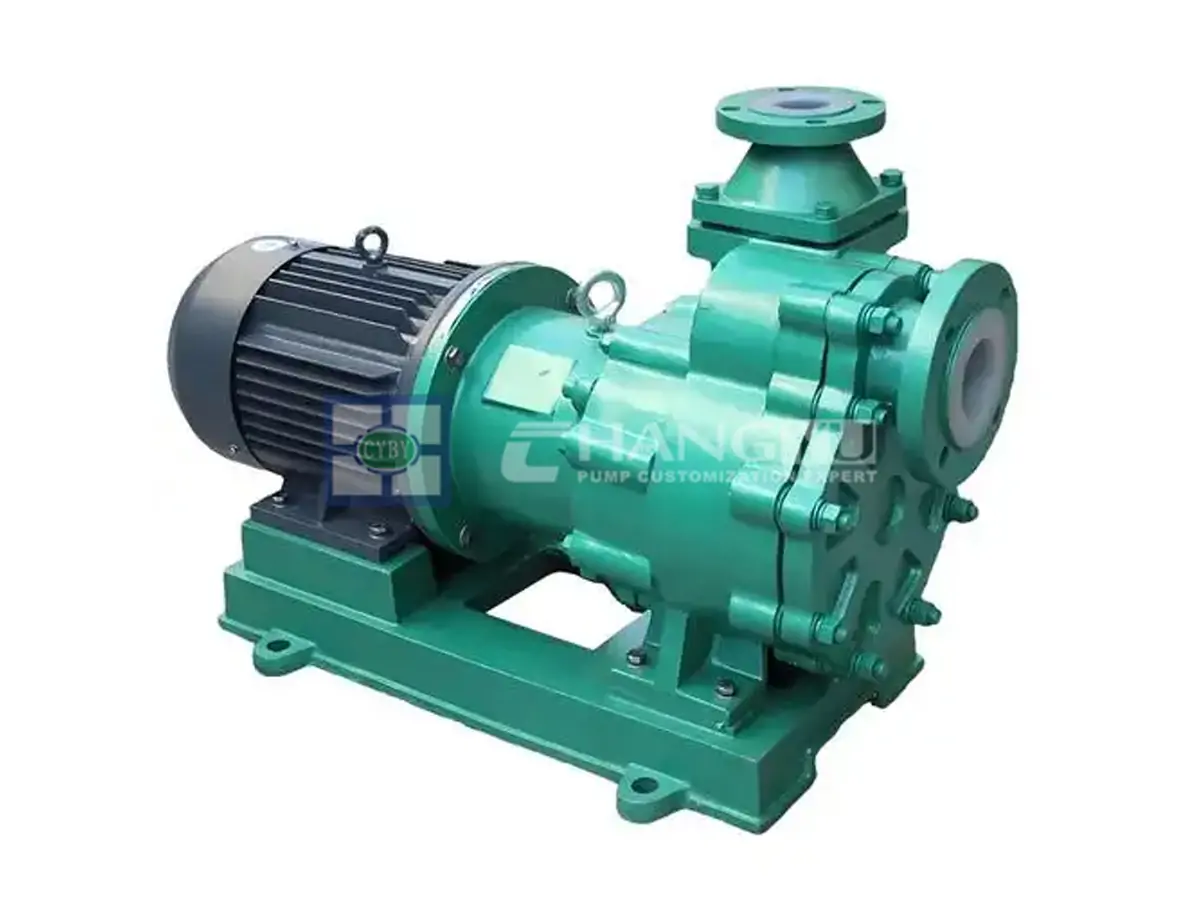
CYQ Series Chemical Resistant Magnetic Drive Pump
The CYQ Series is a sealless magnetic drive pump with wetted components lined in FEP, PFA, or PTFE. The elimination of the mechanical seal provides zero‑leakage containment for bleach transfer service. For applications requiring chlorine‑resistant magnets, the CYQ Series can be configured with Samarium‑Cobalt (SmCo) magnet rotors to prevent permeation‑driven magnet corrosion.
Key Specifications: Flow 3–800 m³/h | Head 15–125 m | Power 2.2–110 kW | Speed 2,950 r/min | Temperature -20°C to 180°C
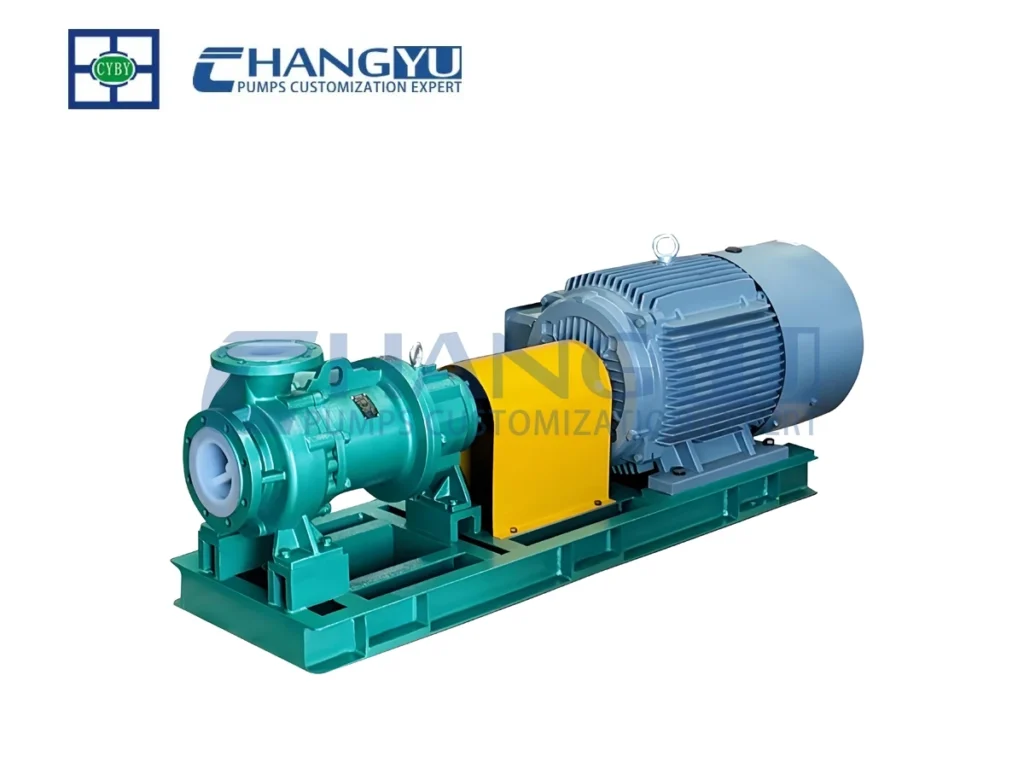
CYC Series Heavy Duty Stainless Steel Magnetic Pump
The CYC Series is a heavy‑duty magnetic drive pump designed in accordance with API 685, with a flange pressure rating of 1.6 MPa. For bleach service, the titanium wetted path option provides metallic structural strength with verified compatibility with sodium hypochlorite.
Key Specifications: Flow 3.6–100 m³/h | Head 20–80 m | Power 1.1–55 kW | Speed 968–3,450 r/min | Temperature -20°C to 100°C

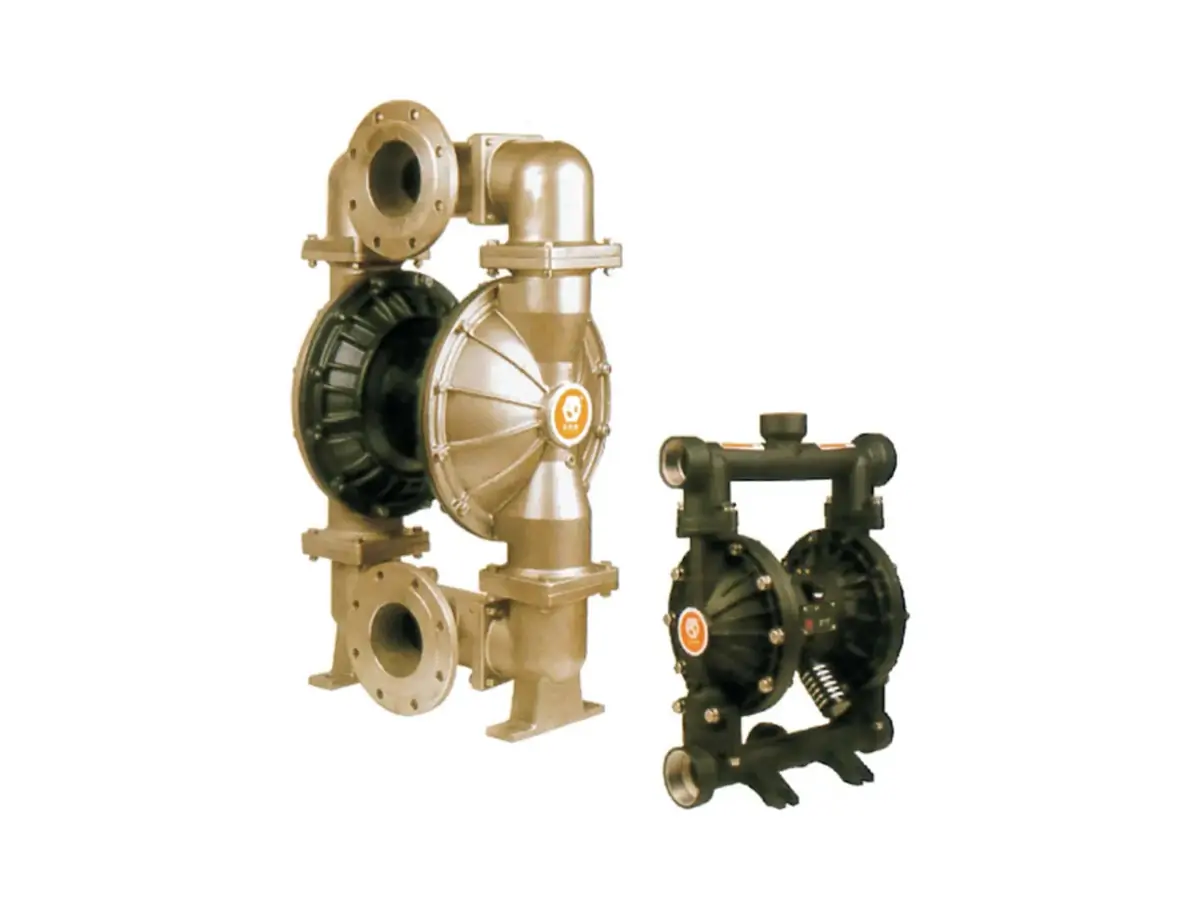
BFQ Series Air Operated Double Diaphragm Pump
The BFQ Series is an air‑operated double diaphragm pump with body materials spanning cast steel, ductile iron, aluminum alloy, PP, stainless steel, and PVDF. For bleach transfer and drum emptying, the PVDF body option provides verified chemical compatibility. The sealless, self‑priming design handles the gas‑laden nature of bleach without vapor lock.
Key Specifications: Flow up to 1,041 L/min | Working pressure 0.84 MPa | Suction lift 7.6 m | Solids passage 9.4 mm
IHF Series Fluoroplastic Lined Centrifugal Pump
The IHF Series is a fluoroplastic‑lined centrifugal pump with the casing and flow‑through components lined in FEP, PFA, or PTFE. Suitable for high‑flow bleach transfer and bulk unloading, it provides the flow capacity of a centrifugal pump combined with full fluoroplastic corrosion resistance.
Key Specifications: Flow 1.6–2,600 m³/h | Head 5–130 m | Power 1.5–110 kW | Speed 1,450–2,900 r/min | Temperature -20°C to 180°C

FAQs about Bleach Chemical Pump
Q1: What materials are compatible with sodium hypochlorite (bleach)?
A: PVC, CPVC, PVDF, PTFE, and PFA are all compatible with sodium hypochlorite across typical concentrations. Titanium is the only commonly available metal that resists bleach. All stainless steels, carbon steel, aluminum, and copper are rapidly attacked and must not be used.
Q2: Is EPDM or Viton better for bleach pump seals?
A: EPDM is compatible at ambient temperature and low concentrations but degrades at elevated temperatures. Standard Viton (FKM) is not recommended — it absorbs the hypochlorite ion and embrittles. FFKM is the standard specification for aggressive bleach service.
Q3: Why does my bleach metering pump keep losing prime?
A: The most likely cause is vapor lock from accumulated oxygen gas. The solution is a pump head with an integrated automatic vent valve, or a peristaltic pump that is inherently tolerant of gas‑laden fluids.
Q4: Can I use a magnetic drive pump for sodium hypochlorite?
A: Yes, but the magnet material must be specified correctly. Standard NdFeB magnets are vulnerable to chlorine permeation through the containment shell. Samarium‑cobalt (SmCo) magnets resist chlorine and are the standard specification for bleach service.
Q5: How do I prevent off‑gassing from disrupting my bleach pump?
A: Match the pump type to the off‑gassing tolerance. Peristaltic pumps handle gas without modification. Diaphragm pumps need integrated vent valves. Centrifugal pumps need flooded suction and venting. Use opaque or UV‑resistant piping to slow decomposition.
Q6: Is a centrifugal pump suitable for bleach transfer?
A: Yes, for high‑flow applications. PVDF or PFA‑lined centrifugal pumps provide the required corrosion resistance. The suction piping must be designed with a continuous rise to the tank, and the mechanical seal must use carbon‑graphite vs. silicon carbide faces with FFKM secondary seals.
Q7: What safety precautions are required when pumping bleach?
A: Verify all pump materials before use. Provide adequate ventilation and secondary containment. Operators must wear chemical‑resistant gloves and eye protection during maintenance.
Q8: How often should bleach pump seals be inspected?
A: Monthly for pumps in continuous service. Replace any seal showing swelling, cracking, or embrittlement immediately. Annually, replace all elastomeric components regardless of apparent condition — oxidative degradation can progress without visible signs.
Expert Selection Recommendations from Changyu Pump Engineers
- Match the magnet material to the bleach environment. Standard NdFeB magnets fail through chlorine permeation. SmCo magnets eliminate this failure mode and are the engineering standard for magnetic drive pumps in bleach service.
- Select elastomers for bleach, not general chemical service. Standard Viton (FKM) absorbs the hypochlorite ion and embrittles. FFKM O‑rings and PTFE‑encapsulated seals are the standard specification.
- Design the system for off‑gassing, not just the pump. A typical 15% bleach solution releases approximately 7.5% of its volume as oxygen gas per year at 25°C — and this rate doubles at 35°C. Short, flooded suction lines, continuous rise piping back to the tank, and integrated vent valves prevent vapor lock more effectively than any pump specification alone.
- Choose the pump type matched to the flow and gas tolerance. Peristaltic pumps serve low‑flow dosing and tolerate gas inherently. Diaphragm pumps provide precision dosing but need vent valves. Magnetic drive pumps provide zero‑leakage transfer, with SmCo magnets specified. Centrifugal pumps handle high‑flow transfer with flooded suction and compatible seals.
Conclusion
A bleach chemical pump must manage corrosion, off‑gassing, and — for magnetic drive designs — chlorine attack on magnets. Material selection, pump type, and system design for gas venting are equally critical. SmCo magnets, FFKM seals, and a piping layout that lets gas escape back to the tank prevent the most common failures.
Contact Changyu Pump with your bleach parameters, and our engineering team will provide a recommendation and quotation tailored to your application.