
Introduction: Pump seal plans describe how liquid keeps a mechanical seal lubricated and cool; the right choice depends on the fluid, operating conditions, contamination limits, and available site services. Plan 11 needs suitable clean liquid and adequate circulation, Plans 21/23 add cooling, Plan 32 supplies an external flush, and Plans 53/54 support pressurised dual seals.
At ChangYu Pump, we start a stainless steel chemical pump enquiry by asking what could stop the seal working: heat, particles, crystals or an unreliable liquid supply. Here is how we compare pump seal plans and turn “mechanical seal included” into a useful quotation.
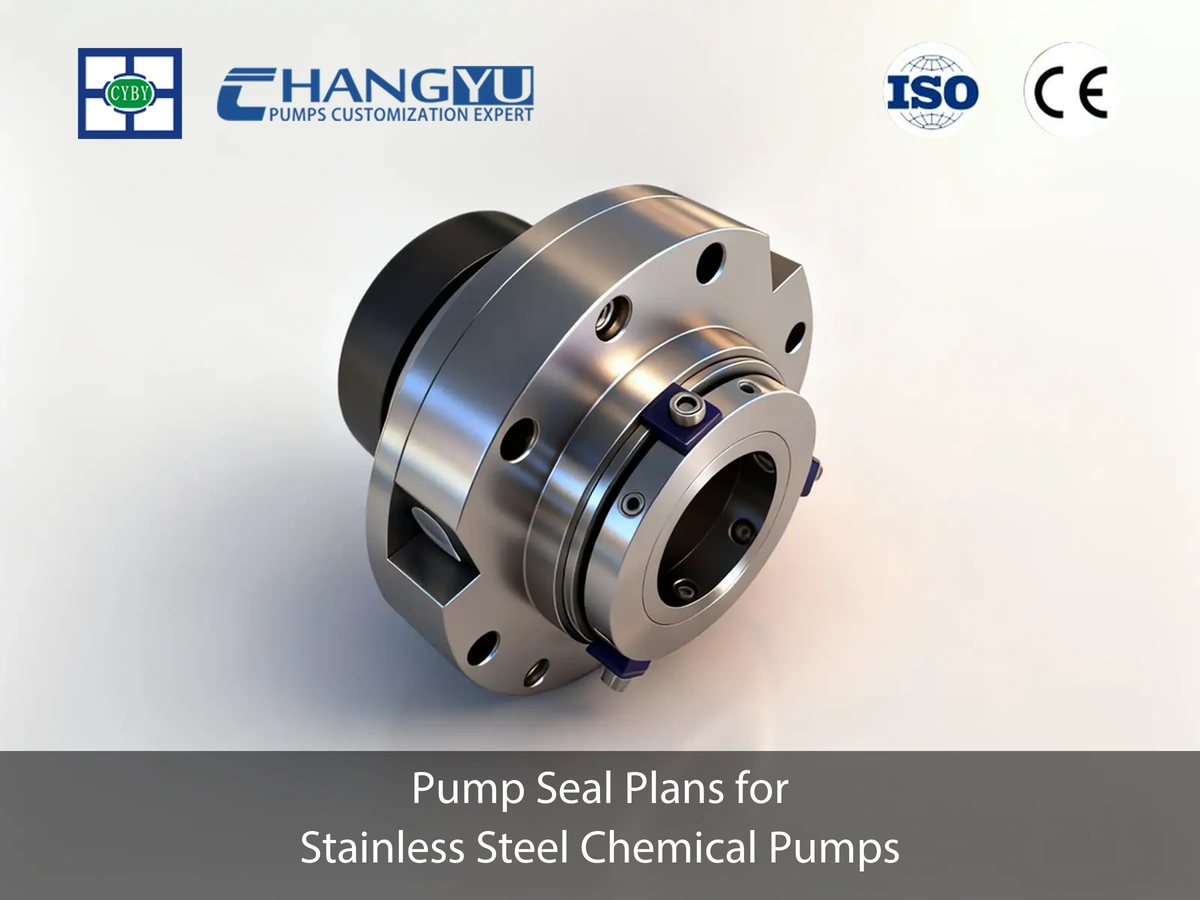
What do pump seal plans actually do?
The mechanical seal helps keep liquid inside the pump around its rotating shaft. Its faces need a thin liquid film to reduce friction and remove heat. The seal chamber is the space around the seal.
Pump seal plans describe the support piping used to maintain those conditions. API 682 gives these arrangements familiar numbers, so buyers and suppliers can discuss the same flow path. A plan number identifies the arrangement; full API compliance must be confirmed separately if your project requires it.
We confirm three points before recommending a seal configuration:
- What reaches the seal? The pumped liquid itself, a clean external flush or liquid between two seals?
- What problem does it solve? Too much heat, particles, deposits or a leakage-control requirement?
- Can the site support it? Is cooling water, a clean liquid supply or other required service available whenever needed?
When we propose a configuration, we explain how it fits your liquid, operating conditions and site services.
Choosing pump seal plans: start with your liquid
When comparing seal plans for pumps, start here. Mark unknown values for confirmation.
| Question | What to share with us | What to consider |
|---|---|---|
| Is the liquid clean? | Solids content, particle size and whether particles settle | Plan 11 where pressure, circulation and thermal conditions suit the clean liquid; external flushing or an engineered dual seal for dirty service |
| Is it hot or likely to boil near the seal? | Operating temperatures, composition and pressure | Cooling with Plan 21/23 and a check of boiling risk |
| Can it form crystals or react when conditions change? | What happens when it cools, evaporates or sits during shutdown | Temperature control, compatible flushing and deposit prevention |
| Can another liquid enter the product? | Approved liquid and maximum permitted addition | Plan 32 only within that allowance; assess barrier-liquid leakage separately |
| What leakage can the site accept? | Product hazards, permitted leakage and collection requirements | Seal arrangement, monitoring and drainage |
Pump seal plans should cover startup and shutdown as well as normal operation. A salt solution may flow freely when warm but crystallise after cooling. Adding a cooler without checking that behaviour can create a blockage.
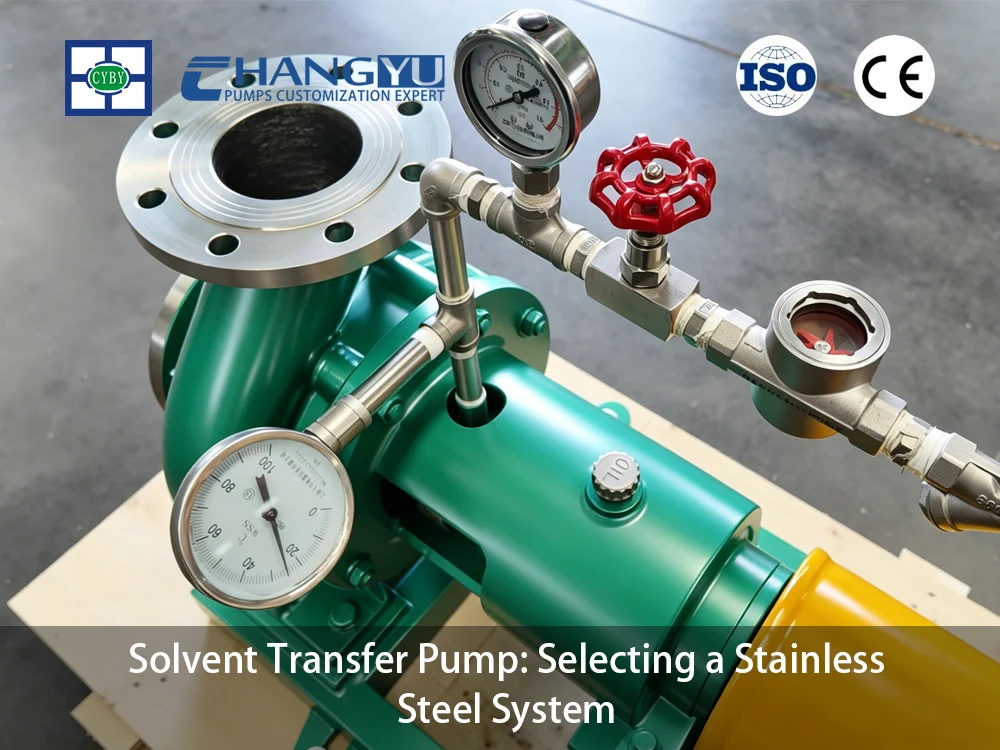
For solvent duty, our Solvent Transfer Pump: Selecting a Stainless Steel System covers compatibility, suction conditions and leakage requirements before seal selection.
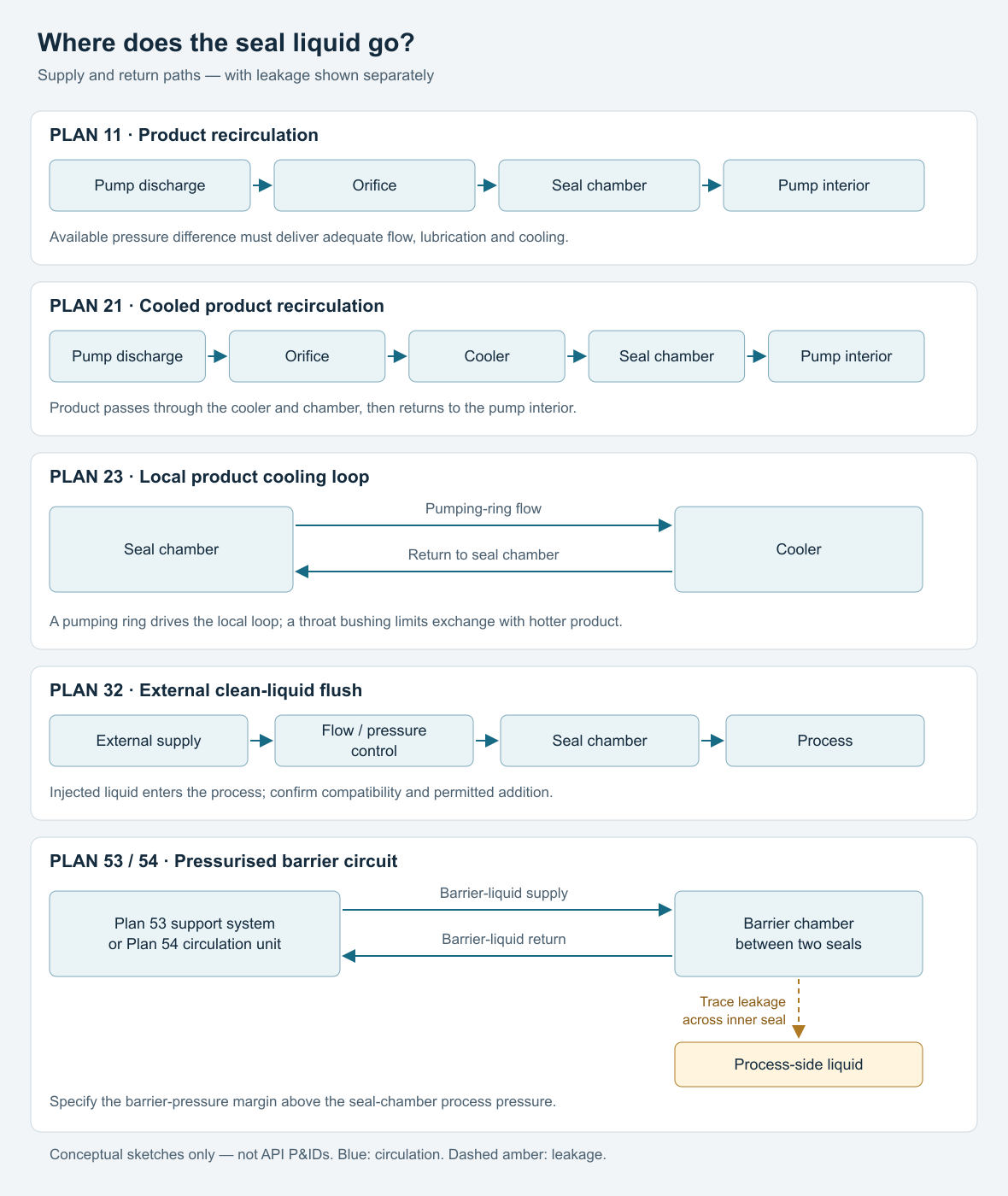
Follow the liquid: five simple flow paths
To understand a pump seal flush, follow the liquid. These sketches show common pump seal plans; ask for the complete piping and instrumentation drawing, or P&ID.
Plan 11: use the pumped liquid
Plan 11 is commonly considered for suitable clean-liquid services when pump discharge pressure can provide adequate circulation to the seal chamber. Check the actual flow path and operating range to confirm sufficient lubrication and cooling; product circulation does not remove particles.
Ask us: “Will enough liquid reach the seal across our operating range, including minimum speed?”
Plans 21 and 23: add cooling where it helps
The difference between these cooling arrangements is what gets cooled. Plan 21 cools product from the pump outlet. Plan 23 cools a local chamber loop, normally driven by a pumping ring; a throat bushing limits mixing with hotter product. It still needs suitable space, circulation and venting.
Ask us: “What temperature will this maintain, what cooling water is needed, and could cooling cause crystals?”
Plan 32: bring in a clean external liquid
This support system uses another liquid to protect the faces. For Plan 32, confirm compatibility, permitted addition and enough supply pressure at the pump connection after pipe and valve losses. Even a small continuous flow affects production: 0.5 L/min adds 720 litres per day. This illustrates the impact, not a recommended flow.
Ask us: “What can enter the product, how much, and what happens if the supply stops?”
Plans 53 and 54: support a pressurised dual seal
Plans 53 and 54 provide pressurised barrier liquid between two seals. Its pressure must stay above the process pressure on the seal-chamber side by the margin specified for the selected seal arrangement. For a proposed system, we confirm the required pressure margin and circulation with the seal supplier for normal operation, startup, shutdown and foreseeable utility interruptions. Plan 53A/B/C use different pressurising arrangements; Plan 54 uses an external circulation unit.
Small amounts of barrier liquid can enter the product through the inner seal. Confirm the contamination allowance before accepting a pressurised dual seal.
Ask us: “Which variant fits our duty, what services does it need, and is its expected leakage acceptable?”
Compare common pump seal plans at a glance
Use this table to compare pump seal plans, then confirm the choice against your actual service.
| Plan | Main job | Possible fit | Main buying check |
|---|---|---|---|
| 11 | Circulate pumped liquid to the seal | Clean service with adequate driving pressure | Pressure difference, flow, lubrication and cooling |
| 21 | Cool liquid drawn from the outlet | Clean hot liquids that tolerate cooling | Cooler capacity, water supply and fouling |
| 23 | Cool a local seal-chamber loop | Suitable hot service | Chamber space, pumping ring and circulation |
| 32 | Inject clean external liquid | Dirty or deposit-forming service allowing addition | Compatibility, pressure and dilution |
| 53A/B/C | Supply barrier liquid between dual seals | Service needing clean face lubrication and leakage control | Exact variant, pressure margin and leakage allowance |
| 54 | Supply externally circulated barrier liquid | Service requiring a dedicated support unit | Circulation, cooling and supply-failure response |
| 62 | Treat the outside of the seal with a quench | Leakage that forms crystals or deposits | Suitable medium and safe drainage |
Plan 62 differs from the other pump seal plans here: it treats the atmospheric side, meaning the outside of the seal, using a suitable medium such as water, steam or nitrogen. It can help control deposits, but it does not replace the liquid film or cooling needed inside the seal chamber.
Let Us Help You Choose a Seal Configuration
As a pump supplier, we help you match the pump, seal materials and support requirements to your application. Use the form below to share your liquid composition, temperature, required flow and head, and any limits on leakage or product contamination. We can help you narrow down suitable options and clarify the proposed configuration and auxiliary-equipment supply scope for your quotation.
Email: [email protected]
TEL/WA: +86-13651913727
How Stainless Steel Chemical Pumps Affect Seal Plan Selection
A stainless steel casing does not make every part around the seal compatible with the liquid. For corrosive, crystallising or volatile media, we review pump seal plans alongside the casing material: the support system must handle the same chemistry and changing conditions.
Four checks connect the pump specification to the seal selection:
- Coolers and fittings: identify their materials separately. The pump’s stainless steel grade does not establish the grade of its cooler, tubing or valves.
- Seal faces and elastomers: check the face pairing and the rubber sealing parts against the liquid and temperature. A compatible casing cannot compensate for an unsuitable seal component.
- Cooling-water quality: chloride risk depends on the specific stainless steel grade, temperature, stress and water conditions. There is no universal chloride limit for every installation.
- External liquids: check flush and barrier liquids for compatibility with both the process and the equipment, including any permitted contamination.
A seal-face compatibility case: In a case we shared, a new mechanical seal leaked after just three days, and replacements of the same model failed in the same way. The video attributes the damage to static-charge accumulation and discharge at the seal faces in a low-conductivity liquid. It illustrates why face materials and fluid properties should be reviewed alongside flushing and cooling. Any material change should be confirmed by the seal supplier for the actual duty.
For a stainless steel chemical pump such as our CYH series, we check the liquid, temperature, face pairing, elastomers and support requirements together. Casing material alone does not decide the plan. Available seal configurations and auxiliary equipment must be confirmed for the specific model and quotation.
If your specification only says “standard seal,” share your liquid details and required duty with us. We can help clarify the seal configuration and the equipment to include in the quotation; the checklist below identifies what needs confirming.
What We Confirm Before You Order
Before quoting pump seal plans, we review the following items with you and the seal supplier. This helps us define the configuration, supply responsibilities and site connections in the quotation.
| Item | What we confirm with you |
|---|---|
| Seal arrangement and pump seal plans | Single or dual seal, exact plan numbers, and any required API compliance or exceptions |
| Pressure and temperature | Minimum, normal and maximum seal-chamber conditions, including startup and shutdown |
| Risk of boiling at the seal | Whether chamber pressure stays sufficiently above the liquid’s vapour pressure at the expected temperature; show the calculation basis |
| Flow and cooling | Required circulation, cooler capacity and cooling-water temperature, pressure, flow and quality |
| External flush or barrier liquid | Approved fluid, required pressure and flow, barrier pressure margin where applicable, contamination allowance and response to supply loss |
| Connections and monitoring | P&ID, connection sizes, materials, vents, drains, instruments and required alarms or shutdown controls |
| Leakage and maintenance | Expected leakage, collection route, spare seal or cartridge and access for servicing |
| What the price includes | Seal, cooler, reservoir or support unit, tubing, fittings, instruments, installation and commissioning responsibilities |
Request gauge or absolute units when checking pressure conditions for pump seal plans. Boiling-risk calculations need consistent absolute pressures; the discharge gauge alone cannot establish the margin.
Pump seal plans need an operating sequence: when must support services start, and how long should they continue after stopping? The pump may remain hot and pressurised with its motor off.
A short requirement you can copy into an enquiry
You can copy this requirement for pump seal plans into an enquiry:
Please identify the seal arrangement and exact piping plans, and provide a piping and instrumentation drawing. Confirm seal-chamber pressure and temperature, the margin against boiling at the seal, required flush or barrier-liquid conditions, and cooling-water needs. State any liquid entering the product, the required monitoring, startup and shutdown sequence, and response to loss of utilities. List all included equipment, buyer-supplied items and any exceptions to the specified standard.
When comparing pump seal plans, look at the installed cost as well as the pump price. A cheaper quotation may leave the cooler, support unit or instruments for you to buy separately.
How Should a Pump Seal Flush Be Specified?
Specify the pump seal flush using its source, composition, available pressure and temperature, required flow and permitted addition to the process. For seal plans for pumps, the drawing should distinguish product recirculation, an external flush and a barrier-liquid circuit; these have different effects on contamination and utilities.
Ask the supplier to confirm how the proposed pump seal plans maintain the required conditions during normal running, startup and shutdown. Include the response to loss of the flush or cooling supply, and identify which instruments and auxiliary equipment are included in the quotation.
FAQ
Does “mechanical seal included” mean the flush system is included?
No. Ask us to identify the exact plan number and provide an itemised equipment list in your quotation. The seal, tubing, cooler and support unit may have different supply responsibilities.
Is Plan 21 always better than Plan 11?
No. Plan 21 adds cooling but also needs a suitable utility supply. Choose it only where cooling helps the liquid and seal; compare Plan 23 for suitable hot service.
Can a dual seal be used when dilution is prohibited?
Check the contamination allowance. Pressurised barrier systems can introduce small amounts of liquid into the product. Other seal arrangements have different leakage behaviour and must be assessed against both product-quality and emissions requirements.
Does a stainless steel pump need a special seal plan?
Pump seal plans depend on the liquid and operating conditions. Stainless steel adds compatibility checks for the support equipment.
Get a seal configuration review for your pump
To review pump seal plans for your application, send us the liquid composition, operating temperature, required flow and head, and any limits on leakage or product contamination. If some data is unavailable, share what you have and identify what still needs confirmation.
For enquiries about seal plans for pumps, useful supporting details include the existing model or nameplate photo, suction conditions and available cooling water or flush liquid. If a seal has failed, add photographs, the piping sketch and when the problem occurs.
Email: [email protected]
TEL/WA: +86-13651913727
You can also review our CYH Series stainless steel centrifugal chemical pump and stainless steel pump range before requesting a configuration quotation. CYH lists single and double mechanical seals with silicon carbide or tungsten carbide options; confirm the face pairing, elastomers and auxiliary equipment for your model in the actual quotation.
Before confirming pump seal plans, agree the pump seal flush requirements, contamination allowance and auxiliary-equipment supply scope. Clear duty data helps us review seal plans for pumps together with the liquid compatibility and operating conditions.
References and further reading
- American Petroleum Institute — API Standard 682: Pumps—Shaft Sealing Systems for Centrifugal and Rotary Pumps. Official public scope and contents overview; use the edition specified for your project.
- Hydraulic Institute — Mechanical Seals for the Pump Industry: Selection, Installation, Maintenance, and Troubleshooting, 2nd Edition. Guidebook information and further reading on seal selection and support systems.