
At ChangYu Pump, when customers ask us about centrifugal pump maximum viscosity, we need more than a room-temperature figure. We need the liquid’s viscosity and density at the actual pumping temperature, together with its cold-start behavior and suction conditions. Those details determine whether an existing metal centrifugal pump can keep doing the job—or whether another pump type deserves a closer look.
There is no universal maximum viscosity for centrifugal pumps. Below roughly 100 cP, a centrifugal pump may remain a reasonable candidate. Around 100–300 cP, we would compare corrected performance with positive displacement alternatives. Above that range, the comparison becomes increasingly important. These are screening bands, not manufacturer ratings or Hydraulic Institute limits. We make the final decision from corrected performance, motor loading, and inlet conditions.
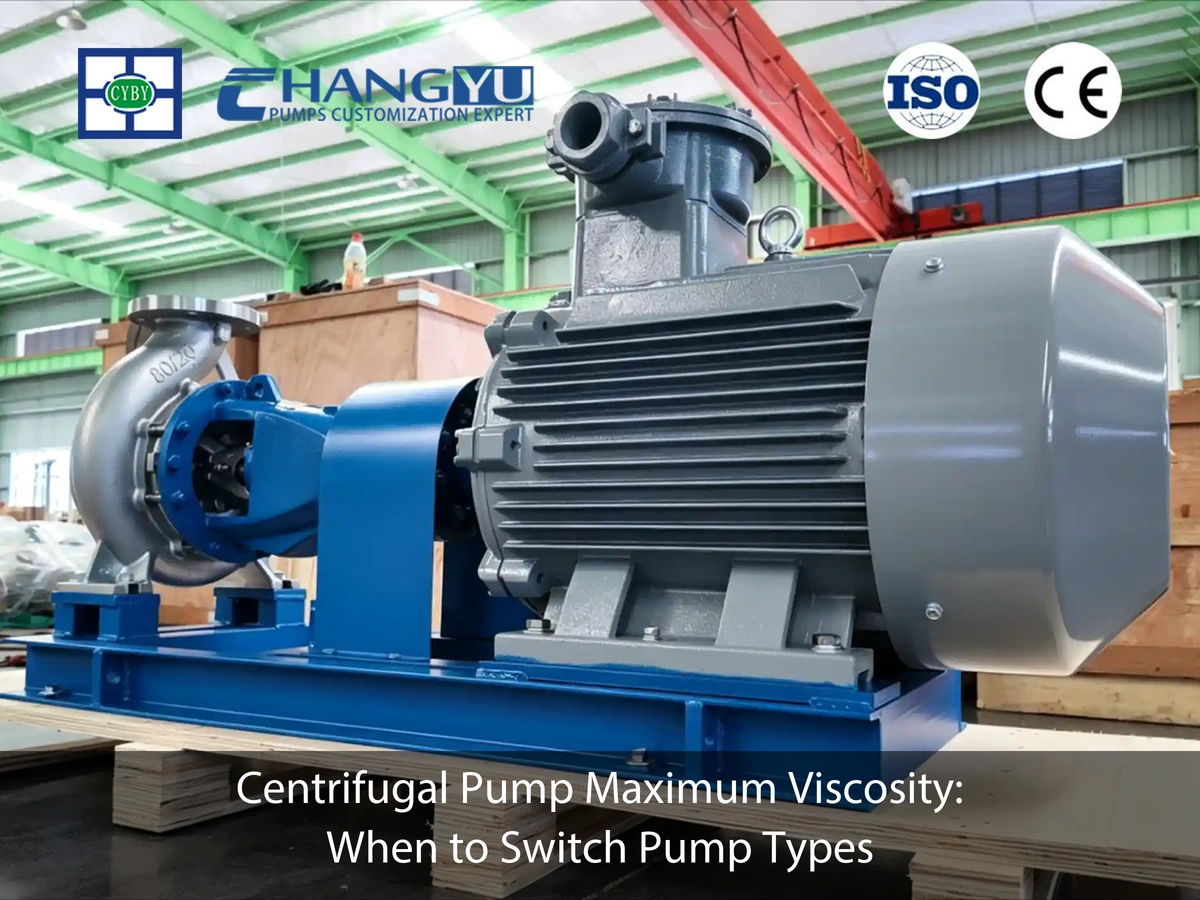
Centrifugal Pump Maximum Viscosity: Use These Ranges for Screening
We use these ranges to shortlist options before checking the actual duty.
| Dynamic viscosity at pumping temperature | Initial selection direction | What needs checking |
|---|---|---|
| Below about 100 cP | Keep a centrifugal pump on the shortlist | Correction where applicable, required duty, motor capacity and suction margin |
| About 100–300 cP | Compare centrifugal and positive displacement options | Corrected efficiency, operating cost, cold starting and inlet losses |
| Above about 300 cP | Give positive displacement pumps serious consideration | Whether a centrifugal option remains technically and economically viable |
| Any viscosity with gel formation, yield stress or substantial gas | Assess the fluid behavior separately | Rheology, inlet filling, priming and suitability of the specific pump design |
Pump size and duty matter. A small pump delivering low flow against high head may become unattractive sooner than a larger pump serving a high-flow duty. Neither case can be settled by the table alone.
Stainless steel construction addresses chemical compatibility, but it does not remove viscosity losses. A suitable casing material does not guarantee suitable hydraulic performance.
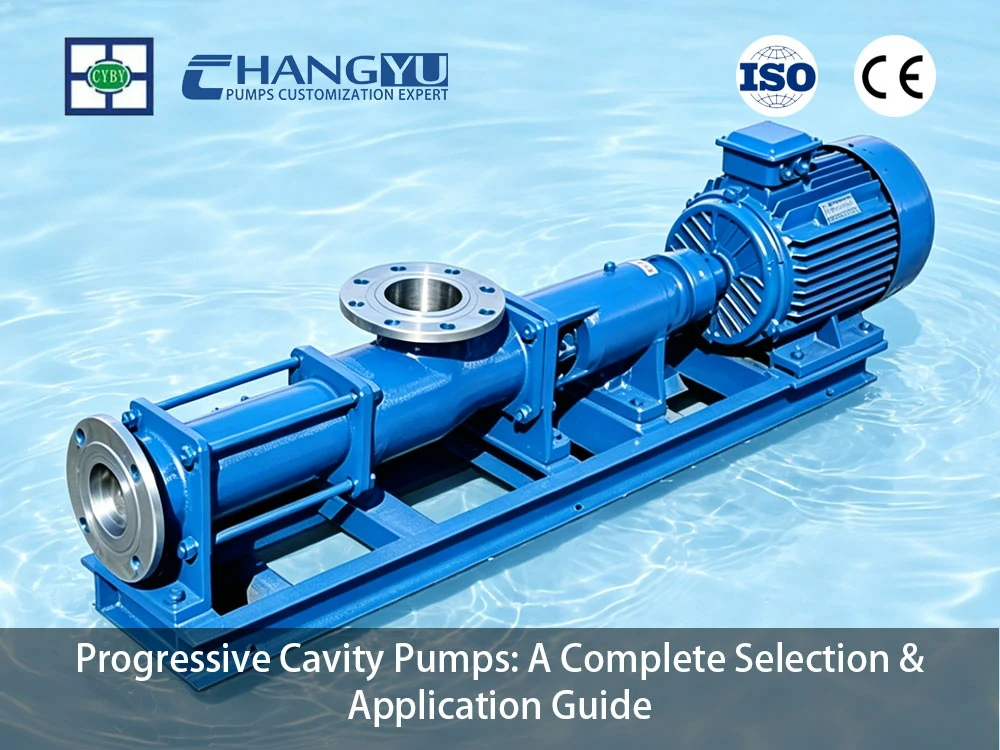
For background on one alternative, see our Progressive Cavity Pumps: A Complete Selection & Application Guide.
Why a Water Curve Can Give You the Wrong Answer
A centrifugal pump’s published performance curve is usually based on water testing. With a more viscous liquid, internal friction and impeller-disc friction increase. Flow, head and efficiency can fall, while the power needed to deliver a specified duty can rise. The Hydraulic Institute explains these effects in How Viscosity Affects Pumping.
There is a second change: the pipework. Greater viscosity increases friction losses at a given flow, so the system curve also needs recalculating. Correcting only the pump curve can still leave the predicted operating point wrong. Both curves must represent the same liquid and temperature before we use their intersection to predict flow.
We therefore need to establish:
- The corrected flow, head and efficiency for the actual liquid.
- The system resistance at the required flow and temperature.
- Where the corrected pump curve intersects that system curve.
- Whether motor capacity, inlet margin and the operating region remain acceptable.
When assessing this type of service, we use corrected performance within the method’s scope. ANSI/HI 9.6.7 provides a method for applicable rotodynamic pumps handling Newtonian liquids. It requires the relevant water-performance data and liquid properties; target flow and head alone are insufficient. See the Hydraulic Institute’s description of ANSI/HI 9.6.7.
We do not apply a fixed percentage loss or assume current always rises. The result depends on density, efficiency and the duty actually delivered.
How Should Centrifugal Pump Maximum Viscosity Be Recorded?
Record centrifugal pump maximum viscosity as a duty-specific assessment, with separate liquid-property values for normal running and the coldest credible restart. Include the temperature, units, density and test method beside each reading so that the supplier can use the same basis.
For a centrifugal pump maximum viscosity review, identify whether each value was measured, estimated or taken from a fluid supplier. If the liquid changes after storage, request data for that condition too; a fresh sample may not represent a tank that has stood overnight.
The Three Inputs That Decide Whether We Keep the Pump
1. Viscosity at running temperature—and at startup
For most liquids, warming reduces viscosity. A fluid that transfers readily after heating may be difficult to move after an overnight shutdown.
We ask for the normal temperature, minimum starting temperature and corresponding viscosity values. A single figure marked “viscosity: 80” leaves us without the units, temperature or measurement conditions needed to use it.
For this calculation, distinguish the two common units:
- cP: dynamic viscosity; 1 cP equals 1 mPa·s.
- cSt: kinematic viscosity; 1 cSt equals 1 mm²/s.
The conversion is cSt = cP ÷ density in g/cm³, using density at the same temperature. For example, 120 cP at a density of 1.20 g/cm³ corresponds to 100 cSt.
For a non-Newtonian liquid, we also need the test method and shear rate. Shear thinning, shear thickening, thixotropy and yield stress can make a single viscosity value misleading. Ordinary Newtonian correction should not be applied without checking its suitability.
2. Density at the same temperature
Density affects pressure and shaft power. At the same head, a denser liquid produces a greater pressure difference. At the same flow, head and efficiency, it also requires more shaft power.
Consider a calculation example: 20 m³/h at 30 m head, with density 1,200 kg/m³. At an assumed pump efficiency of 65%, shaft power is approximately 3.0 kW. At 35%, it is approximately 5.6 kW for the same delivered duty.
These are assumed efficiencies for illustration, not measured pump results. They show why we check corrected efficiency, the full operating range and starting requirements before choosing the motor.
3. Startup and suction conditions
We also check what happens before steady operation begins. Can the liquid reach the inlet? Is the casing primed? Has material settled or hardened? Is the suction line heated as well as the tank?
For viscous service, we would check:
- Minimum tank level and pressure above the liquid.
- Suction-pipe internal diameter, length, elevation and fittings.
- Strainers, valves and their condition.
- Vapor pressure at the pumping temperature.
- Shutdown duration, heating arrangements and restart procedure.
High suction losses can reduce available net positive suction head, or NPSHA. Compare this with the pump’s applicable suction requirement and the required margin. Heating can improve flowability but also increase vapor pressure, so both effects matter.
Changing pump type does not repair an undersized suction line. Positive displacement pumps also need adequate inlet supply. If available suction pressure is insufficient, they can experience cavitation too.
What Evidence Supports a Centrifugal Pump Maximum Viscosity Decision?
A centrifugal pump maximum viscosity decision should show the corrected pump curve, the recalculated system curve and their operating-point intersection. Ask for the predicted flow, head, efficiency and absorbed power at the actual temperature, together with the method and its applicability to your liquid.
When comparing centrifugal pump maximum viscosity with alternative pump capabilities, use the same flow, pressure, operating hours and inlet conditions. The best pump for high viscosity fluids is the option that meets those requirements across the relevant temperatures, rather than the option with the largest catalogue viscosity figure.
When We Would Keep a Metal Centrifugal Pump
We keep a centrifugal pump in consideration when:
- The liquid is Newtonian, or its behavior can be assessed reliably.
- Corrected performance meets the required flow and head.
- Efficiency is acceptable for the expected operating hours.
- The motor covers the operating range and starting requirements.
- Inlet supply and NPSH margin are adequate.
- Solids, gas, corrosion and seal compatibility are within the selected configuration’s capabilities.
Impeller geometry, clearances and speed may improve a configuration, but we verify the resulting performance. Reducing speed also reduces available head; an open or semi-open impeller is not an automatic solution for thick liquids.
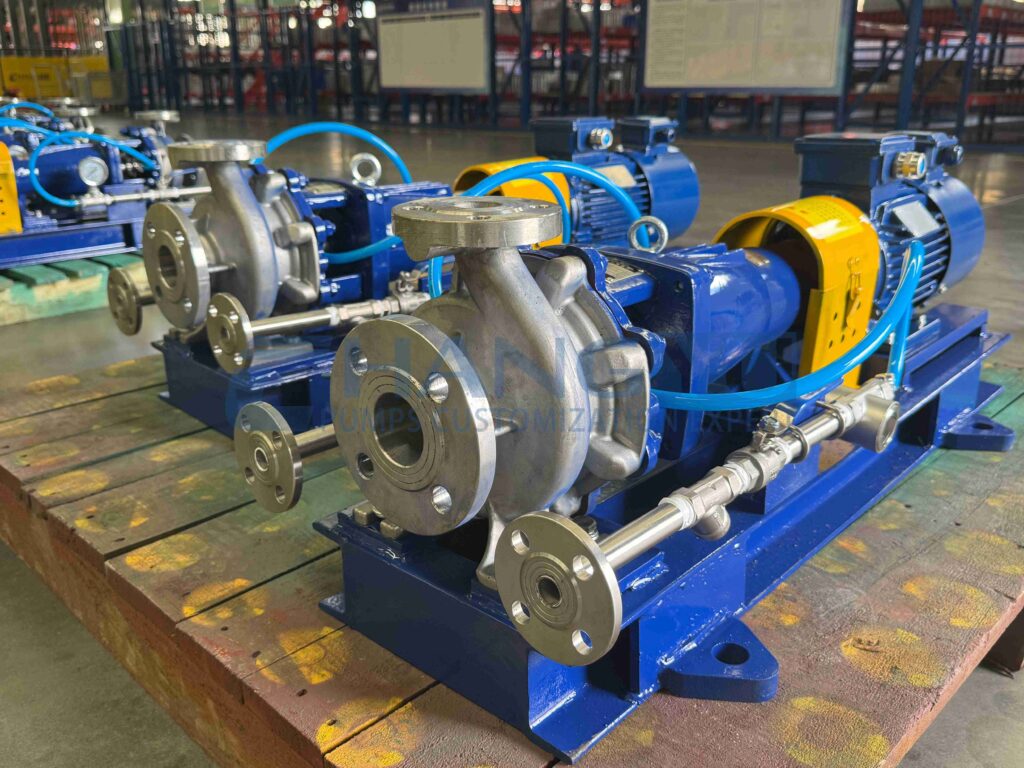
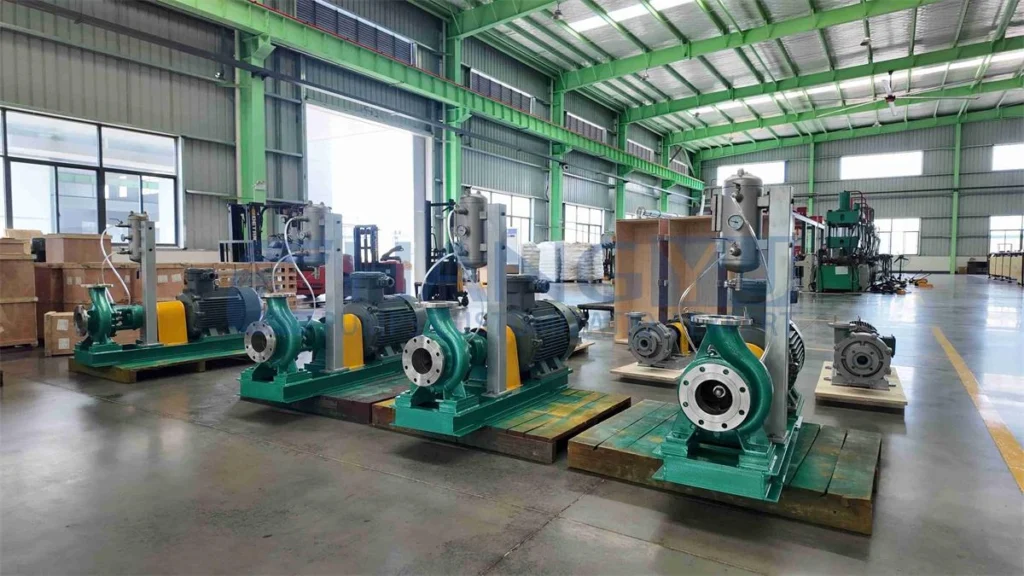
For compatible chemical liquids that pass these checks, we can review the CYH Series stainless steel chemical centrifugal pump, including its material and seal configuration for the actual service.
When We Would Compare Positive Displacement Pumps
We compare other pump types when corrected flow is inadequate, efficiency makes continuous operation expensive, or startup and inlet filling remain unreliable.
High differential pressure at low flow, metering requirements, or pronounced non-Newtonian behavior can also justify comparing pump technologies. Gas content and volatility need separate assessment; neither automatically makes every positive displacement pump suitable.
The best pump for high viscosity fluids depends on more than thickness:
| Pump type | Where we would consider it | Selection details that matter |
|---|---|---|
| Metal centrifugal pump (CYH Series) | Continuous transfer with acceptable corrected performance | Efficiency, operating region, suction margin and chemical compatibility |
| Progressive cavity pump (G Series) | Viscous liquids, some solids-bearing fluids and controlled low-shear transfer | Stator compatibility, particle size, speed, inlet filling and dry-run protection |
| Gear pump | Clean, often lubricating viscous liquids requiring steady transfer | Abrasiveness, clearances, temperature, speed and differential pressure |
| Air-operated double-diaphragm pump (BFQ Series) | Intermittent transfer, some solids-bearing chemicals and duties needing priming capability | Viscosity derating, suction lift, air supply, pulsation and diaphragm compatibility |
| Metering diaphragm pump | Controlled chemical dosing within the model’s viscosity capability | Dosing accuracy, check-valve filling, inlet conditions and discharge pressure |
We distinguish transfer diaphragm pumps from metering diaphragm pumps: using a diaphragm does not by itself ensure dosing accuracy.
We also check installation requirements. For motor-driven rotary positive displacement pumps, provide suitable overpressure protection against a blocked discharge.
Before recommending a model, we check inlet conditions and viscosity derating. Our comparison covers purchase price, energy, maintenance, heating and reliability.
How Do We Choose the Best Pump for High Viscosity Fluids?
Ask the supplier to explain the basis of the centrifugal pump maximum viscosity assessment for the proposed model, speed and impeller diameter. The quotation should identify the liquid-property assumptions, motor requirements, allowable operating region, suction requirements and any heating needed before starting.
Treat centrifugal pump maximum viscosity as one part of the complete configuration review. For a chemical duty that retains a mechanically sealed centrifugal pump, also review pump seal plans for stainless steel chemical pumps; acceptable hydraulic performance does not by itself establish suitable seal support.
Submit These Details for a Pump Configuration Review
For a configuration review, send us the following information. Mark unknown values and label any estimates.
| Information | What to provide |
|---|---|
| Liquid | Name, composition, concentration and available safety data sheet |
| Temperature | Minimum, normal and maximum pumping temperature; cold-start temperature |
| Viscosity | Values at relevant temperatures, units and measurement method; shear rate where applicable |
| Density | Density or specific gravity, with its reference temperature |
| Required duty | Minimum, normal and maximum flow; total dynamic head or differential pressure |
| Suction conditions | Tank pressure, minimum level, elevations, pipe internal diameter, length, fittings and strainers |
| Startup | Shutdown duration, heating, priming, backpressure and any gel formation or settling |
| Solids and gas | Concentration, particle size, abrasiveness, entrained gas and vapor-pressure data if available |
| Existing equipment | Model, speed, impeller diameter, motor rating, seal arrangement and performance curve |
| Operating evidence | Measured temperature, flow, suction/discharge pressure, current, vibration and fault timing |
Readings from both startup and stable running are particularly useful. State whether flow improves after warming, whether trouble begins as the tank empties, and whether a strainer pressure drop has changed.
A low-flow complaint with high current requires a different investigation from low flow with low current. Neither proves viscosity is the only cause; speed, rotation, blockage, wear and instrumentation may also need checking.
Email: [email protected]
TEL/WA: +86-13651913727
FAQ
What is the centrifugal pump maximum viscosity?
There is no single value that applies to all centrifugal pumps. The approximate 100 cP and 100–300 cP bands above help screen options. A specific pump’s suitability depends on corrected performance, fluid behavior, inlet conditions and operating cost. A correction method’s calculation range is not a recommended operating limit.
Is 300 cP too thick for a centrifugal pump?
Not automatically. At 300 cP, we would compare corrected centrifugal performance with suitable positive displacement alternatives. Density, temperature, pump size and required duty matter. We cannot decide from cP alone.
What is the best pump for high viscosity fluids?
Progressive cavity pumps are worth considering for viscous or some solids-bearing liquids; gear pumps suit many clean viscous services. Diaphragm options can suit chemical transfer or dosing, depending on design. We choose the option that meets the complete duty, including startup and inlet supply.
Can a larger motor solve the problem?
A larger motor may address a verified power shortage. It does not restore head or flow lost through viscosity, improve inlet supply, or make an unsuitable hydraulic configuration efficient. We would check the cause before changing the motor.
Can we use room-temperature viscosity for a heated process?
Use viscosity at the actual pumping temperature for the running-duty assessment, and at the starting temperature for restart checks. Without both, we may overlook the hardest part of the cycle.
Send Us Your Duty Before Choosing the Next Pump
If you are checking whether an existing metal pump can handle your viscous liquid, send us the liquid details, temperature-dependent viscosity and density, flow/head requirement, suction layout, startup procedure and current model. Attach the performance curve and operating readings you have.
We can review whether the duty supports a CYH configuration within our stainless steel pump range or whether a positive displacement option should be considered. The aim is a pump that meets the process requirement, starts reliably and makes sense to operate.
Email: [email protected]
TEL/WA: +86-13651913727
For a centrifugal pump maximum viscosity review, send the running and startup liquid properties with the required duty and suction layout. We can then compare corrected centrifugal performance with suitable alternatives and discuss the best pump for high viscosity fluids for those specific conditions.
References and Technical Sources
We prepared this guide using the Hydraulic Institute references below and our product information. The viscosity bands are screening guidance, not limits specified by ANSI/HI 9.6.7. The power example uses assumed efficiencies; final selection requires a duty-specific review.
- Hydraulic Institute — ANSI/HI 9.6.7: Rotodynamic Pumps Guideline for Effects of Liquid Viscosity on Performance. Official scope and overview of performance correction for applicable radial-flow pumps handling Newtonian liquids.
- Peter Gaydon, Hydraulic Institute — How Viscosity Affects Pumping (December 7, 2022). Explains viscosity effects on centrifugal and positive displacement performance, starting torque and inlet requirements.
- ChangYu Pump product information: CYH chemical centrifugal pumps, G Series progressive cavity pumps and BFQ air-operated double-diaphragm pumps. Product construction and configuration options.