
If your sump liquid contains corrosive substances or solid particles, your existing pump may suffer repeated seal wear, blockage and declining flow. You may be considering a vertical pump but are unsure how a vertical cantilever pump, a vertical sump pump and a vertical submersible pump differ. Start by checking how the shaft is supported, which components contact the liquid and whether the inlet can remain adequately submerged at the lowest operating level.
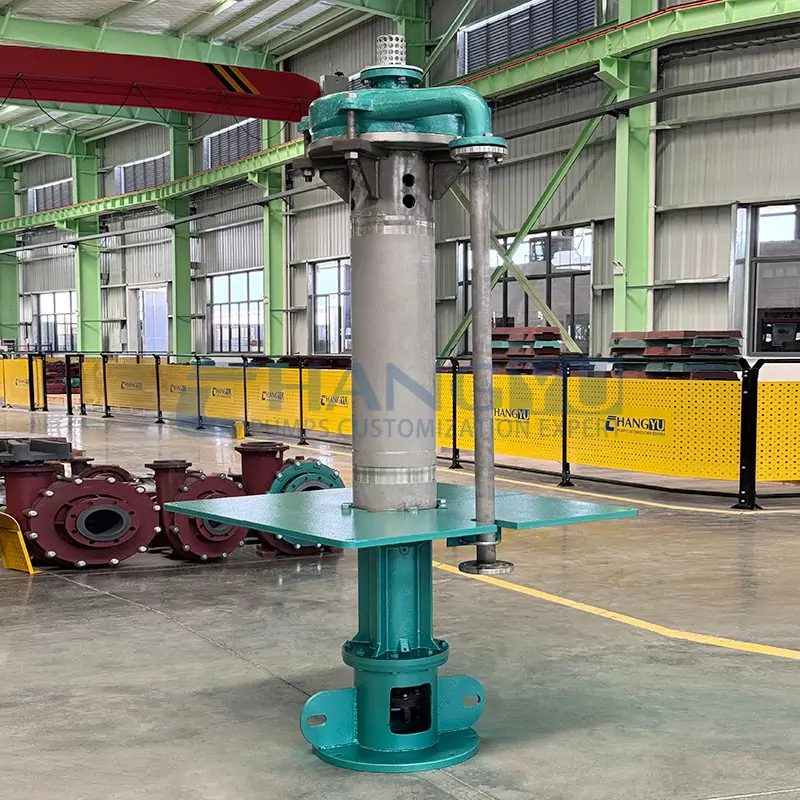
The term vertical cantilever pumps usually refers to vertical centrifugal pumps with the motor and support bearings above the liquid level, a shaft extending downward and an impeller immersed in the liquid. A true cantilever design has no support bearings below the liquid level, reducing the exposure of submerged bearings to abrasive particles or corrosive media. Its unsupported shaft length is limited by shaft stiffness, speed and loading, so simply extending the shaft will not make it suitable for a sump of any depth.
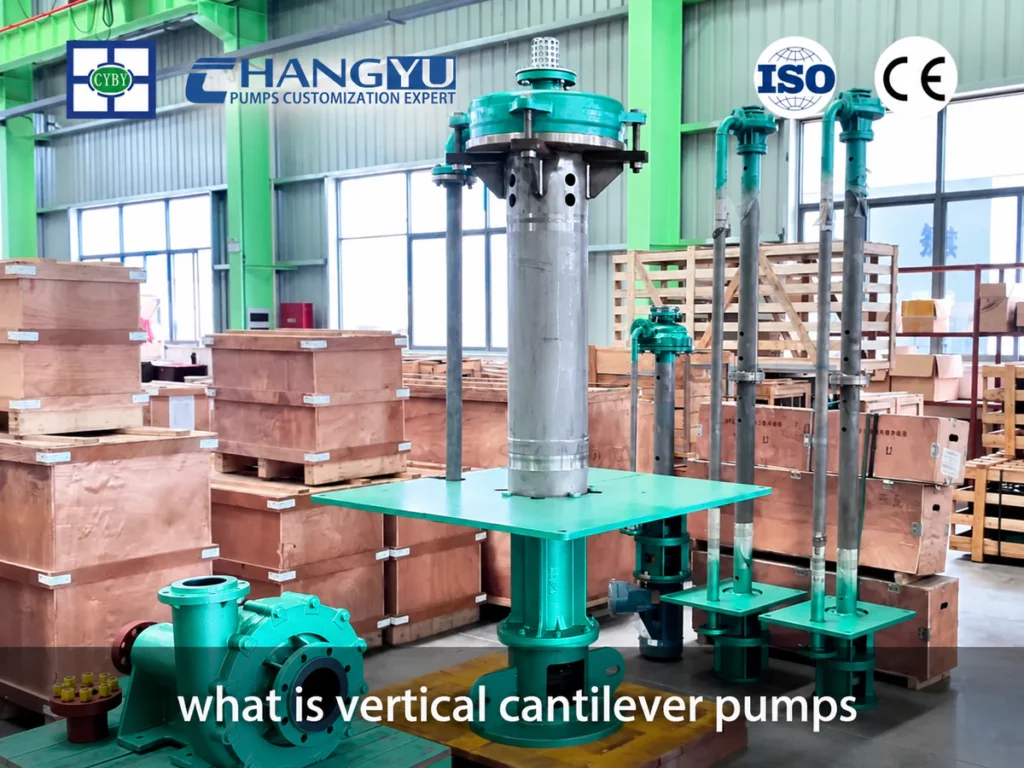
At Changyupump, we assess the liquid, operating levels and installation conditions to help you distinguish between vertical pump configurations. This article explains how to decide whether a cantilever design suits your duty, which parameters govern selection and where our related products and technical documents fit into that assessment.
How does a vertical cantilever pump work
The motor drives the shaft and impeller. Liquid enters the center of the impeller, receives energy and passes through the casing flow passages to the outlet before traveling through the discharge pipe. This is the operating principle of a centrifugal pump; the term vertical cantilever describes its installation and support arrangement.
In a typical vertical cantilever pump, bearings above the mounting plate carry the rotor loads, while the overhung shaft drives the submerged impeller. An inlet immersed directly in the liquid usually removes the need for an external suction pipe. Before starting, however, the inlet must be adequately submerged, the flow passages must have the required liquid fill and the manufacturer’s minimum operating level must be met.

Having no submerged support bearings and having no mechanical seal are different design features. Packing, gas isolation or other sealing arrangements may still be required, depending on vessel pressure, volatility and vapor containment requirements. The term sealless indicates the removal of a particular conventional sealing arrangement. It does not, by itself, establish that a pump is a cantilever design or that the complete system carries no leakage risk.
Types of vertical pumps
The term vertical pump covers a broad category, including pumps that draw from tanks and sumps as well as units installed in pipelines for pressure boosting. We recommend identifying the liquid source and required function first, then comparing flow, head, and materials.
| Pump type keyword | Configuration and common duties | What to distinguish during selection |
|---|---|---|
| vertical cantilever pump | Bearings above the liquid support an overhung shaft and submerged impeller for suitable sump and tank duties. | No submerged support bearings; unsupported shaft length is limited. |
| vertical sump pump | Draws from a sump or tank; may use cantilever or other shaft support arrangements. | The word sump describes the application, not the bearing arrangement. |
| vertical inline pump / vertical inline centrifugal pump | A vertical centrifugal pump installed in a pipeline for circulation and pressure boosting. | Usually does not extend a long shaft into a sump to draw liquid. |
| vertical multistage pump / vertical multistage centrifugal pump | Successive impellers add head, commonly for water supply and pressure boosting. | Greater head does not mean suitability for highly abrasive slurry. |
| vertical turbine pump | Usually has submerged bowl assemblies, a column pipe and drive shaft for duties such as water abstraction. | Common long-shaft designs have guide bearings and differ from true cantilever arrangements. |
| Vertical submersible pump | Market terminology may describe a fully submersible unit or a vertical pump with only the pump end immersed. | Confirm motor immersion, bearing locations and protection requirements. |
The term vertical slurry pump emphasizes solids handling, while vertical sump pump describes the location from which liquid is drawn. Both terms may describe the same pump, but neither replaces a check of its cantilever arrangement, solids passage capability and wear-resistant materials.


Difference between vertical and horizontal pumps
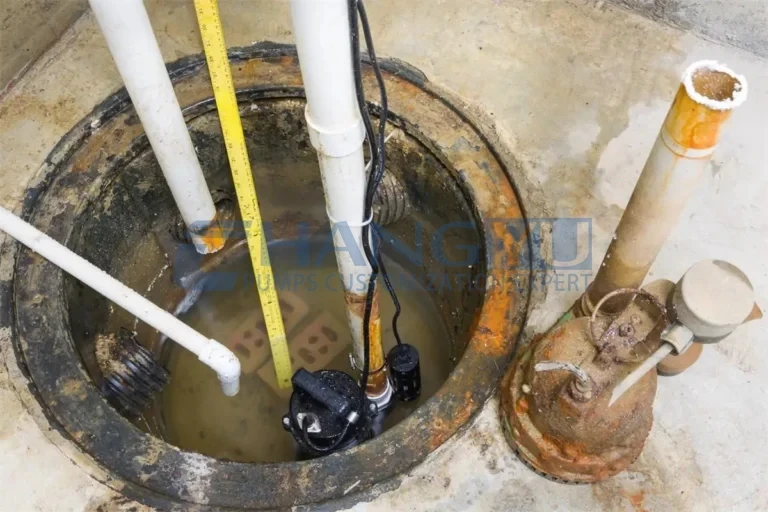
The choice between vertical and horizontal installation starts with the liquid source and how to maintain a reliable supply to the impeller. For underground sumps, tanks and neutralization pits, an immersed vertical arrangement places the inlet directly in the liquid and reduces floor space requirements. A horizontal pump is often installed outside the sump, where servicing and replacement are usually easier, but its inlet arrangement and suction piping need careful design.
A vertical cantilever pump needs sufficient overhead clearance to lift out the complete pump or rotor assembly for maintenance. Floors, pipework or operating platforms above the sump can determine whether the arrangement is practical before the pump footprint becomes the deciding factor. A horizontal pump needs maintenance space at floor level; a flooded-suction arrangement below the liquid level can also provide favorable inlet conditions.
Our engineers also examine liquid-level changes, pipe losses and liquid temperature. Immersed installation can improve inlet conditions, but it does not automatically eliminate cavitation: vapor bubbles form when local pressure falls too low and then collapse as pressure recovers. High liquid temperature, low operating levels or a blocked inlet can cause cavitation in a vertical pump as well.
Where are vertical cantilever pumps used?
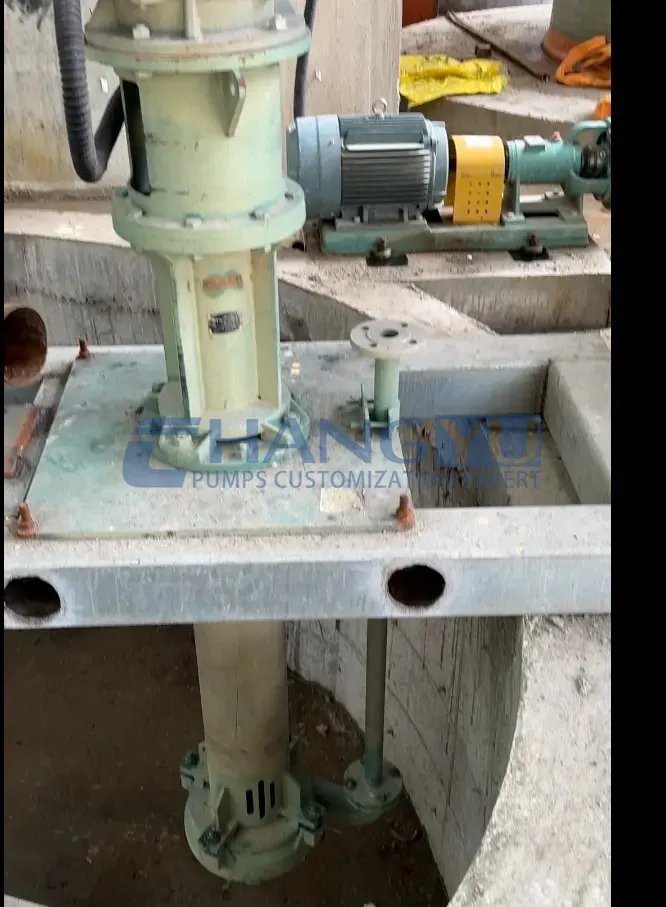
Where particles in a sump cause wear to submerged support components, or where the liquid makes those components difficult to maintain, vertical cantilever pumps are worth evaluating. Typical duties include industrial wastewater sumps, process drainage containing fine particles, slurry pits in metallurgical processes and chemical-liquid transfer where the selected materials are suitable.
These duties share a need for reliable liquid intake and fewer maintenance points that are difficult to reach below the liquid level. For abrasive slurry, meaning liquid containing particles that cause mechanical wear, particle hardness, size, solids concentration and passage geometry must also be assessed. Cantilever support addresses only part of the problem; wear-resistant materials and impeller design still affect performance in service.
We reassess the configuration if the sump is very deep, the liquid is volatile, the vessel operates under significant pressure or the slurry is highly viscous. A long-shaft immersed pump, a suitable fully submersible unit, a horizontal slurry pump or a positive displacement pump may suit some duties better. Selection must reflect the transfer task rather than the vertical pump label alone.

How do we select a vertical cantilever pump
First, establish the liquid composition, concentration, normal temperature and maximum temperature. The same acid or alkali can require different materials as concentration, temperature and impurities change. For saline or mixed liquids, we also need information on chlorides, oxidizing substances and cleaning fluids. A pH value alone is usually insufficient for corrosion-resistant material selection.
Second, establish the solids content and record the maximum particle size, hardness, shape and presence of fibers. An open impeller has exposed vanes and can help certain solids-bearing liquids pass through, but permissible particle size, clearance and efficiency must be checked for each model. An open design does not mean that every type of particle will pass without blockage.
Third, define the flow rate and head. The flow rate is the volume to be transferred per unit of time; head is the energy the pump adds per unit weight of liquid, usually expressed in meters. Required system head includes elevation differences, outlet pressure requirements, and losses through pipes and valves, rather than sump depth alone. Density affects shaft power requirements, while viscosity changes can also affect performance and efficiency.
Fourth, provide the distance from the mounting plate to the inlet, bottom clearance, normal and minimum liquid levels, sump opening dimensions and available lifting clearance. For a true cantilever arrangement, we must verify the permissible unsupported shaft length. For a long-shaft arrangement with submerged guide supports, sleeve and guide-bearing materials and lubrication requirements also need checking.
Finally, we check the performance curve at the actual duty point: the required combination of flow and head. We also assess its position relative to BEP, the best efficiency point, because operating too far from it can increase vibration and loading. Inlet conditions require a check of NPSH, or net positive suction head, with an appropriate margin for the model and service conditions. Low-level and overload protection should also be provided where required.
If you are unsure which option to choose, contact our engineering team. We will assist within 24 hours.
Email: [email protected]
TEL/WA: +86-13651913727
Which Changyupump vertical pump series fits your application
If you are looking for a vertical cantilever pump, send us your purchasing specification and sump drawing first. We will establish whether the project explicitly requires a design without submerged support bearings, then evaluate the configurations we can offer. Changyupump’s FYH and FY are immersed pump series relevant to tank and sump transfer. Whether a particular model meets the cantilever requirement must be confirmed against its structural drawing and technical agreement.
FYH Series for corrosive tank liquids
For corrosive tank liquids, acid or alkali process drainage and chemical wastewater, we can begin by evaluating the FYH Series Fluoroplastic Semi-submersible Pump. The series uses an immersed vertical arrangement, and we offer material configurations including FEP and UHMWPE. FEP is a fluoroplastic, while UHMWPE is ultra-high-molecular-weight polyethylene. Their chemical resistance, wear resistance and temperature limits differ, so they are not interchangeable.
When customers want to reduce maintenance associated with conventional mechanical seals, we discuss the options in relation to the specific FYH construction. If the liquid contains particles, we also check whether the impeller, sleeves and guide supports suit the medium. An immersed installation, the removal of a particular mechanical seal and the absence of submerged bearings are separate features that we clarify during selection.
FY Series for metal material options
For duties suited to metallic wetted parts, we can evaluate the FY Series Stainless Steel Vertical Submersible Pump. We offer material options including 304, 316, 316L, 2205 and 2507; 2205 and 2507 are duplex stainless steels. These grades identify configurations available for discussion. Final selection still depends on liquid composition, concentration, temperature and solids.
The immersed pump end of the FY draws directly from a tank or sump. Depending on the duty, we can discuss open or semi-open impellers, immersion length and motor configuration. If your specification requires all support bearings to remain above the liquid level, we will check the drawing before confirming a configuration, rather than treating the immersed-pump name as a structural commitment.
CYL and CDL Series for circulation and pressure boosting
For pipeline circulation or pressure boosting, compare the CYL Series vertical inline centrifugal pump. For clean liquids or other media permitted by the model specification, a CDL Series vertical multistage centrifugal pump may be considered where greater head is needed. These series address pipeline transfer and multistage boosting respectively; they do not directly replace a sump intake arrangement for solids-bearing liquids.
We introduce these series to help narrow your options according to the duty. A quotation should specify the materials, impeller, bearing arrangement, immersion length and duty point, rather than only a model number or maximum flow.
FAQs about vertical pumps
The following questions cover installation, maintenance and related pump types so that you can request a quotation with clearer technical requirements.
How does a vertical turbine pump work
A vertical turbine pump usually transfers energy to the liquid through submerged impellers. The liquid passes through the guide components into the column pipe and then to the surface discharge. In a common multistage bowl assembly, successive impellers add head. This is the basic process described by vertical turbine pump working principle.
Common long-shaft configurations use guide bearings to support the drive shaft; a submersible vertical turbine pump may instead use a submerged motor. When comparing either with a vertical cantilever pump, check the support arrangement, motor position and installation depth. Calling both a vertical pump does not mean that their installation or maintenance requirements are the same.
Does vertical turbine pump installation apply to vertical cantilever pumps
No. The procedures are not directly interchangeable. A vertical turbine pump installation commonly involves bowl assemblies, sectional column pipes, long-shaft connections and bearing lubrication. For a vertical cantilever pump, the main checks include unsupported shaft length, mounting-plate rigidity, running clearances and lifting space.
Both types require checks of motor rotation, minimum operating level, inlet-to-bottom clearance and independent support for discharge piping. Use the installation drawing for the specific model to establish clearances and assembly tolerances, rather than using another pump type’s manual as the installation specification.
Can a vertical cantilever pump run dry
The word cantilever alone does not establish that dry running is permitted. The absence of submerged support bearings may reduce some risks associated with liquid-lubricated components, but internal rubbing, heat buildup, residual liquid and other sealing components must still be considered. Lubrication conditions are especially important for immersed pumps that have guide bearings or sleeves.
We recommend model-specific low-level shutdown protection and written confirmation of whether temporary loss of liquid is permitted and for how long. Intermittent operation does not mean continuous operation without liquid is acceptable.
How do you maintain and troubleshoot vertical cantilever pumps?
Routine maintenance should track changes in flow, discharge pressure, current, vibration and bearing temperature, with lubrication of the upper bearings as specified. During shutdown inspections, check the impeller and casing for wear, changes in clearance, corrosion and loose fasteners. If the actual pump supplied has submerged guide supports, inspect its sleeves and guide bearings as well.
If flow declines, first check liquid level, rotation, inlet or outlet blockage and valve positions. If vibration increases, investigate air entrainment, cavitation, impeller imbalance, alignment and support condition. Before inspection, stop and isolate the equipment, then drain and clean it as required by the liquid being handled. A vertical turbine pump maintenance program and vertical turbine pump troubleshooting may also involve long-shaft guide bearings, sectional shafts and bowl assemblies; those procedures cannot simply be applied to a cantilever pump.
Can a vertical slurry pump handle every type of slurry
No. The suitability of a vertical slurry pump depends on particle hardness, maximum size, solids concentration, settling behavior and corrosiveness. Fine-particle chemical wastewater and high-concentration mineral slurry can have very different material, passage and power requirements.
For settling media, assess agitation, deposits at the sump bottom and shutdown flushing arrangements. Wear-resistant pump construction can slow wear, but it cannot resolve every sedimentation or system blockage problem.
Can vertical booster pumps replace a vertical sump pump
Usually not as a direct replacement. The main function of vertical booster pumps is to increase pipeline pressure, typically where suitable inlet conditions are already available. A vertical sump pump draws liquid from a sump. Their inlet conditions and permissible media may differ.
If a site needs both sump intake and higher discharge pressure, we assess whether a single pump can meet the duty or whether staged transfer and separate boosting are needed. The ability of downstream equipment to handle any particles must be checked at the same time.
What should you ask vertical pump manufacturers before ordering
When comparing vertical pump manufacturers, ask each supplier to base its proposal on the same duty conditions and specify the duty point, structural drawing, materials list, minimum liquid level, immersion length, sealing and lubrication arrangements, spare parts and scope of supply. For vertical cantilever pumps, ask specifically whether any support bearings are below the liquid level.
If you are also comparing vertical turbine pump manufacturers or vertical turbine pumps suppliers, first confirm whether the configuration offered suits your sump and liquid. Fire protection, deep-well abstraction and chemical wastewater transfer have different technical requirements. A supplier’s use of the term vertical pump does not replace a review of its specific product.
Why work with Changyupump for vertical pump selection
We are Changyupump, Anhui Changyu Pump and Valve Manufacturing Co., Ltd., established in 2006. Our product range includes chemical centrifugal pumps, slurry pumps, magnetic drive pumps and immersed pumps. For corrosion, abrasion and sump intake problems, we evaluate the liquid conditions together with the equipment configuration.
You can discuss the FYH and FY immersed pump series with us, or compare CYL and CDL products for pipeline circulation and boosting. Our engineers first need to understand the duty, then confirm a model and configuration. Where the project explicitly requires no submerged bearings, we include that requirement in the proposal review and base the supply on the confirmed drawings and technical documents.
Where can you find vertical pump PDF documents?
To review construction, performance parameters and installation information before requesting a quotation, start with the semi-submersible pump catalogue PDF linked from our FYH product page. It covers several chemical immersed pump series, so locate the relevant model and avoid applying the construction or temperature limits of one series to another.
For pipeline transfer and boosting arrangements, refer to the vertical inline pump specifications PDF and vertical multistage centrifugal pump specifications PDF respectively.
If you are looking for a vertical cantilever pump PDF, tell us the required configuration and duty conditions. We will provide the relevant documents once the structure is confirmed. A general catalogue supports initial comparison; final selection also requires the model-specific performance curve, installation drawing and agreed technical conditions.
Contact Changyupump for your vertical pump application
Selecting vertical cantilever pumps means establishing whether cantilever support suits the liquid, immersion length and site installation conditions. Bearings located above the liquid can reduce submerged maintenance points, while actual performance still depends on materials, solids passage, duty point and level control. Deeper sumps, different corrosion conditions and pipeline boosting duties require the corresponding immersed, inline or multistage configuration.
If you face repeated seal damage, sump-pump blockage or declining flow, or are unsure whether you need a true design without submerged bearings, contact Changyupump. Please provide the liquid name and concentration, temperature, solids content and maximum particle size, required flow and head, sump dimensions and minimum liquid level. An existing pump nameplate, failure photographs or a sump drawing will also help us understand the problem more quickly.
Email: [email protected]
TEL/WA: +86-13651913727