
1. Corrosion and Crystallization Challenges in Ammonium Sulfate Slurry Pumps
Ammonium sulfate slurry presents two distinct but interrelated challenges for industrial pumping equipment: sự ăn mòn from the acidic liquid phase, and quá trình kết tinh from the dissolved solids. These failure modes often act together—localized corrosion can create rough surface sites that accelerate crystal nucleation, while crystal buildup can trap corrosive media against pump surfaces, accelerating material degradation.
The liquid phase of ammonium sulfate slurry is corrosive due to two factors. Ammonium sulfate solution itself has a pH of 5.0–6.0 at 1 M concentration, which is moderately acidic. More significantly, the ammonium sulfate production process typically involves a reaction between ammonia and sulfuric acid, and residual sulfuric acid frequently remains in the slurry. This residual acid can drive the pH significantly lower, particularly in processes where the acid-to-ammonia ratio is not perfectly controlled.
The solid phase presents a crystallization risk. Ammonium sulfate has a solubility curve that changes markedly with temperature. When a near-saturated solution experiences a temperature drop within the pump, the dissolved salt can rapidly precipitate as crystals, leading to:
- Lỗi niêm phong: Buildup around mechanical seal faces, causing seal leakage
- Impeller imbalance: Crystal deposition on the impeller, creating vibration and accelerated bearing wear
- Flow restriction: Accumulation in the volute casing, restricting flow and increasing discharge pressure
- Rotating assembly seizure: In severe cases, complete blockage of the rotating assembly
Crystallization-related seal failures are a leading contributor to unplanned maintenance in ammonium sulfate processing plants, making seal reliability a key consideration in pump selection for this application.
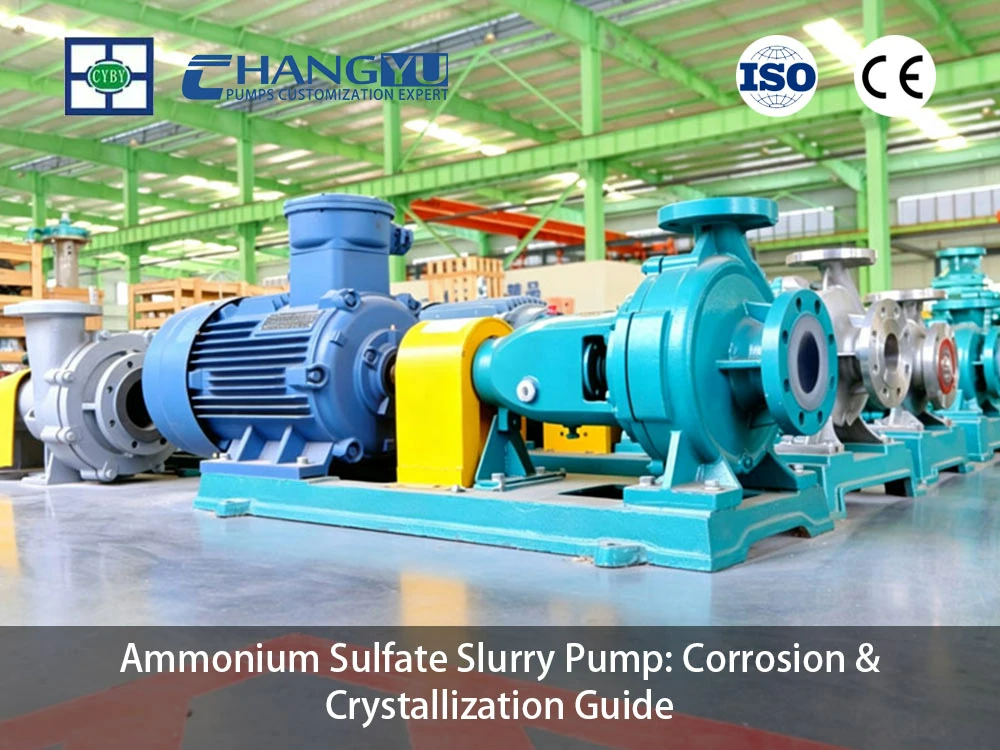
2. Corrosion Mechanisms in Ammonium Sulfate Service
2.1 Residual Sulfuric Acid Corrosion
The primary corrosion risk in ammonium sulfate slurry pumps comes from residual sulfuric acid (H₂SO₄) that remains unreacted in the process stream. The corrosivity depends on the acid concentration and temperature:
- Dilute sulfuric acid (below 80%): Highly corrosive to most metals. At elevated temperatures, dilute H₂SO₄ attacks carbon steel, stainless steel, and even some nickel alloys. This is the most common corrosion scenario in ammonium sulfate processes.
- Concentrated sulfuric acid (above 80%): Less corrosive to some metals but more aggressive to organic materials. Requires careful material selection.
- Intermediate concentrations (20–80%): The most aggressive range for sulfuric acid corrosion, requiring fully lined or non-metallic pump construction.
2.2 pH and Temperature Effects
The corrosion rate in ammonium sulfate service increases with temperature. At process temperatures above 60°C, even mildly acidic solutions can cause measurable corrosion of metallic pump components. This is why lined pumps—where the wetted surfaces are isolated from the metal structure by a corrosion-resistant lining—are the standard choice for ammonium sulfate slurry handling.
2.3 Material Performance Under Corrosive Conditions
Three lining materials are commonly used in ammonium sulfate slurry pumps, each with a different corrosion resistance profile:
| Chất liệu | Sulfuric Acid Resistance | Phạm vi nhiệt độ | Khả năng chống mài mòn |
|---|---|---|---|
| UHMWPE (UHB Series) | ≤80% H₂SO₄ | -20°C to 90°C (standard), up to 100–120°C (modified) | >9x carbon steel |
| FEP (CYB-ZKJ Series) | ≤80% H₂SO₄ | -20°C đến 120°C | Trung bình |
| PFA/PTFE (CYQ Series) | All concentrations, including 98% H₂SO₄ and oleum | -20°C đến 180°C | Trung bình |
UHMWPE offers the highest abrasion resistance—more than nine times the wear resistance of carbon steel under standard test conditions—making it a preferred choice when the slurry contains high concentrations of crystalline solids. The UHB series features a steel-lined construction with 8–20 mm UHMW-PE lining, providing a robust barrier against both corrosive attack and abrasive wear.
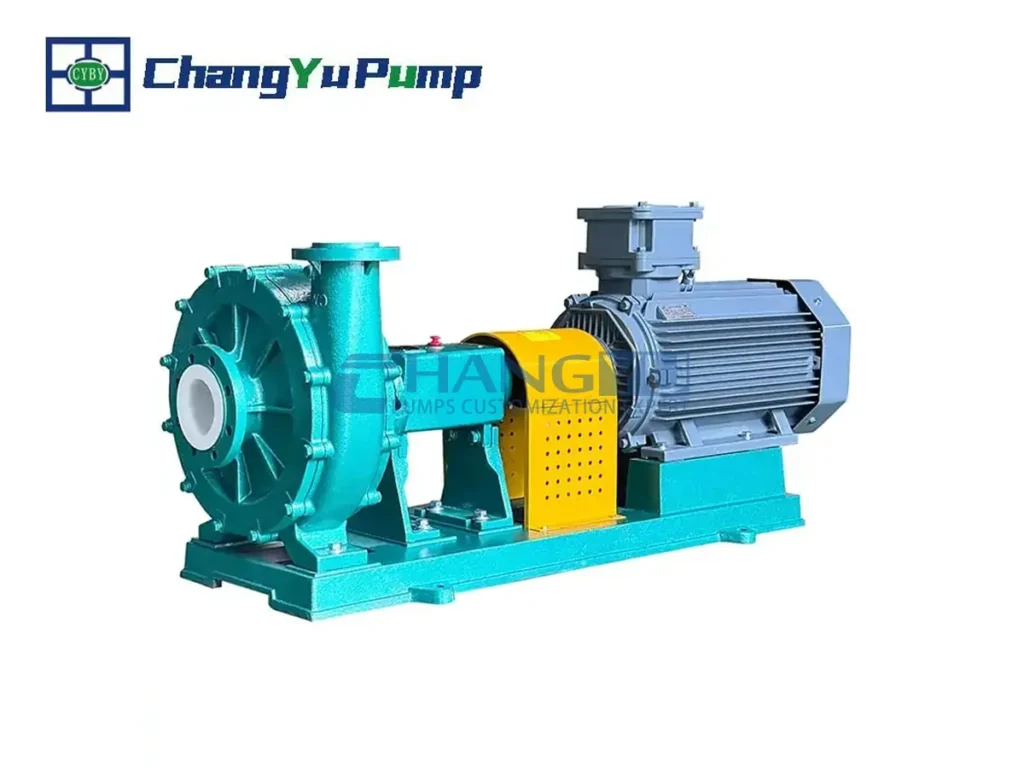
Fluoroplastic linings (FEP, PFA, PTFE) offer broader chemical resistance and higher temperature capability. The CYB-ZKJ series uses FEP lining with a temperature range of -20°C to 120°C and handles sulfuric acid concentrations up to 80%, while the CYQ series with PFA/PTFE lining handles the full concentration range including 98% concentrated acid at temperatures up to 180°C.
3. Root Causes of Crystal Formation in Pump Seals and Impellers
3.1 Solubility Characteristics of Ammonium Sulfate
Ammonium sulfate exhibits a solubility curve that changes significantly with temperature. According to standard solubility data (Perry’s Chemical Engineers’ Handbook), the solubility of (NH₄)₂SO₄ in water is approximately:
| Nhiệt độ (°C) | Solubility (g/100 g H₂O) | Change from 20°C |
|---|---|---|
| 20°C | 75.4 | — |
| 30°C | 78.0 | +3.4% |
| 40°C | 81.8 | +8.5% |
| 50°C | 84.8 | +12.5% |
| 60°C | 88.0 | +16.7% |
| 70°C | 91.7 | +21.6% |
| 80°C | 95.3 | +26.4% |
| 90°C | 99.2 | +31.6% |
| 100°C | 103.3 | +37.0% |
The solubility difference between 30°C and 80°C is approximately 17.3 g/100 g H₂O—a change of roughly 22%. When a saturated or near-saturated ammonium sulfate solution experiences a temperature drop of 15–20°C across the pump, the solution can enter a supersaturated state, triggering rapid crystal nucleation on pump internal surfaces.
3.2 Temperature Gradients in the Seal Chamber
The seal chamber requires particular attention. The mechanical seal generates localized heat at the sliding faces, but the seal housing area—particularly near the atmospheric side—can experience localized cooling due to heat dissipation through the housing and surrounding piping. This thermal gradient creates conditions where ammonium sulfate crystals preferentially nucleate and grow around the seal faces, eventually forcing the faces apart and causing leakage.
3.3 Surface Roughness and Nucleation Sites
Crystal nucleation is thermodynamically favored on rough surfaces. Pump internal surfaces that have been roughened by corrosion or mechanical wear provide preferential nucleation sites for ammonium sulfate crystals. This creates a self-reinforcing cycle: corrosion creates roughness, roughness promotes crystal nucleation, and crystal growth traps corrosive media against the surface, accelerating further corrosion.
4. Engineering Solutions for Corrosion and Crystallization Control
4.1 Seal Chamber Temperature Control for Crystallization Prevention
Maintaining the temperature above the saturation point throughout the pump is a primary strategy for preventing crystallization.
External Flush (API Plan 32): A clean external flush introduces a small flow of clear liquid—typically water or a dilute ammonium sulfate solution—into the seal chamber. This dilutes the local concentration and raises the temperature, reducing the risk of crystal nucleation at the seal faces. The CYB-ZKJ series is designed to accommodate mechanical seals with API 682 flushing protocols, providing a standardized interface for implementing flush plans. API 682 is the industry standard for mechanical seal systems in centrifugal and rotary pumps, and Plan 32 is one of the recognized configurations for crystallization-prone applications.
Steam or Hot Water Jacketing: For processes where dilution is not acceptable, the seal housing can be fitted with a steam or hot water jacket. This maintains the internal temperature above the saturation point without altering the process chemistry. For FEP-lined pumps such as the CYB-ZKJ series, the temperature range of -20°C to 120°C provides adequate headroom for jacket operation.
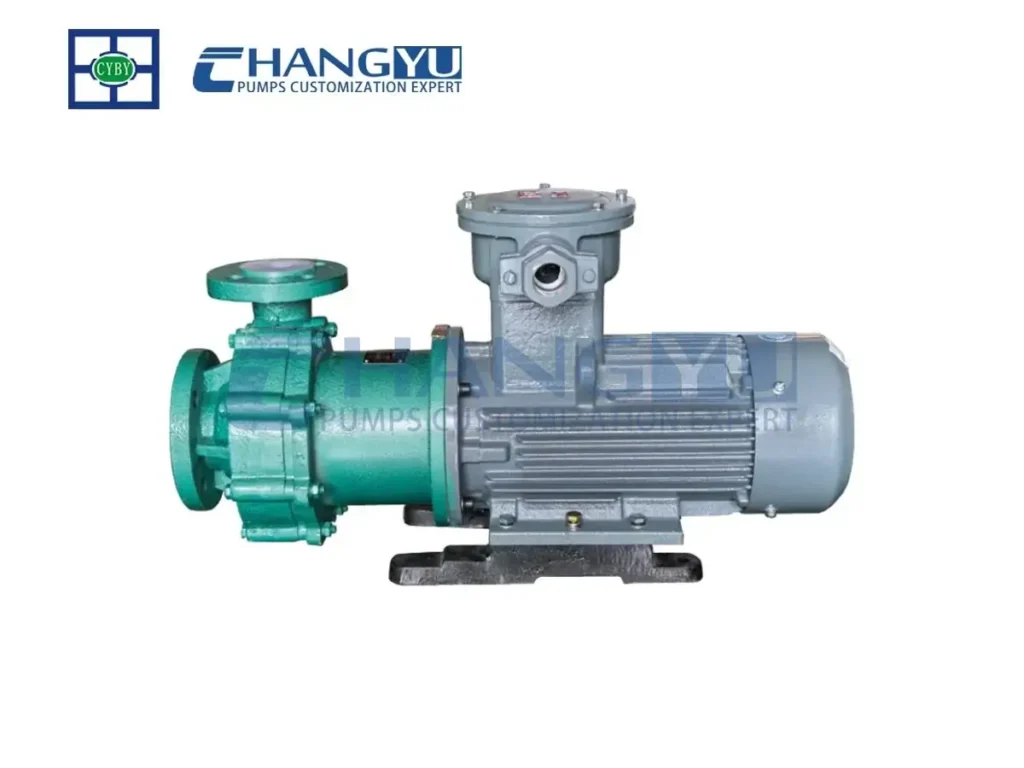
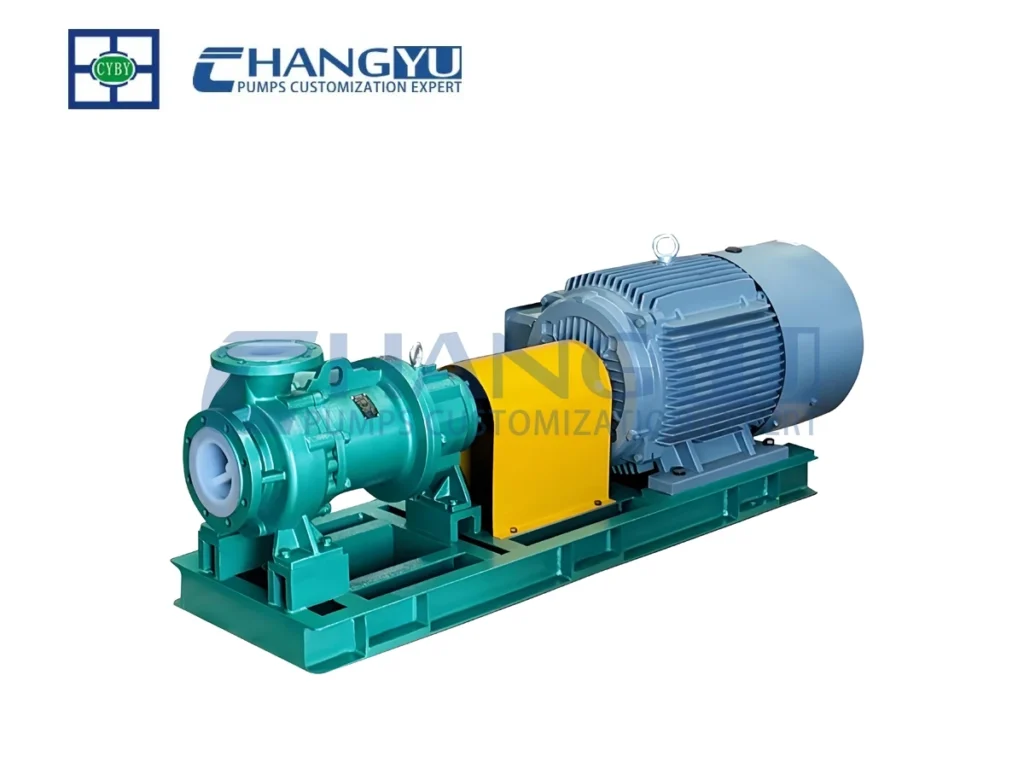
Magnetic Drive Alternative: For applications where mechanical seal maintenance is a recurring cost, a sealless magnetic drive pump eliminates the dynamic seal entirely. The CYQ series magnetic drive pump uses a containment shell and magnetic coupling to transmit torque without a shaft penetration, removing the primary crystallization failure point. The CYQ series handles temperatures from -20°C to 180°C with FEP, PFA, or PTFE lining, and is designed to meet ASME B73.3 sealless pump standards. This configuration is suitable for ammonium sulfate processes where the solution temperature exceeds 100°C or where concentrated sulfuric acid (up to 98%) is present.
4.2 Impeller Design for Crystal-Laden Slurries
The impeller geometry directly affects how crystals accumulate and whether they can be flushed out during operation.
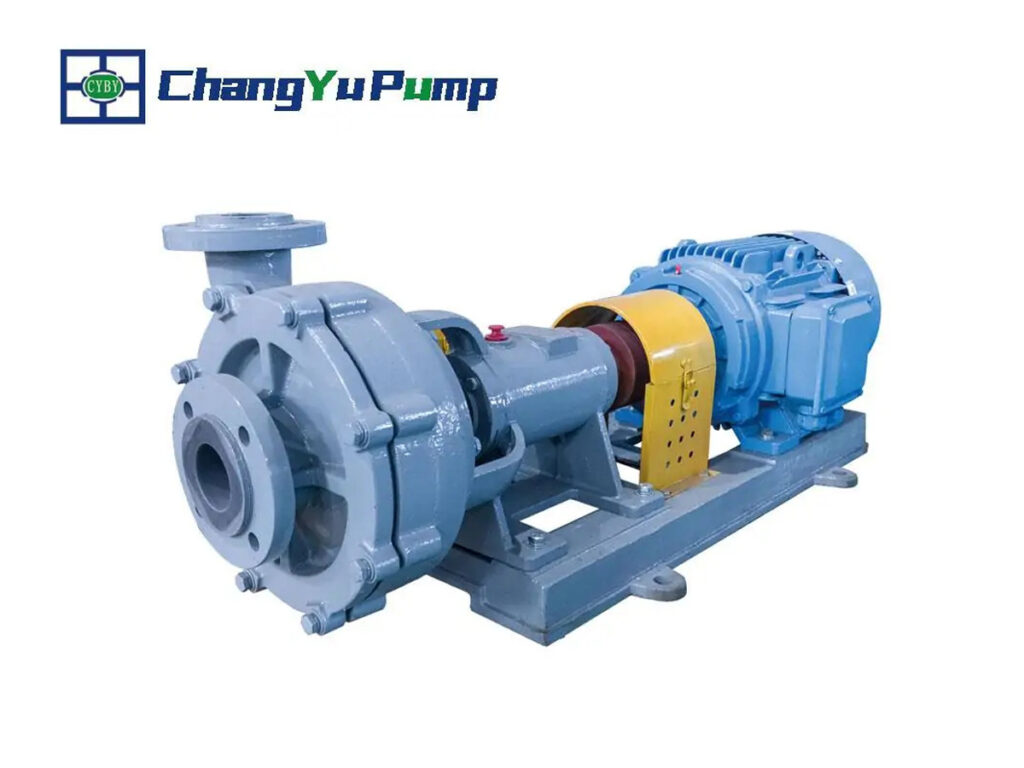
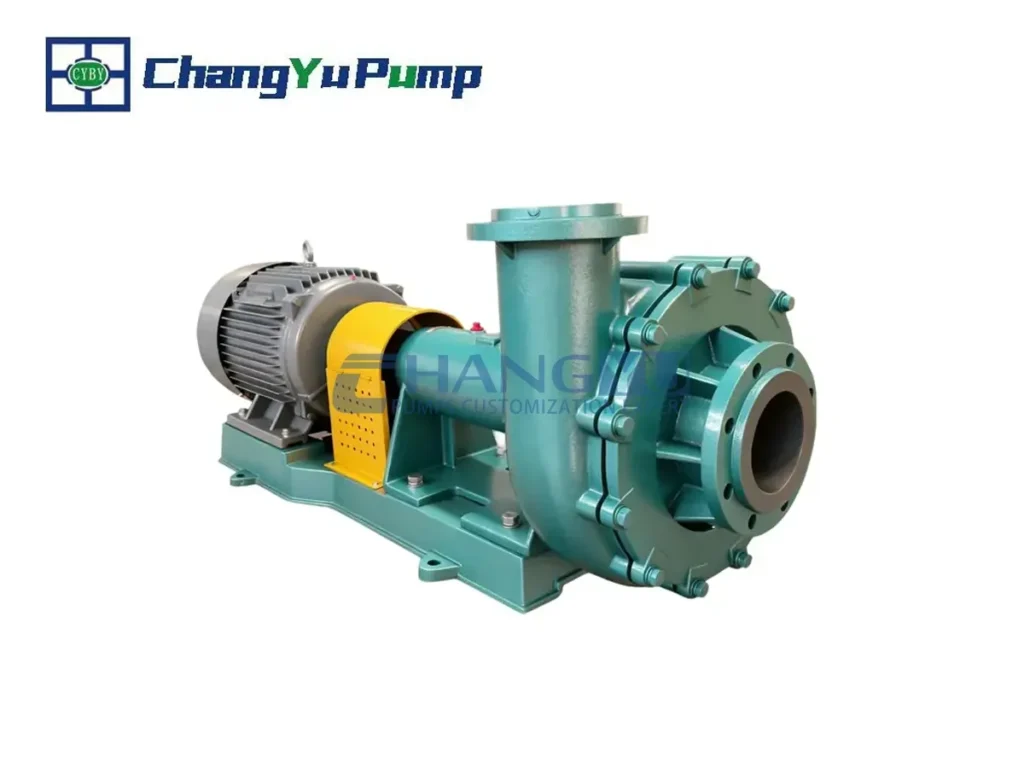
Cánh quạt bán mở: The UHB series uses a high-passage semi-open impeller design (without a front cover plate) that widens the flow path and enhances the pump’s ability to handle particulate-laden media. The design includes rear vanes that reduce pressure in the seal chamber, extending pump service life. The open flow channels reduce the surface area where crystals can adhere and allow any buildup to be flushed away more easily.
Cánh quạt kín: For higher head requirements, a closed impeller provides better hydraulic efficiency. The CYQ series uses a closed impeller design with all wetted parts made of fluoroplastic, suitable for aggressive chemical media. The internal passages can be specified with a smoother finish to reduce crystal adhesion sites.
Clearance Management: Maintaining adequate clearance between the impeller and the casing is a standard consideration in the engineering selection process for corrosion-resistant pumps handling crystallizing media. A wider clearance allows crystal deposits to pass through without seizing the rotating assembly. The engineering team at Changyu Pump evaluates the crystal size distribution and expected buildup rate to determine the appropriate clearance for each application.
4.3 Corrosion-Resistant Material Selection
The lining material of the pump’s wetted parts is the primary defense against corrosion, while also affecting crystal adhesion.
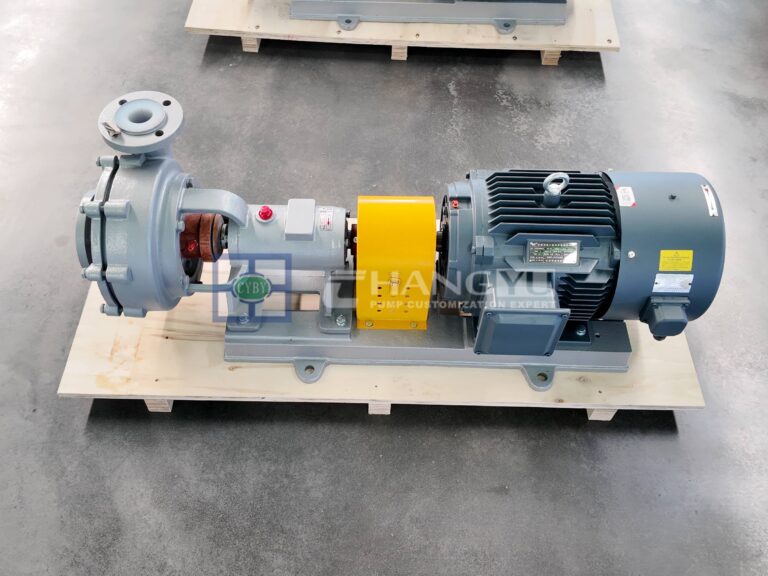
UHMWPE (UHB Series): Ultra-high molecular weight polyethylene (UHMW-PE) offers a low coefficient of friction, high abrasion resistance—more than nine times the wear resistance of carbon steel under standard test conditions—and resistance to sulfuric acid up to 80% concentration. The UHB series features a steel-lined construction with 8–20 mm UHMW-PE lining, providing a robust barrier against corrosive attack. The standard temperature range is -20°C to 90°C, with modified materials extending the range up to 100–120°C for specific applications. This series handles flow rates from 3 to 2600 m³/h with heads up to 100 m.
FEP Lining (CYB-ZKJ Series): FEP (fluorinated ethylene propylene) offers a smooth, non-porous surface that resists both chemical attack and crystal adhesion. The CYB-ZKJ series uses FEP lining with 8–20 mm sintered construction, temperature range of -20°C to 120°C, and handles sulfuric acid concentrations up to 80%. For higher temperature requirements, PFA lining is available. The dual-end mechanical seal supports API 682 flushing, and the semi-open impeller handles slurries with up to 20% flexible solid particles.
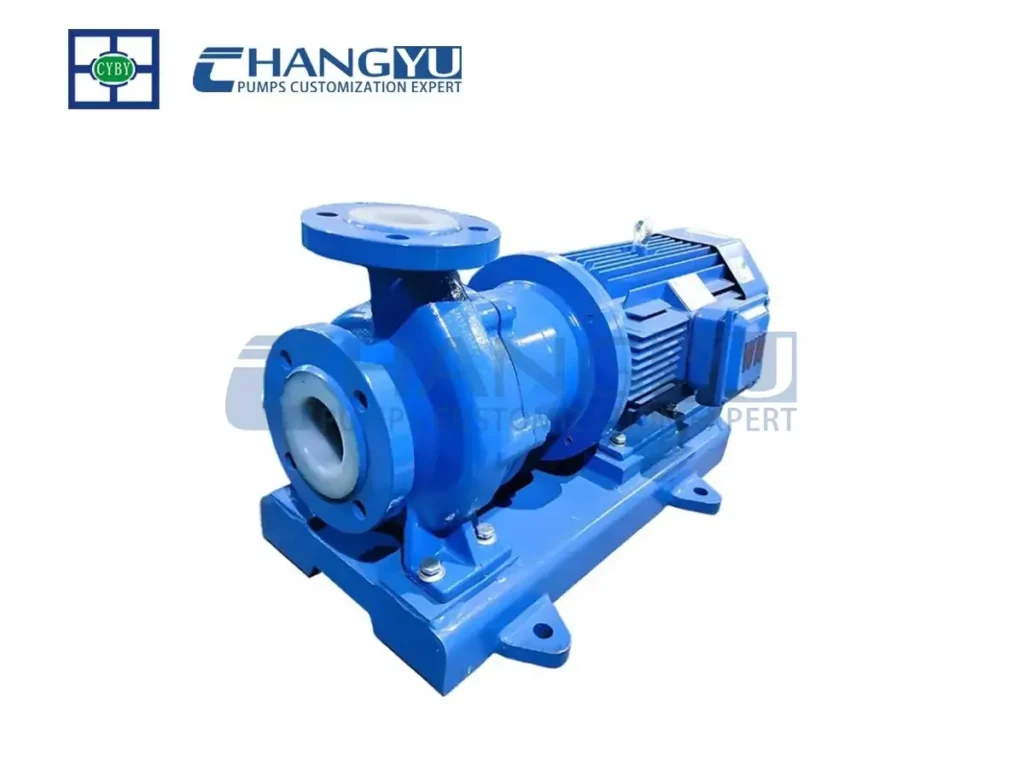
PFA/PTFE Lining (CYQ Series): For applications requiring the broadest chemical resistance and highest temperature capability, the CYQ magnetic drive series uses FEP, PFA, or PTFE lining (8–15 mm) with a temperature range of -20°C to 180°C. This series is compatible with the full concentration range of sulfuric acid including 98% concentrated acid and oleum, making it suitable for processes where residual acid concentration is high or variable.
5. Installation Best Practices for Crystallization Prevention
5.1 Piping Layout
Proper piping layout is critical for preventing crystal accumulation:
- Suction piping: Keep suction lines as short and direct as possible. Eliminate high points where vapor pockets can form, as vapor pockets cause localized cooling and promote crystallization.
- Vertical suction lift: Avoid vertical suction lift configurations. Always design with a flooded suction (positive suction head) to maintain consistent flow and temperature.
- Drain valves: Install drain valves at low points in the piping system to allow complete flushing between batch operations.
5.2 Flush System Setup
If using API Plan 32 external flush:
- Flush liquid temperature: The flush liquid should be at least 10–15°C above the saturation temperature of the ammonium sulfate solution at the seal chamber pressure.
- Lưu lượng: Typical flush flow rates range from 2–5 L/min depending on seal size and operating conditions. Consult the pump manufacturer for specific recommendations.
- Continuous operation: The flush system must operate continuously during pump operation. Intermittent flushing can cause thermal shock and accelerate seal face damage.
5.3 Startup and Shutdown Procedures
- Pre-start flush: Before starting the pump, flush the seal chamber with warm water or dilute ammonium sulfate solution for 2–3 minutes to remove any accumulated crystals.
- Warm-up period: For steam-jacketed pumps, activate the jacket 15–20 minutes before startup to bring the seal chamber temperature above the saturation point.
- Shutdown flush: After stopping the pump, continue the flush for 3–5 minutes to clear residual ammonium sulfate from the seal chamber.
- Standby pumps: For standby pumps in crystallization service, consider installing a small recirculation line to maintain gentle flow and prevent crystal settling.
6. Maintenance and Troubleshooting Guide
6.1 Các dạng hỏng hóc thường gặp
| Triệu chứng | Nguyên nhân có thể | Hành động được khuyến nghị |
|---|---|---|
| Increasing seal leakage | Crystal buildup on seal faces | Flush seal chamber with warm water; verify flush plan parameters |
| Vibration during operation | Crystal deposits on impeller causing imbalance | Disassemble and clean impeller; check for erosion damage |
| Motor current fluctuation | Partially blocked volute casing | Flush system; inspect for crystal accumulation in casing |
| Sudden shaft seizure | Rapid crystallization in seal chamber | Apply steam or hot water to seal housing; disassemble if necessary |
| Excessive seal face wear | Crystal particles embedded in seal faces | Upgrade to harder seal face materials (SiC vs. carbon); verify flush filter mesh size |
6.2 Recommended Inspection Intervals
| Inspection Item | Tần số | Key Check Points |
|---|---|---|
| Seal chamber temperature | Hàng ngày | Compare with saturation temperature of the solution |
| Flush system flow rate | Hàng ngày | Verify flow meter reading; check for blockages |
| Giám sát rung động | Hàng tuần | Track baseline and trend; investigate changes >20% |
| Seal leakage observation | Hàng tuần | Record drip rate; investigate any increase |
| Impeller visual inspection | Hàng quý | Check for crystal deposits, erosion, and corrosion |
| Lining thickness measurement | Hàng năm | Verify lining integrity; replace if thickness < 50% of original |
6.3 Troubleshooting: Crystallization Checklist
When crystallization is suspected, follow this checklist in order:
- Check temperature profile: Measure temperature at suction, discharge, and seal chamber. Compare with the saturation temperature at the corresponding pressure.
- Verify flush system: Confirm flush liquid flow rate, temperature, and composition. Check for blockages in the flush line.
- Inspect cooling jacket: If equipped, verify steam or hot water supply to the jacket.
- Review operating cycle: Has the pump been idle for more than 30 minutes without flushing? Have there been recent changes in process temperature or concentration?
- Examine piping: Are there uninsulated sections of pipe near the pump that could cause localized cooling?
7. Ammonium Sulfate Slurry Pump Selection Guide by Operating Conditions
| Điều kiện hoạt động | Nguy cơ ăn mòn | Crystallization Risk | Dòng bơm khuyến nghị | Key Parameters |
|---|---|---|---|---|
| Intermittent batch operation, temperature drops below 50°C | Low–moderate | Cao | CYB-ZKJ | Flow 3–2600 m³/h, head ≤80 m, FEP lining, API 682 seal support, external flush plan |
| Continuous operation, temp > 60°C, high crystal load | Trung bình | Cao | UHB series | Flow 3–2600 m³/h, head 5–100 m, temp -20°C to 90°C, UHMWPE lining, >9x carbon steel wear resistance |
| Recurring seal failure, zero leakage required | Moderate–high | Cao | Dòng CYQ | Flow 3–800 m³/h, head 15–125 m, temp -20°C to 180°C, magnetic drive sealless, ASME B73.3 |
| High temperature (>100°C) with residual H₂SO₄ | Cao | Trung bình | Dòng CYQ | PFA/PTFE lining, handles 98% H₂SO₄ and oleum |
| High flow (>800 m³/h) with crystalline particles | Trung bình | Cao | CYB-ZKJ | Flow up to 2600 m³/h, FEP lining, ≤80% H₂SO₄, semi-open impeller |
| Abrasive slurry with high solids content | Low–moderate | Trung bình | UHB series | 8–20 mm UHMWPE lining, k-type dynamic seal with cooling jacket |
Các câu hỏi thường gặp
Q1: What causes ammonium sulfate crystallization in slurry pumps?
A: The primary cause is a temperature drop of 15–20°C or more across the pump, which pushes a near-saturated ammonium sulfate solution into supersaturation. The seal chamber is particularly vulnerable because it can experience localized cooling due to heat dissipation through the housing.
Q2: What material is best for corrosion resistance in ammonium sulfate service?
A: For residual sulfuric acid up to 80%, UHMWPE (UHB series) and FEP (CYB-ZKJ series) are both suitable. For processes involving concentrated acid above 80% or temperatures above 120°C, PFA or PTFE lining (CYQ series) is recommended. The selection depends on the specific acid concentration, temperature, and abrasion level.
Q3: Can a magnetic drive pump handle ammonium sulfate slurry with crystals?
A: Yes. The CYQ series magnetic drive pump, with fluoroplastic lining and a sealless containment shell, is suitable for ammonium sulfate slurry. The absence of a dynamic mechanical seal eliminates the primary failure point for crystallization-induced leakage. The temperature range of -20°C to 180°C covers most process conditions.
Q4: What seal flush plan is recommended for ammonium sulfate service?
A: API Plan 32 (clean external flush) is a common choice. It introduces a small flow of clean liquid into the seal chamber to dilute the local concentration and raise the temperature. The CYB-ZKJ series supports API 682 flushing protocols, which provide standardized interfaces for implementing flush plans.
Q5: How does UHMWPE compare with FEP lining for ammonium sulfate handling?
A: UHMWPE (UHB series) offers higher abrasion resistance—more than nine times that of carbon steel—and a lower coefficient of friction, making it a strong choice for slurries with high crystal content. FEP (CYB-ZKJ series) offers a wider temperature range (-20°C to 120°C) and resistance to higher sulfuric acid concentrations (up to 80%). The choice depends on whether the primary concern is abrasion or temperature/acid concentration.
Q6: What information is needed to select the right pump for ammonium sulfate slurry?
A: The engineering team requires the following parameters: flow rate, head, specific gravity, temperature profile (inlet, discharge, and seal chamber), crystal size and concentration, residual acid content and concentration, and operating cycle (continuous or batch).
Q7: How often should the pump be inspected for crystal buildup?
A: Seal chamber temperature and flush system flow rate should be checked daily. Vibration monitoring and seal leakage observation should be performed weekly. Impeller visual inspection is recommended quarterly.
Q8: What is the difference between UHB, CYB-ZKJ, and CYQ series pumps?
A: UHB series uses UHMWPE lining for maximum abrasion resistance; CYB-ZKJ series uses FEP lining for higher temperature resistance and is equipped with API 682 dual-end mechanical seals; CYQ series is a magnetic drive sealless pump for zero-leakage applications with PFA/PTFE lining for the highest chemical resistance.
9. Expert Engineering Support for Ammonium Sulfate Pump Applications
Selecting the right pump configuration for ammonium sulfate slurry requires evaluation of multiple process parameters that interact with each other. The key variables include:
- Temperature profile across the pump (inlet, discharge, and seal chamber)
- Crystal size and concentration in the slurry
- Residual acid content and its effect on material compatibility
- Operating cycle (continuous vs. batch, with or without standby)
- Flow rate and head requirements for the process
About Changyu Pump: Anhui Changyu Pump and Valve Manufacturing Co., Ltd. has been manufacturing corrosion-resistant and abrasion-resistant pumps since 2006, with a 20,000 m² facility and annual output of over 20,000 units delivered to markets including Europe, Africa, and Central Asia. The company holds ISO 9001, CE, and ATEX certifications, with 30+ technical patents in steel-lined UHMW-PE technology.
The engineering team provides one-on-one technical consultation and can deliver a customized pump solution with a quotation within 24 hours. For a detailed evaluation of your ammonium sulfate slurry application, contact the engineering team with the following information:
- Email: [email protected]
- WhatsApp / Tel / WeChat: +86-13651913727
- Required information: flow rate, head, specific gravity, temperature, crystal content, and acid concentration