
An end suction centrifugal pump is a practical choice for many clean-liquid transfer and circulation duties. For stainless steel service, the right choice depends on five things: the liquid, required flow, total head, suction conditions, and seal arrangement.
Start with those details before choosing a motor or comparing prices. A larger motor cannot correct a restricted inlet. A more expensive alloy cannot make a clean-liquid impeller suitable for abrasive slurry.
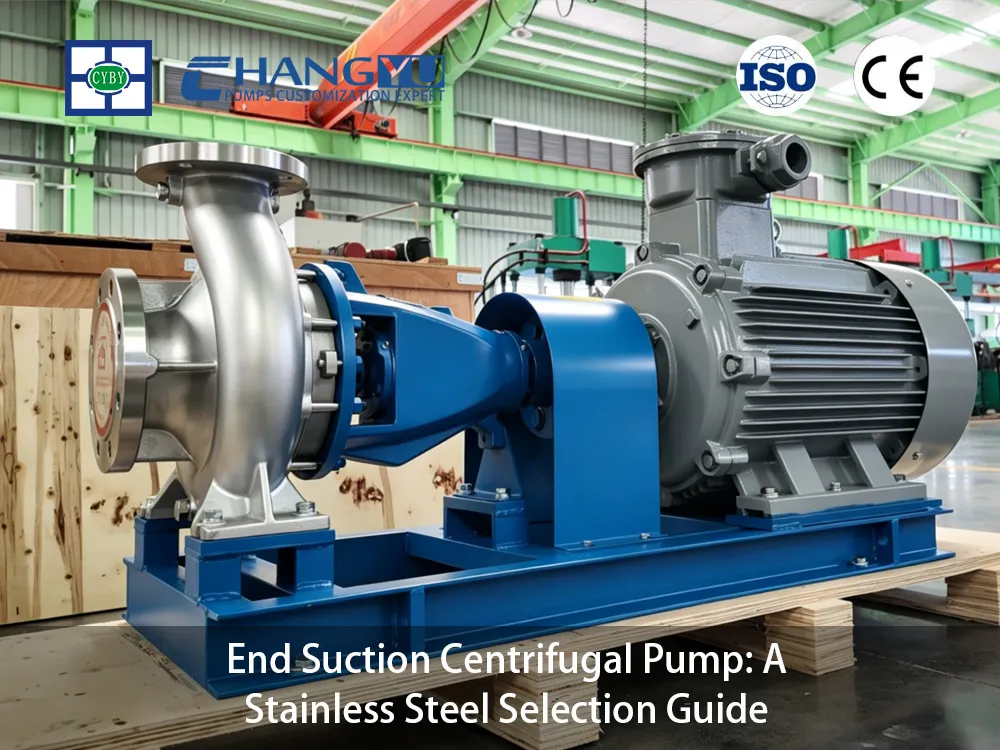
This guide explains the main layouts and a step-by-step selection method. It focuses on stainless steel industrial pumps, with clear starting points from Changyu’s product range.
1. What is an end suction centrifugal pump?
An end suction centrifugal pump takes liquid into the impeller along the shaft axis. The impeller adds energy, and the casing directs liquid towards the discharge, usually at right angles to the inlet.
“End suction” describes the inlet layout. “Centrifugal” describes the pumping principle. “Stainless steel” identifies a material choice. Each term answers a different part of the selection question.
The layout is useful when a horizontal installation fits the plant and the liquid suits the impeller and seal. Changyu’s CYA horizontal single-stage centrifugal pump is an end suction design for clean liquids, using a closed impeller.
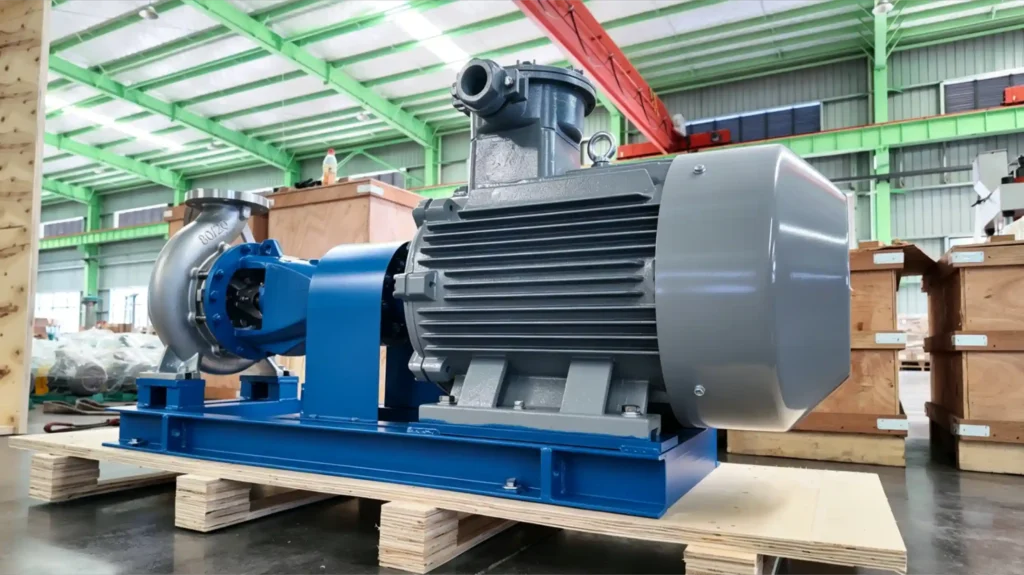
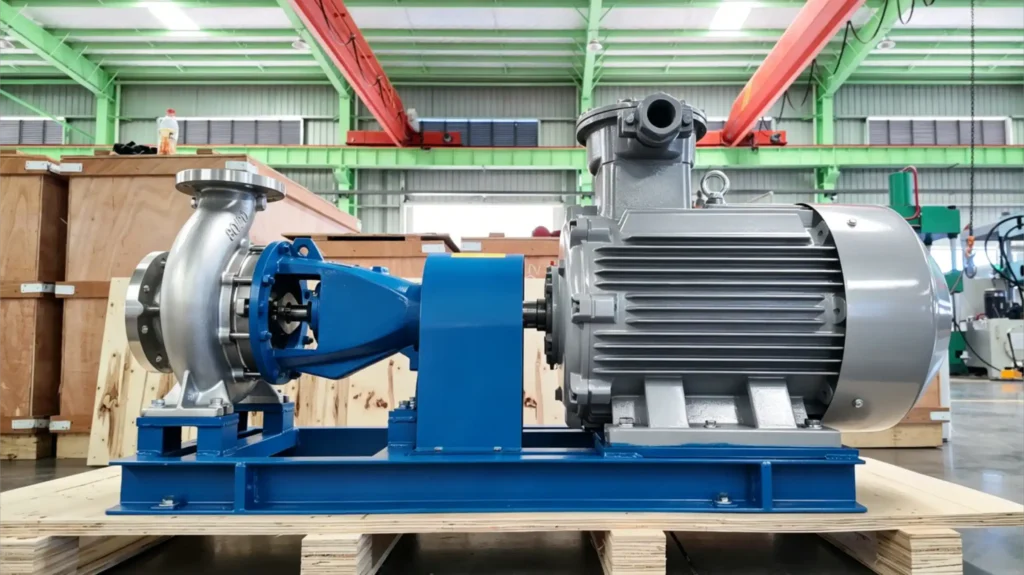
Clean does not necessarily mean drinking water. It means the liquid meets the selected pump’s limits for particles and other contaminants. Chemical compatibility needs a separate check.
2. Compare the main stainless steel pump configurations
Choose the layout around your liquid, available space, and maintenance needs. The following options are not interchangeable, even when their catalogue flow ranges overlap.
| Configuration | When to consider it | Main check before selection |
|---|---|---|
| Close-coupled end suction | Clean-liquid duties with limited installation space | Motor arrangement and access for seal replacement |
| Frame-mounted end suction | Duties that benefit from separate pump bearings and a coupling | Alignment, baseplate support, and removal space |
| Chemical process centrifugal | Compatible chemical transfer requiring a duty-specific seal and material package | Full liquid composition and seal-support needs |
| Stainless steel slurry pump | Corrosive liquids containing abrasive particles | Particle size, concentration, impeller passage, and wear |
| Inline or split-case centrifugal | Projects where pipe layout or larger-flow requirements favour another arrangement | Actual duty curve, footprint, and service access |
An end suction centrifugal pump can be close-coupled or separately coupled. Chemical process pumps may also use an end suction layout. These descriptions overlap; they are not separate performance grades.
Also distinguish close-coupled from closed impeller. Close-coupled describes the connection to the motor. Closed impeller describes the impeller itself.
For Changyu enquiries, start with CYA for clean-liquid transfer, CYH for chemical process duties, and HB for abrasive slurry assessment. Final model selection still follows the operating conditions.
Our guide to stainless steel industrial centrifugal pump types extends this comparison to magnetic-drive, self-priming, vertical immersed and slurry-service configurations.
3. Set the flow and total head together
An end suction centrifugal pump needs a duty point: a specified flow at a specified head. A request for “a 30-metre pump” leaves the required capacity unresolved.
For batch transfer, begin with volume and time. Moving 12 cubic metres in 30 minutes requires an average flow of 24 cubic metres per hour. Then check whether the process needs that rate throughout the batch or allows it to change.
Total dynamic head includes the difference in liquid levels, vessel pressure differences, and losses through the flow path. Pipes, bends, valves, filters, and heat exchangers all contribute.
Consider this simplified example for two open tanks:
- Difference between relevant liquid levels: 10 metres.
- Pipe and fitting losses at the required flow: 8 metres.
- Filter loss at the selected condition: 4 metres.
- Calculated duty head: approximately 22 metres, with negligible velocity-head difference.
This is an illustration, not a model recommendation. If the receiving tank is pressurised, add that pressure difference as head of the actual liquid. If the filter becomes dirty, calculate that condition too.
- Practical tip: give the supplier normal, minimum, and maximum duty conditions. Avoid adding arbitrary safety margins to every input; several hidden margins can produce a badly oversized pump.
4. Check the end suction centrifugal pump curve
The pump operates where its curve meets the system curve. A catalogue’s maximum flow and maximum head are usually different points. You cannot assume both occur together.
Ask for a curve marked with your normal duty and expected range. Check where those points sit relative to the best efficiency point and the manufacturer’s permitted operating region.
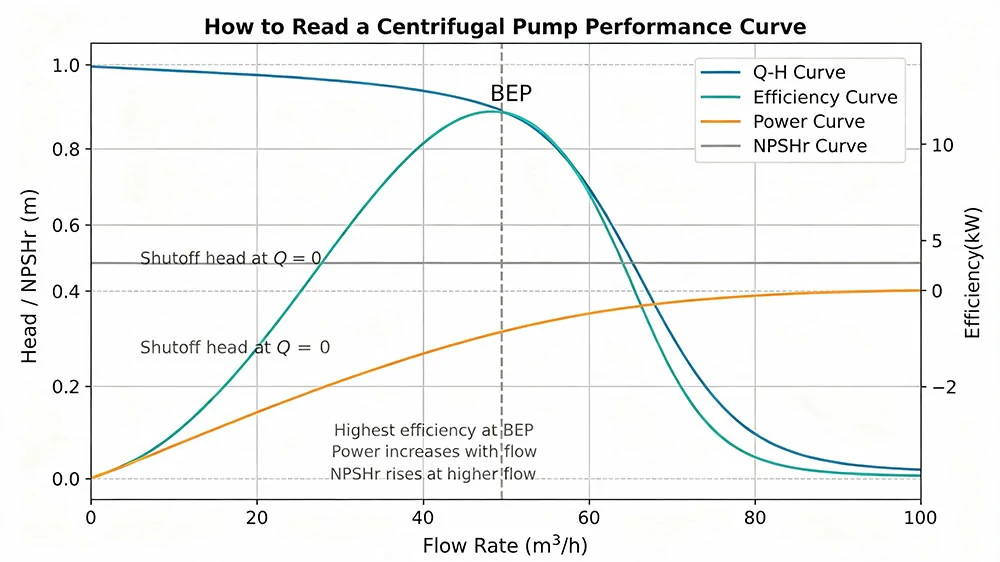
The Hydraulic Institute’s pump FAQs explain these curve and operating-region concepts. They help turn a catalogue comparison into a check of how the pump will actually run.
If an end suction centrifugal pump will run most of the day at low flow, do not select it solely around a short peak demand. Discuss a smaller model, a suitable impeller diameter, or speed control as the duty allows.
For variable speed operation, check the full speed range. Minimum flow, motor cooling, seal conditions, and the system’s static head still matter.
A useful quotation includes the curve, impeller diameter, speed, absorbed power, and suction requirement. A model number and motor rating alone are not enough to compare two offers fairly.
5. Confirm suction conditions before increasing motor size
A stainless steel end suction centrifugal pump must receive enough liquid at its inlet. Poor suction can cause noise, unstable flow, vibration, and damage even when the discharge duty looks correct.
The key check is net positive suction head, or NPSH. The installation provides NPSH available. The pump has an NPSH requirement at the selected flow and speed. A suitable margin is needed between them.
For background, use the Hydraulic Institute Data Tool alongside the selected pump’s data. Simply matching a published required value does not establish a suitable margin for every application.
Review the most demanding credible condition:
- The lowest supply-tank level.
- The highest liquid temperature and its vapour pressure.
- Any vacuum in the supply vessel.
- Suction-pipe losses, including a dirty strainer.
- Air leaks, gas entrainment, and tank-outlet submergence.
A pump that works with a full, cool tank may struggle near the end of a warm batch. Lowering the pump, reducing inlet losses, or revising the duty can help where the calculation supports it.
A standard end suction centrifugal pump is not automatically self-priming. If the liquid level is below the inlet, describe the suction lift and priming arrangement before ordering.
6. Select stainless steel and the mechanical seal together
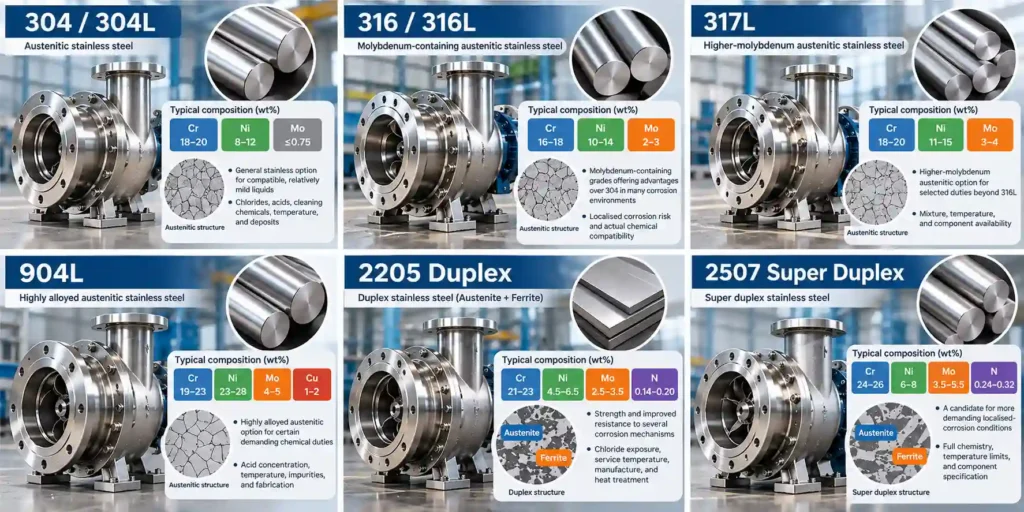
“Stainless steel construction” is too broad for a purchase specification. List the materials of the casing, impeller, shaft sleeve, seal faces, O-rings, and gaskets exposed to the liquid.
Changyu’s CYA product information includes 304, 316, and 316L options. The stainless steel centrifugal pump collection provides a broader view of pump families and material choices. Availability depends on the model and component.
Use the complete liquid composition, concentration, temperature, and cleaning conditions to select the alloy. Chlorides, deposits, and contaminants can change the result. A switch from 304 to 316L is not a universal corrosion solution.
For the mechanical seal, specify compatible face and elastomer materials. Confirm whether the duty needs flushing, cooling, or another support arrangement.
Changyu’s maintenance material highlights dry running, poor cooling, vibration, particles, and blocked flushing as possible seal-failure causes. If a seal fails repeatedly, investigate those conditions before ordering the same replacement again.
Practical tip: ask for one component material schedule attached to the quotation. This makes it easier to spot a suitable casing paired with an unsuitable gasket or seal component.
7. Choose the motor and leave room for maintenance
Motor power follows the hydraulic selection and liquid properties. Density affects the power needed for a given flow and head. Viscosity may also change performance and efficiency.
For illustration, a duty of 40 cubic metres per hour at 35 metres head, with density 900 kilograms per cubic metre and pump efficiency 60%, requires approximately 5.7 kW of shaft power.
The calculation uses density × gravity × flow × head ÷ efficiency, with flow in cubic metres per second. The final motor choice must cover the approved operating range, drive losses, and applicable service requirements. This example is not a CYA sizing recommendation.
Before installing an end suction centrifugal pump, check the maintenance drawing. Back-pull-out construction can simplify service, but only if there is space to remove the rotating assembly. Confirm whether the motor must move and whether a spacer coupling is included.
Support piping independently. Check alignment, rotation, lubrication, priming, and seal-support readiness against the supplied instructions.
After commissioning, record normal flow, pressures, current, and seal condition. That baseline helps your team recognise a blocked strainer or process change before replacing sound equipment.
8. Prepare a useful selection enquiry
For an end suction centrifugal pump quotation, send one duty sheet that purchasing and operations can both approve:
- Liquid composition, concentration, and available safety data sheet.
- Temperature range, density, viscosity, and solids information.
- Normal and maximum flow, with calculated total head.
- Tank levels, vessel pressures, and suction-pipe details.
- Proposed alloy, seal needs, and material-documentation requirements.
- Power supply, site classification where relevant, and control method.
- Connection sizes, installation drawing, operating hours, and service space.
For a replacement, add the old pump’s model and actual operating measurements. Explain why it is being replaced. Copying a nameplate can repeat a sizing problem if the process has changed.
FAQ
Is an end suction centrifugal pump suitable for stainless steel chemical service?
Yes, when the liquid, alloy, seal, and operating conditions suit the selected model. End suction describes the inlet layout; it does not establish chemical resistance. Provide the full mixture and temperature range so the complete wetted assembly can be assessed.
Which is better: close-coupled or frame-mounted?
Choose close-coupled construction where a compact arrangement and its service method suit the plant. Consider frame-mounted construction where separate bearings, motor arrangements, or maintenance access are useful. Compare actual installation drawings and replacement procedures before deciding.
Can an end suction centrifugal pump handle slurry?
A clean-liquid model should not be assumed suitable. Particles can block impeller passages, wear components, and damage seals. Specify particle size, concentration, hardness, and settling behaviour. A dedicated stainless steel slurry configuration may be the better starting point.
Is this pump self-priming?
Not by default. A conventional end suction centrifugal pump needs the correct priming arrangement before startup. If it must lift liquid from below its inlet, supply the tank and pipe details so priming and suction performance can be checked together.
Why does the pump lose flow as the tank empties?
The inlet pressure falls with the liquid level. Air entry or vaporisation may then reduce performance. Check minimum level, submergence, temperature, suction restrictions, and the operating point. A larger motor does not remove these causes.
What matters most when comparing quotations?
Compare the same duty point, curve, material schedule, seal arrangement, motor basis, and maintenance access. Check the assumptions and operating limits in each offer. The lowest purchase price is only useful when the supplied configuration suits the service.
Discuss your stainless steel pump duty
Need help selecting an end suction centrifugal pump? Share your liquid, flow, head, temperature, and tank arrangement in the form below. Start with the CYA product details, or contact Changyu to discuss a different stainless steel configuration.
Email: [email protected]
TEL/WA: +86-13651913727
About the author and sources
Prepared by Jade, Changyu Pump. This guide draws on Changyu product information and supplied maintenance material, with independent hydraulic references linked in the relevant sections. Numerical examples are illustrative. Final selection depends on the project duty and confirmed equipment specification.
- Changyu CYA product information: construction and material options.
- Changyu stainless steel pump range: product families and material choices.
- Hydraulic Institute pump FAQs: curves, operating regions, and suction guidance.
- Hydraulic Institute Data Tool: pump and system engineering background.